
Water damage restoration does not end when visible water is removed. Moisture can remain trapped in drywall, flooring, wood framing, insulation, and subfloors even after surfaces appear dry.
Dehumidifiers are essential for removing this moisture from the drying environment. However, incorrect sizing, poor placement, uncontrolled outside air, unsuitable temperatures, and incomplete moisture monitoring can all slow structural drying.
Why Dehumidification Matters in Water Damage Restoration
After standing water is extracted, moisture remains trapped inside porous building materials. Air movers help this moisture evaporate, while dehumidifiers remove the resulting water vapor from the air.
If humidity remains high, evaporation slows and wet materials take longer to dry. Effective restoration therefore depends on water extraction, airflow, dehumidification, temperature control, and moisture monitoring working together.
Here are five common dehumidifier mistakes that can slow down water damage restoration.
Mistake 1: Choosing a Dehumidifier That Is Too Small
A common mistake is choosing a dehumidifier based solely on room size.
Two rooms with the same dimensions can have very different moisture loads. A room with slightly damp carpet requires far less moisture-removal capacity than one with saturated drywall, wet insulation, soaked flooring, and damp framing.
Why Undersized Equipment Slows Drying
During the early drying stage, wet materials can release large amounts of moisture into the air.
If the dehumidifier cannot remove moisture quickly enough, RH stays high and the difference in vapor pressure between the wet material and surrounding air becomes smaller.
This can lead to:
- Slower evaporation
- Longer drying times
- Reduced air-mover effectiveness
- Longer equipment runtime
- Higher risk of secondary moisture damage
A dehumidifier can therefore run continuously while still being insufficient for the job.
What Affects Required Dehumidification Capacity?
Several factors should be considered when sizing restoration equipment:
- Affected area: Larger drying zones generally require more capacity.
- Water intrusion: Heavy flooding creates a much larger moisture load than a minor leak.
- Wet materials: Drywall, wood, insulation, carpet, and concrete hold moisture differently.
- Temperature: Lower temperatures may reduce the performance of some refrigerant units.
- Initial humidity: An environment at 80% RH requires more drying than one starting around 50%.
- Air infiltration: Open doors, windows, or damaged walls can continuously introduce additional moisture.
Large or divided restoration areas may also require multiple dehumidifiers instead of one oversized unit.
Mistake 2: Poor Dehumidifier Placement
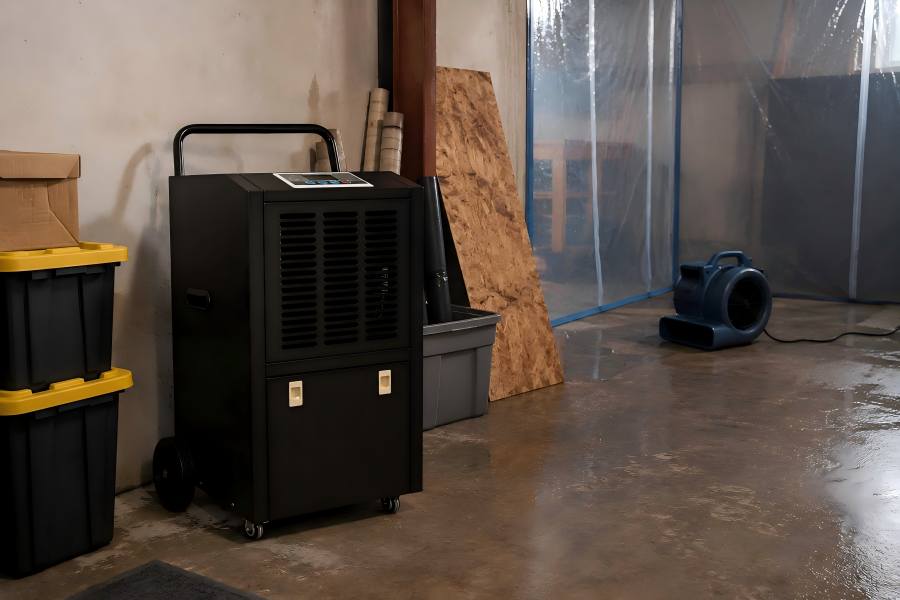
Correct capacity alone does not guarantee good drying performance. Equipment placement also matters.
A dehumidifier needs unrestricted airflow through its intake and discharge. Poor positioning can reduce circulation and cause the unit to process the same nearby air repeatedly.
Avoid Blocking the Intake
Placing equipment directly against walls, furniture, plastic barriers, or stored materials can restrict incoming airflow.
The machine should have enough clearance to pull humid air from the surrounding drying zone.
Keep the Dry-Air Outlet Clear
Dry discharge air also needs room to circulate.
If the outlet faces a wall, corner, curtain, or stack of materials, dry air may remain concentrated around the machine instead of reaching wetter areas.
Consider the Moisture Source
In large rooms or multi-room projects, a dehumidifier placed too far from wet materials may struggle to process humid air effectively.
Doors, corridors, cabinets, partitions, and furniture can all interrupt airflow. Equipment should therefore be positioned according to drying zones rather than simply wherever electrical outlets are available.
Combine Dehumidifiers With Air Movers
Air movers and dehumidifiers perform different jobs.
Air movers accelerate moisture evaporation, while dehumidifiers extract the released moisture from the air.
The drying cycle can be simplified as:
Wet material → evaporation → humid air → dehumidifier → dry air
Without enough airflow, moisture remains around wet surfaces. Without enough dehumidification, the air becomes too humid for efficient evaporation.
Both systems need to work together.
Mistake 3: Allowing Humid Outside Air Into the Drying Area
Opening windows may seem like a good way to speed up drying, but during humid weather it can have the opposite effect.
If outdoor air contains more moisture than the controlled drying environment, bringing it indoors adds additional load to the dehumidifier.
How Outside Air Delays Drying
Suppose a drying chamber has already reached 40%–45% RH while outdoor air is warm and humid.
If windows or exterior doors remain open, the dehumidifier must remove moisture from both:
- Wet building materials
- Incoming outdoor air
Instead of concentrating on structural moisture, part of the equipment capacity is continuously used to process new humidity entering the space.
This can increase drying time and energy use.
Use Containment When Appropriate
Creating a controlled drying zone can improve dehumidification efficiency.
This may involve:
- Closing unnecessary doors and windows
- Sealing openings
- Using temporary plastic barriers
- Separating affected and unaffected spaces
- Controlling HVAC operation
Containment reduces the volume of air that must be conditioned and helps maintain more stable drying conditions.
Not every project should be completely sealed. Ventilation decisions also depend on contamination, safety requirements, building conditions, and the restoration method.
Mistake 4: Ignoring Temperature During Drying
Humidity is only one part of structural drying. Temperature also affects evaporation, moisture movement, and dehumidifier performance.
Temperature Affects Evaporation
Under suitable operating conditions, warmer air can accelerate evaporation from wet materials.
As moisture evaporates, air movers carry it away from the surface and dehumidifiers remove it from the surrounding air.
However, heat alone will not solve a moisture problem.
If evaporation increases but dehumidification capacity does not, humidity may rise quickly and drying efficiency can decline.
Airflow, temperature, and moisture removal must remain balanced.
Low Temperatures Can Reduce Refrigerant Performance
Refrigerant dehumidifiers remove moisture by cooling humid air below its dew point, allowing water to condense on the evaporator coil.
When room temperatures are low, the coil may approach freezing, causing frost buildup. Defrost cycles may then reduce the unit’s effective dehumidification capacity.
This is particularly relevant in:
- Cold basements
- Unheated buildings
- Winter restoration projects
- Warehouses
- Low-temperature work areas
Rated capacity alone therefore does not tell the full story. Equipment should also be selected according to actual operating temperature.
When LGR Dehumidifiers Are Useful
LGR dehumidifiers are widely used in professional water damage restoration projects.
They are designed to continue removing moisture efficiently as the drying environment becomes less humid.
This matters because moisture is easier to remove from very humid air during the early stage of restoration. Later, RH decreases while significant moisture may still remain inside structural materials.
LGR dehumidifiers are especially useful for:
- Saturated building materials
- Multi-day drying projects
- Lower-humidity drying conditions
- Commercial restoration work
- Projects requiring faster structural drying
When Desiccant Dehumidifiers May Be Better
Desiccant systems remove moisture using an adsorbent rotor rather than relying mainly on refrigeration and condensation.
They can be useful when temperatures are low or when very dry air is required.
Typical applications include:
- Cold buildings
- Winter restoration
- Low-temperature industrial spaces
- Specialized structural drying
- Low-humidity or low-dew-point applications
The right technology depends on temperature, moisture load, target humidity, and project requirements.
Mistake 5: Relying Only on Room Humidity Readings
A low room RH does not necessarily mean the structure is dry.
Air often dries much faster than building materials. A room may measure 40% RH while the subfloor, wall cavity, framing, or flooring still contains excessive moisture.
Common Areas Where Moisture Hides
Water can migrate into hard-to-see areas, including:
- Drywall
- Wall cavities
- Wood framing
- Subfloors
- Hardwood flooring
- Carpet padding
- Insulation
- Concrete
- Cabinets
- Baseboards
A surface may feel dry even when deeper layers still contain moisture.
Why Equipment Is Sometimes Removed Too Early
If dehumidifiers and air movers are removed based only on room RH, trapped structural moisture may remain.
This can contribute to:
- Musty odors
- Mold growth
- Swelling and warping
- Paint failure
- Flooring damage
- Corrosion
- Additional repair work
Restoration decisions should therefore be based on both environmental readings and material moisture measurements.
Monitor Building Materials Directly
Restoration technicians may use:
- Pin-type moisture meters
- Pinless moisture meters
- Thermo-hygrometers
- Temperature sensors
- Infrared cameras
Readings should be taken from consistent locations throughout the drying process.
Rather than looking at one isolated reading, technicians should monitor the drying trend and compare affected materials with appropriate drying targets or unaffected reference areas.
| Measurement | What It Shows |
| Relative Humidity | Moisture level in the air |
| Temperature | Conditions affecting evaporation and equipment |
| Material Moisture | Whether building materials are actually drying |
| Dehumidifier Output | Whether equipment is removing moisture effectively |
| Drying Trend | Whether conditions are improving over time |
If material moisture stops decreasing, the drying setup should be reviewed instead of simply leaving the equipment running longer.
How to Improve Dehumidifier Performance During Restoration
Avoiding the five mistakes above can significantly improve drying efficiency. A few additional practices can also help.
Extract Liquid Water First
Dehumidifiers should not replace water extraction.
Pumps, extractors, and wet vacuums can remove standing water much faster than trying to evaporate the same water into the air.
Better extraction reduces the load on both dehumidifiers and air movers.
Create a Controlled Drying Zone
Close unnecessary openings and divide very large spaces when appropriate.
Reducing the effective drying volume can help equipment lower humidity faster and maintain more stable conditions.
Maintain Proper Airflow
Position air movers so that dry air reaches wet surfaces and humid boundary-layer air is moved away.
Airflow should support evaporation without spreading contaminants into unaffected areas.
Keep Filters and Air Paths Clean
Restoration sites often contain dust, fibers, drywall particles, and other debris.
Dirty filters restrict airflow and may reduce dehumidifier performance. Regular inspection and cleaning help maintain proper operation.
Check Drainage
Restoration dehumidifiers can collect large amounts of condensate.
Drain hoses and pumps should be checked for:
- Kinks
- Blockages
- Loose connections
- Poor drainage
- Overflow risk
A drainage failure can stop effective moisture removal and may even create additional water damage.
Adjust Equipment as the Project Changes
Drying conditions are not constant.
Moisture loads are usually highest at the beginning. As surfaces dry, moisture movement from deeper materials slows.
Equipment placement, airflow, and dehumidification capacity should therefore be reviewed throughout the project rather than kept unchanged from start to finish.
When to Use LGR or Commercial Restoration Dehumidifiers
Household dehumidifiers can control humidity in bedrooms, basements, and other small residential spaces, but professional water damage restoration often involves much heavier moisture loads.
Commercial restoration dehumidifiers are designed for continuous operation, stronger airflow, higher moisture removal, and demanding jobsite conditions.
They are commonly used for:
- Flooded basements
- Burst pipes
- Storm damage
- Multi-room water intrusion
- Wet drywall and framing
- Saturated flooring
- Commercial buildings
- Construction drying
- Large restoration projects
They often provide continuous drainage, durable housings, transport-friendly designs, and greater moisture-removal capacity than standard household models.
LGR dehumidifiers are particularly common because they can continue working efficiently as RH decreases during the later stages of structural drying.
Matching the Dehumidifier to the Drying Environment
There is no single dehumidifier setup that works for every water damage project.
Before selecting equipment, restoration professionals should consider:
- Temperature
- Initial RH
- Size of the affected area
- Severity of water intrusion
- Type and quantity of wet materials
- Outdoor humidity
- Airflow requirements
- Electrical supply
- Drainage conditions
- Target drying levels
A warm residential room with moderate water damage may require a very different solution from a cold warehouse containing wet concrete and structural materials.
Equipment selection should therefore be based on actual drying conditions and adjusted according to monitoring data.