
A humid home does not always need more ventilation, and poor ventilation does not automatically require a dehumidifier. ERVs, HRVs, and dehumidifiers solve different problems.
Some homes need better fresh-air exchange, while others, especially in humid climates, require active moisture removal for comfort and protection.
What Causes Excess Humidity in a Home?
Indoor humidity comes from both outside and inside the building. Warm, moisture-heavy outdoor air can enter through doors, windows, ventilation systems, wall gaps, and other air leaks.
Daily activities also add moisture. Cooking, showering, drying clothes, cleaning, and normal occupancy continuously release water vapor into indoor air.
Common causes of excessive household humidity include:
- Humid outdoor air entering the building
- Cooking, bathing, and laundry
- Poor bathroom or kitchen exhaust
- Air leaks around doors and windows
- Damp basements or crawl spaces
- Water intrusion or plumbing leaks
- Oversized air-conditioning systems
- Insufficient HVAC runtime
- Poorly designed ventilation
- Highly airtight building construction
An air conditioner provides some dehumidification while cooling, but may be less effective in mild, humid weather. An oversized unit can also shut down before enough moisture is removed.
This is why a comfortable indoor temperature does not necessarily mean humidity is under control. A room may stay at 23–24°C and still feel sticky when relative humidity remains above 60%.
What Is an ERV and How Does It Work?
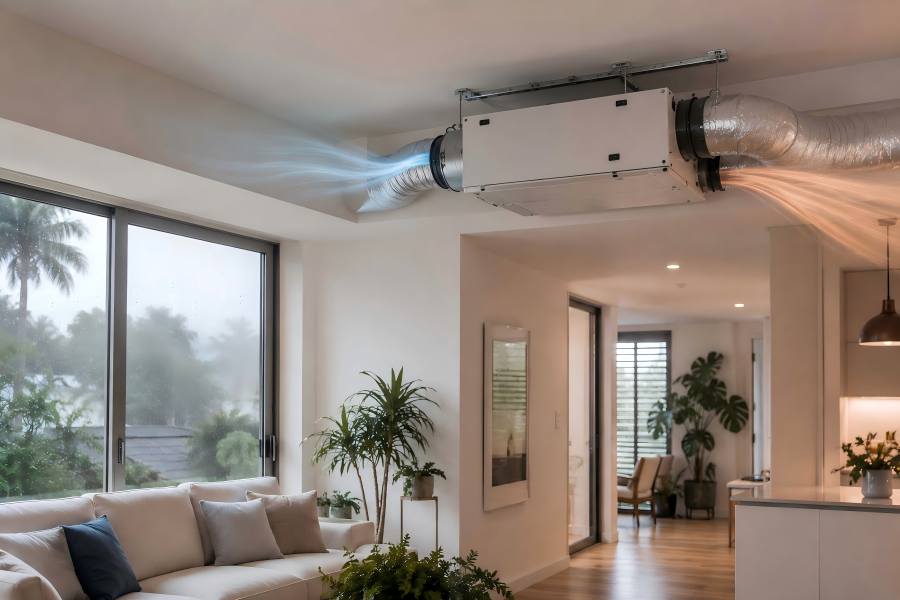
An Energy Recovery Ventilator (ERV) provides fresh outdoor air while exhausting stale indoor air through separate airflow paths.
Inside the unit, the two air streams pass through an energy-exchange core, allowing heat and some moisture to transfer without directly mixing.
During humid summer conditions, an ERV can reduce some of the moisture entering with fresh outdoor air. Instead of bringing untreated humid air directly inside, part of the moisture is transferred toward the outgoing exhaust air.
This makes ERVs useful for:
- Airtight homes requiring controlled fresh air
- Warm and humid regions
- Mixed climates
- Homes with stale air or odor problems
- Buildings requiring continuous mechanical ventilation
- Energy-efficient homes with limited natural air leakage
However, an ERV is not an active dehumidifier. It can reduce the moisture load caused by ventilation, but it does not continuously remove large amounts of water from indoor air.
If indoor RH stays at 65%, 70%, or higher, an ERV alone may not solve the problem.
What Is an HRV and How Does It Work?
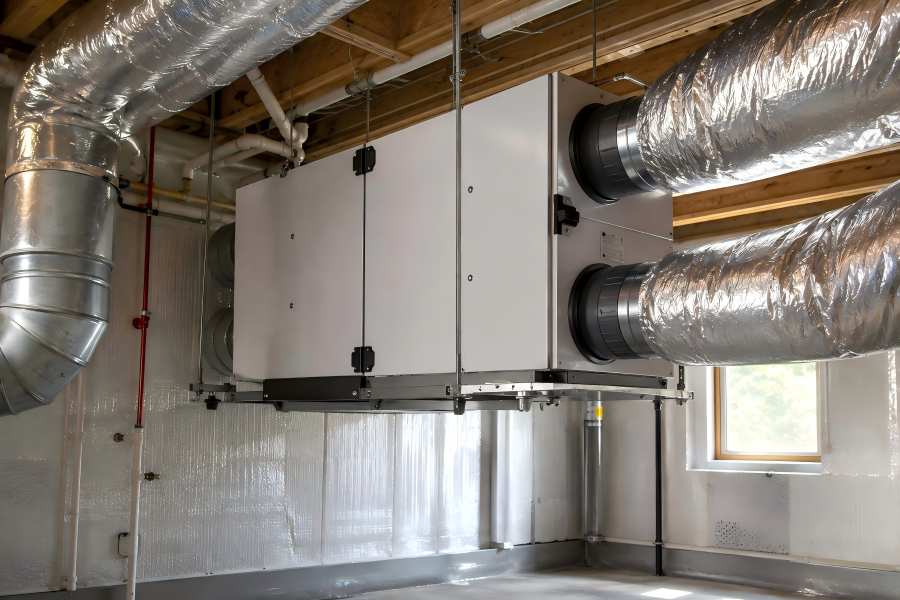
A Heat Recovery Ventilator (HRV) provides fresh-air exchange by removing stale indoor air and bringing in outdoor air. Its main role is heat recovery, rather than moisture recovery.
During winter, warm indoor exhaust air passes through the heat exchanger and transfers heat to colder incoming outdoor air. This reduces the heating load created by ventilation.
Unlike most ERVs, HRVs generally do not transfer significant amounts of moisture between the two air streams. Moist indoor air is exhausted while outdoor air enters the building.
HRVs are commonly used in:
- Cold climates
- Homes with long heating seasons
- Airtight energy-efficient buildings
- Houses experiencing winter condensation
- Buildings requiring continuous fresh-air ventilation
During cold, dry weather, an HRV can help lower indoor humidity because the incoming outdoor air contains relatively little moisture. Once heated indoors, this dry air can absorb moisture from the home.
The situation changes during summer. If outdoor air is warm and humid, an HRV can introduce more moisture indoors, increasing the load on the air conditioner or dehumidifier.
What Does a Dehumidifier Actually Do?
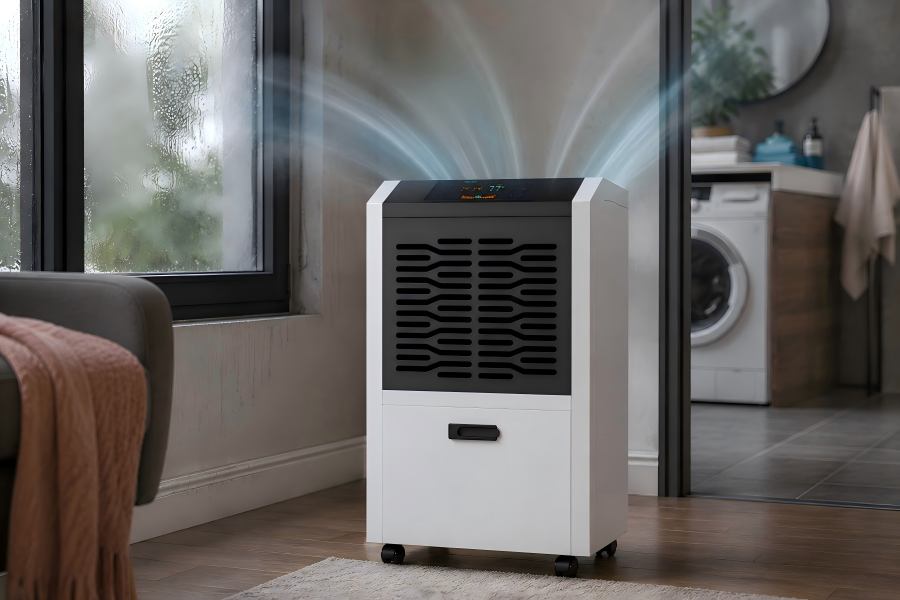
A dehumidifier has a different job. Instead of primarily exchanging indoor and outdoor air, it actively removes water vapor from indoor air.
A refrigerant dehumidifier cools humid air over an evaporator coil, condensing and draining the moisture. The resulting drier air is returned to the room.
Its main purpose is simple: reduce indoor relative humidity.
Dehumidifiers are especially useful when:
- Indoor RH regularly exceeds 60%
- Rooms remain damp despite air conditioning
- Basements smell musty
- Window or surface condensation occurs
- Moisture affects several rooms
- The home is located in a humid climate
- HVAC cooling demand is too low to remove enough moisture
Portable units generally serve one room, basement, garage, or localized damp area. Whole-house dehumidifiers can be connected to ductwork and provide more consistent humidity control across multiple rooms.
Unlike an ERV or HRV, however, a standard dehumidifier does not provide fresh outdoor air. It manages moisture, not ventilation.
ERV vs. HRV vs. Dehumidifier: Key Differences
Although all three systems influence indoor comfort, they should not be treated as interchangeable equipment.
| Feature | ERV | HRV | Dehumidifier |
| Main Purpose | Fresh-air ventilation | Fresh-air ventilation | Moisture removal |
| Actively Removes Water | No | No | Yes |
| Transfers Moisture | Yes | Usually no | No |
| Recovers Heat | Yes | Yes | No |
| Provides Fresh Air | Yes | Yes | No |
| Main Control Target | Ventilation | Ventilation | Indoor RH |
| Typical Best Use | Humid/mixed climates | Cold climates | High indoor humidity |
The simplest distinction is that ERVs and HRVs manage air exchange, while dehumidifiers manage moisture concentration.
That difference becomes especially important when diagnosing a humid home.
When Does a Humid Home Need an ERV?
An ERV makes the most sense when a home needs controlled outdoor air but bringing in untreated outdoor air would create additional cooling and humidity loads.
Modern airtight houses are a common example. Because natural air leakage is limited, mechanical ventilation may be necessary to remove odors, CO₂, cooking pollutants, and other indoor contaminants.
An ERV may be appropriate when:
- The house feels stuffy
- Windows remain closed most of the year
- Indoor CO₂ frequently rises
- The building envelope is highly airtight
- Fresh-air ventilation is required
- Outdoor humidity is relatively high
- Energy-efficient ventilation is a priority
An ERV can make ventilation easier to manage, but it should not automatically be considered the solution to high indoor RH.
If moisture comes from a wet basement, water leakage, high internal moisture production, or insufficient AC dehumidification, additional measures will still be necessary.
When Does a Home Need an HRV?
An HRV is usually more attractive in colder regions where heat recovery is a major concern and outdoor winter air is relatively dry.
During winter, the system can exhaust moisture-heavy indoor air while recovering much of its heat. This can help reduce condensation on windows and other cold surfaces.
An HRV may be suitable when:
- Winters are long and cold
- Indoor humidity rises during the heating season
- Fresh-air ventilation is necessary
- Window condensation is common in winter
- Outdoor air is generally dry
- Summer humidity is not the main concern
Climate is critical. Installing an HRV in a hot, humid region may increase summer moisture loads because incoming outdoor humidity is not substantially transferred back to the exhaust air.
That does not make HRVs unsuitable equipment. It simply means their strengths are more closely aligned with cold-climate ventilation than dedicated summer humidity control.
When Is a Dehumidifier the Better Choice?
If indoor RH remains high even when ventilation is adequate, a dehumidifier is usually the more direct solution.
A hygrometer provides a useful starting point. If several rooms repeatedly stay above about 60% RH for long periods, the home likely has more moisture than the HVAC system can effectively remove.
Warning signs include:
- Indoor RH consistently above 60%
- Sticky or clammy indoor air
- Musty odors
- Condensation on windows or pipes
- Damp basement walls or floors
- Mold appearing on surfaces
- Wood floors swelling or cupping
- Furniture or stored materials becoming damp
- AC running without adequately lowering RH
In these situations, increasing ventilation may actually make things worse when outdoor conditions are humid.
A dehumidifier removes moisture regardless of whether the outdoor air is humid. This makes it particularly useful in coastal, subtropical, rainy, and other moisture-heavy climates.
Can an ERV or HRV Replace a Dehumidifier?
Usually not when a home has a significant moisture problem.
ERVs can reduce the amount of outdoor moisture introduced through mechanical ventilation. That is valuable, but their moisture-transfer capacity is different from the water-removal capacity of a dedicated dehumidifier.
An HRV provides even less direct protection against summer humidity because moisture generally enters with the incoming outdoor air.
Consider a home with indoor humidity around 68% RH during summer. If moisture comes from outdoor infiltration, occupancy, cooking, damp foundations, and low AC runtime, ventilation equipment alone may not reduce RH to 50% or 55%.
A properly sized dehumidifier can actively remove liters of water from indoor air each day. ERVs and HRVs are not designed around this same moisture-removal function.
Do You Need Both Ventilation and Dehumidification?
Many homes do.
Ventilation and dehumidification solve two separate problems. A house can have clean, well-ventilated air and still be too humid. It can also have comfortable humidity while suffering from poor fresh-air exchange.
In a humid climate, one practical configuration is:
Outdoor Air → ERV → Conditioned Space
The ERV reduces the energy and moisture load associated with incoming ventilation air.
At the same time:
Indoor Air → Whole-House Dehumidifier → Dry Air Returned to Home
The dehumidifier actively controls indoor RH.
This combination allows ventilation rate and humidity level to be managed more independently. That can be particularly useful in tightly built homes where opening windows is not an effective ventilation strategy.
Whole-House Dehumidifier vs. Portable Unit
Once dedicated dehumidification is needed, the next decision is whether a portable or whole-house system makes more sense.
Portable dehumidifiers are generally appropriate when the moisture problem is concentrated in one area. Basements, laundry rooms, garages, and individual bedrooms are typical examples.
Whole-house systems are better suited to situations where humidity affects several rooms or floors.
| Factor | Portable Dehumidifier | Whole-House Dehumidifier |
| Coverage | One room or zone | Multiple rooms / whole home |
| Installation | Simple | Usually ducted |
| Drainage | Tank or hose | Usually continuous drain |
| Humidity Control | Local | Centralized |
| Noise | In occupied room | Can be installed remotely |
| Maintenance | Individual unit | Centralized |
| Best Use | Localized dampness | Whole-home humidity |
A portable unit may solve a basement problem at relatively low cost. Installing several portable units throughout a large home, however, can become inconvenient.
Where high humidity affects the entire house, centralized equipment usually offers more consistent RH control.
How Climate Affects the Right Choice
Climate should be one of the first factors considered before selecting ventilation or humidity-control equipment.
Hot and Humid Climates
In warm, humid regions, outdoor air contains a large amount of moisture for much of the year. Bringing this air indoors without treatment can quickly raise indoor RH.
An ERV + dehumidifier combination is often useful because the ERV manages ventilation while reducing part of the incoming moisture load, and the dehumidifier removes excess indoor moisture.
Cold and Dry Climates
In cold winter conditions, outdoor air is usually dry. An HRV provides fresh-air exchange while recovering heat from the indoor air being exhausted.
This ventilation process may also help reduce excessive winter humidity and condensation.
Mixed Climates
Mixed climates experience both humid summers and cold winters. The best strategy depends heavily on building airtightness, occupancy, HVAC design, and seasonal moisture loads.
An ERV may provide balanced ventilation, while a dehumidifier can operate only during periods when indoor RH rises above the target.
How to Diagnose What Your Home Really Needs
Buying equipment before identifying the actual moisture problem can result in unnecessary energy use and disappointing performance.
Start by measuring indoor conditions instead.
Measure Indoor RH
Place hygrometers in several areas, including bedrooms, living spaces, basements, and other moisture-prone zones.
Check Whether the Problem Is Seasonal
Humidity that appears mainly during summer may be related to outdoor moisture, AC operation, or ventilation.
Year-round dampness may suggest building-envelope leakage, groundwater, plumbing, or other persistent moisture sources.
Identify Which Rooms Are Affected
One damp basement does not necessarily justify whole-house equipment.
If humidity is consistently high throughout the building, centralized dehumidification becomes more reasonable.
Evaluate Ventilation
Check whether bathrooms and kitchens exhaust properly and whether the home receives enough controlled fresh air.
Poor ventilation and high humidity can occur together, but they still require different solutions.
Check the HVAC System
An oversized air conditioner may satisfy temperature demand quickly while removing too little moisture.
Correcting airflow, runtime, equipment sizing, or controls may improve humidity performance before additional equipment is installed.
Recommended Indoor Humidity Levels
For many homes, an indoor relative humidity range of approximately 40% to 60% RH provides a practical balance between comfort and moisture control.
During humid seasons, many homeowners target approximately 45% to 55% RH when HVAC and building conditions allow it.
Long periods above 60% RH can create conditions that favor:
- Mold growth
- Musty odors
- Dust mite activity
- Condensation
- Wood movement
- Material deterioration
- Reduced thermal comfort
Lower is not always better. Excessively dry indoor air can also cause discomfort, particularly during winter.
The goal should therefore be stable humidity rather than maximum moisture removal.
ERV, HRV or Dehumidifier: Quick Selection Guide
The correct system depends more on the problem being solved than the name of the equipment.
| Home Condition | Recommended Solution |
| Stale air but normal humidity | ERV or HRV |
| Humid home with adequate ventilation | Dehumidifier |
| Humid home with poor ventilation | ERV + Dehumidifier |
| Excess winter humidity in cold climate | HRV |
| Humid basement only | Portable or Basement Dehumidifier |
| Multiple rooms consistently humid | Whole-House Dehumidifier |
| Airtight home in humid climate | ERV + Whole-House Dehumidifier |
| Fresh-air requirement in mixed climate | ERV |
| High RH during mild weather | Dehumidifier |
This table should be treated as a starting point rather than a fixed design rule.
House size, climate, ventilation rate, insulation, air leakage, moisture generation, and HVAC capacity can all change the final equipment selection.