
Humidity control in a commercial grow facility cannot be based on floor area alone. Plant transpiration, irrigation, and changing HVAC performance all affect the moisture load.
Accurate sizing should consider irrigation, runoff, target RH, HVAC latent removal, ventilation, and actual room conditions.
Understand the Main Moisture Sources
Before selecting equipment, first identify where moisture enters the grow room. In most facilities, plants and irrigation create the largest load, but they are not the only sources.
Ignoring smaller moisture sources can cause a system that looks correct on paper to struggle during peak conditions.
Plant Transpiration
Plants absorb water through their roots and release a large portion of it back into the air through their leaves. This process is one of the main reasons commercial grow rooms need continuous dehumidification.
Transpiration changes throughout the crop cycle. Larger plants with a dense canopy normally release more moisture than seedlings because they have greater leaf area and consume more water.
Lighting intensity also affects moisture production. Under strong lighting, plant activity, temperature, and water uptake generally increase, which can raise the moisture load inside the room.
Irrigation Water
Daily irrigation provides one of the most practical starting points for sizing because it gives a measurable quantity of water entering the growing system.
Not all irrigation water becomes humidity. Some leaves the room as drainage or runoff, while some remains temporarily in growing media or plant tissue.
However, most water absorbed by actively growing plants eventually returns to the room air through transpiration. Daily irrigation records are therefore usually more useful than simply counting plants.
Other Moisture Loads
Other moisture sources can also affect peak capacity, especially in rooms with frequent access or significant outside-air exchange.
These may include:
- Wet floors and growing media
- Open water tanks
- Fresh-air ventilation
- Building infiltration
- Door openings
- Cleaning processes
Each source may appear small individually, but together they can become important when the room is already operating close to the dehumidifier’s capacity.
Start With Daily Irrigation Volume
A practical sizing calculation starts with the total volume of irrigation water supplied to the grow room over 24 hours.
For example, if 500 plants receive an average of 1.5 liters each per day, total irrigation is:
500 × 1.5 L = 750 L/day
The next step is to subtract water that leaves the growing space as runoff or drainage.
If runoff averages 15%:
750 L × 15% = 112.5 L/day runoff
The remaining water is:
750 − 112.5 = 637.5 L/day
This does not mean the dehumidifier must remove exactly 637.5 liters every day. Some water may remain temporarily in the growing media or plant structure.
However, it provides a useful reference for estimating how much moisture may eventually return to the room air.
Basic Moisture-Load Formula
Daily irrigation − runoff = approximate plant-related moisture load
This method is more useful than floor area alone because two grow rooms of identical size can have completely different irrigation rates and plant densities.
A lightly planted 500 m² room may produce less moisture than a densely planted 250 m² room operating under high-intensity lighting.
Calculate Plant Transpiration Load
Irrigation volume gives a good starting point, but actual crop water use provides an even better reference when reliable records are available.
The amount of water released through transpiration depends on several operating conditions.
Important factors include:
- Plant quantity and size
- Growth stage
- Lighting intensity
- Room temperature
- Relative humidity
- Air circulation
- Irrigation frequency
- Canopy density
Instead of relying only on theoretical plant values, actual irrigation and runoff records from previous crop cycles can provide more useful sizing data.
For example, if a room consistently receives 600 L/day and 90 L/day leaves as runoff, roughly 510 L/day remains within the plant-room system.
During mature growth stages, much of this water may eventually need to be removed by the HVAC and dedicated dehumidification systems.
Account for Growth Stage
The moisture load changes significantly as plants develop. A dehumidifier selected only for propagation conditions may become undersized once the canopy reaches full development.
Sizing should therefore be based on the highest expected moisture load rather than the average load across the entire crop cycle.
| Growth Stage | Typical Moisture Load | Humidity Control Consideration |
| Propagation / Seedling | Low | Smaller plants and lower transpiration |
| Early Vegetative | Low–Medium | Water uptake begins increasing |
| Late Vegetative | Medium–High | Larger leaf area increases transpiration |
| Flowering | High | Dense canopy and higher water consumption |
| Late Flower | High | Lower target RH may require greater active removal |
Propagation and Seedling Stage
Young plants have limited leaf area and relatively low water consumption. Moisture generation is therefore generally lower than during later growth stages.
Higher RH targets are also often used during early development, reducing the moisture-removal demand.
Vegetative Stage
As plants grow, leaf area and root development increase. Irrigation volume normally rises at the same time.
The dehumidification load can therefore increase quickly between early and late vegetative growth.
Flowering Stage
Flowering rooms often create the highest moisture load because plants are mature, canopy density is high, and water consumption can be significant.
At the same time, the target RH may be lower than during vegetative growth, making moisture removal more demanding.
Late Flower
Late flowering can require especially stable humidity control.
Dense plant material, restricted airflow through the canopy, and lower RH targets can increase the risk of localized moisture accumulation if equipment capacity or air distribution is insufficient.
Define the Required Temperature and RH
Dehumidifier capacity varies with entering air conditions. A unit that removes a certain amount of moisture at warm, humid conditions may remove substantially less water at lower temperature or lower RH.
This is why the largest capacity number on a specification sheet should not automatically be used for sizing.
Important design conditions include:
- Normal room temperature
- Current operating RH
- Target RH
- Lights-on temperature
- Lights-off temperature
- Seasonal conditions
If a dehumidifier is rated at 30°C and 80% RH but the actual grow room operates around 24°C and 50% RH, actual moisture-removal capacity may be considerably lower.
Equipment should therefore be selected using performance data as close as possible to the real room conditions.
Lights-On vs. Lights-Off Dehumidification Load
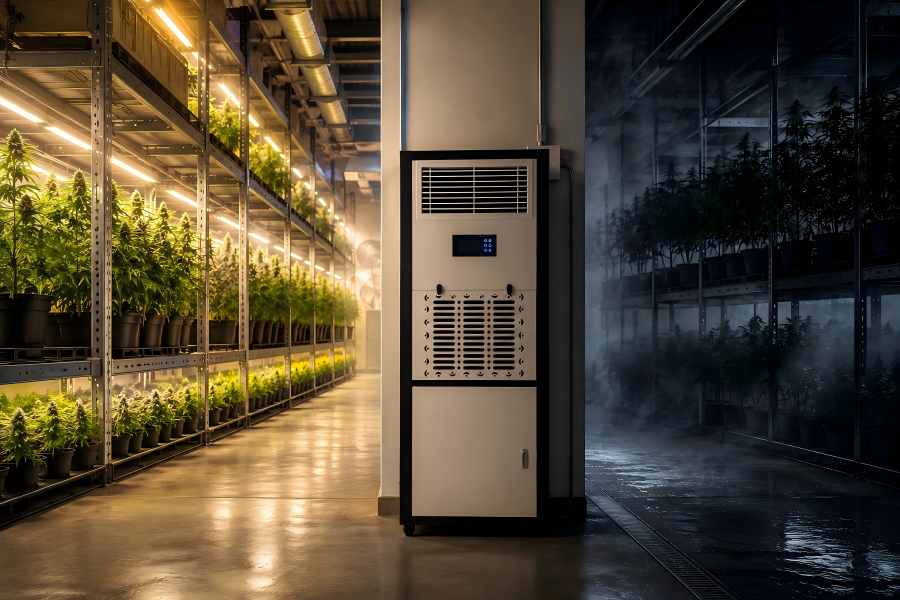
One of the most important sizing issues in grow facilities is the difference between lights-on and lights-off operation.
Humidity behavior can change quickly when the lighting cycle changes.
| Condition | Lights On | Lights Off |
| Room Temperature | Higher | Lower |
| Plant Transpiration | Usually higher | Often reduced |
| Cooling Demand | High | Lower |
| HVAC Runtime | Longer | Often shorter |
| HVAC Moisture Removal | Often higher | May decrease |
| RH Behavior | More stable | Can rise quickly |
| Dehumidifier Role | Shares load with HVAC | May carry more latent load |
During Lights-On
Lighting generates heat, so the cooling system normally operates more frequently.
While cooling the room, HVAC equipment also condenses part of the water vapor from the air. This means it contributes to the total moisture-removal capacity.
Plant transpiration may be high during this period, but longer HVAC runtime can offset part of that load.
During Lights-Off
When lights switch off, room temperature falls and sensible cooling demand decreases.
The cooling system may run less frequently, reducing its moisture-removal contribution even though plants, growing media, and room surfaces may continue releasing moisture.
Because the air is cooler, RH can also rise quickly after the temperature drops. Dedicated dehumidification may therefore carry a larger share of the latent load during lights-off periods.
Consider the HVAC System
The HVAC system should be included in the moisture-load calculation because air-conditioning equipment removes both sensible heat and latent moisture.
However, rated cooling capacity should not be treated as equivalent to dehumidification capacity.
Important HVAC information includes:
- Actual cooling capacity
- Latent removal performance
- Runtime
- Supply-air conditions
- Lights-on operation
- Lights-off operation
A cooling system may remove substantial moisture during lights-on operation because it runs continuously under the lighting load.
Once the lights switch off, that contribution can fall sharply.
Do not simply subtract the maximum theoretical HVAC latent capacity from the plant moisture load. Use verified operating data and consider how much moisture removal is actually available during the most demanding humidity period.
Room Size Still Matters
Moisture load should determine basic capacity, but room dimensions still affect how the equipment should be installed.
A large room needs sufficient airflow to move humid air back toward the dehumidifier and distribute dry air throughout the canopy.
Important room factors include:
- Floor area
- Ceiling height
- Total room volume
- Canopy density
- Air circulation
- Room zoning
For example, one large dehumidifier may theoretically remove enough water for a 1,000 m² room, but it may not maintain uniform RH if dry air cannot reach distant sections.
In this case, several smaller units may provide better control even if their combined nominal capacity is similar.
Fresh Air and Infiltration Loads
Outdoor air can add a considerable latent load, particularly in warm and humid climates.
This is especially important in facilities that use continuous ventilation rather than operating as tightly sealed rooms.
Moisture entering with outside air depends on:
- Outdoor temperature and RH
- Ventilation airflow
- Building leakage
- Door opening frequency
- Exhaust airflow
- Pressure differences
For a sealed grow room, infiltration may be relatively small under normal conditions.
For a room that continuously exhausts air and replaces it with untreated outdoor air, outside humidity can become one of the major moisture loads.
Outdoor-air moisture should therefore be calculated separately when ventilation rates are significant.
Add a Practical Sizing Margin
Grow-room moisture loads are rarely constant.
Plant development, irrigation changes, weather, door activity, filter condition, and equipment performance can all move the actual load above the original estimate.
A practical sizing margin can help accommodate:
- Peak transpiration
- Seasonal humidity
- Higher plant density
- Frequent access
- Filter loading
- Future load increases
A project may use a margin of roughly 10–25%, depending on how reliable the input data is and how critical humidity stability is.
Excessive oversizing should also be avoided. It increases equipment cost and can make control less stable if units frequently start and stop.
Example: Sizing a Commercial Grow Room
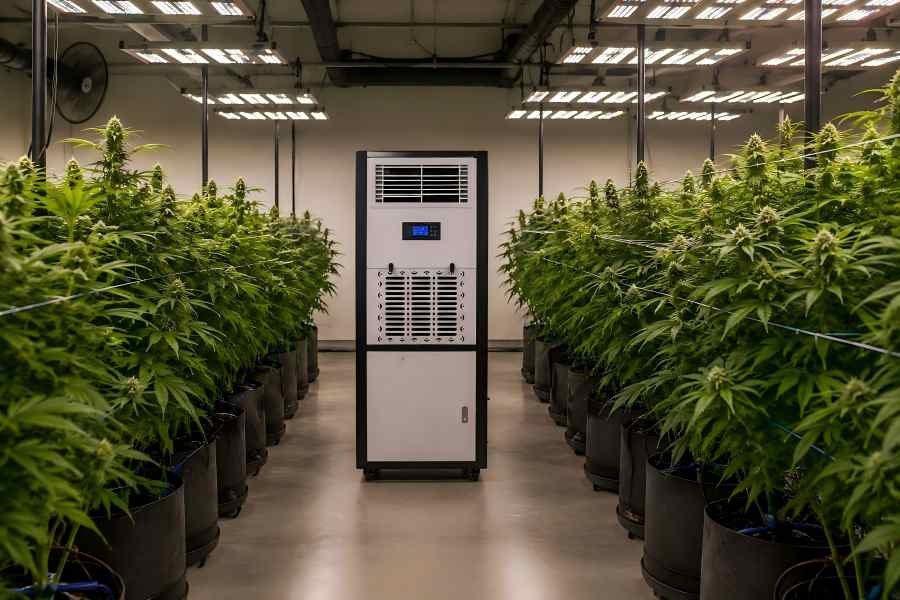
Consider a commercial grow room with 500 mature plants.
Assume the following design inputs:
| Item | Example Value |
| Number of plants | 500 |
| Irrigation per plant | 1.5 L/day |
| Total irrigation | 750 L/day |
| Runoff | 15% |
| Runoff volume | 112.5 L/day |
| Estimated remaining water | 637.5 L/day |
| Verified HVAC latent removal | 120 L/day |
| Design margin | 20% |
Step 1: Calculate Total Irrigation
500 plants × 1.5 L/day = 750 L/day
Step 2: Subtract Runoff
750 × 15% = 112.5 L/day
Approximate water remaining in the grow environment:
750 − 112.5 = 637.5 L/day
This represents a conservative plant-related moisture reference rather than an exact instantaneous dehumidifier load.
Step 3: Account for HVAC Moisture Removal
Suppose operating records confirm that the HVAC system removes approximately 120 L/day during the relevant design period.
The remaining moisture load becomes:
637.5 − 120 = 517.5 L/day
The HVAC contribution should only be included if its latent performance is confirmed under actual grow-room conditions.
If the cooling system operates very little during lights-off periods, a more conservative calculation may reduce or completely exclude this contribution.
Step 4: Add a Design Margin
Using a 20% reserve:
517.5 × 1.20 = 621 L/day
The dedicated dehumidification system should therefore provide approximately 621 L/day of effective moisture removal under the actual room temperature and RH conditions.
If a unit is advertised as 200 L/day at warmer and more humid test conditions but provides only 150 L/day under the actual grow-room conditions:
4 × 150 = 600 L/day
Four units would still be slightly below the calculated requirement.
Five units would provide:
5 × 150 = 750 L/day
This configuration would provide greater reserve capacity while also allowing staged operation.
Choosing One Large Unit vs. Multiple Dehumidifiers
Once total moisture-removal capacity is known, the next decision is whether to use one large unit or divide the load among several smaller dehumidifiers.
One Large Dehumidifier
| Pros | Cons |
| Simpler electrical installation | No equipment redundancy |
| Fewer drain connections | More difficult air distribution |
| Fewer maintenance points | Larger impact if the unit stops |
One large system can work well in smaller rooms with good duct distribution.
In a large room with dense racks or canopy areas, airflow may become the limiting factor rather than moisture-removal capacity.
Multiple Dehumidifiers
| Pros | Cons |
| Better airflow distribution | More wiring |
| Zonal control | More drain connections |
| Equipment redundancy | More service points |
| Staged operation |
Using several units can make it easier to match capacity to changing crop conditions.
For example, two units may operate during lower-load periods, while additional machines start automatically as RH rises.
Multiple units also provide redundancy. If one dehumidifier stops, the remaining equipment can continue removing moisture until service is completed.
Dehumidifier Placement and Air Distribution
Correct sizing does not guarantee good humidity control if the equipment cannot move air effectively through the grow space.
The intake must be able to draw humid room air freely, while the dry-air outlet should distribute conditioned air without creating short circuits.
Important considerations include:
- Keep air intakes clear
- Keep discharge paths open
- Avoid direct high-velocity airflow onto plants
- Distribute dry air across the canopy
- Prevent humid dead zones
- Coordinate with circulation fans
- Use ducting where required
Avoid placing the supply outlet where dry air immediately returns to the machine intake.
This can cause the controller to detect artificially dry conditions while remote sections of the room remain humid.
Sensor location and airflow direction should therefore be planned together.
Drainage Requirements
Commercial grow-room dehumidifiers may remove hundreds of liters of water per day.
That condensate must leave the equipment continuously without causing overflow or interrupting operation.
Drainage design should consider:
- Gravity drains
- Condensate pumps
- Pipe diameter
- Drain slope
- Overflow protection
- Access for cleaning
- Multiple-unit drain capacity
For gravity drainage, maintain a continuous downward slope and avoid sections where water can collect.
Where the drain point is above the dehumidifier outlet, a condensate pump may be required.
If several machines share the same drain, the main line should be sized for their combined maximum condensate output.
Controls and Sensors for Grow Facilities
Accurate humidity control depends heavily on sensor location.
A sensor mounted directly at the dehumidifier intake may represent conditions around the machine but not RH inside a dense canopy or at the opposite end of the room.
Larger facilities can use several sensors distributed throughout different zones.
Useful control options include:
- Remote RH sensors
- Multiple sensor inputs
- Automatic RH setpoints
- Lighting-cycle schedules
- Alarm reporting
- Modbus or BACnet
- Remote monitoring
- Data logging
Sensors should be installed where they represent the actual crop environment rather than directly beside doors, supply outlets, wet floors, or other locations that can distort readings.
For zoned rooms, individual dehumidifiers can respond to sensors located near the areas they serve.
This allows moisture-removal capacity to follow actual room conditions instead of operating every machine from a single RH reading.
Putting the Sizing Process Together
A commercial indoor grow facility should not be sized using a single rule such as liters per square meter or pints per plant.
Those values can help with an early estimate, but final equipment selection should follow the actual water balance of the room.
A practical sequence is:
- Determine daily irrigation volume.
- Subtract measured runoff.
- Estimate moisture returning to the room.
- Check peak growth-stage demand.
- Define actual temperature and target RH.
- Evaluate verified HVAC latent removal.
- Add ventilation and infiltration loads.
- Apply a practical capacity margin.
The calculated capacity should then be compared with dehumidifier performance at the actual operating condition, not only the highest capacity shown on the product datasheet.
After capacity is confirmed, equipment quantity, placement, drainage, airflow, sensors, and control logic can be designed around the grow-room layout.