
Selecting the right industrial dehumidifier requires more than choosing capacity. Proper sizing considers room size, moisture load, temperature, airflow, RH requirements, and application conditions to ensure efficient humidity control for warehouses, factories, pharmaceutical facilities, and cold rooms.
Key Factors Affecting Industrial Dehumidifier Sizing
Industrial dehumidifier capacity depends on the total moisture load inside the facility. Engineers typically evaluate several major factors before selecting equipment.
1. Facility Size and Room Volume
The first step in dehumidifier sizing is understanding the size of the space.
Important parameters include:
- Floor area (m²)
- Ceiling height (m)
- Total room volume (m³)
A larger room generally requires higher dehumidification capacity because it contains more air volume and usually experiences greater moisture accumulation.
However, room volume alone cannot determine the correct capacity.
For example:
A 1,000 m² warehouse with low personnel activity and good sealing may require less capacity than a 500 m² production area with frequent door opening and high moisture generation.
Therefore, industrial sizing should combine room volume with actual moisture conditions.
2. Target Relative Humidity Level
The required humidity level directly affects dehumidifier capacity.
The lower the target RH, the more moisture the system needs to remove.
Typical industrial humidity requirements include:
| Application | Typical RH Requirement |
| General warehouse | 50%–60% RH |
| Pharmaceutical storage | 35%–50% RH |
| Cleanroom | 35%–55% RH |
| Food processing | 40%–60% RH |
| Cold storage | 30%–50% RH |
| Battery manufacturing | 10%–30% RH |
Maintaining 50% RH requires significantly less capacity than maintaining 20% RH.
For low humidity applications, desiccant dehumidifiers are often preferred because they can achieve lower dew points compared with conventional refrigerant systems.
3. Moisture Load Calculation
The total moisture load is one of the most important factors in industrial dehumidifier sizing. It determines how much moisture the dehumidifier needs to remove to maintain the required humidity level.
Moisture inside an industrial facility usually comes from multiple sources, including air infiltration, stored materials, personnel, and production processes. A complete capacity calculation should consider all possible moisture sources to ensure stable and efficient operation.
Air Infiltration
Humid outdoor air entering through:
- Doors
- Windows
- Ventilation systems
- Building gaps
can significantly increase the moisture load.
Facilities with frequent door opening, such as cold rooms, logistics warehouses, and loading areas, often require additional dehumidification capacity to compensate for continuous air exchange.
Product Moisture
Many materials release moisture during storage, handling, or processing. This moisture can become a major part of the overall humidity load.
Common examples include:
- Food products
- Pharmaceutical powders
- Chemicals
- Paper products
- Wood materials
The moisture content of incoming materials and storage conditions should be evaluated during dehumidifier selection.
Human Activity
People generate moisture through:
- Breathing
- Sweating
- Movement
Production workshops, laboratories, and processing areas with a high number of operators typically require greater dehumidification capacity compared with low-occupancy spaces.
Equipment and Production Processes
Industrial operations can create additional humidity through:
- Washing operations
- Steam systems
- Mixing processes
- Drying processes
- Cooling operations
These internal moisture sources can vary significantly depending on the production process and operating schedule. Accurate sizing should include all moisture-generating factors to ensure reliable humidity control and prevent equipment from being overloaded.
4. Temperature Conditions
Temperature has a major impact on dehumidifier selection.
Different dehumidifier technologies perform differently under various temperature conditions.
Refrigerant Dehumidifiers
Typically used in:
- Environments with temperatures between 15°C and 35°C
- Warehousing areas
- Commercial buildings
- General industrial spaces
These systems remove moisture by lowering air temperature below the dew point, allowing water vapor to condense into liquid water.
Desiccant Dehumidifiers
Suitable for:
- Low-temperature environments
- Cold storage
- Battery production
- Pharmaceutical applications
- Low RH requirements
They use adsorption materials to remove moisture and can operate effectively in environments from approximately -20°C to 50°C depending on design.
5. Airflow Requirement
Capacity alone is not enough.
Industrial dehumidifiers must provide sufficient airflow to circulate and treat the entire space.
Airflow selection depends on:
- Room volume
- Required air changes per hour (ACH)
- Humidity uniformity requirements
- Equipment layout
A properly sized system should distribute dry air evenly throughout the facility.
Insufficient airflow may create:
- Local humidity areas
- Condensation points
- Uneven product protection
How to Calculate Industrial Dehumidifier Capacity
A basic estimation method considers:
- Room volume
- Initial humidity
- Target humidity
- Temperature
- Moisture generation rate
The general calculation process includes:
Step 1: Calculate Room Volume
Formula:
Room Volume = Length × Width × Height
Example:
A production room:
- Length: 30 m
- Width: 20 m
- Height: 5 m
Room volume:
30 × 20 × 5 = 3,000 m³
Step 2: Determine Moisture Removal Requirement
Engineers determine the required moisture removal capacity per hour based on:
- Air moisture difference
- Air exchange rate
- Internal moisture generation
The result is converted into:
- kg/h
- L/day
For example:
A facility requiring 10 kg/h moisture removal needs approximately:
10 × 24 = 240 kg/day
Therefore, the selected system should provide around 240 L/day capacity or higher depending on operating conditions.
Understanding Dehumidifier Capacity Ratings
Industrial dehumidifiers are commonly rated by:
L/day (Liters per Day)
Shows the amount of water the unit can remove in 24 hours under specific operating conditions.
Example:
A 240 L/day dehumidifier can theoretically remove approximately 240 liters of moisture per day under rated conditions.
kg/h (Kilograms per Hour)
Commonly used for industrial applications.
Conversion:
1 kg of water ≈ 1 liter of water
Example:
10 kg/h ≈ 240 kg/day ≈ 240 L/day
Airflow (m³/h)
Indicates the volume of air processed by the dehumidifier every hour.
Higher airflow capacity helps achieve:
- Faster humidity reduction
- Better air distribution
- More stable RH control
Choosing Between Refrigerant and Desiccant Dehumidifiers
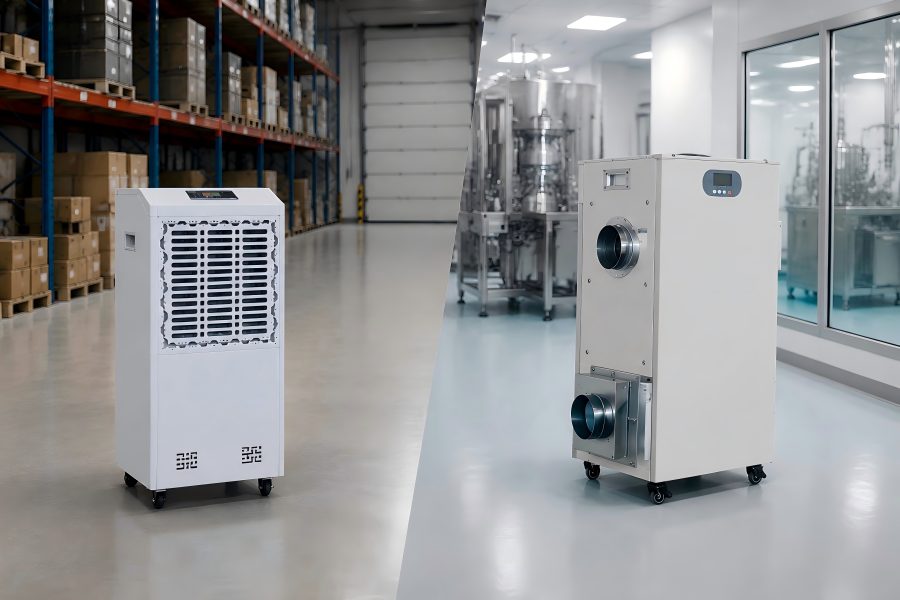
The correct technology depends on the required humidity level and operating environment.
| Factor | Refrigerant Dehumidifier | Desiccant Dehumidifier |
| Temperature Range | Medium temperature environments | Wide temperature range |
| RH Control | Usually 40%–60% RH | Can reach 10%–40% RH |
| Energy Consumption | Lower | Higher but stronger moisture removal |
| Applications | Warehouse, storage, commercial areas | Pharmaceutical, battery, cold storage |
| Installation | Portable, floor-standing, ducted | Mainly ducted and centralized |
For standard humidity control, refrigerant systems may provide an economical solution.
For strict humidity requirements, desiccant systems are often the better choice.
Industrial Dehumidifier Sizing Examples
Example 1: Warehouse Dehumidifier Sizing
Facility:
- Area: 2,000 m²
- Height: 6 m
- Temperature: 25°C
- Target RH: 50%
Considerations:
- Large air volume
- Product moisture
- Door opening frequency
- Ventilation conditions
A high-airflow industrial refrigerant dehumidifier or ducted system may be suitable depending on moisture load.
Example 2: Pharmaceutical Production Room
Facility:
- Area: 500 m²
- Temperature: 22°C
- Target RH: 35%
Requirements:
- Stable humidity
- Clean air
- Continuous operation
The system may require:
- High-efficiency filtration
- Precise RH control
- Refrigerant or desiccant technology depending on process requirements
Example 3: Cold Storage Facility
Facility:
- Temperature: 0°C–5°C
- Target RH: 40%
Challenges:
- Low temperature
- Condensation risk
- Door opening moisture infiltration
A low-temperature desiccant dehumidifier is often selected because conventional systems lose efficiency at low temperatures.
Common Mistakes When Selecting Industrial Dehumidifier Capacity
Selecting Based Only on Room Size
Room size is an important factor, but it does not determine the actual moisture load. Facilities with the same dimensions may require different capacities due to differences in production processes, ventilation, materials, and humidity requirements.
Ignoring Door Opening Frequency
Frequent door opening introduces humid outdoor air and increases moisture load. Cold rooms, warehouses, and logistics facilities with high traffic should consider air infiltration when selecting dehumidifier capacity.
Choosing Capacity Without Future Expansion
Industrial facilities may expand production or storage areas in the future. Selecting equipment with reasonable capacity margins helps avoid replacement costs while maintaining long-term humidity control.
Ignoring Installation Conditions
Dehumidifier performance is affected by installation factors such as:
- Air duct design
- Air distribution
- Ventilation conditions
- Internal heat sources
Proper system planning ensures stable airflow, efficient operation, and reliable humidity control.