
Water damage restoration goes beyond visible water removal. Moisture can remain inside drywall, flooring, wood framing, insulation, and subfloors even after surfaces appear dry.
Choosing between an LGR dehumidifier and a conventional refrigerant dehumidifier affects drying speed, energy use, runtime, and final moisture levels.
What Is an LGR Dehumidifier?
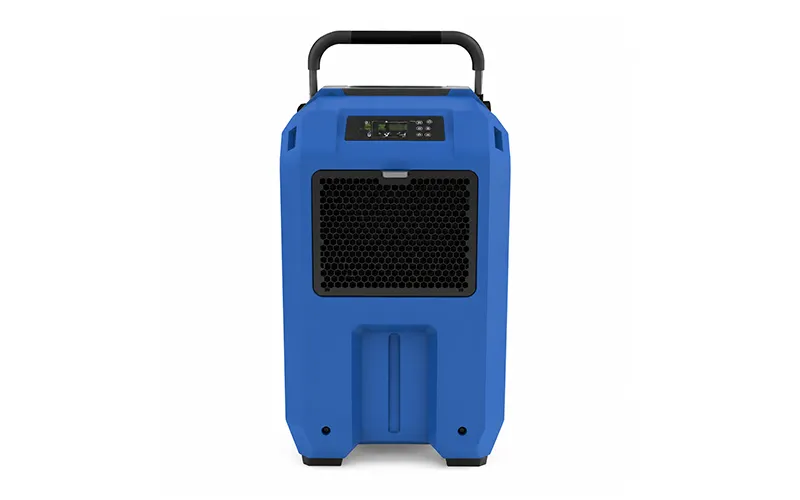
LGR stands for Low Grain Refrigerant. LGR dehumidifiers are advanced refrigerant systems that maintain efficient moisture removal even as the drying area becomes relatively dry.
Like standard refrigerant units, they draw humid air across a cold evaporator coil, condense water vapor into liquid water, and drain it away.
The main difference is the heat-exchange and refrigeration design. LGR technology can process air more effectively at lower moisture levels, which makes it especially useful during the later stages of structural drying.
How LGR Dehumidification Works
An LGR dehumidifier usually pre-cools incoming air before it reaches the evaporator coil. This improves condensation and helps the refrigeration system remove more moisture from each volume of processed air.
After moisture removal, the air is reheated and discharged back into the drying area. This lower-moisture air continues to support evaporation from wet materials.
This becomes important after the first stage of restoration. The room may already feel dry, but wood, drywall, flooring, and other materials can still contain significant moisture internally.
Key Features of LGR Dehumidifiers
Common restoration-grade LGR dehumidifiers may include:
- High moisture-removal capacity
- Low-grain outlet air
- Strong lower-RH performance
- Automatic defrost
- Continuous drainage or condensate pump
- Digital humidity and temperature monitoring
- Duct connection capability
- Portable wheels, handles, or stackable cabinets
These features make LGR dehumidifiers well suited to water damage restoration, flood cleanup, carpet drying, flooring recovery, and long-duration structural drying.
What Is a Conventional Refrigerant Dehumidifier?
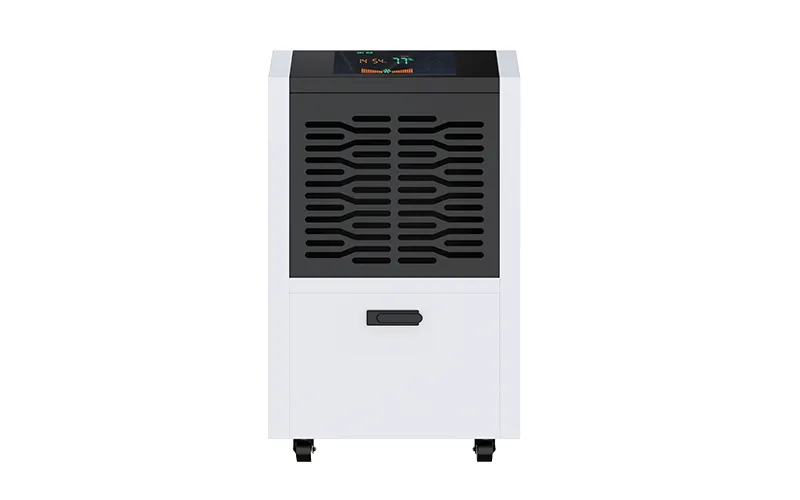
A conventional refrigerant dehumidifier uses a standard refrigeration cycle to remove water vapor from the air. Humid air enters the machine and passes across a cold evaporator coil.
As air falls below its dew point, moisture condenses on the coil. The water drains away, and dry air returns to the room through the condenser.
How Conventional Refrigerant Dehumidifiers Work
A typical conventional unit contains several core components:
- Compressor
- Evaporator coil
- Condenser coil
- Expansion device
- Fan
- Air filter
- Condensate collection system
This design is simple, reliable, and effective in warm and humid environments. It is widely used for basements, warehouses, storage rooms, commercial spaces, and general humidity control.
The limitation becomes more noticeable as relative humidity drops. Under drier conditions, moisture removal can decrease more quickly than with LGR technology.
Typical Characteristics
Conventional refrigerant dehumidifiers generally provide:
- Good performance in warm conditions
- Strong moisture removal at higher RH
- Straightforward operation
- Simple maintenance
- Broad capacity availability
- Lower initial equipment cost in many cases
For light restoration or general moisture control, this level of performance may be completely sufficient.
LGR vs. Conventional Dehumidifiers: Key Differences
Both systems use refrigeration, so the real difference is not the basic dehumidification principle. The key difference is how well they maintain moisture removal as the drying environment becomes less humid.
| Feature | LGR Dehumidifier | Conventional Dehumidifier |
| Refrigeration Design | Advanced low-grain system | Standard refrigeration system |
| High-RH Performance | Strong | Strong |
| Lower-RH Performance | Generally stronger | Usually declines sooner |
| Outlet Air | Lower moisture content | Moderately dry |
| Initial Drying | Very effective | Effective |
| Final Drying | Better suited | More limited |
| Structural Drying | Highly suitable | Suitable for lighter jobs |
| Typical Use | Restoration and structural drying | General humidity control |
During the first 12–24 hours of a wet project, the difference may not be obvious because both machines are working in high-moisture air. The performance gap often becomes clearer as RH falls.
Why LGR Dehumidifiers Perform Better During Restoration
Professional restoration is not simply about making the room feel less humid. The real goal is to continue removing moisture from building materials until they return close to acceptable dry levels.
That requires low-moisture air, good airflow, controlled temperature, and enough time for moisture inside the structure to migrate toward exposed surfaces.
Lower Moisture Content in Processed Air
Relative humidity is useful, but it does not always show the actual amount of moisture in the air. Restoration work often also considers grains per pound, or GPP, to understand moisture content more clearly.
When the surrounding air contains less moisture, wet materials have a stronger tendency to release water vapor. This creates better conditions for continuous evaporation.
LGR dehumidifiers are designed to produce lower-grain air, which helps maintain that moisture difference as the drying process continues.
Better Performance at Lower Relative Humidity
Consider a drying area that begins at around 80% RH. Both an LGR and a conventional refrigerant dehumidifier may remove a large amount of water during the first day.
Once RH falls to around 45–50%, the situation changes. Conventional equipment may begin to lose removal capacity, while an LGR unit is designed to keep producing drier process air.
This becomes important when room conditions look acceptable but moisture readings in floors, walls, or wood remain above target.
Faster Structural Drying
Moisture is released from building materials at varying rates. Some may dry quickly, while others can retain water well below the exposed surface.
Common materials that may require extended drying include:
- Drywall
- Timber framing
- Hardwood flooring
- OSB or plywood subfloors
- Carpet and underlay
- Cabinets
- Concrete surfaces
- Wall and floor cavities
A dry room does not automatically mean these materials are dry. Continued low-moisture airflow is often necessary to keep moisture moving outward.
More Consistent Drying Conditions
A restoration project may last three, five, or seven days depending on water load, material type, airflow, and temperature. Equipment performance needs to remain useful throughout that period.
A conventional unit may perform very well on day one but lose effectiveness later. LGR technology is better suited to maintaining drying pressure as environmental moisture levels decrease.
How Temperature and Humidity Affect Dehumidifier Performance
Refrigerant dehumidifiers do not deliver the same moisture-removal capacity under every condition. Temperature and RH strongly influence how much water can be condensed from the air.
For this reason, the rated pints-per-day or liters-per-day value should always be checked together with the test conditions used by the manufacturer.
Performance in Warm, Humid Conditions
The warmer the air, the more water vapor it can hold. When both temperature and RH are high, refrigerant dehumidifiers operate under favorable conditions for condensation.
A unit tested at around 30°C and 80% RH may remove considerably more moisture than the same machine operating at 20°C and 50% RH.
This means two products with similar headline capacities may perform differently on a real restoration site. Performance curves are useful when available.
Performance as Humidity Drops
As RH falls, less moisture reaches the evaporator coil with each volume of air. Moisture-removal output therefore tends to decline.
Conventional refrigerant dehumidifiers usually experience this drop sooner. LGR systems are designed to extend effective refrigeration performance into lower-moisture conditions.
This is one of the main reasons LGR equipment is often preferred for intermediate and final structural drying.
Low-Temperature Limitations
LGR technology improves refrigerant performance, but it does not remove the basic temperature limitations of refrigeration systems.
At lower temperatures, the evaporator coil can approach freezing. Frost or ice may form, restricting airflow and reducing water removal.
Most restoration-grade systems use automatic defrost to manage this problem. In very cold environments, a desiccant dehumidifier may be more suitable than either LGR or conventional refrigeration.
LGR vs. Conventional Dehumidifiers for Water Damage Restoration
Different water damage projects create different drying demands. A small plumbing leak does not require the same equipment strategy as a flooded hotel, school, office, or warehouse.
The best choice depends on moisture load, affected area, construction materials, temperature, airflow, and the final drying target.
Flood and Water Intrusion Cleanup
Standing water should normally be extracted first. Dehumidifiers are not intended to replace pumps, extractors, or other bulk water-removal equipment.
After extraction, moisture remains in the air and building materials. Air movers promote evaporation, while dehumidifiers remove it from the air.
Conventional units may perform well during the high-RH stage. LGR equipment becomes more valuable as room humidity decreases and hidden moisture remains.
Carpet and Flooring Drying
Flooring systems can hold moisture in several layers, which makes visual inspection unreliable. A dry-looking surface may still have wet material underneath.
Areas that may require checking include:
- Carpet surface
- Carpet cushion
- Hardwood boards
- Laminate joints
- Adhesive layers
- OSB or plywood subfloors
- Floor cavities
Air movement helps release moisture from these layers. Dehumidification then prevents the surrounding air from becoming saturated again.
Wall and Ceiling Drying
Water from roof leaks, burst pipes, sprinkler systems, or flooding can enter wall and ceiling assemblies. Moisture may remain inside drywall, insulation, framing, or enclosed cavities.
Low-moisture air supports evaporation from these materials. In some projects, airflow may also need to be introduced directly into cavities or enclosed spaces.
LGR units are useful here because they help maintain a dry surrounding environment while hidden moisture gradually migrates outward.
Large Commercial Restoration Projects
Commercial restoration may require several dehumidifiers and a large number of air movers operating at the same time.
Typical equipment may include:
- LGR dehumidifiers
- Air movers
- Water extractors
- HEPA air scrubbers
- Duct systems
- Moisture meters
- Data loggers
In large projects, consistent performance matters. Even a small delay in reaching target moisture levels can add another full day of labor, equipment use, and electricity across the site.
Drying Performance at Different Stages of Restoration
A restoration project can be divided into three broad stages: initial drying, intermediate drying, and final drying.
The moisture conditions change during each stage, even when the same equipment remains on site.
Initial Drying Stage
The first stage usually has the highest moisture load. RH may be high, surfaces may still be visibly wet, and evaporation can occur quickly.
The main priorities are usually:
- Remove bulk water
- Set air movers
- Start dehumidification
- Record initial temperature and RH
- Check affected material moisture
- Establish dry reference readings
Both LGR and conventional refrigerant units can perform effectively during this stage.
Intermediate Drying Stage
After about 24–48 hours, the space often feels noticeably drier. However, moisture may still remain inside wood, flooring, cabinets, walls, or subfloors.
At this point, low humidity becomes more important because the remaining moisture must migrate from inside the material to the surface.
LGR dehumidifiers generally begin to show a stronger performance advantage during this stage.
Final Drying Stage
In the final stage, visible water is usually gone and residual moisture is harder to remove. Material readings become more important than room appearance.
Low-grain air helps maintain the moisture difference needed to continue drying. Conventional units may still work, but LGR systems are usually better suited to these lower-RH conditions.
| Drying Stage | Typical Conditions | Conventional Unit | LGR Unit |
| Initial | 65–90% RH, high moisture load | Strong | Strong |
| Intermediate | 45–65% RH, hidden moisture remains | Moderate | Strong |
| Final | 30–50% RH, residual moisture | More limited | Better suited |
| Completion | Materials nearing dry target | Condition-dependent | Easier to maintain low moisture |
The RH values above are general examples rather than fixed restoration standards. Actual completion criteria should be based on material readings, dry references, and project requirements.
Energy Efficiency and Operating Costs
Electricity is only one part of restoration cost. Equipment runtime, labor, site visits, transportation, and project duration can cost more than the power consumed by the dehumidifier.
For that reason, cost should be evaluated across the full drying period rather than only by comparing machine wattage.
Daily Electricity Cost
Assume a conventional dehumidifier uses 900 W and operates continuously for 24 hours.
0.9 kW × 24 hours = 21.6 kWh/day
At an electricity price of $0.15/kWh, the daily operating cost is approximately:
21.6 × $0.15 = $3.24/day
Now assume an LGR dehumidifier uses 1,100 W:
1.1 kW × 24 hours = 26.4 kWh/day
At the same electricity rate:
26.4 × $0.15 = $3.96/day
The LGR unit costs about $0.72 more per day in this example.
Total Drying Energy Cost
Daily cost does not show the full picture. Project duration must also be included.
If the conventional unit runs for 6 days:
21.6 kWh × 6 = 129.6 kWh
Total electricity cost:
129.6 × $0.15 = $19.44
If the LGR unit reaches the same drying target in 4 days:
26.4 kWh × 4 = 105.6 kWh
Total electricity cost:
105.6 × $0.15 = $15.84
Despite the higher daily power consumption, the LGR example uses 24 kWh less energy and saves about $3.60 per unit over the full project.
With six units, the difference becomes approximately $21.60 in electricity.
Labor and Monitoring Cost
Drying time also affects labor. Suppose site checking, moisture readings, and equipment adjustments require 1.5 hours per day.
At a loaded labor cost of $50/hour:
1.5 hours × $50 = $75/day
An extra two days would add around:
$75 × 2 = $150
If two people are needed for each visit, the additional labor can rise to approximately $300, before transportation or administrative expenses are added.
Equipment-Day Cost
Equipment utilization can also be included in project budgeting.
Assume an internal allocation of $50 per day for a conventional unit and $70 per day for an LGR unit.
Six conventional units used for six days:
6 × 6 × $50 = $1,800
Six LGR units used for four days:
6 × 4 × $70 = $1,680
In this example, the LGR setup has a higher daily rate but still saves around $120 in total equipment-day cost.
These numbers are example calculations only. Actual values depend on equipment price, depreciation, local labor, rental rates, and maintenance costs.
Equipment Purchase Cost
Initial purchase price should also be considered over the full service life of the machine.
Suppose a conventional unit costs $1,500 and an LGR unit costs $2,200. The price difference is $700.
If the LGR unit is used on 200 projects, the additional purchase cost averages:
$700 ÷ 200 = $3.50 per project
That small per-project difference can be justified if the equipment consistently reduces drying time or improves final drying performance.
LGR vs. Conventional Dehumidifier Specifications to Compare
Daily water-removal capacity is important, but it should never be the only selection factor.
Moisture Removal Capacity
Capacity is normally shown in:
- Pints per day
- Liters per day
Always compare the test temperature and RH beside the capacity rating. A high rating at 30°C and 80% RH does not mean the same result will be achieved at 20°C and 45% RH.
Airflow
Airflow is usually expressed in:
- CFM
- m³/h
The machine needs enough airflow to move humid air through the system and distribute dry air back into the affected zone.
Operating Temperature Range
Confirm the minimum and maximum operating temperature limits. Lower temperatures can reduce refrigeration efficiency and increase defrost frequency.
This is especially important for basements, winter projects, and unheated buildings.
Operating RH Range
For general humidity control, a system may only need to maintain moderate RH. Structural drying often requires useful performance at lower humidity levels.
This is one of the main specifications that separates LGR from conventional performance.
Power Consumption
Several machines operating together can create a significant electrical load.
For example, six 1.1 kW dehumidifiers require:
6 × 1.1 kW = 6.6 kW
Add ten 300 W air movers:
10 × 0.3 kW = 3.0 kW
The combined running load becomes approximately 9.6 kW, before other equipment is added.
Static Pressure and Ducting Capability
Some restoration jobs require dry air to be delivered through ducts into remote rooms, cavities, or containment areas.
Long ducts increase resistance, so the unit must provide enough fan pressure to maintain useful airflow.
Drainage System
Continuous drainage is important because professional units may collect many liters of water per day.
Common options include:
- Gravity drainage
- Built-in condensate pump
- External pump
- Long drain hose connection
A pump is especially useful where the drain point is higher or farther away from the machine.
Portability
Restoration equipment is frequently moved between rooms, floors, and vehicles.
Useful design features include:
- Large wheels
- Strong handles
- Compact dimensions
- Balanced lifting points
- Stackable cabinets
- Impact-resistant housing
These details do not affect laboratory moisture-removal capacity, but they strongly affect daily usability.
Air Movers and Dehumidifiers: Why Restoration Requires Both
A dehumidifier cannot dry wet materials efficiently if moisture is not first moving into the surrounding air.
Air movers and dehumidifiers therefore perform different but complementary roles.
Role of Air Movers
Air movers increase airflow across wet surfaces and disturb the humid boundary layer close to the material.
They are commonly used around:
- Flooring
- Carpet
- Walls
- Cabinets
- Furniture
- Structural surfaces
This supports faster evaporation and moves moisture into the room air.
Role of Dehumidifiers
Once moisture enters the air, the dehumidifier must remove it quickly enough to prevent RH from rising again.
The drying cycle can be summarized as:
Wet Material → Air Movement → Evaporation → Moist Air → Dehumidification → Dry Air
If air movement is strong but dehumidification is undersized, room humidity can rise. If dehumidification is strong but airflow is poor, moisture may remain trapped in the materials.
When Should Restoration Professionals Choose an LGR Dehumidifier?
LGR is generally the better choice when strong performance is needed beyond the initial high-humidity stage.
Typical applications include:
- Water damage restoration
- Flood recovery
- Structural drying
- Carpet and subfloor drying
- Hardwood floor drying
- Drywall and wall cavity drying
- Commercial property restoration
- Multi-day drying projects
The main advantage appears when room RH has already dropped but material moisture remains above target.
When Can a Conventional Dehumidifier Be Enough?
A conventional refrigerant dehumidifier can still be a practical solution for less demanding moisture-control applications.
It may be suitable for:
- Basements
- Warehouses
- Storage rooms
- Garages
- Workshops
- Warm humid spaces
- Temporary moisture problems
- Light restoration work
If the goal is routine RH control rather than deep structural drying, conventional refrigeration may provide all the performance needed.
LGR vs. Conventional Dehumidifiers: Which Is Better for Restoration?
For professional water damage restoration, LGR dehumidifiers generally provide stronger overall drying performance.
The biggest advantage is not always visible on day one. The difference becomes more important after RH falls and moisture remains inside floors, walls, wood, and other building materials.
Conventional refrigerant units remain useful for high-humidity conditions and general moisture control. They simply tend to lose effective water-removal performance sooner as the air becomes drier.
How to Choose the Right Restoration Dehumidifier
Before selecting equipment, evaluate the actual drying conditions rather than using room size alone.
Key factors include:
- Affected Area Size
Measure both floor area and room volume, especially in large or divided spaces. - Initial Moisture Load
Consider how much water entered the building and how deeply materials were saturated. - Ambient Temperature
Lower temperatures can reduce refrigerant performance and increase defrost cycles. - Starting Relative Humidity
Initial RH provides a useful baseline for tracking drying progress. - Target Moisture Level
Use material readings, not room RH alone, to decide when drying is complete. - Wet Material Type
Wood, drywall, concrete, carpet, and insulation release moisture at different rates. - Electrical Capacity
Calculate the combined load of dehumidifiers, air movers, pumps, and filtration equipment. - Drainage and Project Duration
Continuous drainage and long-term reliability become more important on multi-day jobs.
Monitoring Is as Important as Equipment Selection
Even a high-performance LGR dehumidifier cannot replace regular moisture measurement. Restoration decisions should be based on actual conditions rather than appearance alone.
Common monitoring tools include:
- Moisture meters
- Thermo-hygrometers
- Psychrometers
- Infrared cameras
- Data loggers
Readings should be taken at consistent locations throughout the project. If RH improves but material moisture stops falling, airflow, temperature, or equipment capacity may need to be adjusted.
Monitoring can also reduce unnecessary operating cost. Six 1.1 kW LGR units running for one extra day consume:
6 × 1.1 × 24 = 158.4 kWh
At $0.15/kWh, that unnecessary day adds approximately:
158.4 × $0.15 = $23.76
This does not include additional labor, transportation, or equipment-day charges.