
Running a dehumidifier 24 hours a day can help control persistent humidity, but continuous operation does not mean the compressor should run nonstop.
Most modern units support extended use when properly installed and maintained. Safe operation depends on reaching the target RH, normal cycling, reliable drainage, and no unusual heat, noise, or leaks.
Can a Dehumidifier Run 24 Hours a Day?
Yes. Many modern dehumidifiers can remain powered on 24 hours a day. Their built-in humidistats monitor indoor RH and automatically start or stop moisture removal as conditions change.
For example, if the target is set to 50% RH, the compressor runs when humidity rises above that level and reduces or stops operation once the target is reached.
There is therefore a difference between:
- Leaving the dehumidifier switched on all day
- Allowing the fan to operate for long periods
- Running the compressor continuously for 24 hours
Temporary nonstop operation can be normal when drying a very damp basement, after heavy rain, or during the first few days of use. However, if the compressor never cycles off, the humidity load, unit capacity, or settings should be checked.
When Is 24-Hour Dehumidifier Operation Safe?
Long operating periods are generally safe when the unit is correctly sized, properly installed, and used within the manufacturer’s operating conditions.
Good airflow is particularly important. Blocked air inlets, dirty filters, or furniture placed too close to the unit can reduce moisture removal and increase operating temperature.
For safer long-term operation, make sure the dehumidifier has:
- Correct capacity for the space
- Clean filters
- Clear air intake and outlet
- Reliable drainage
- Suitable operating temperature
- Stable electrical connection
- Working safety protections
Drainage is also important. A dehumidifier operating throughout the day can collect a considerable amount of water, so continuous drainage is usually more practical than repeatedly emptying a tank.
Why Does Your Dehumidifier Keep Running Continuously?
A dehumidifier running almost nonstop is not necessarily defective. In many cases, it simply cannot reach the selected humidity level because moisture continues entering the space.
A very low RH setting can also increase runtime. Trying to maintain 30% RH in a humid residential environment requires much more moisture removal than maintaining 45%–50% RH.
Common reasons for continuous operation include:
- Indoor RH remains above the set point
- The unit is too small
- Outdoor humidity is very high
- Doors or windows remain open
- A basement or crawl space adds moisture
- Plumbing or foundation moisture is present
- The air filter is dirty
- Airflow around the unit is blocked
If the unit runs all day but the RH barely changes, use a separate hygrometer to confirm the humidity reading and inspect the room for an ongoing moisture source.
What Happens If a Dehumidifier Runs All Day?
Running a dehumidifier throughout the day can provide more stable humidity because the system responds whenever moisture increases.
This is particularly useful in basements, laundry rooms, storage areas, coastal homes, and other locations where RH changes frequently.
Potential benefits include:
- More stable indoor humidity
- Less condensation
- Faster drying
- Reduced damp or clammy air
- Better protection for furniture and stored items
- Less manual operation
The main drawback is increased energy use. Longer compressor and fan runtime also adds operating hours to internal components.
That does not mean daily operation automatically damages the unit. It simply makes regular filter cleaning, drainage inspection, and general maintenance more important.
Can Running a Dehumidifier 24/7 Cause Overheating?
A properly functioning dehumidifier is designed to handle the heat produced during normal operation.
In fact, warm discharge air is normal for refrigerant dehumidifiers. Air passes over a cold evaporator coil to remove moisture and is then reheated as it moves across the condenser.
Restricted airflow and dirty components can increase the risk of problems.
Watch for:
- An unusually hot cabinet
- Burning or electrical smells
- Frequent automatic shutdown
- Weak airflow
- Abnormal compressor noise
- Excessive vibration
Many modern dehumidifiers include thermal overload or automatic protection functions, but these should not replace routine maintenance.
If a unit repeatedly overheats, stop using it until the airflow, filter, electrical supply, and internal condition have been checked.
Is It Safe to Leave a Dehumidifier Running Overnight?
A dehumidifier can usually operate overnight when it is correctly installed and equipped with automatic controls.
A built-in humidistat allows the unit to cycle according to actual humidity demand, while full-tank protection can stop a portable model when its water container reaches capacity.
Before overnight operation, check that:
- The unit is on a stable surface
- Air openings are clear
- The filter is clean
- The power cord is undamaged
- The tank is installed correctly
- The drain hose is secure
- No water is leaking
Continuous drainage is especially useful for overnight operation because the unit does not need to stop when a tank becomes full.
Avoid placing clothes, towels, curtains, or furniture directly against the dehumidifier, as these can restrict airflow.
Should You Leave a Dehumidifier Running When You’re Away?
Unattended operation requires more care because no one is present to notice a blocked drain, water leak, or unusual operating condition.
A modern unit with automatic humidity control, continuous drainage, and appropriate protection functions may be suitable for extended unattended use when installed correctly.
The drain system should be checked carefully. Make sure the hose:
- Is firmly connected
- Is not kinked
- Has a clear flow path
- Maintains the required slope
- Reaches a suitable drain
If a condensate pump is used, test it before relying on it for unattended operation.
The dehumidifier should also be connected to a suitable electrical outlet according to the manufacturer’s requirements. Avoid overloaded power strips or unsuitable extension cords.
Should a Dehumidifier Run Continuously or Cycle On and Off?
For normal residential use, cycling on and off is generally a sign that the system is reaching the selected humidity level.
The compressor removes moisture until the room approaches the target RH. It then stops or reduces operation until humidity rises again.
Some models continue operating the fan periodically even when the compressor is off. This helps the humidity sensor sample room air.
Because of this, a dehumidifier may sound as though it is running continuously even though active dehumidification has stopped.
Continuous compressor operation is more common when:
- The space is initially very damp
- Outdoor humidity is extremely high
- The target RH is too low
- The unit is undersized
- Moisture continuously enters the room
Once normal indoor conditions are established, a properly sized unit should generally begin cycling rather than operating continuously at full load.
What Humidity Level Should You Set for Continuous Operation?
For many homes, approximately 40%–50% RH provides a practical balance between comfort, moisture control, and energy use.
Maintaining an unnecessarily low RH can significantly increase dehumidifier runtime without providing much additional benefit.
A simple reference is:
- 40%–50% RH: suitable for many homes
- 50%–55% RH: acceptable for many normal living areas
- Below 40% RH: often unnecessary in standard residential spaces
- Above 60% RH: generally considered excessively humid
Humidity requirements can change with the season. Indoor air may naturally become drier during winter, while summer outdoor air can introduce considerably more moisture.
Instead of choosing the lowest possible setting, use a target that keeps the home comfortable while preventing condensation, musty odors, and other moisture problems.
How Much Electricity Does a Dehumidifier Use Running 24 Hours?
Electricity consumption depends on the unit’s power rating and how long the compressor actually operates.
For example, assume a dehumidifier consumes 500 W during active operation.
500 W ÷ 1,000 = 0.5 kW
If it operates continuously for 24 hours:
0.5 kW × 24 hours = 12 kWh/day
At an example electricity price of $0.16/kWh:
12 kWh × $0.16 = $1.92/day
Over 30 days:
$1.92 × 30 = $57.60/month
However, a unit with automatic humidity control may not run its compressor for all 24 hours.
If the same 500 W unit actively dehumidifies for only 12 hours:
0.5 kW × 12 = 6 kWh/day
At $0.16/kWh, that equals approximately $0.96 per day, or $28.80 per month.
Actual consumption depends on:
- Dehumidifier efficiency
- Room humidity
- RH setting
- Outdoor conditions
- Space size
- Room temperature
- Moisture load
- Local electricity rates
Portable vs. Whole-House Dehumidifiers for 24/7 Use
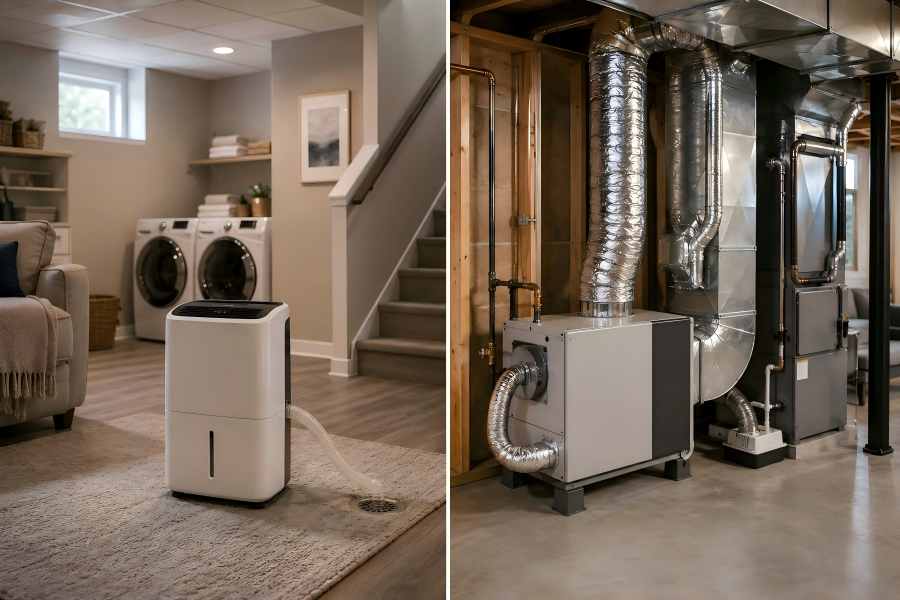
Portable and whole-house dehumidifiers can both operate for extended periods, but their intended coverage and installation methods are different.
| Feature | Portable Dehumidifier | Whole-House Dehumidifier |
| Coverage | One room or local area | Multiple rooms or whole home |
| Installation | Plug-in | Fixed or ducted |
| Drainage | Tank or drain hose | Usually continuous |
| RH Control | Localized | Centralized |
| Air Distribution | Limited by room airflow | Can use ductwork |
| Daily Maintenance | Usually more | Usually less |
| Best For | Local humidity | Long-term whole-home control |
Portable units work well when excess humidity is limited to one basement, bedroom, laundry room, or other localized area.
However, several portable units operating throughout a house can become inconvenient because each requires separate filters, controls, drainage, and maintenance.
A whole-house dehumidifier can treat a much larger volume of air and distribute dry air through dedicated or existing ductwork.
For homes that need dehumidification throughout the humid season, a dedicated system may provide more consistent coverage.
Signs Your Dehumidifier Should Not Be Running Constantly
Continuous operation becomes a concern when the unit runs for long periods without improving indoor humidity.
For example, if RH remains around 70% after many hours, the equipment may be undersized, blocked, incorrectly installed, or dealing with an ongoing moisture source.
Warning signs include:
- Compressor never stops after reaching target RH
- Burning or electrical smell
- Excessive cabinet heat
- Loud vibration or rattling
- Water leakage
- Ice buildup on coils
- Weak airflow
- RH does not decrease
- Electricity consumption rises unexpectedly
Persistent coil icing can result from low temperature, restricted airflow, dirty coils, or refrigeration problems.
Water leakage should also be corrected immediately. A blocked drain, damaged tank, loose hose, or failed condensate pump can allow collected moisture to escape back into the room.
How to Run a Dehumidifier Safely for Long Periods
Safe long-term operation depends mainly on proper settings, airflow, drainage, and routine maintenance.
Set the Right RH
For many homes, around 40%–50% RH is sufficient. Avoid excessively low settings that force unnecessary compressor operation.
Keep the Filter Clean
A dirty filter restricts airflow and reduces moisture-removal performance. Inspect and clean it regularly when the unit operates every day.
Keep Air Openings Clear
Do not block the intake or discharge with furniture, curtains, boxes, or clothing.
Use Continuous Drainage
A secure drain hose or condensate pump is more practical than repeatedly emptying the tank during long-term operation.
Check the Moisture Source
Inspect for plumbing leaks, roof leaks, groundwater, foundation seepage, and excessive outdoor air infiltration.
Use Automatic Humidity Control
A humidistat allows the dehumidifier to operate only when humidity rises above the selected level.
Inspect the Unit Regularly
Look for:
- Water leaks
- Dust buildup
- Unusual noise
- Excessive heat
- Loose drainage hoses
- Damaged power cords
- Abnormal humidity readings
Regular inspection helps identify small problems before they affect long-term operation.