
Choosing the right dehumidifier involves more than room size. The internal technology affects moisture-removal capacity, noise, energy use, temperature performance, and applications.
Compressor and thermoelectric models are two common options. Compressor units offer stronger moisture removal, while thermoelectric units are smaller, quieter, and better for light humidity in small spaces.
What Is a Compressor Dehumidifier?
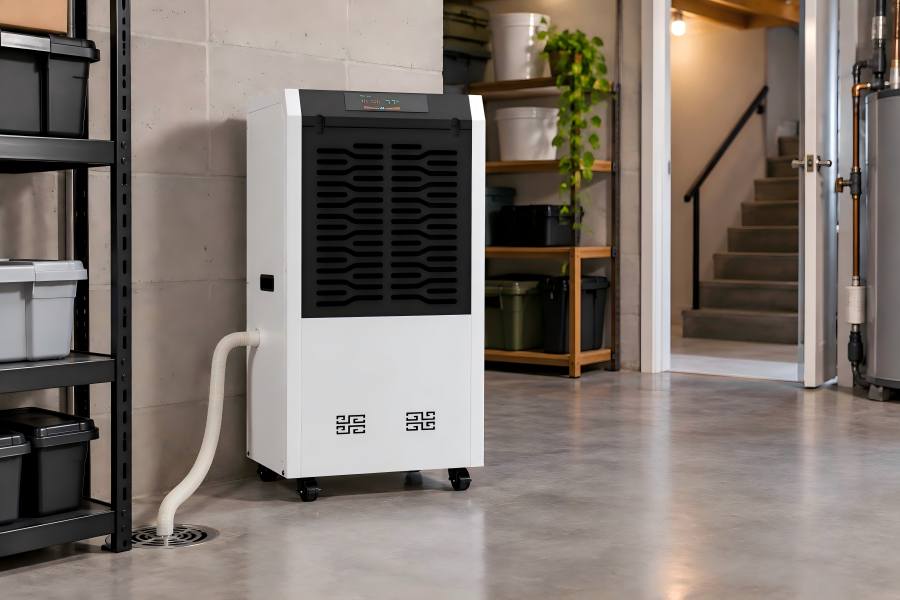
A compressor dehumidifier uses a refrigeration cycle to cool humid air below its dew point. As moist air passes over the cold evaporator coil, water vapor condenses into liquid water and is collected or drained away.
The dried air then passes through the condenser coil before returning to the room, allowing compressor models to remove much more moisture than thermoelectric units.
Because of their higher capacity, compressor dehumidifiers are commonly used in bedrooms, basements, living rooms, laundry rooms, garages, and other medium-to-large spaces.
How a Compressor Dehumidifier Works
The basic operating process includes:
- Humid air enters through the fan
- Air passes over a cold evaporator coil
- Moisture condenses into water
- Condensate flows into a tank or drainage system
- Dry air passes over the condenser
- Warmer, drier air returns to the room
The compressor circulates refrigerant between the evaporator and condenser, creating the cooling effect needed for moisture removal.
This refrigeration process gives compressor dehumidifiers much higher capacity and makes them suitable for continuous humidity control.
Main Components
A typical compressor dehumidifier includes:
- Compressor
- Evaporator coil
- Condenser coil
- Fan
- Refrigerant circuit
- Water collection or drainage system
Higher-end models may also include automatic defrost, digital humidity control, continuous drainage, condensate pumps, and smart controls.
What Is a Thermoelectric Dehumidifier?
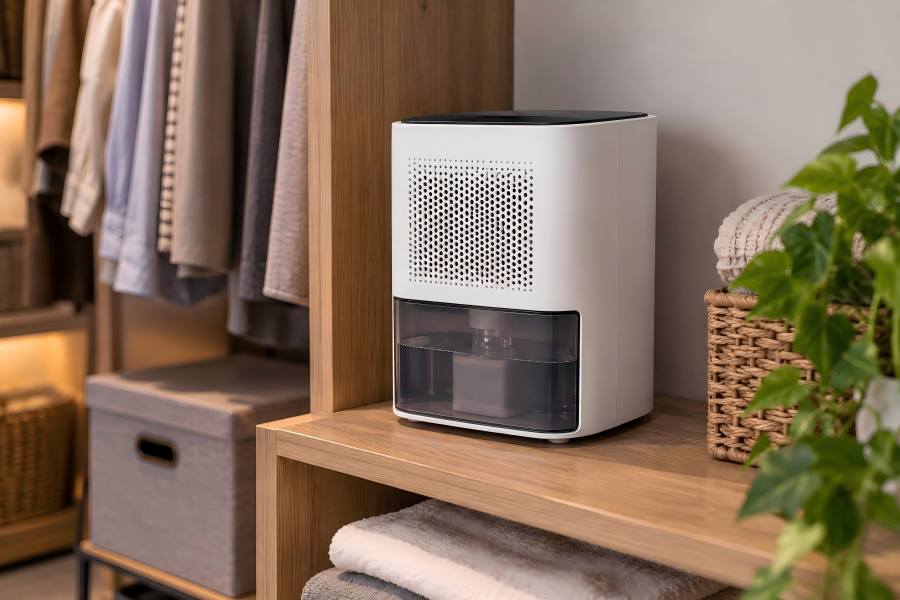
A thermoelectric dehumidifier uses a Peltier module instead of a compressor and refrigerant system.
Electricity creates a cold side and a warm side within the module. Moisture condenses on the cold surface into liquid water, which is collected in a small tank.
Because there is no compressor, thermoelectric units are lightweight, compact, and quiet. However, their moisture-removal ability is significantly lower.
How a Thermoelectric Dehumidifier Works
The process includes:
- Electricity passes through the Peltier module
- One side of the module becomes cold
- Humid air contacts the cold surface
- Water vapor condenses
- Heat transfers to the warm side
- A fan removes excess heat
- Condensate collects in the tank
Unlike compressor models, thermoelectric units do not use a refrigeration cycle or circulating refrigerant.
This simpler design reduces noise and size but limits overall moisture-removal performance.
Main Components
A thermoelectric dehumidifier usually contains:
- Peltier module
- Heat sinks
- Fan
- Condensation plate
- Water tank
- Electronic controls
These units are commonly used for closets, cabinets, small bathrooms, RV storage areas, and other small spaces.
Compressor vs. Thermoelectric Dehumidifiers: Quick Comparison
The two technologies serve different purposes. Compressor models focus on stronger moisture removal, while thermoelectric models focus on compact size and quiet operation.
| Feature | Compressor Dehumidifier | Thermoelectric Dehumidifier |
| Technology | Refrigeration cycle | Peltier effect |
| Moisture Removal | High | Low |
| Suitable Room Size | Medium–Large | Small |
| Noise Level | Moderate | Low |
| Power Consumption | Higher | Lower |
| Moisture Removal Efficiency | Generally Better | Generally Lower |
| Temperature Range | Warm to moderate | Mild indoor conditions |
| Physical Size | Larger | Compact |
| Continuous Drainage | Common | Less common |
| Best For | Basements, bedrooms, large rooms | Closets, small spaces |
A thermoelectric dehumidifier is not simply a smaller compressor model. The two technologies are designed for different moisture loads and applications.
Moisture-Removal Capacity: Which Is More Powerful?
The biggest difference between compressor and thermoelectric dehumidifiers is moisture-removal capacity.
Compressor units use a stronger cooling system, allowing them to condense much more water from the air during operation.
Compressor Dehumidifier Capacity
Compressor models are available in different capacities and can remove significant amounts of moisture every day.
They are suitable for:
- Medium and large rooms
- High indoor humidity
- Basements
- Garages
- Laundry areas
- Long-term humidity control
When properly sized, a compressor dehumidifier can quickly reduce elevated RH and maintain stable humidity conditions.
Thermoelectric Dehumidifier Capacity
Thermoelectric units remove much less moisture and are mainly designed for localized humidity control.
They are suitable for:
- Small enclosed spaces
- Mild dampness
- Closets
- Cabinets
- Small bathrooms
- Storage areas
They are not designed for large moisture sources or whole-room humidity problems.
Which Option Is Right for Different Room Sizes?
Room size matters because larger spaces contain more air and usually experience higher moisture loads.
However, actual humidity conditions should always be considered alongside room size.
Small Spaces
Thermoelectric dehumidifiers are often suitable for:
- Closets
- Wardrobes
- Small bathrooms
- RV compartments
- Storage cabinets
- Small utility spaces
For example, a closet with mild humidity may only require gradual moisture reduction to protect clothing and stored items.
A compact thermoelectric unit can provide enough control without taking up much space.
Medium and Large Spaces
Compressor dehumidifiers are generally better for:
- Bedrooms
- Living rooms
- Basements
- Garages
- Laundry rooms
- Apartments
- Large storage areas
A large basement with damp walls or high humidity can produce far more moisture than a thermoelectric unit can handle.
Noise Level: Which Dehumidifier Is Quieter?
Noise is one area where thermoelectric models have a clear advantage.
Since they do not use compressors, their main noise source is usually the fan.
Thermoelectric Dehumidifiers
Thermoelectric units are commonly selected for quiet environments because they eliminate compressor vibration and refrigeration-cycle noise.
Advantages include:
- No compressor vibration
- Low operating noise
- Compact fan operation
- Suitable for bedrooms and offices
However, quiet operation should not replace proper capacity selection. A silent unit that cannot control humidity will not provide effective results.
Compressor Dehumidifiers
Compressor models produce additional sound because they contain more moving components.
Common noise sources include:
- Compressor operation
- Fan airflow
- Refrigerant movement
- Cabinet vibration
Modern compressor dehumidifiers can still operate quietly, especially at lower fan speeds.
For bedrooms and living spaces, checking the rated noise level is important when selecting a model.
Energy Consumption and Efficiency
A lower wattage rating does not always mean better efficiency.
Thermoelectric units usually consume less electricity per hour, but they also remove much less moisture. Compressor models consume more power but can remove significantly more water.
For example:
Thermoelectric Dehumidifier
Power consumption: 50W
Daily operation:
0.05 kW × 24 hours = 1.2 kWh/day
Compressor Dehumidifier
Power consumption: 400W
Daily operation:
0.4 kW × 8 hours = 3.2 kWh/day
Although the compressor model uses more electricity, it may remove several times more moisture during the same period.
Therefore, efficiency should be compared by moisture removed per kWh rather than wattage alone.
Performance in Different Temperatures
Temperature affects how effectively a dehumidifier can condense moisture from the air.
Both technologies perform best under specific operating conditions.
Compressor Dehumidifiers
Compressor models generally perform best in warm and moderately humid environments.
Potential limitations include:
- Reduced performance in cold rooms
- Frost formation on coils
- Longer operating cycles at low temperatures
Useful features for cooler spaces include:
- Automatic defrost
- Low-temperature operation
- Temperature protection
Basements and garages often require special attention because temperatures can be lower than normal living areas.
Thermoelectric Dehumidifiers
Thermoelectric units do not use refrigeration coils, but their performance also decreases when temperature and humidity are low.
Because condensation depends on moisture availability, very dry air limits their effectiveness.
For applications requiring very low humidity or cold-temperature operation, other technologies may be more suitable.
Compressor vs. Thermoelectric for High Humidity
Humidity level directly affects the required moisture-removal capacity.
Around 50–60% RH
Both technologies may work depending on room size.
Thermoelectric models can handle small enclosed spaces, while compressor units are better for larger rooms.
Around 60–70% RH
More moisture-removal capacity becomes necessary.
Compressor models are generally more effective because they can reduce humidity faster.
Around 70–80% RH
This indicates a heavier moisture load.
Compressor dehumidifiers are usually the better choice for basements, garages, and larger spaces.
Above 80% RH
Very high humidity may indicate leaks, water intrusion, or ventilation issues.
A more powerful dehumidifier may help, but the moisture source should also be addressed.
Drainage and Maintenance Differences
Drainage requirements depend largely on how much moisture the unit collects.
Compressor Dehumidifier Drainage Options
Common options include:
- Water tank
- Gravity drain
- Continuous drain hose
- Built-in pump
Because compressor models remove more moisture, continuous drainage is often preferred for long-term operation.
Thermoelectric Dehumidifier Drainage
Most thermoelectric models use:
- Small water tank
- Manual emptying
- Automatic shutoff when full
Their lower moisture-removal capacity usually makes a small tank sufficient.
Maintenance Comparison
Both technologies require regular maintenance:
- Cleaning filters
- Emptying water tanks
- Checking drainage paths
- Cleaning air inlets
- Removing dust
Compressor models generally require more maintenance because they contain more mechanical components.
Compressor vs. Thermoelectric Dehumidifiers for Bedrooms
Bedroom applications require a balance between noise and moisture control.
A thermoelectric model may work well when:
- The room is small
- Humidity is mild
- Quiet operation is important
A compressor model is usually better when:
- RH remains above 60%
- The room is larger
- Faster moisture removal is required
Important features include:
- Noise rating
- Sleep mode
- Humidity control accuracy
- Tank size
- Continuous drainage options
Compressor vs. Thermoelectric Dehumidifiers for Basements
Basements often have higher moisture loads because of:
- Damp foundation walls
- Ground moisture
- Limited ventilation
- Cooler surfaces
- Seasonal humidity changes
For these conditions, compressor dehumidifiers are usually the better choice.
Advantages include:
- Higher moisture-removal capacity
- Better long-term humidity control
- More drainage options
- Larger coverage area
Continuous drainage is often recommended to avoid frequent tank emptying.
Which One Is Better for Bathrooms and Closets?
Different small spaces require different solutions.
Bathroom
A small thermoelectric unit may help with light humidity after occasional use.
However, showers can quickly release large amounts of moisture. Bathrooms with frequent condensation problems may require better ventilation or stronger dehumidification.
Closet
Closets usually have much lower moisture loads.
A compact thermoelectric unit can be practical for:
- Clothing storage
- Seasonal humidity
- Musty odors
- Small enclosed spaces
Advantages and Disadvantages of Compressor Dehumidifiers
| Pros | Cons |
| High moisture-removal capacity | Larger size |
| Suitable for larger rooms | Higher operating noise |
| Better for high humidity conditions | Higher power consumption |
| More drainage options | More mechanical components |
| Better moisture removal efficiency | Reduced performance in cold conditions |
| Suitable for continuous operation | — |
Advantages and Disadvantages of Thermoelectric Dehumidifiers
| Pros | Cons |
| Compact size | Low moisture-removal capacity |
| Quiet operation | Limited room coverage |
| Simple construction | Not suitable for severe humidity |
| Lightweight | Small water tanks |
| Low power consumption | Lower moisture removal efficiency |
| Easy portability | Not suitable for large spaces |
How to Choose Between Compressor and Thermoelectric Dehumidifiers
Before choosing a dehumidifier, consider:
- Room size
- Current RH level
- Moisture source
- Target humidity
- Room temperature
- Noise requirements
- Drainage access
- Expected operating time
The correct technology depends on the actual humidity problem rather than only price or size.
Choose a Compressor Dehumidifier When:
- The room is medium or large
- Humidity remains high
- Strong moisture removal is required
- Continuous drainage is needed
- The unit will operate for long periods
Choose a Thermoelectric Dehumidifier When:
- The space is very small
- Humidity is mild
- Quiet operation is important
- Portability matters
- Only localized moisture control is needed
Compressor vs. Thermoelectric Dehumidifiers: Final Comparison
| Choose | Best When |
| Compressor Dehumidifier | Strong moisture removal is needed for medium or large spaces |
| Thermoelectric Dehumidifier | Quiet and compact humidity control is needed for small spaces |
Compressor dehumidifiers are well suited for basements, bedrooms, living areas, and spaces requiring effective humidity control.
Thermoelectric models are better suited for closets, cabinets, RV compartments, and small areas with mild humidity.
The best option depends on matching the technology to the actual moisture load instead of choosing based only on noise, price, or power consumption.