
Weapons and ammunition can remain in storage for long periods, so stable environmental conditions are important. Excess moisture may increase corrosion risk, damage packaging, and promote condensation inside cabinets, safes, and storage rooms.
For many indoor storage applications, around 40%–50% RH is a practical starting point. However, temperature, packaging, room construction, storage duration, and specific facility requirements should always be considered together.
What Humidity Level Is Recommended for Weapons Storage?
For general indoor weapons storage, maintaining approximately 40%–50% relative humidity provides a practical balance between moisture protection and avoiding unnecessary over-drying.
The goal is not to reduce room humidity as much as possible. Stable moderate humidity is usually more useful than allowing RH to fluctuate widely throughout the day or between seasons.
| Storage Condition | Typical RH Target |
| General Weapons Storage | 40%–50% RH |
| Long-Term Controlled Storage | 35%–50% RH |
| Humid Storage Environment | Keep consistently below about 55% RH |
| Combined Weapons & Ammunition Storage | Around 40%–50% RH |
These figures should be treated as general references rather than universal standards. Manufacturer, facility, regulatory, or preservation requirements should take priority where specific conditions are defined.
A room maintained consistently around 45%–50% RH is generally easier to manage than one that repeatedly moves between very dry and very humid conditions.
Why High Humidity Is a Problem
High RH increases the amount of moisture available in the air. When metal surfaces, cabinets, packaging, and shelving remain exposed for long periods, moisture-related deterioration can gradually develop.
The risk becomes greater when humidity combines with poor airflow, dust, salt, fingerprints, chemical residues, or frequent temperature changes.
Common moisture-related problems include:
- Surface rust
- Metal corrosion
- Oxidation
- Mold on cases or packaging
- Damp cardboard boxes
- Moisture inside cabinets
- Damage to optics or electronics
- Musty odors
Corrosion may not appear immediately. A storage room can remain too humid for weeks before visible rust develops, which is why regular monitoring is more useful than waiting for damage to become obvious.
Humidity above 55%–60% RH for extended periods generally deserves more attention, especially in basements, underground rooms, coastal environments, or poorly ventilated storage areas.
Can Humidity Be Too Low?
Extremely low humidity is usually unnecessary for general weapons storage. Aggressive drying may increase operating cost without providing meaningful additional protection once the room is already stable and dry.
Very dry air can also affect materials other than metal, including:
- Wood
- Leather
- Rubber components
- Certain seals
- Adhesives
Wood can lose moisture and change dimension over time, while leather may become harder or less flexible in very dry environments.
For mixed-material storage, a moderate and stable RH is therefore often more practical than trying to maintain extremely low humidity continuously.
What Humidity Level Is Best for Ammunition Storage?
Ammunition generally benefits from a cool, dry, and stable environment protected from moisture and major temperature fluctuations.
For rooms storing both weapons and ammunition, approximately 40%–50% RH can serve as a practical general target when no more specific requirement applies.
Other important factors include:
- Packaging type
- Sealed or opened containers
- Storage duration
- Room temperature
- Door-opening frequency
- Air leakage
- Water intrusion risk
Sealed containers provide greater environmental protection than open cardboard packaging exposed directly to humid room air.
How Humidity Can Affect Ammunition Storage
Long-term moisture exposure can affect both metal components and storage packaging.
Metal corrosion may develop when exposed surfaces remain in humid conditions, particularly when condensation or contaminants are present.
Cardboard packaging can absorb moisture, soften, deform, or develop mold during extended storage in damp environments.
Temperature swings can also produce condensation on metal containers, shelving, or packaging even when average room RH appears acceptable.
For long-term storage, reducing repeated moisture and temperature fluctuations is generally more important than maintaining an unnecessarily low RH level.
Temperature and Humidity Should Be Controlled Together
Relative humidity changes with temperature, so RH control alone cannot fully prevent condensation.
A room may show an acceptable humidity reading while cold walls, cabinets, or metal surfaces fall below the air’s dew point and develop surface moisture.
Typical condensation risks include:
- Rapid temperature changes
- Cold exterior walls
- Underground rooms
- Poor insulation
- Humid outdoor air entering a cool room
- Poor air circulation
- Storage close to cold concrete surfaces
For example, warm humid air entering a cool basement can condense on metal surfaces before the central humidity sensor shows a large change.
Why Dew Point Matters
Dew point indicates the temperature at which airborne moisture starts condensing.
If a storage surface becomes colder than the dew point, condensation may form even when room RH remains below 60%.
For this reason, stable temperature and stable RH should be treated as part of the same environmental-control strategy.
Avoid large daily temperature swings, uncontrolled outdoor air, cold storage surfaces, and repeated condensation wherever possible.
Humidity Requirements for Different Storage Areas
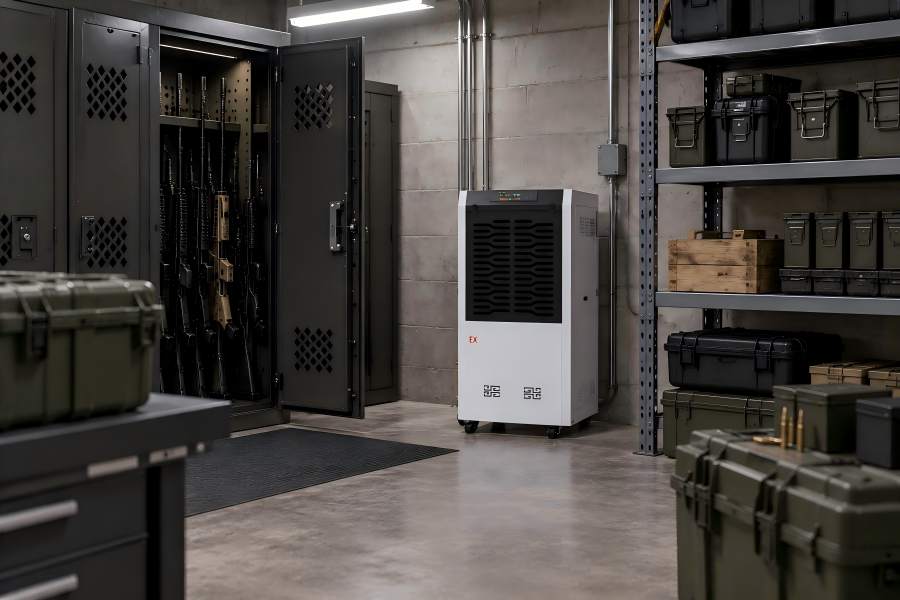
Different storage areas have different moisture risks. A small conditioned room behaves very differently from an underground concrete space or an enclosed cabinet.
Gun Safe
Small enclosed spaces can trap moisture, especially when placed near cold walls or in basements.
Useful measures include:
- Internal RH monitoring
- Basic air circulation
- Controlled dehumidification
- Regular visual inspection
A hygrometer inside the safe provides a more accurate picture than relying only on the surrounding room RH.
Armory or Weapons Storage Room
Larger rooms require more consistent humidity control across the entire storage area.
Important factors include:
- Room volume
- Outdoor humidity
- Wall temperature
- Storage density
- Door-opening frequency
- Ventilation
- Air leakage
Humidity may vary behind cabinets, near walls, or in corners with poor circulation, so multiple sensors can be useful in larger rooms.
Ammunition Storage Room
Ammunition storage areas should focus on stable temperature, low condensation risk, and protection of packaging from long-term moisture exposure.
Room RH, storage containers, shelving layout, and air circulation should all be considered together.
Basement Storage
Basements often face higher moisture loads because of cold surfaces and moisture movement through floors and walls.
Common problems include:
- Ground moisture
- Cold concrete
- Limited ventilation
- Seasonal humidity
- Water seepage
A basement that reaches 65%–75% RH in summer may require continuous dehumidification rather than occasional operation.
How to Measure Humidity in Storage Areas
Humidity should be measured rather than estimated by comfort. A room may feel normal while RH is high enough to increase long-term corrosion or condensation risk.
Useful monitoring devices include:
- Digital hygrometers
- Wall-mounted RH sensors
- Temperature and humidity loggers
- Remote monitoring systems
Sensor Placement
Avoid installing a sensor directly beside the dry-air outlet of a dehumidifier because discharge air can create an artificially low reading.
Better locations include representative storage zones, near exterior walls, inside enclosed cabinets, and areas where condensation is more likely.
For larger rooms, using several sensors can reveal local humid zones that a single central sensor may miss.
Check Sensor Accuracy
Humidity sensors can drift over time. Installed readings should therefore be compared periodically with a reliable reference instrument.
A controller displaying 45% RH when the actual room is closer to 55% RH can allow moisture problems to develop without obvious warning.
How Often Should Conditions Be Checked?
Small conditioned rooms may only require regular manual checks, while larger or long-term storage areas benefit from continuous monitoring.
Data logging can help identify seasonal changes, overnight RH increases, door-opening effects, equipment failure, and temperature fluctuations that may otherwise go unnoticed.
What Type of Dehumidifier Is Suitable?
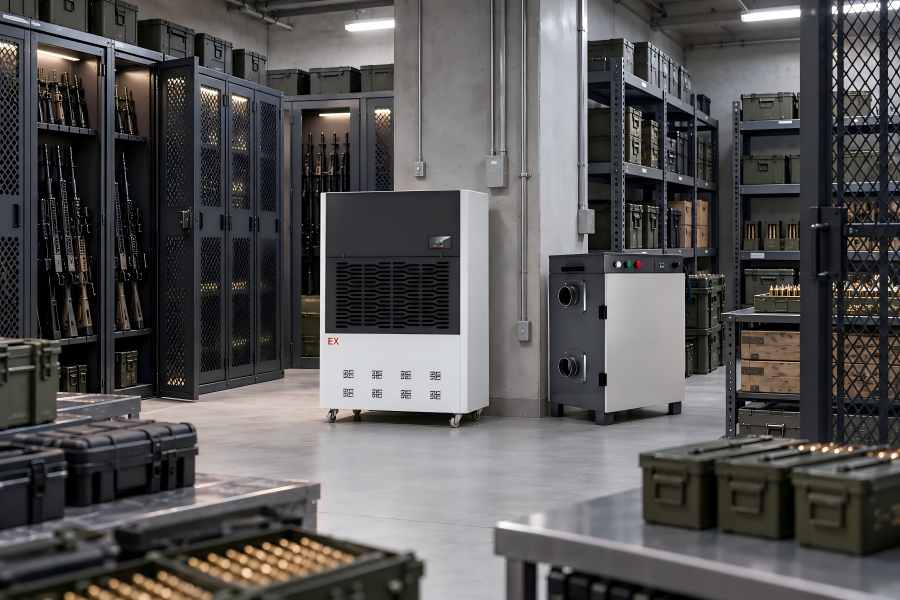
The correct dehumidifier depends on room temperature, moisture load, room size, and target RH.
The two main technologies are refrigerant dehumidifiers and desiccant dehumidifiers.
Refrigerant Dehumidifiers
Refrigerant units lower humid air below its dew point so moisture condenses and drains out.
They are commonly suitable for normal-temperature spaces such as:
- Armories
- Basements
- Warehouses
- Equipment rooms
- Conditioned storage areas
Their main advantages include relatively high moisture-removal capacity, automatic RH control, continuous drainage, and good efficiency at typical indoor temperatures.
For storage rooms operating around normal occupied-building temperatures, a properly sized refrigerant unit is often practical.
Desiccant Dehumidifiers
Desiccant systems use an adsorbent rotor rather than relying mainly on refrigeration.
They are more suitable when:
- Temperature is low
- Winter operation is required
- Lower dew points are needed
- Refrigeration performance becomes limited
- Tighter low-humidity control is required
For cold or unheated storage buildings, desiccant dehumidification may provide more stable performance than a conventional compressor-based unit.
How to Size a Dehumidifier for a Storage Room
Dehumidifier capacity should not be selected by floor area alone. Two rooms of the same size can have very different moisture loads.
Important sizing factors include:
- Room volume
- Starting RH
- Target RH
- Temperature
- Outdoor humidity
- Air infiltration
- Ventilation rate
- Door-opening frequency
- Wall and floor moisture
For example, a sealed 100 m² room inside a conditioned building may need much less capacity than a 100 m² underground room with frequent outdoor air infiltration.
A dehumidifier should remove moisture faster than it enters the room while still maintaining the target RH.
If the unit runs continuously without reaching the selected humidity, the machine may be undersized or the room may have excessive infiltration or moisture entry.
Common Humidity-Control Mistakes
Even properly selected equipment can perform poorly if the storage environment is not managed correctly.
Setting RH Too High
Allowing humidity to stay above about 55%–60% RH for long periods increases moisture-related risk.
Short temporary rises are generally less important than sustained high humidity.
Over-Drying the Space
Extremely low RH may increase operating time and energy consumption without providing meaningful additional protection.
Moderate and stable humidity is usually more practical.
Relying on One Sensor
Large rooms can develop local humid zones behind cabinets, near exterior walls, or in areas with poor airflow.
Multiple monitoring points provide a better picture of the actual storage environment.
Ignoring Temperature
Acceptable average RH does not guarantee that condensation cannot occur.
Cold surfaces may still fall below the dew point and collect moisture.
Using an Undersized Dehumidifier
An undersized unit may run continuously without achieving the target humidity.
This increases operating hours while leaving the room inadequately controlled.
Poor Air Circulation
Dry air must circulate throughout the storage space.
Dense shelving, cabinets pushed directly against walls, and blocked airflow can create stagnant areas where RH remains higher than the room average.