
Horizontal and vertical dehumidifiers can provide similar moisture-removal performance, but their cabinet layouts suit different installation environments.
The right choice depends on floor space, ceiling height, ductwork, airflow, drainage, maintenance access, and required capacity, rather than cabinet orientation alone.
What Is a Horizontal Dehumidifier?
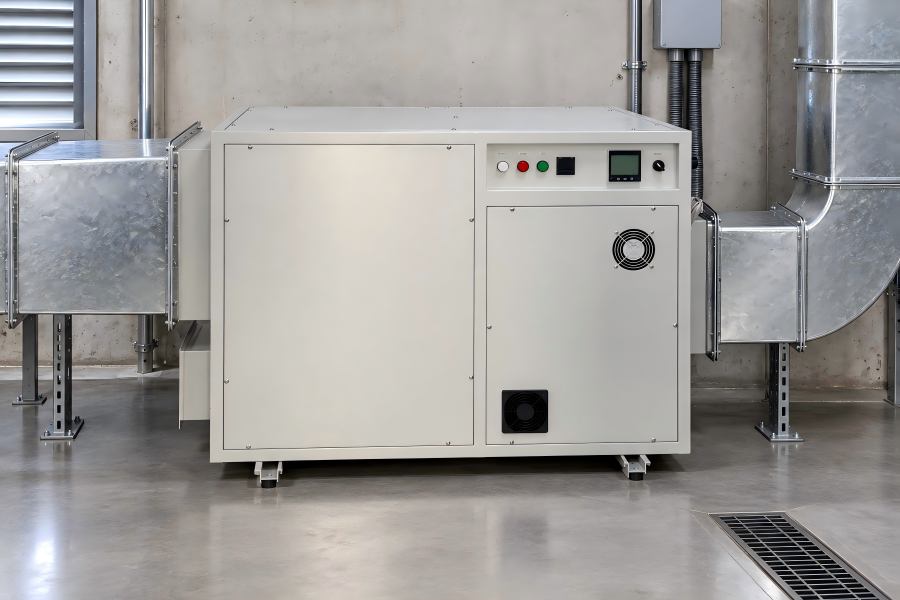
A horizontal dehumidifier uses a wider, lower cabinet. Its compressor, fan, coils, filters, and controls are arranged along a relatively low-profile equipment body.
This design is commonly used where equipment needs to fit above ceilings, on mechanical platforms, or within ducted commercial and industrial systems.
Typical Characteristics
- Low-height cabinet
- Wider equipment footprint
- Suitable for duct connection
- Can fit above ceilings or inside mechanical spaces
- Common in commercial and industrial systems
- Flexible supply and return-air arrangements
Horizontal units are particularly useful for concealed installation. The equipment can remain outside occupied or production areas while dry air is delivered through ducts.
They can also support relatively direct airflow paths, with humid return air entering one side and conditioned dry air leaving through another connection.
Typical Applications
- Warehouses
- Factories
- Laboratories
- Hotels
- Office buildings
- Basements
- Ceiling-mounted applications
- Ducted humidity-control systems
In hotels and offices, horizontal equipment can be installed above ceilings or in service areas so large dehumidifiers do not occupy usable room space.
In warehouses and factories, larger horizontal units can also serve centralized duct systems where dry air must reach several parts of the facility.
What Is a Vertical Dehumidifier?
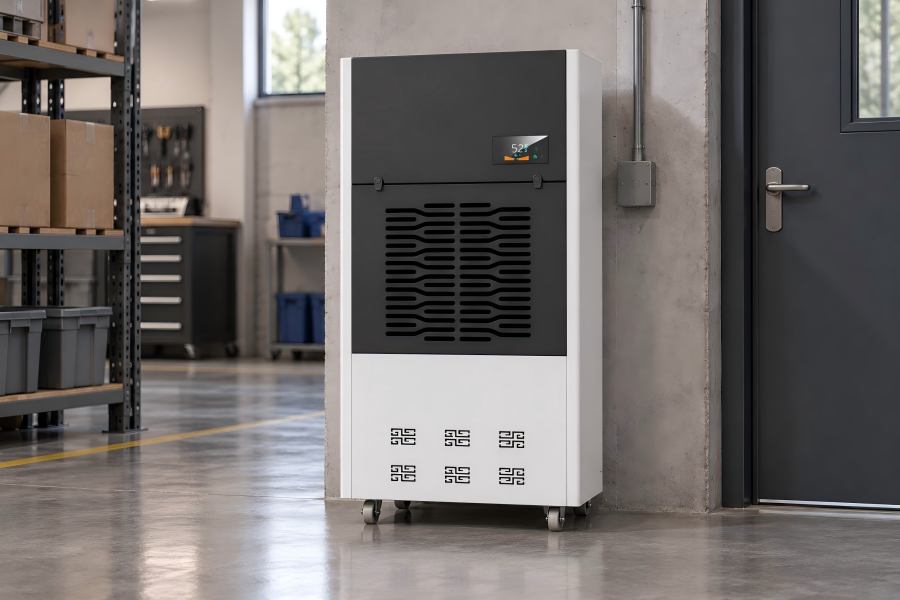
A vertical dehumidifier uses a taller, narrower cabinet. Its internal components are arranged to reduce the amount of floor area required.
This configuration is practical where installation height is available but floor space needs to remain open for production, storage, or circulation.
Typical Characteristics
- Tall cabinet design
- Smaller floor footprint
- Easier floor-standing installation
- Convenient front or side service access
- Suitable for limited floor space
- Common in equipment rooms and industrial spaces
Vertical dehumidifiers are usually easier to install directly on the floor because they do not require ceiling suspension or large support frames.
Depending on the model, air can enter from the front, rear, or side and discharge upward, forward, or through a duct connection.
Typical Applications
- Storage rooms
- Industrial workshops
- Equipment rooms
- Basements
- Archives
- Pharmaceutical areas
- Commercial spaces
- Facilities with limited floor area
A narrow cabinet can fit beside walls, between equipment, or inside compact mechanical spaces without taking up a wide section of floor.
This can be useful in industrial facilities where working aisles, storage racks, and production equipment already compete for available space.
Horizontal vs. Vertical Dehumidifier: Key Differences
The main difference is the physical equipment layout rather than the basic dehumidification principle.
| Factor | Horizontal Dehumidifier | Vertical Dehumidifier |
| Cabinet Shape | Wide and low | Tall and narrow |
| Floor Footprint | Larger | Smaller |
| Height Requirement | Lower | Higher |
| Ceiling Installation | More Suitable | Usually Less Suitable |
| Floor Installation | Yes | Excellent |
| Duct Integration | Excellent | Good–Excellent |
| Service Access | Depends on layout | Often easier from front/side |
| Space Utilization | Better where height is limited | Better where floor space is limited |
| Typical Application | Ducted / concealed systems | Floor-standing systems |
A horizontal model is not automatically more powerful, and a vertical model is not automatically more efficient.
The main question is which cabinet arrangement fits the facility, duct routing, drainage position, and future maintenance requirements more effectively.
How Installation Space Affects the Choice
Available installation space is often the first practical factor to consider. Horizontal units use more width but less height, while vertical units use less floor area but need more overhead clearance.
Choose Horizontal When
- Ceiling height is limited
- Equipment must fit above a ceiling
- A mechanical platform is available
- Wide installation space is available
- Ductwork runs horizontally
For example, a hotel corridor may have sufficient ceiling void but no suitable nearby floor area. A low-profile horizontal unit can fit above the ceiling and connect to supply and return vents.
Horizontal designs are also useful when the dehumidifier needs to align directly with existing horizontal ductwork.
Choose Vertical When
- Floor space is limited
- Ceiling height is sufficient
- Floor-standing installation is preferred
- Service access from the front is important
- Equipment needs a compact footprint
A warehouse mechanical room may have enough height but only a narrow area available between electrical panels and other equipment.
In this situation, a vertical unit can preserve floor space while remaining accessible for routine service.
Installation clearance also matters. Even if the cabinet fits physically, filters and access panels still need enough room to be removed.
Airflow and Ductwork Differences
Cabinet orientation influences how ducts are connected, but it does not automatically determine airflow performance.
Important airflow factors include:
- Rated airflow
- Intake and discharge direction
- External static pressure
- Duct length
- Filter resistance
- Fan capacity
- Number of bends
- Duct dimensions
Horizontal units are often convenient for ducted systems because their inlet and outlet positions can align naturally with horizontal supply and return ducts.
This makes them suitable for larger warehouses, factories, offices, laboratories, and other facilities requiring centralized air distribution.
Vertical dehumidifiers can also be connected to ducts. Depending on the model, they may support top, side, rear, or customized supply-air connections.
For shorter duct runs or free-blow applications, a vertical unit can be equally practical.
External Static Pressure Matters
A ducted dehumidifier must overcome resistance from ducts, elbows, filters, grilles, dampers, and other airflow components.
If total pressure resistance exceeds fan capability, actual airflow can fall below the design value.
Reduced airflow can affect:
- Moisture-removal capacity
- Heat-transfer performance
- Compressor operation
- Coil temperature
- Energy efficiency
- Room air distribution
For this reason, required airflow and external static pressure should be confirmed before selecting either cabinet orientation.
Maintenance and Service Access
Maintenance access can significantly affect long-term operating convenience, especially where the equipment runs continuously.
Typical service items include:
- Filters
- Evaporator coils
- Condenser coils
- Drainage system
- Fan
- Compressor
- Sensors
- Electrical controls
A horizontal unit installed at floor level or on a low platform can be easy to maintain. However, an above-ceiling unit may require ladders or dedicated service openings.
If the equipment is crowded by pipes, beams, ducts, or cable trays, routine filter and coil maintenance can become difficult.
Vertical floor-standing models often provide easier front or side access because major components remain at working height.
This can reduce service time in warehouses, industrial workshops, and mechanical rooms.
Service Clearance Should Be Planned Early
Do not check only whether the cabinet fits into the installation space.
Also confirm whether there is enough clearance to:
- Remove filters
- Open service panels
- Clean coils
- Reach drainage components
- Replace fans
- Access compressors
- Inspect electrical parts
Providing adequate service space during installation can reduce maintenance difficulty and equipment downtime later.
Drainage Requirements
Refrigerant dehumidifiers produce condensate, so both horizontal and vertical designs require reliable drainage.
Important drainage considerations include:
- Gravity drain height
- Drain slope
- Condensate pump requirement
- Trap design where required
- Drain accessibility
- Overflow protection
Vertical floor-standing units can often connect directly to a nearby floor drain using a short gravity drainage line.
This arrangement is usually simple as long as the hose or pipe maintains a continuous downward slope.
Horizontal ceiling-mounted units require more careful drainage planning because condensate may need to pass through a ceiling space before reaching the drain.
If sufficient gravity slope cannot be maintained, a condensate pump may be required.
Ceiling Installation Requires More Attention
A blocked or leaking drain above a ceiling can damage finishes, equipment, or occupied areas below.
For this reason, ceiling-mounted installations should provide easy drain access and suitable overflow protection.
A secondary drain pan or water-level protection may also be considered where leakage risk needs to be minimized.
Capacity and Performance
Horizontal and vertical cabinet styles can provide similar dehumidification capacities.
Orientation itself does not determine how many liters or pints of water the machine can remove each day.
Performance depends more on:
- Compressor capacity
- Coil size
- Airflow
- Refrigerant system
- Entering temperature
- Entering RH
- Fan performance
- Heat exchanger design
For example, a horizontal model rated at 240 L/day and a vertical model rated at 240 L/day can provide similar nominal moisture-removal capacity under the same test conditions.
The more important question is whether either model can deliver its rated airflow and capacity under the facility’s actual temperature, RH, and duct conditions.
Check Rating Conditions
Dehumidifier capacity is determined under specified temperature and humidity conditions.
A 240 L/day rating under warm, humid test conditions may be lower when the same unit operates in cooler or drier air.
When comparing equipment, check:
- Test temperature
- Test RH
- Rated airflow
- Power input
- Operating temperature range
- Target RH range
Technical specifications provide a much better basis for equipment selection than cabinet shape alone.
Energy Efficiency Comparison
Neither horizontal nor vertical dehumidifiers are automatically more energy-efficient.
Energy use depends more strongly on refrigeration efficiency, fan power, duct pressure, room conditions, and operating hours.
Energy performance depends on:
- Moisture-removal efficiency
- Fan power
- Static pressure
- Duct resistance
- Compressor efficiency
- Operating temperature
- RH set point
- Runtime
A horizontal unit connected to a long duct network may require additional fan power because it operates against higher static pressure.
A vertical free-blow model may experience lower resistance and therefore need less fan energy.
However, a properly designed horizontal system with short, correctly sized ducts can also operate efficiently.
The entire air-distribution system should therefore be evaluated rather than assuming cabinet orientation determines efficiency.
Simple Energy Example
Suppose two commercial dehumidifiers provide similar capacity and the refrigeration section of each uses approximately 3.2 kW.
If the horizontal ducted installation requires 0.6 kW of fan power, total input becomes approximately:
3.2 + 0.6 = 3.8 kW
If the vertical free-blow unit requires 0.3 kW for airflow:
3.2 + 0.3 = 3.5 kW
The difference results mainly from airflow resistance, not from the horizontal or vertical cabinet itself.
Installation and Cost Comparison
Horizontal and vertical units with similar capacities may have comparable equipment prices. Most project-cost differences come from mounting, ductwork, drainage, and labor.
Horizontal Dehumidifier Costs
May include:
- Equipment
- Ceiling suspension or platform
- Ductwork
- Drainage
- Access panels
- Installation labor
Horizontal installations may cost slightly more where ceiling suspension, long duct runs, or additional service access is required.
Vertical Dehumidifier Costs
May include:
- Equipment
- Floor installation
- Short duct connections if required
- Drainage
- Electrical connection
- Installation labor
Vertical floor-standing models are generally simpler to install when extensive ductwork is not required.
Illustrative Installation Comparison
| Cost Factor | Horizontal | Vertical |
| Equipment | $1,200–$2,800 | $1,200–$2,800 |
| Mounting / Support | $150–$500 | $50–$150 |
| Ductwork | $200–$800 | $80–$400 |
| Basic Installation | $200–$600 | $150–$450 |
| Illustrative Total | $1,750–$4,700 | $1,480–$3,800 |
These figures are illustrative only. Actual costs depend on capacity, duct length, building layout, drainage, controls, and local labor rates.
Overall, vertical units may have lower installation costs in simple floor-standing applications, while horizontal units can require additional mounting and ductwork.
Which Design Is Better for Different Applications?
The best cabinet design varies according to how each facility uses its available space and distributes dry air.
Warehouses
Horizontal ducted units are useful when dry air must be distributed across large storage areas.
Vertical units work well when local humidity control is required and floor-standing installation is easier.
Factories
The choice depends on equipment layout, mechanical space, duct requirements, and available floor area.
A vertical model can fit into a narrow equipment zone, while a horizontal unit may integrate better with centralized ductwork.
Pharmaceutical Facilities
Horizontal units can be incorporated into concealed or ducted humidity-control systems.
Vertical models are practical in dedicated equipment rooms where routine service access is important.
Cold Storage
Both cabinet designs can work, but operating temperature, drainage, airflow, defrost performance, and required RH are more important than orientation.
For very cold environments or low dew-point requirements, desiccant dehumidification may also need to be considered.
Basements
Vertical units are practical when floor-standing installation is easy and ceiling spaces are already occupied by pipes or utilities.
Horizontal units are useful when equipment must be suspended or installed in a separate mechanical space.
Hotels and Offices
Horizontal or ceiling-mounted models are often preferred because the equipment can remain hidden from occupants.
Dry air can then be distributed through ductwork and ceiling vents without placing large equipment inside guest rooms or office spaces.
A large facility can also use both layouts. Horizontal units may handle ducted areas while vertical models serve storage rooms, mechanical areas, or local humidity-control zones.
Horizontal or Vertical Dehumidifier: Which One Is Right for Your Facility?
Neither configuration is universally better. Equipment orientation should be selected only after determining the required dehumidification capacity and airflow.
Before selecting the equipment, check:
- Required dehumidification capacity
- Available floor space
- Available installation height
- Ductwork layout
- Required airflow
- External static pressure
- Drainage location
- Service access
- Noise requirements
- Installation method
- Future maintenance
- Expansion requirements
A horizontal dehumidifier is generally better where low installation height, ceiling mounting, concealed installation, or extensive duct integration is required.
It is particularly practical for hotels, offices, laboratories, warehouses, and centralized commercial or industrial humidity-control systems.
A vertical dehumidifier is usually better where floor footprint is limited, floor-standing installation is preferred, and convenient maintenance access is important.
It is commonly used in warehouses, storage rooms, workshops, basements, archives, and dedicated equipment rooms.
The final decision should therefore consider space layout, airflow, ductwork, drainage, service access, and required capacity, rather than assuming one cabinet orientation automatically provides better dehumidification performance.