
A dehumidifier needs stable airflow to remove moisture efficiently. Its filter helps protect coils, fans, sensors, and internal air passages from dust that can gradually reduce performance.
The main options are washable filters and replaceable filters. Both work well when correctly selected, but they differ in airflow resistance, filtration efficiency, maintenance, cost, and suitable applications.
What Does a Dehumidifier Filter Do?
A dehumidifier filter sits in the incoming air path before air reaches the evaporator and other internal components. Its primary function is to keep dust and debris away from the machine.
The main functions of a dehumidifier filter include:
- Capturing dust and airborne particles
- Protecting evaporator and condenser coils
- Maintaining stable airflow
- Reducing dirt buildup inside the cabinet
- Protecting fan blades and motors
- Supporting long-term moisture-removal efficiency
- Reducing maintenance frequency
When dust accumulates on the evaporator coil, it creates an insulating layer that reduces heat transfer. Less humid air reaches the cold coil surface, so moisture-removal capacity can gradually decline.
A restricted filter can also increase compressor runtime and energy use. Most standard dehumidifier filters are therefore designed mainly for equipment protection, not complete room air purification.
What Is a Washable Dehumidifier Filter?
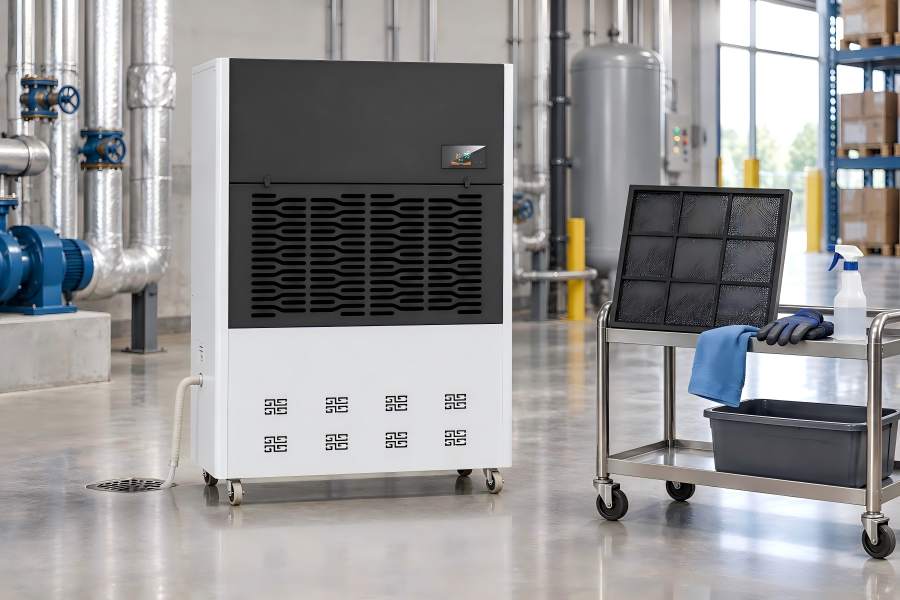
A washable filter is a reusable filter that can be removed, cleaned, dried, and installed again. It is common in household, portable, and light commercial dehumidifiers.
Common Materials
- Nylon mesh
- Plastic mesh
- Polypropylene mesh
- Foam
- Reusable synthetic media
- Metal-supported mesh
These materials usually provide relatively low airflow resistance while capturing larger dust, hair, fibers, and debris.
Typical Applications
- Bedrooms
- Living rooms
- Residential basements
- Home offices
- Hotels
- Light commercial spaces
- Small storage rooms
- Clean mechanical rooms
They work particularly well where dust levels are moderate and filters can be inspected and cleaned regularly.
Pros and Cons
| Pros | Cons |
| Reusable for repeated use | Requires regular cleaning |
| Lower long-term replacement cost | Must be dried before reinstalling |
| Relatively low airflow resistance | Cleaning takes additional labor |
| Produces less filter waste | Filtration efficiency may be limited |
| Easy to inspect visually | Can become damaged after repeated washing |
| Suitable for routine maintenance | May not capture very fine particles |
| Useful as a pre-filter | Improper cleaning can shorten filter life |
Main Advantage: Reusability
A washable filter can be used many times instead of being discarded whenever dust builds up. This helps reduce recurring filter purchases for dehumidifiers running throughout the year.
The main trade-off is maintenance time. Filters must be removed and cleaned before airflow becomes noticeably restricted.
Airflow Performance
Washable mesh filters generally have relatively open media, allowing strong airflow through the machine. This is useful because dehumidification performance depends heavily on sufficient airflow across the coils.
The trade-off is that coarse reusable filters usually capture larger particles rather than very fine airborne contaminants.
Cleaning Requirements
Reusable does not mean maintenance-free. A neglected washable filter can become heavily loaded with dust and significantly reduce airflow.
The filter should be fully dry before reinstallation. A damp filter can introduce unwanted moisture and may contribute to odors or microbial buildup.
What Is a Replaceable Dehumidifier Filter?
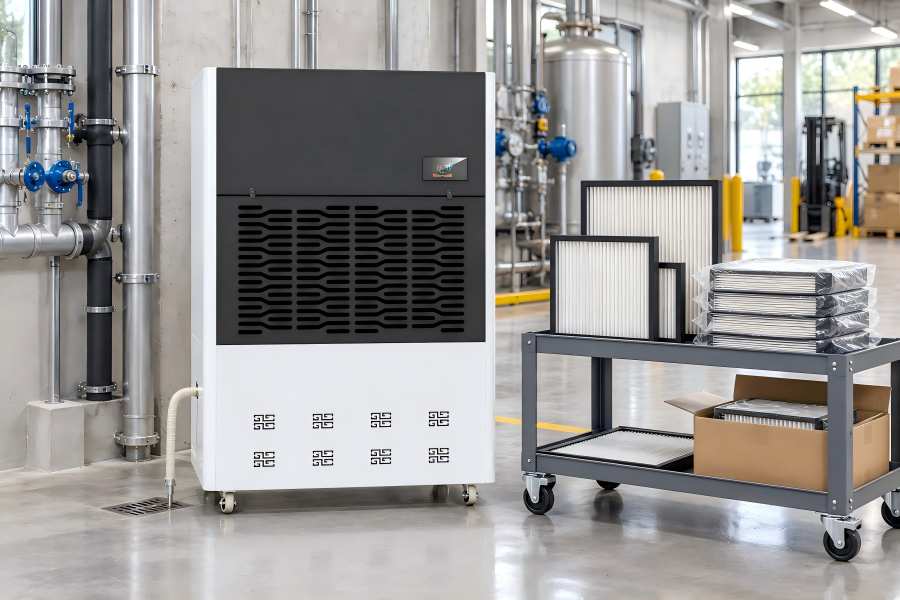
A replaceable filter is replaced when it becomes dirty or reaches its recommended service life, making it common in commercial and industrial equipment.
Common Types
- Disposable synthetic filters
- Pleated filters
- Polyester media
- Fiberglass media
- Activated carbon filters
- Medium-efficiency particulate filters
- High-efficiency secondary filters
Their main advantage is that manufacturers can select different filtration grades according to the operating environment.
Typical Applications
Replaceable filters are often used in:
- Commercial buildings
- Warehouses
- Factories
- Industrial production spaces
- Laboratories
- Medical environments
- Dusty storage facilities
- Restoration equipment
- Ducted dehumidification systems
They are useful where fast maintenance and predictable filtration performance are more important than reusability.
Pros and Cons
| Pros | Cons |
| Quick and simple maintenance | Requires recurring filter purchases |
| Consistent performance when replaced correctly | Generates more waste |
| Higher-efficiency options available | Spare filters need to be stocked |
| Good for dusty environments | Wrong filter can restrict airflow |
| No washing or drying required | Long-term cost may be higher |
| Easy to standardize maintenance procedures | Neglected replacement increases pressure drop |
| Suitable for multi-stage systems | Some specialty filters are expensive |
Main Advantage: Filtration Options
Replaceable filters can use finer and deeper filter media than most washable mesh filters. This provides more flexibility for warehouses, factories, laboratories, and other demanding environments.
However, finer filtration usually creates higher pressure resistance, so filter selection must match the fan and airflow design of the dehumidifier.
Easier Maintenance
Replacing a filter is generally faster than washing and drying one. Maintenance staff can remove the dirty filter, install a clean replacement, and immediately return the unit to operation.
The main requirement is keeping suitable spare filters available.
How Filter Type Affects Dehumidifier Airflow
Airflow directly affects how much humid air reaches the evaporator coil. If a filter becomes blocked or is too restrictive, less air passes through the dehumidifier.
This can result in:
- Lower moisture removal
- Longer compressor runtime
- Higher energy consumption
- Reduced room circulation
- Coil icing
- Increased internal temperature
- Higher fan load
Filter cleanliness can therefore be more important than whether the filter is washable or replaceable.
Why Dirty Filters Are a Problem
As dust builds up, the open area of the filter media decreases and resistance rises. The dehumidifier may continue running normally while actual airflow gradually falls.
This can make RH reduction slower and increase operating hours even though there is no obvious refrigeration fault.
Higher Efficiency Is Not Always Better
A denser filter may capture more particles, but it can also increase pressure drop.A highly dense filter can restrict airflow and reduce the benefits of cleaner air.
The correct filter should provide adequate filtration without unnecessarily restricting airflow.
Filtration Efficiency: Which One Captures More Dust?
Replaceable filters generally offer more options for fine-particle filtration, while washable filters usually focus on larger particles and lower airflow resistance.
Washable Filters
- Hair
- Lint
- Large dust particles
- Fibers
- Debris
- Larger airborne contaminants
This makes them especially useful as first-stage filters protecting coils and fans.
Replaceable Filters
Depending on the filter grade, replaceable filters may capture:
- Smaller dust particles
- Fine fibers
- Pollen
- Industrial particulate
- Some odors when activated carbon is used
- Smaller suspended contaminants
They are therefore more suitable when finer filtration is needed.
Filtration vs. Dehumidification Performance
Higher filtration efficiency does not automatically mean better dehumidifier performance. An excessively dense filter can reduce airflow and limit the benefits of cleaner air.
Filter efficiency, surface area, pressure drop, and fan capacity should therefore be considered together.
Maintenance Comparison
Washable and replaceable filters require different maintenance routines.
| Maintenance Factor | Washable Filter | Replaceable Filter |
| Routine Inspection | Required | Required |
| Cleaning | Yes | No |
| Drying Before Use | Yes | No |
| Regular Replacement | Occasional | Yes |
| Spare Filters Needed | Usually No | Yes |
| Maintenance Time | Higher | Lower |
| Waste Generation | Lower | Higher |
| Best for Quick Service | Moderate | Excellent |
Washable Filter Maintenance
A typical maintenance process may include:
- Turn off the dehumidifier.
- Remove the filter.
- Vacuum loose dust.
- Rinse with clean water if required.
- Allow the filter to dry completely.
- Inspect for tears or deformation.
- Reinstall the filter.
The main issue is drying time. Commercial users sometimes keep a spare washable filter so the machine can continue operating while the other one is cleaned.
Replaceable Filter Maintenance
Replaceable filters require less service time. The dirty filter is simply removed and replaced with a clean one.
This makes them convenient for facilities with many dehumidifiers or standardized maintenance schedules.
Cost Comparison: Washable vs. Replaceable Filters
Filter cost involves more than the initial purchase price. Cleaning labor, replacement frequency, spare inventory, and downtime should also be considered.
Washable Filter Cost
Suppose a washable filter costs $20 and lasts two years. If it is cleaned every two months, that results in approximately six cleaning cycles per year.
At 10 minutes per cleaning and a labor rate of $18/hour, yearly cleaning labor is about $18. Including the filter itself, the approximate annual cost is around $28.
Replaceable Filter Cost
Suppose a replaceable filter costs $12 and is changed every three months.
Four filters cost $48 per year. If each replacement takes five minutes, annual labor is around $6, giving a total of approximately $54 per year.
Cost Comparison Example
| Cost Item | Washable Filter | Replaceable Filter |
| Filter Purchase | $20 every 2 years | $12 every 3 months |
| Approx. Annual Filter Cost | $10 | $48 |
| Approx. Annual Labor | $18 | $6 |
| Approx. Annual Total | $28 | $54 |
| Waste | Low | Higher |
These figures are illustrative. Actual costs depend on filter size, filtration grade, dust level, labor cost, and maintenance frequency.
Which Filter Is Better for Different Environments?
The best filter depends strongly on how much dust the dehumidifier encounters and how maintenance is managed.
Residential Use
Washable filters are often ideal for household dehumidifiers. Indoor dust levels are usually moderate, and users can remove and clean the filter periodically.
Their low recurring cost also suits long-term residential use.
Offices and Commercial Buildings
Both options can work well. Washable filters suit facilities with regular cleaning, while replaceable filters are convenient for standardized service schedules.
Multi-stage filtration may also be used where better particle control is required.
Warehouses
Warehouses often contain cardboard fibers, packaging dust, and other airborne debris.
Replaceable pleated filters may provide more predictable filtration, while washable pre-filters can capture larger particles before they reach the main filter.
Industrial Environments
Industrial facilities may produce much heavier dust loads.
Typical sources include:
- Manufacturing processes
- Powder handling
- Packaging
- Woodworking
- Construction materials
- Textile fibers
- Metal dust
Replaceable or multi-stage filtration is often more practical under these conditions.
Restoration and Construction Sites
Restoration equipment may be exposed to drywall dust, insulation fibers, wood particles, and construction debris.
A practical arrangement is often washable pre-filter + replaceable secondary filter, which balances large-particle capture with finer filtration.
Can a Dehumidifier Use Both Washable and Replaceable Filters?
Yes. Many commercial and industrial dehumidifiers use multiple filtration stages so one filter does not need to capture everything.
Stage 1: Washable Pre-Filter
This stage captures:
- Hair
- Fibers
- Large dust particles
- Debris
- Packaging material
Because the filter is reusable, it can be cleaned frequently at relatively low cost.
Stage 2: Replaceable Medium-Efficiency Filter
The second stage removes smaller particles that escape the washable pre-filter.
Capturing large debris first helps extend the service life of the secondary filter.
Stage 3: Optional Specialized Filter
Depending on the application, a third stage may include:
- Activated carbon
- Higher-efficiency particulate filtration
- Odor-control media
- Specialized industrial filter media
Multi-stage filtration is especially useful where both equipment protection and improved air cleanliness are required.
How Often Should Dehumidifier Filters Be Cleaned or Replaced?
There is no universal maintenance schedule. Filter condition should be based on actual operating environment and dust load.
Important factors include:
- Operating hours
- Dust concentration
- Room cleanliness
- Filter size
- Filtration grade
- Airflow volume
- Construction activity
- Outdoor air infiltration
Practical Inspection Intervals
| Environment | Suggested Inspection Interval |
| Clean Residential Space | Every 1–3 months |
| Office / Hotel | Every 1–2 months |
| Warehouse | Every 2–6 weeks |
| Industrial Facility | Every 2–4 weeks |
| Construction / Restoration | Weekly or more frequently |
These are only starting points. Heavy restoration dust may require checks every few days, while a clean office filter may remain usable much longer.
Pressure Drop Monitoring
Larger commercial systems may monitor the pressure difference across the filter.
As dust loading increases, pressure drop rises, providing a more accurate maintenance signal than time alone.
Signs a Dehumidifier Filter Needs Attention
A filter can affect performance before it becomes completely blocked.
Reduced Airflow
The most obvious sign is weaker discharge airflow.
If airflow falls noticeably, the filter should be checked before investigating more complex refrigeration problems.
Longer Dehumidification Time
A unit that previously reached the target RH quickly may begin taking much longer.
A restricted filter can be one possible cause.
Higher Compressor Runtime
Lower airflow means less humid air reaches the evaporator.
The compressor may therefore operate longer to maintain the same RH.
Coil Icing
Restricted airflow can lower evaporator temperature enough for ice to form.
Icing further reduces airflow and moisture-removal capacity.
Increased Noise
A fan pulling air through a blocked filter may produce more noticeable suction, whistling, or airflow noise.
Visible Dust
Heavy dust buildup clearly indicates the filter requires cleaning or replacement.
Maintenance should ideally take place before the filter becomes completely covered.
Unusual Odors
Dust and moisture trapped on a dirty washable filter can sometimes create unpleasant odors.
Cleaning or replacement may be necessary.
Washable vs. Replaceable Filters: Quick Comparison
| Factor | Washable Filter | Replaceable Filter |
| Reusable | Yes | No |
| Initial Cost | Low–Moderate | Low |
| Long-Term Material Cost | Lower | Higher |
| Cleaning Required | Yes | No |
| Drying Required | Yes | No |
| Filtration Options | Limited–Moderate | Moderate–High |
| Airflow Resistance | Usually Lower | Depends on Filter Grade |
| Maintenance Labor | Higher | Lower |
| Waste Generation | Lower | Higher |
| Best for Light Dust | Excellent | Good |
| Best for Heavy Dust | Good as Pre-Filter | Excellent |
| High-Efficiency Options | Limited | Better |
| Multi-Stage Filtration | Excellent as First Stage | Excellent as Secondary Stage |
| Inventory Requirement | Low | Higher |
Washable filters prioritize reusability and lower recurring material cost, while replaceable filters offer greater filtration flexibility and faster servicing.
Which One Is Better for a Dehumidifier?
There is no universal winner. The better choice depends on dust level, airflow requirements, maintenance practices, and filtration needs.
Choose a Washable Filter When
A washable filter is usually better when:
- The environment is relatively clean
- Dust concentration is moderate
- Low recurring cost is important
- Routine cleaning is practical
- Strong airflow is a priority
- The filter mainly protects the coils
- Waste reduction is important
This makes washable filters particularly suitable for residential, hotel, office, and light commercial dehumidifiers.
Choose a Replaceable Filter When
A replaceable filter is generally better when:
- Dust concentration is higher
- Finer filtration is required
- Fast maintenance is important
- Cleaning facilities are unavailable
- Standardized replacement schedules are preferred
- Industrial contamination is present
- Secondary filtration is needed
These filters are better suited to warehouses, factories, laboratories, and other demanding applications.
Use Both When
A combination of washable and replaceable filters is often the most practical option for commercial and industrial dehumidifiers.
A washable pre-filter captures large debris, while a replaceable secondary filter handles finer particles.
This arrangement can:
- Protect coils
- Maintain airflow
- Reduce secondary filter loading
- Extend filter life
- Lower replacement frequency
- Improve overall filtration performance
For demanding applications, multi-stage filtration provides a strong balance between airflow, equipment protection, filtration efficiency, maintenance time, and operating cost.