
Your building may need both when the air conditioner keeps rooms comfortable but humidity remains above the required level. A ceiling-mounted dehumidifier can address that remaining moisture load. If the existing HVAC system already controls temperature and humidity satisfactorily, adding another machine may offer little benefit.
The decision should follow the building’s operating pattern. A busy afternoon, a rainy morning, and an empty overnight period place different demands on the equipment. A system that performs well during peak summer heat can still leave a stockroom or office damp during milder weather.
A Ceiling-mounted Dehumidifier is one way to add humidity control while preserving usable floor space. It complements suitable cooling equipment when the two duties do not line up. One uncomfortable afternoon is too little evidence to justify the extra equipment.
Cooling and Moisture Removal: Two Different Jobs
A conventional air conditioner responds primarily to a temperature requirement. As moist air passes over a sufficiently cold cooling coil, water condenses and drains away. Moisture removal therefore occurs alongside cooling, although the amount depends on the equipment and its operating conditions.
A refrigerant dehumidifier also uses a cold surface to collect water, but a typical self-contained model reheats the air before returning it to the room. Its humidity controller can call for operation even when the room does not need further cooling.
This difference in control is more useful to a building manager than the fact that both machines contain refrigeration components. The air conditioner can be satisfied while the humidity controller still calls for drying. The building then needs a way to manage moisture without relying entirely on a temperature request.
| Question | Conventional air conditioner | Ceiling-mounted refrigerant dehumidifier |
|---|---|---|
| What usually starts operation? | A cooling demand from the temperature control | A humidity demand from the humidity control |
| What happens to moisture? | Water can condense during suitable cooling operation | Water is collected during dehumidification operation |
| What happens to room heat? | Heat is moved out of the conditioned space | A typical self-contained unit returns warmer, drier air |
| Can it work when cooling demand is low? | Depends on available humidity-control functions | Can operate independently within its specified conditions |
| What must be checked? | Cooling and latent capacity, controls, airflow, and drainage | Removal capacity, heat output, airflow, mounting, access, and drainage |
The table describes common arrangements, not every HVAC design. Some air-conditioning systems include dedicated humidity control, reheat, or outdoor-air treatment. Before proposing an additional unit, establish what the installed system can already do and whether those functions are enabled and working.
Why Can an Air-conditioned Building Still Feel Damp?
The Cooling Demand Ends Before the Moisture Load Does
A room can reach its temperature setting while moisture continues entering through ventilation, open doors, or normal activities. Once the cooling request ends, a basic thermostat-controlled system may stop actively drying the air even though the building still has a humidity problem.
This mismatch is worth investigating during humid weather with modest outdoor temperatures. Solar gain and equipment heat may be low, so little cooling is needed. Moisture brought in by outdoor air or released by cleaning does not necessarily fall by the same proportion.
The Cooling Equipment or Controls Need Attention
Oversized cooling equipment can satisfy a temperature request quickly and cycle too often, reducing the opportunity for moisture removal. However, frequent cycling is a symptom to investigate, not proof of one particular fault. Controls, airflow, and actual operating demand also need review.
Ask the HVAC contractor to check the existing installation before adding equipment. A restricted filter, unsuitable control configuration, or drainage problem deserves correction in its own right. A new dehumidifier should not become an expensive way to conceal a repair that the air conditioner needs.
The Moisture Source Has Changed
A building may become damper after occupancy increases, cleaning practices change, or deliveries move to a frequently opened entrance. The cooling system might still meet the temperature requirement because the added moisture is not accompanied by a matching increase in sensible heat.
Check for water ingress and wet materials as well. Rain penetration or a plumbing leak needs a building repair. Equipment can help with the drying process, but it does not make a continuing leak an acceptable part of normal operation.
When Does Your Building Need Both Systems?
The clearest case is a repeated, measured mismatch: room temperature is acceptable, but humidity remains outside the requirement during representative use. The requirement should come from the occupants, stored materials, or process, rather than a single universal percentage applied to every business.
Keep temperature and humidity records together. Add brief notes about opening hours, wet cleaning, door activity, and weather conditions. A useful record explains when the problem occurs; an isolated reading mainly tells you that further investigation is needed.
- Comfortable temperature, persistent dampness: The room is already cool enough, but its measured humidity repeatedly exceeds the agreed limit.
- Problems outside cooling hours: Humidity rises overnight or during mild weather when the air conditioner operates less.
- Moisture-sensitive contents: Stored goods or business activities need more consistent conditions than the current cooling controls provide.
- Continued moisture entry: Necessary ventilation or normal operations create a load that remains after practical source-control improvements.
For a hotel, the concern may be a back-of-house area that stays humid between occupied periods. In a retail business, it may be a cool stockroom affected by frequent deliveries. These are examples of possible duties, not evidence that every hotel or shop needs separate dehumidification.
For multiple rooms, check each room’s requirements and air paths. Adding one ceiling machine above a corridor does not establish control inside closed offices or storage rooms. The selection must describe how air reaches the unit and returns to the areas that need treatment.
When Is the Existing Air Conditioner Enough?
If temperature and humidity records remain within the building’s requirements across representative operating periods, an additional dehumidifier may be unnecessary. Continue normal maintenance and review the data when occupancy, ventilation, or the use of the premises changes.
An existing HVAC system may also have unused humidity-control capability. Ask the contractor to explain its available modes, sensor arrangement, and operating limits. Some installations can address the problem through commissioning or a suitable controls adjustment rather than another cabinet.
Be careful with the dry mode on a room air conditioner. Its behavior varies by model and may involve reduced airflow, altered cycling, or continued cooling. Check the instructions and measured room result instead of assuming that the mode provides independent humidity control under every condition.
If the building needs moisture control but has little need for cooling, a dehumidifier alone might be appropriate within its operating range. That decision still requires a temperature check: the heat released by a typical self-contained refrigerant unit may change the room’s cooling needs.
Will a Ceiling-mounted Dehumidifier Make the Room Warmer?
With a self-contained refrigerant model, the supply air leaves the cabinet at a higher temperature than it entered. The refrigeration process recovers heat within the unit, and its electrical input also contributes heat. Suspending the cabinet above the room does not remove that thermal effect.
If this heat remains inside a cooled building, the air conditioner may need to remove it. Ask the supplier for the proposed unit’s heat contribution at relevant operating conditions, then include it in the HVAC review. Do not estimate the complete impact from the moisture-removal rating alone.
That interaction is why a separate dehumidifier is not automatically an energy-saving accessory. It can provide useful control where additional drying is needed, but it also consumes electricity and may increase cooling demand. The business case should reflect the combined system.
If the process permits very little temperature variation, ask the designer to reconsider how the equipment rejects heat. Do not assume that a standard ceiling-mounted model offers remote heat rejection or temperature-neutral operation. Those capabilities need to appear in the selected model’s technical proposal.
How Should the Two Systems Work Together?
Give Temperature and Humidity Clear Control Responsibilities
Define the room conditions first, then agree which equipment responds to each demand. In a common arrangement, the air conditioner handles temperature while the dehumidifier responds to humidity. More integrated systems need a documented sequence that explains interactions and operating priorities.
Both machines running at the same time is not automatically a problem. Cooling may be needed while moisture is being removed. The concern is avoidable operation, such as equipment reacting to a poorly placed sensor or settings that do not reflect the room’s actual requirement.
Locate sensors where they represent the controlled space. Readings beside a supply outlet, open door, warm ceiling pocket, or wet cleaning area may not describe the condition experienced elsewhere. Where contents require local protection, include measurements near those contents in the verification plan.
Check Airflow Before Connecting Ducts
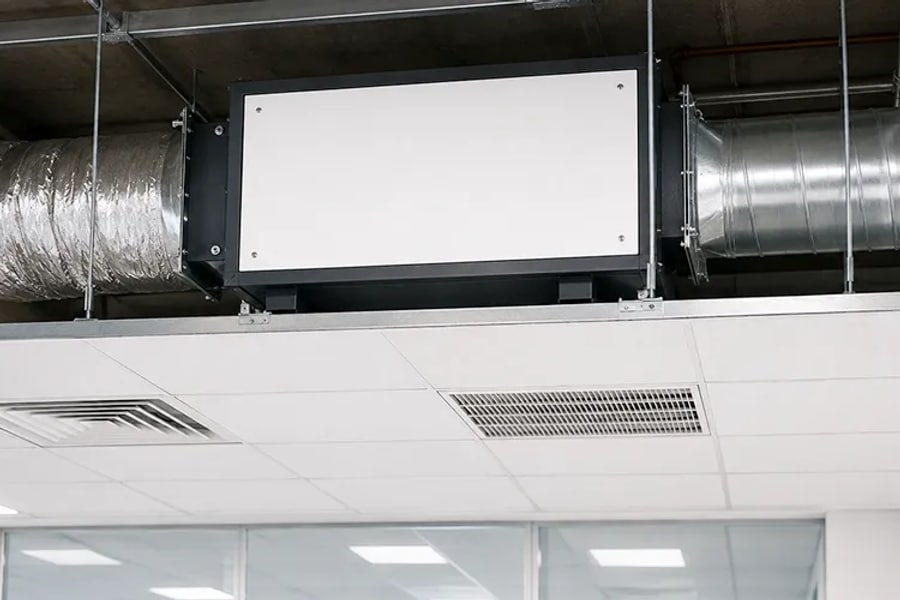
A ceiling unit can use its own supply and return paths, or it may be incorporated into a designed HVAC arrangement. These approaches have different requirements. The existence of a round duct connection does not establish compatibility with a building’s existing air-conditioning ducts.
For a shared arrangement, the designer needs to evaluate pressure, airflow direction, operating modes, and any required dampers or interlocks. Check what happens when only one system operates. Unplanned reverse flow or recirculation can undermine an installation that appears reasonable on a simple drawing.
Dehumidification also does not replace required ventilation. A recirculating machine removes water from the air it processes; it does not automatically provide fresh outdoor air or exhaust contaminants. Keep ventilation requirements in the design and include their moisture effect in the equipment selection.
What Must Be Checked Before Installing Above the Ceiling?
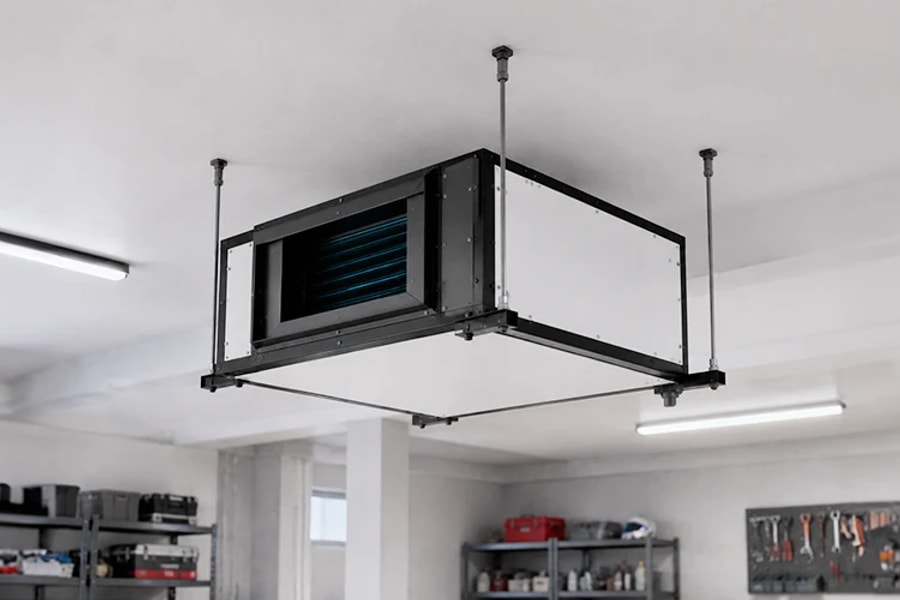
The available void must accommodate more than the cabinet. Connections, insulation where needed, filter removal, drainage, and future component replacement all require space. Measure the usable space after accounting for beams and existing services, rather than relying on the nominal ceiling height.
Confirm the support arrangement with the installation contractor using the selected unit’s weight and mounting requirements. A suspended ceiling finish is not the load-bearing structure. The project also needs a workable route for lifting the machine into position and removing it if necessary later.
- Structural support: Have the installer confirm how this particular unit will transfer its weight to the building structure.
- Service access: Allow technicians to reach filters, drainage components, controls, and replaceable parts.
- Condensate routing: Confirm whether the complete route permits gravity drainage or needs a suitable pump.
- Noise transmission: Review the cabinet location, supports, duct paths, and the requirements of nearby occupied rooms.
- Leak response: Specify appropriate detection, shutdown, or containment arrangements for the installation.
WetWells lists ducted, concealed, and exposed suspended options on its ceiling-mounted product page. Treat these as possible layouts to discuss. The chosen arrangement still needs confirmation against the building, the equipment configuration, and the contractor’s installation plan.
Test drainage before closing the ceiling and preserve access to inspection points. Overhead water collection deserves particular attention because a fault may affect finishes or property below. The aim is a maintainable installation, not simply a machine that fits out of sight.
How Do You Size the Additional Dehumidifier?
Start with the moisture load that remains after accounting for the existing HVAC system under the same operating conditions. Do not add the largest available dehumidifier to an already large air conditioner and assume the result will be more reliable.
Do not assume the moisture duty left to the dehumidifier stays constant between opening time and closing time. During peak cooling, the air conditioner may remove a substantial amount of water. During a mild but humid period, the same building can need independent drying because the cooling equipment operates much less.
Ask for selection at the expected inlet temperature and humidity, including the conditions close to the target. Catalog capacities are measured at stated test points. Two models should not be compared as equivalent when their published water-removal figures come from different conditions.
Floor area is useful for describing the project, but it is not enough to complete the selection. Occupancy, ventilation, door traffic, room separation, and wet activities all affect the duty. Specify any required recovery time after cleaning or deliveries as well.
The WetWells commercial dehumidifier range provides a starting point for discussing business applications. Request a written recommendation that identifies the assumed moisture load, selected operating point, air distribution, and any conditions still requiring a site check.
How Should You Compare Costs?
The figures below are illustrative USD budgeting calculations for a small, straightforward project. They are not WetWells quotations, market price ranges, or guaranteed running costs. Lower totals depend on limited operating hours, a low electricity tariff, and an installation that needs little additional site work.
Equipment and Installation Budget
For a worked budget only, assume an equipment allowance of $1,000, basic installation of $400, and a $100 contingency. These assumptions produce a $1,500 starting budget. Obtain a project quotation before treating any of these allowances as a purchasing budget.
This simple example assumes nearby power and drainage, accessible structural supports, and short air routes. Freight, import duties, taxes, extensive ductwork, structural alterations, and any air-conditioner replacement are excluded. If the existing AC remains suitable, its replacement allowance is $0; necessary repairs and modifications still need separate prices.
Monthly Electricity Cost
Calculate electricity cost as average operating input in kW × equivalent operating hours × electricity price per kWh. The examples use an assumed tariff of $0.10/kWh and 26 operating days per month. The power inputs are calculation assumptions, not specifications for a particular WetWells model.
| Illustrative operating pattern | Monthly electricity use | Dehumidifier electricity cost |
|---|---|---|
| 0.6 kW for 4 equivalent hours per day | 62.4 kWh | $6.24/month |
| 0.8 kW for 6 equivalent hours per day | 124.8 kWh | $12.48/month |
| 1.0 kW for 8 equivalent hours per day | 208 kWh | $20.80/month |
These are low-use examples, not a typical bill for every building. Use the selected model’s input and the expected duty cycle to replace the assumptions. At $0.20/kWh, the same three examples become $12.48, $24.96, and $41.60 per month. Standby power and separately powered accessories must also be counted.
Additional Cooling and Maintenance
Include any extra electricity the air conditioner uses while dealing with the dehumidifier’s heat. For example, an assumed additional AC input of 0.3 kW for 4 hours per day, over 26 days at $0.10/kWh, adds $3.12/month. This is a separate calculation assumption, not a predicted heat-load relationship for the equipment.
For an internal maintenance allowance, two basic checks per year at 1 staff-hour each and an assumed labor cost of $30/hour total $60/year. This covers only the assumed staff time. Filters, replacement parts, contractor call-outs, access equipment, and repairs are additional.
Combining the first electricity example with the illustrative cooling increment gives $9.36/month. If that same duty applies for all 12 months, adding the $60 maintenance allowance gives $172.32/year. This is an incremental example for the added equipment, not the building’s complete HVAC bill.
Compare Savings at the Same Indoor Conditions
Do not describe the added dehumidifier as an automatic saving. If a verified control change avoids 100 kWh/month, that is worth $10/month at the assumed tariff. Subtract the added drying, cooling, and accessory consumption before presenting a net saving or payback period.
Request separate quotation lines for equipment, installation, commissioning, and service access. Compare options at the same acceptable temperature and humidity, and use readings from representative operating periods. A low initial allowance is useful for planning only when the final quotation confirms that the proposed scope can meet the building’s moisture load.
Performance Checks Before Handover
Agree an acceptance check that covers both cooling and humidity control. Record temperature and humidity in the areas that matter, confirm the intended operating modes, and observe drainage and alarms. The measurements should reflect representative business activity rather than an empty room with every door closed.
Include a period with modest cooling demand if that is when the original problem occurs. A demonstration during hot weather may confirm cooling performance without demonstrating the reason the supplementary dehumidifier was purchased. The test should address the actual complaint.
Use the relationship between air moisture and dew point when investigating condensation. Water on a cold surface depends on both air conditions and surface temperature. Lowering humidity can help, but damaged insulation or an unusually cold surface may also need attention.
- Evidence of need: Provide room logs showing when acceptable temperature and excessive humidity occur together.
- Existing HVAC details: Share equipment information, control functions, operating hours, and available service findings.
- Installation information: Include ceiling dimensions, proposed air routes, drainage points, and maintenance access.
- Performance requirements: State the acceptable temperature and humidity conditions and the locations where they apply.
- Handover records: Retain agreed settings, test results, maintenance instructions, and the responsible service contacts.
Send these details with your enquiry so WetWells can review whether a ceiling-mounted dehumidifier should supplement the existing cooling system. The useful proposal will explain the remaining moisture duty and how both systems will meet the building’s requirements together.