
Nighttime humidity control should begin before the greenhouse becomes wet. After the daytime heat input declines, the greenhouse may cool without a corresponding loss of water vapor. A dehumidifier may help manage that moisture, but its operation must be coordinated with the crop’s temperature needs, irrigation, airflow, and ventilation.
The evening problem is often a change in conditions rather than a sudden equipment failure. A greenhouse that appeared dry during the afternoon may approach condensation after sunset. Looking only at the daily average can miss the interval when leaves and glazing stay wet.
A greenhouse dehumidifier should be selected and controlled for the growing environment it will actually see. WetWells offers installation and configuration choices for different greenhouse layouts. The operating plan below follows the night in stages rather than treating one humidity setting as a complete solution.
Before Sunset: Reduce Avoidable Moisture Sources
Review the Last Irrigation Event
Start with the crop’s water requirement and the approved irrigation strategy. Do not withhold necessary irrigation merely to improve a room humidity number. Instead, review avoidable runoff, leaks, and timing that leaves unnecessary standing water as the greenhouse cools.
Check whether the affected zone receives more water than intended because of damaged emitters or uneven delivery. A local wet area can influence nearby conditions and create a misleading impression of a greenhouse-wide equipment problem.
Record the last irrigation time alongside temperature and humidity trends. If the moisture complaint consistently follows a particular event, the growing team can investigate that relationship. A dehumidifier schedule should reflect the actual production routine rather than an assumed dry evening.
Inspect Floors, Channels, and Drainage
Look for puddles and blocked drainage paths in areas that can be inspected safely. Water remaining outside the intended crop system can continue contributing moisture. Correcting a drainage problem reduces an avoidable source without asking the air-treatment equipment to compensate indefinitely.
Keep inspection findings specific. A note that the floor was wet is less useful than a location, photograph, and explanation of whether the water came from irrigation, cleaning, a leak, or condensate. Different sources need different corrective actions.
Review how dehumidifier condensate leaves the growing area. It should follow the approved drainage arrangement rather than discharge onto a floor where it can evaporate again. Any proposed reuse needs separate assessment for the crop and the water-management system.
At Dusk: Watch Temperature and Moisture Together
Relative humidity changes with temperature. An evening rise in the percentage does not necessarily mean the air suddenly gained an equivalent amount of water. Record temperature at the same time so the growing team can interpret the trend rather than reacting to one display.
Condensation depends on surface temperature as well as air condition. A leaf or glazing surface can become wet when it is cold enough relative to the surrounding air. The dew point provides a useful way to examine that relationship.
Do not assume that the temperature measured at the controller equals the temperature of the coldest crop surface. Sensor location, radiation, air movement, and the structure can produce differences. Measurements should represent the part of the crop being protected.
Set the control objective with the growing team. Crop type, development stage, production method, and disease-management plan all matter. A universal nighttime humidity target would ignore those differences and can encourage unnecessary drying.
Use Canopy Measurements to Check the Control Signal
Choose Representative Positions
A sensor near the dehumidifier outlet can respond faster than the crop zone. A meter beside an entrance or a puddle may describe that small area rather than conditions throughout the crop. Both readings may be real while answering different questions.
Include positions within representative crop zones, following suitable instrument placement and the growing team’s monitoring plan. Avoid placing sensors where they are directly wetted or obstruct airflow through their sensing elements. Keep placement consistent when comparing nights.
Inspect instruments and document their condition. A contaminated or damaged sensor can drive inappropriate operation. Where measurement accuracy is important, use an appropriate verification procedure rather than assuming that disagreement between two inexpensive meters identifies the faulty one.
Compare Trends Instead of Isolated Readings
Record the timing of humidity rises, temperature changes, irrigation, screen movement, and equipment operation. A synchronized record can reveal whether the unit starts too late, treats the wrong zone, or encounters a recurring load change.
Compare similar weather and crop conditions where possible. A quiet dry night and a humid night following irrigation are not interchangeable performance tests. Keep the circumstances visible instead of selecting the lowest overnight reading as evidence of success.
The goal is to maintain the agreed crop environment over the relevant period. A short dip below the setpoint followed by hours of excessive humidity may indicate a control or distribution issue that an average value hides.
During the Night: Coordinate the Equipment
Dehumidification and Heating
Heating can lower relative humidity by raising temperature, but it does not by itself remove water from the enclosed air. A dehumidifier addresses moisture removal through its particular process. The two actions should be coordinated with the crop’s temperature limits.
A self-contained refrigerant dehumidifier commonly returns warmer air to the space. Whether that thermal contribution is useful depends on the greenhouse conditions and the selected configuration. Do not assume that more drying is harmless to temperature control.
Review the sequence when several controllers can act independently. A heating system, vents, and dehumidifier responding to different sensor locations may create conflicting operation. Document which measurement governs each action and what happens near the operating limits.
Dehumidification and Ventilation
Outdoor relative humidity alone does not establish whether ventilation will dry the greenhouse. Compare the relevant indoor and outdoor air conditions. Cold outside air can have a different moisture content from warmer inside air even when its relative humidity percentage is high.
Ventilation also affects temperature and other growing requirements. Keep its necessary functions in the operating plan. A recirculating dehumidifier does not automatically replace all reasons the greenhouse exchanges air with outdoors.
Use a site-specific control strategy rather than applying a universal timed venting cycle. Structure, climate, crop, and heating arrangement vary. The growing and engineering teams should agree the acceptable tradeoffs and the response to changing weather.
Air Movement Around Closed Screens
Fans can move humid air away from a crop pocket; water removal still requires an effective drying or air-exchange process. Check whether the airflow reaches the canopy and avoids treating only the space above it.
Thermal screens and partitions can change the effective air paths. Review conditions on the crop side of a closed screen and confirm how the dehumidifier exchanges air with that zone. A sensor above the screen may not describe what the plants experience below.
Keep discharge away from positions where a concentrated stream could create an unsuitable local crop condition. The appropriate layout depends on the equipment, plants, and available aisle space. Check it under normal crop density rather than only in an empty structure.
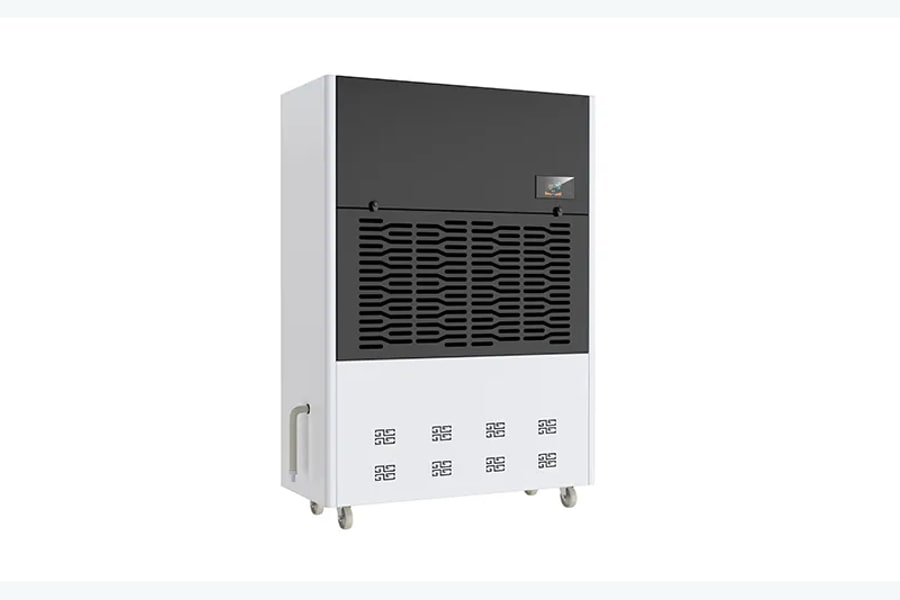
Match the Machine to Nighttime Conditions
Ask for performance information at the expected nighttime inlet temperature and humidity. A catalog water-removal rate measured under a different condition is not sufficient evidence that the unit can handle the night duty.
For refrigerant equipment, understand the operating limits and any defrost behavior relevant to the selected model. Normal protective or defrost states can affect average output. Review the complete operating cycle instead of assessing only a short period of active collection.
Provide crop area and volume, but also explain irrigation, transpiration-related load assumptions, infiltration, ventilation, and the intended temperature schedule. The selection should reflect the moisture sources and exchanges, not simply the greenhouse footprint.
Consider the actual nighttime operating window. If the requirement is to control a particular period after sunset, daily capacity averaged over twenty-four hours may not describe the rate needed during that period. Ask how the selected unit addresses the documented duty.
Allow the supplier to distinguish measured data from calculated selection information. Identify assumptions that depend on the growing operation and confirm them with the responsible team. Unexplained spare capacity is not a substitute for understanding the load.
Use a Dusk-to-Dawn Operating Record
| Stage | Record | Question to answer |
| Before sunset | Irrigation, wet areas, initial room conditions | What moisture sources enter the night? |
| Early evening | Temperature fall, humidity trend, equipment start | Does control respond to the transition? |
| Overnight | Canopy conditions, screens, operating states | Are representative crop zones controlled? |
| Before sunrise | Leaf wetness observations and remaining condensation | Did the system maintain the intended condition? |
The table is a recording framework, not a fixed crop schedule. Adjust observation times to the greenhouse’s operation and the period when the problem occurs. Assign someone to review the record so that recurring issues lead to an action.
Record unusual events, including a door left open, interrupted power, or a change in screen position. These events can explain an isolated night without demonstrating that the equipment selection is wrong. Repeating the review under normal conditions helps separate a one-off event from a persistent problem.
If Humidity Still Climbs, Investigate in a Useful Order
First confirm that the displayed value represents the affected crop zone and that the instrument is suitable. Next check whether the unit was actually removing moisture during the period in question. An illuminated controller is not proof of continuous drying.
Inspect air paths, filters, and drainage according to the model instructions. A restricted inlet or a fault response can change operation. Keep the maintenance findings separate from the load calculation so the team does not increase equipment size to compensate for a service problem.
Then compare the night’s load and settings with the selection brief. Additional crop density, different irrigation, extended closed-screen operation, or a changed temperature target may alter the requirement. Record the change before requesting a revised equipment recommendation.
- Reading check: Verify sensor location and condition.
- Operation check: Identify runtime, alarms, and relevant operating states.
- Distribution check: Confirm that treated air reaches the crop zone.
- Load check: Compare irrigation, crop, and ventilation conditions with the brief.
Do not respond to every humidity rise by lowering the setpoint further. If the unit already runs continuously, a lower target may not address the limiting factor. It can also move the requested crop environment away from the agreed production requirements.
At Sunrise: Review the Crop and the Record Together
Inspect representative locations for continuing wetness and condensation, following the crop-management procedure. Link observations to the overnight record. The team needs to know whether the condition was brief, repeated, or sustained rather than merely whether one leaf was wet.
Environmental control can help manage conditions associated with moisture-related disease risk, but it is not a diagnosis or a complete disease-control program. Keep crop health decisions with the appropriate growing specialists and avoid promising that a dehumidifier alone prevents every fungal problem.
If changes are needed, document the adjustment and its intended purpose. Altering irrigation, temperature, fan layout, and humidity settings together makes it harder to understand the result. Review manageable changes against the growing requirements and comparable operating periods.
Review Changes in Crop Density
A layout checked at the beginning of a growing cycle may behave differently as plants fill the available space. Revisit sensor exposure and air movement when the canopy changes. Keep aisles and equipment clearances usable instead of assuming the original circulation pattern remains unchanged.
Include that change in the next selection review if additional capacity is being considered. The supplier needs to understand the mature crop arrangement and the intended seasonal operation. A photograph of an empty greenhouse can be useful for installation planning but cannot describe all the restrictions around a developed canopy.
Prepare the Next Night’s Plan
Keep the plan short enough for staff to use: required crop conditions, sensor positions, equipment schedule, drainage checks, alarm response, and the person responsible for review. Include what to do when the usual operating pattern cannot be maintained.
When discussing the application with WetWells, send the greenhouse layout, crop information, nighttime temperature range, humidity trends, irrigation timing, screen arrangement, and available drainage. Photographs of the crop and intended air routes help explain constraints that floor area cannot show.
Request a recommendation that identifies the selection conditions and installation assumptions. The useful result is a coordinated nighttime operating plan supported by suitable equipment, with enough records to determine whether the crop environment is being maintained as intended.