
Industrial portable dehumidifiers require flexible mobility for applications such as warehouses, factories, construction sites, and restoration projects. The right wheel design improves transportation efficiency, equipment stability, and user safety during operation.
Wheel selection depends on factors including equipment weight, movement frequency, floor conditions, and working environment to ensure reliable long-term performance.
Key Factors to Consider Before Choosing Wheel Design
Equipment Weight and Load Capacity
The equipment weight is one of the most important factors when selecting a wheel design for an industrial portable dehumidifier. Industrial models usually contain larger compressors, high-capacity fans, bigger heat exchangers, and reinforced metal structures, resulting in higher overall weight compared with residential or commercial units.
Each wheel must support a portion of the total load while handling additional forces caused by movement, vibration, and uneven surfaces. Choosing wheels with insufficient load capacity may lead to:
- Wheel deformation
- Damaged caster brackets
- Difficult transportation
- Reduced stability
- Increased maintenance costs
For example, a compact portable dehumidifier may only require standard caster wheels, while a large industrial dehumidifier with higher airflow capacity may require reinforced heavy-duty wheels with stronger frames and bearings.
Manufacturers usually consider a safety margin when selecting wheels to ensure reliable performance under actual working conditions.
Moving Frequency and Transportation Requirements
The frequency of movement directly affects the suitable wheel design. Different applications require different levels of mobility.
Some industrial portable dehumidifiers are installed in one location for extended periods, such as factories, warehouses, or storage areas. In these cases, simple and durable wheel designs may provide sufficient performance.
However, equipment used in water damage restoration, rental services, and construction projects may need to be moved frequently between different locations. These applications require wheels that provide:
- Smooth transportation
- Easy direction adjustment
- High wear resistance
- Strong impact resistance
- Reliable braking performance
For frequently relocated equipment, swivel caster wheels with brakes are commonly preferred because they allow operators to move and position the dehumidifier quickly.
Floor Conditions and Working Environment
The working environment plays an important role in wheel selection. Different surfaces create different requirements for wheel materials and structures.
Concrete Floors
Concrete floors are common in factories and warehouses. Wheels used in these environments should provide:
- High wear resistance
- Stable rolling performance
- Good load support
Polyurethane wheels are often suitable because they combine durability with smooth movement.
Uneven Construction Surfaces
Construction sites may include rough surfaces, dust, debris, and small obstacles. Larger wheels with stronger structures are recommended because they can move more easily across uneven areas.
Sensitive Indoor Flooring
For offices, laboratories, and commercial buildings, floor protection and noise reduction are important. Rubber and polyurethane wheels help prevent scratches and reduce vibration.
Outdoor Applications
If industrial portable dehumidifiers are used outdoors, wheels should have better resistance to moisture, dirt, and temperature changes.
Space Limitations and Maneuverability
The installation area also determines the required wheel flexibility.
Industrial portable dehumidifiers may need to pass through:
- Narrow corridors
- Storage aisles
- Production areas
- Doorways
- Basement spaces
Swivel caster wheels provide 360-degree rotation, allowing operators to change directions easily without lifting the equipment.
For larger machines, a combination of fixed wheels and swivel casters can provide both directional stability and flexible movement.
Common Wheel Designs for Industrial Portable Dehumidifiers
Fixed Wheels
Fixed wheels are designed for straight-line movement and provide a simple, durable solution for industrial equipment. They are suitable for applications where the dehumidifier follows predictable transportation paths.
| Pros | Cons |
| Simple and durable structure | Limited maneuverability |
| High mechanical strength for industrial use | Not ideal for narrow spaces |
| Excellent directional stability during straight movement | Requires more effort when changing direction |
| Lower maintenance requirements | — |
Fixed wheels are commonly used for:
- Large industrial portable dehumidifiers
- Semi-permanent installations
- Equipment moved mainly in straight directions
Their simple construction provides excellent durability and reliability, but they are less suitable for environments requiring frequent repositioning.
Swivel Caster Wheels
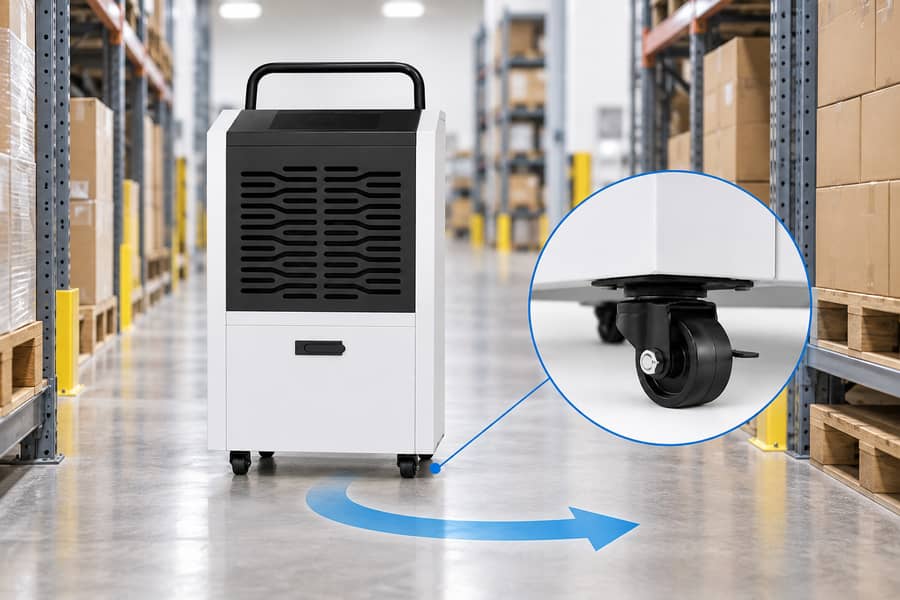
A swivel mounting lets the wheel turn toward the direction of travel. On a portable dehumidifier, this helps the operator steer around shelving and line the cabinet up with a doorway.
| Pros | Cons |
| 360-degree rotation for flexible movement | Requires proper load selection |
| Easy directional changes in confined spaces | May need brakes for stationary operation |
| Reduced operator effort during transportation | More complex structure compared with fixed wheels |
| Useful when the unit changes position often |
Typical places to use this steering arrangement include:
- Warehouses
- Workshops
- Commercial buildings
- Restoration projects
They allow operators to move equipment efficiently, especially in areas with limited space.
Locking Caster Wheels
Locking caster wheels combine mobility and stability. They allow operators to move the equipment easily and secure it in position during operation.
This feature is especially important because industrial portable dehumidifiers often operate continuously for many hours. Without proper locking systems, vibration or uneven surfaces may cause unwanted movement.
Main advantages include:
- Improved operating safety
- Better equipment positioning
- Reduced accidental movement
- Increased stability
Locking casters are commonly used in professional industrial drying and restoration equipment.
Heavy-Duty Industrial Casters
For a heavier dehumidifier, the caster assembly must be rated for the load carried through its wheel, bearing, bracket, and mounting plate.
They usually include:
- Reinforced brackets
- Strong bearings
- Larger wheel diameters
- Impact-resistant materials
These casters are suitable for:
- Large-capacity industrial dehumidifiers
- Construction drying equipment
- Heavy restoration machines
Heavy-duty designs improve transportation reliability in demanding environments.
Wheel Material Selection for Industrial Portable Dehumidifiers
Different wheel materials provide different levels of durability, noise reduction, and environmental resistance.
| Wheel Material | Advantages | Suitable Applications |
| Rubber | Low noise, vibration reduction, floor protection | Offices, commercial buildings, indoor areas |
| Polyurethane | High wear resistance and smooth movement; chemical compatibility varies | Factories, warehouses, industrial floors |
| Nylon | Lightweight and rigid; check moisture compatibility | Dry industrial environments |
| Steel | High load capacity; verify the assembly rating | Heavy-duty industrial equipment |
Rubber Wheels
Rubber wheels provide excellent shock absorption and reduce operating noise. A resilient tread can help limit rolling noise and protect delicate flooring, provided the wheel stays clean and its compound is suitable for that surface.
However, rubber wheels may experience faster wear compared with polyurethane wheels under heavy industrial use.
Polyurethane Wheels
Polyurethane wheels are one of the most common choices for industrial portable equipment because they provide a balance between durability and mobility.
Advantages include:
- High abrasion resistance
- Smooth operation
- Good load capacity
- Non-marking options, depending on the tread compound
They are suitable for most warehouses, factories, and industrial facilities.
Nylon Wheels
Nylon wheels are lightweight and rigid, but moisture absorption and chemical compatibility vary by material grade. They are suitable for dry industrial environments requiring strong mechanical performance.
Steel Wheels
Steel wheels can support heavy loads when the complete wheel assembly is appropriately rated. However, they may create more noise and are less suitable for finished indoor flooring.
Wheel Size Selection Guide for Portable Dehumidifiers
The diameter bands below are illustrative starting points, not Wetwells model specifications or certified load limits. Confirm the complete caster rating, mounting clearance, floor obstacles, and machine stability before selecting a size.
Wheel diameter affects movement efficiency, obstacle handling, and equipment stability.
| Wheel Size | Characteristics | Suitable Applications |
| 50–100 mm | Compact design, suitable for smooth surfaces | Small portable dehumidifiers |
| 100–150 mm | Balanced mobility and stability | General industrial applications |
| 150 mm+ | Better obstacle handling and load support | Construction and heavy-duty environments |
Small Wheels (50–100 mm)
Small wheels are suitable for lightweight portable dehumidifiers used on smooth indoor floors.
Advantages:
- Compact design
- Lower equipment height
- Reduced cost
However, they are less effective on uneven surfaces.
Medium Wheels (100–150 mm)
A diameter in this range can offer more clearance over small floor joints without raising the cabinet as much as a larger wheel. They are commonly selected for industrial portable dehumidifiers used in warehouses and factories.
Large Wheels (150 mm+)
Large wheels reduce pushing force and improve movement across rough surfaces.
They are recommended for:
- Construction drying
- Outdoor applications
- Heavy industrial environments
Wheel Configuration: How Many Wheels Does an Industrial Portable Dehumidifier Need?
Two-Wheel Design
Two-wheel systems provide a simple and economical mobility solution.
Advantages:
- Lower cost
- Compact structure
- Easy transportation for lightweight units
Two-wheel layouts can suit portable units designed to tilt onto a transport handle; suitability depends on the balance and handling instructions.
Four-Wheel Design
Four-wheel systems are a common configuration for industrial portable dehumidifiers.
Benefits include:
- Better stability
- Improved weight distribution
- Easier movement
- Reduced operator effort
Four wheels can reduce handling effort, but safe staffing depends on the unit weight, required pushing force, route, and manufacturer instructions.
Multi-Wheel Heavy-Duty Design
Large industrial dehumidifiers may require additional wheels to distribute weight more evenly.
Advantages:
- Higher load distribution
- Improved stability
- Reduced stress on individual wheels
Wheel Brake and Safety Features
Total Lock Brakes
A total-lock mechanism holds the wheel against rolling and keeps its caster fork from turning. Check that every required brake is engaged before running the unit.
Directional Locking Systems
Directional locking systems keep wheels aligned during transportation and improve control when moving heavy equipment.
Anti-Vibration Wheel Design
Anti-vibration wheels reduce impact and vibration transmission, helping protect:
- Compressors
- Fans
- Electrical components
- Internal structures
How Wheel Design Affects Industrial Portable Dehumidifier Performance
Mobility Efficiency
A suitable wheel system reduces physical effort and improves transportation efficiency. Operators can move equipment faster between different working areas.
Equipment Protection
Proper wheels reduce shock and vibration during transportation, helping protect internal components and extending equipment service life.
User Safety
Reliable wheel structures and braking systems reduce accidental movement during operation.
Installation Flexibility
Portable designs allow one dehumidifier to serve multiple locations, reducing the need for multiple fixed systems.
Wheel Design Recommendations for Different Applications
| Application | Recommended Wheel Design |
| Warehouse Dehumidification | Polyurethane swivel casters with brakes |
| Construction Drying | Large rubber or polyurethane wheels |
| Water Damage Restoration | Heavy-duty locking casters |
| Factory Production Areas | Industrial polyurethane casters |
| Basement Drying | Compact swivel wheels |
| Cold Storage Areas | Corrosion-resistant assemblies with suitable low-temperature ratings |
Custom Wheel Options for Industrial Portable Dehumidifiers
Manufacturers can customize wheel systems according to specific application requirements.
Wheel Size Customization
Different wheel diameters and widths can be selected according to equipment weight and transportation conditions.
Load Capacity Adjustment
Wheel structures can be reinforced for heavier industrial applications.
Material Selection
Customers can select rubber, polyurethane, nylon, or special materials depending on environmental requirements.
Brake System Customization
Different braking solutions can improve positioning accuracy and operational safety.
Special Environment Solutions
Manufacturers can provide customized wheels for:
- Corrosion-resistant environments
- Low-temperature applications
- Anti-static requirements
Wheel Maintenance Tips for Industrial Portable Dehumidifiers
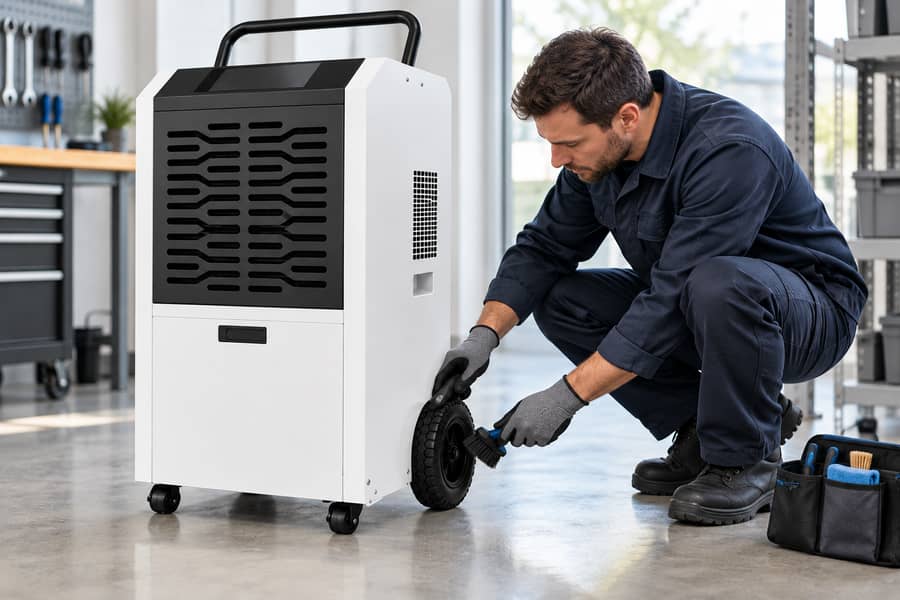
Regular maintenance helps maintain mobility performance and extend wheel service life.
Recommended practices include:
- Inspect wheels regularly for cracks or deformation.
- Check caster bearings for abnormal noise.
- Remove dust and debris from wheel assemblies.
- Test brake functions before operation.
- Replace damaged wheels immediately.
- Lubricate serviceable components only as the manufacturer specifies.
Proper maintenance ensures industrial portable dehumidifiers remain easy to transport throughout their service life.