
Refrigerant and desiccant commercial dehumidifiers both control excess moisture, but they differ in operating principles, temperature performance, energy consumption, and cost.
The choice should reflect how warm the facility is, how dry its air must become, and how the equipment will be used. This guide compares both options to help commercial buyers make informed decisions.
What Is a Refrigerant Commercial Dehumidifier?
A refrigerant commercial dehumidifier uses a refrigeration system to remove excess moisture from indoor air. It is commonly used in warm, humid environments where condensation-based moisture removal is effective.
These systems typically include a compressor, evaporator coil, condenser coil, fan, and drainage system. Refrigerant dehumidifiers are widely available in portable, floor-standing, and ducted configurations.
How Does a Refrigerant Dehumidifier Work?
Refrigeration extracts water from an airstream by lowering its temperature until condensation occurs.
- Air Intake: The fan pulls moisture-laden room air through the inlet.
- Cooling: The evaporator chills the incoming airstream.
- Condensation: Moisture forms droplets on the chilled coil surface.
- Drainage: Collected water flows into a tank or drainage system.
- Air Discharge: The treated air is reheated and returned to the room.
This process is particularly effective when the incoming air contains substantial moisture.
Key Features of Refrigerant Dehumidifiers
- Effective moisture removal: Performs well in warm, humid conditions.
- Lower initial cost: Typically involves less upfront spending than a desiccant installation serving a similar duty.
- Simple installation: Many models require only electrical power and drainage.
- Automatic humidity control: Commonly includes adjustable humidistats.
- Flexible configurations: Available as portable, ducted, or permanently installed systems.
Common Applications
Refrigerant commercial dehumidifiers are commonly used in:
- Commercial warehouses and storage facilities
- Office buildings and hotels
- Commercial basements
- Retail and hospitality facilities
- Water-damage restoration projects
They are generally suitable for environments requiring moderate humidity control without extremely low dew point requirements.
What Is a Desiccant Commercial Dehumidifier?
A desiccant commercial dehumidifier removes moisture from air using materials that adsorb water vapor. Unlike refrigerant systems, desiccant dehumidifiers do not rely primarily on cooling air below its dew point.
Many industrial desiccant systems use a rotating wheel containing silica gel or another moisture-adsorbing material.
These systems are particularly useful in low-temperature environments and applications requiring very dry air.
How Does a Desiccant Dehumidifier Work?
A typical industrial desiccant dehumidifier uses a rotating desiccant wheel and a regeneration system.
- Air Intake: Humid process air enters the dehumidifier.
- Moisture Adsorption: Desiccant material captures water vapor from the air.
- Dry Air Supply: Dehumidified air is delivered to the controlled environment.
- Regeneration: A separate heated air stream removes accumulated moisture from the desiccant.
- Moisture Exhaust: The moisture-laden regeneration air is discharged outside the controlled space.
The regeneration process allows the desiccant material to be reused continuously.
Key Features of Desiccant Dehumidifiers
- Low-temperature performance: Effective in cold environments where conventional refrigeration becomes less efficient.
- Low humidity capability: Can achieve very low humidity levels and dew points.
- Precise moisture control: Suitable for moisture-sensitive manufacturing processes.
- Continuous operation: Industrial systems can support extended operating schedules.
- Flexible regeneration energy: Some systems use electricity, gas, steam, or waste heat.
Common Applications
Desiccant commercial dehumidifiers are frequently used in:
- Cold storage warehouses
- Pharmaceutical manufacturing
- Food processing facilities
- Lithium battery production
- Industrial dry rooms
- Laboratories and specialized storage facilities
They are especially valuable where condensation, corrosion, or extremely low humidity requirements make conventional refrigeration unsuitable.
Refrigerant vs. Desiccant Commercial Dehumidifiers: Key Differences at a Glance
The following table summarizes the main differences between refrigerant and desiccant commercial dehumidifiers.
| Comparison Factor | Refrigerant Dehumidifier | Desiccant Dehumidifier |
| Working Principle | Refrigeration and condensation | Moisture adsorption and regeneration |
| Temperature Performance | Best in warm, humid environments | Effective in cold environments |
| Humidity Control | Moderate humidity requirements | Low humidity and dew point requirements |
| Moisture Removal | Condenses water into liquid | Adsorbs water vapor |
| Energy Consumption | Often lower in warm, humid conditions | Depends on regeneration energy and system design |
| Installation | Generally simpler | Often requires additional ductwork |
| Maintenance | Compressor, coils, filters, and drainage | Desiccant rotor, filters, and regeneration system |
| Initial Cost | Generally lower | Generally higher |
| Typical Applications | Warehouses, offices, commercial buildings | Cold storage, dry rooms, industrial facilities |
Although these differences provide useful guidance, actual performance depends on equipment design, operating temperature, humidity conditions, and required moisture removal capacity.
What Are the Main Differences Between Refrigerant and Desiccant Commercial Dehumidifiers?
1. Working Principle and Moisture Removal Technology
The fundamental difference between refrigerant and desiccant dehumidifiers is how they remove moisture from the air.
Refrigerant Dehumidifiers
Refrigerant systems remove moisture through condensation. Humid air passes over a cold evaporator coil, causing water vapor to become liquid water.
Key characteristics include:
- Require a refrigeration circuit and compressor.
- Remove moisture through cooling and condensation.
- Collect liquid water through a drainage system.
- Perform effectively when air temperature and moisture content are relatively high.
Desiccant Dehumidifiers
Desiccant systems remove moisture through adsorption, where water molecules attach to the surface of a desiccant material.
Key characteristics include:
- Use moisture-adsorbing materials such as silica gel.
- Do not require cooling below the dew point for moisture removal.
- Typically use heated regeneration air to restore adsorption capacity.
- Can produce very dry air in demanding environments.
The appropriate technology depends on the required humidity conditions rather than the moisture removal method alone.
2. Operating Temperature and Humidity Performance
Temperature strongly influences dehumidification performance, making it one of the most important selection factors.
Refrigerant Dehumidifiers
Refrigerant systems generally perform best in warm environments with moderate to high humidity.
As temperatures decrease, moisture removal capacity often declines because less water vapor is available in the air and evaporator coils may approach freezing conditions.
Some commercial models include automatic defrost systems or specialized low-temperature designs.
Desiccant Dehumidifiers
Desiccant systems can remain effective at low temperatures because moisture removal does not depend on condensation at a cold coil.
They are often preferred when:
- Operating temperatures are consistently low.
- Relative humidity must remain very low.
- Low dew points are required.
- Condensation must be prevented on sensitive surfaces.
For example, a conventional refrigerant dehumidifier may be suitable for a warehouse maintained at 25°C, while a desiccant system may be more appropriate for a cold storage environment operating near 5°C.
However, exact equipment selection must consider the target dew point, moisture load, and manufacturer performance data.
3. Dehumidification Capacity and Efficiency
Both refrigerant and desiccant dehumidifiers are available in different capacities, but their performance changes under different environmental conditions.
Refrigerant Dehumidifier Performance
- High moisture removal capacity in warm, humid environments.
- Capacity generally decreases as temperature and humidity decline.
- Often efficient for general commercial moisture control.
- Performance depends on compressor design, airflow, and refrigeration conditions.
Desiccant Dehumidifier Performance
- Can maintain moisture removal performance at low temperatures.
- Supports processes that need exceptionally dry air.
- Performance depends on rotor design, regeneration temperature, and airflow.
- May require additional cooling to manage heat introduced during adsorption.
A high-capacity refrigerant dehumidifier is not necessarily more effective than a smaller desiccant system when extremely low humidity is required.
Commercial buyers should compare equipment performance at the actual operating temperature and humidity rather than relying exclusively on rated capacity.
4. Energy Consumption and Operating Costs
Energy efficiency is a major consideration for commercial facilities operating dehumidification equipment for extended periods.
Refrigerant dehumidifiers primarily consume electricity through compressors, fans, and control components.
Desiccant dehumidifiers consume energy through fans, rotor motors, and regeneration heating systems. Depending on the equipment design, regeneration heat may come from electricity, gas, steam, or recovered thermal energy.
Key Energy Cost Factors
Refrigerant Systems
- Compressor electricity consumption
- Fan power requirements
- Defrost operation
- Daily operating hours
- Temperature and humidity conditions
Desiccant Systems
- Regeneration heater energy consumption
- Process and regeneration fan power
- Rotor motor electricity consumption
- Available waste heat or alternative heating sources
- Additional cooling requirements
Estimated Monthly Operating Costs
The following table provides illustrative electricity costs based on an assumed rate of $0.17/kWh, 30 operating days, and the stated average electrical power consumption.
| Operating Scenario | Average Electrical Power | Daily Hours | Monthly Electricity Cost |
| Refrigerant – Moderate Use | 800 W | 12 | $48.96 |
| Refrigerant – Extended Use | 1,500 W | 16 | $122.40 |
| Desiccant – Moderate Use | 2,000 W | 12 | $122.40 |
| Desiccant – Continuous Use | 3,500 W | 24 | $428.40 |
These figures are hypothetical operating scenarios rather than measured comparisons of equally sized systems. The desiccant examples assume electric regeneration heating is included in the stated power demand.
Actual energy consumption varies substantially according to equipment capacity, regeneration technology, operating conditions, and humidity requirements.
For desiccant systems using gas, steam, or recovered heat, electricity costs alone do not represent total energy expenses.
Which Technology Is More Energy Efficient?
Refrigerant dehumidifiers are often more energy-efficient for moderate humidity control in warm environments.
Desiccant systems may provide better overall performance when very low humidity or low-temperature operation is required.
In some industrial applications, combining refrigeration-based pre-cooling with desiccant dehumidification can reduce the energy needed to achieve demanding humidity targets.
5. Site Setup and Equipment Care
Each technology brings its own site preparation tasks and servicing needs.
Refrigerant Dehumidifier Installation
Refrigerant systems generally require:
- Suitable electrical power
- Adequate airflow clearance
- Condensate drainage
- Accessible maintenance space
- Appropriate operating temperature conditions
Portable commercial models often require minimal installation, while larger ducted systems may need professional integration.
Desiccant Dehumidifier Installation
Industrial desiccant systems may require:
- Process air supply and return ductwork
- Regeneration air intake
- Moisture exhaust ducting
- Electrical or thermal energy connections
- Additional cooling or temperature control equipment
Because desiccant systems discharge moisture through a regeneration air stream, proper exhaust design is essential.
Routine Maintenance
Refrigerant Systems
- Clean air filters and coils.
- Inspect condensate drainage.
- Check refrigeration system performance.
- Verify humidity sensors and controls.
Desiccant Systems
- Inspect and replace air filters.
- Check desiccant rotor operation.
- Inspect regeneration heaters and airflow.
- Verify seals, drive components, and control systems.
Both technologies require regular maintenance to maintain efficiency and prevent unexpected downtime.
6. Equipment Price and Long-Term Investment
Initial equipment price is another important difference between refrigerant and desiccant commercial dehumidifiers.
Refrigerant systems are generally more affordable for standard commercial applications, particularly portable and medium-capacity units.
Industrial desiccant systems often involve higher initial costs because of their rotor assemblies, regeneration systems, specialized controls, and installation requirements.
Typical Purchase Price Considerations
Refrigerant Commercial Dehumidifiers
- Generally lower purchase prices for standard commercial applications.
- Portable models may require little additional installation.
- Maintenance costs depend on compressor, coil, and drainage system condition.
- Commonly available from commercial equipment suppliers.
Desiccant Commercial Dehumidifiers
- Often higher initial equipment investment.
- Additional ductwork and regeneration connections may increase installation expenses.
- Specialized components can increase maintenance costs.
- May provide essential performance advantages in low-temperature and low-dew-point environments.
Actual equipment prices vary widely depending on capacity, airflow, humidity requirements, and customization.
Total Cost of Ownership
Commercial buyers should consider:
- Equipment purchase price: Initial investment in the dehumidification system.
- Installation expenses: Electrical connections, drainage, ductwork, and commissioning.
- Energy consumption: Electricity and thermal energy required during operation.
- Maintenance costs: Filters, inspections, repairs, and replacement components.
- Equipment lifespan: Expected operating life under specified conditions.
- Operational performance: Ability to maintain required humidity and minimize production interruptions.
For general commercial humidity control, refrigerant systems often provide a cost-effective solution.
For specialized industrial environments, desiccant technology may justify its higher investment by meeting humidity requirements that conventional refrigeration cannot achieve efficiently.
Refrigerant vs. Desiccant Commercial Dehumidifiers: Which Should You Choose?
Choosing between refrigerant and desiccant commercial dehumidifiers depends on the operating environment, target humidity, moisture load, and budget.
Neither technology is universally superior. Each offers advantages under different conditions.
When to Choose a Refrigerant Commercial Dehumidifier
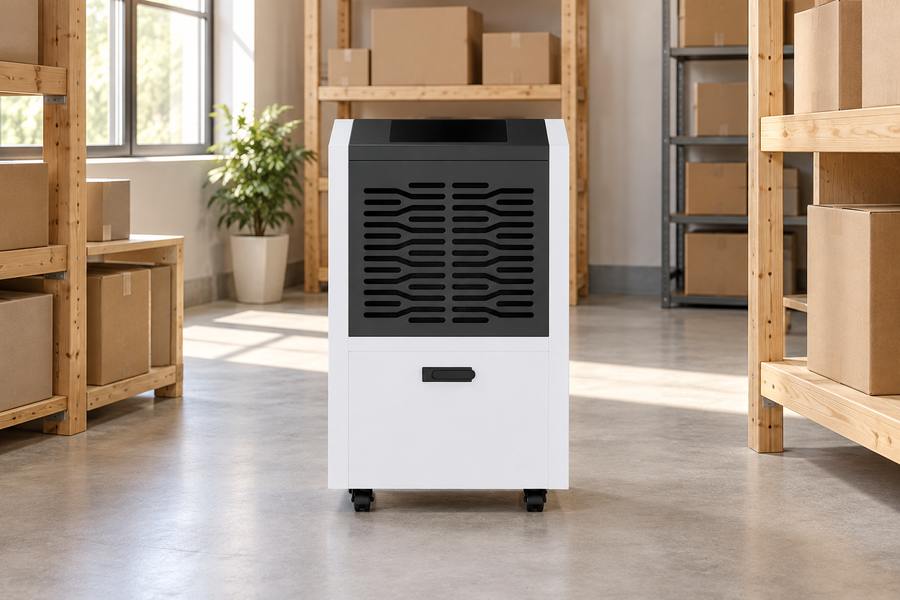
Refrigerant dehumidifiers are generally recommended for warm, humid environments requiring moderate moisture control.
Choose a refrigerant dehumidifier when:
- Operating temperatures are relatively warm.
- Target humidity levels are moderate.
- High moisture removal capacity is required in humid conditions.
- Lower initial equipment costs are important.
- Simple installation and maintenance are preferred.
Typical Applications
- Commercial warehouses
- Office buildings
- Hotels and hospitality facilities
- Commercial basements
- General storage facilities
For example, a warehouse operating at approximately 25°C with a target relative humidity of 50% may be well suited to refrigeration-based dehumidification.
A properly sized refrigerant system can maintain suitable humidity while providing relatively straightforward operation and maintenance.
When to Choose a Desiccant Commercial Dehumidifier
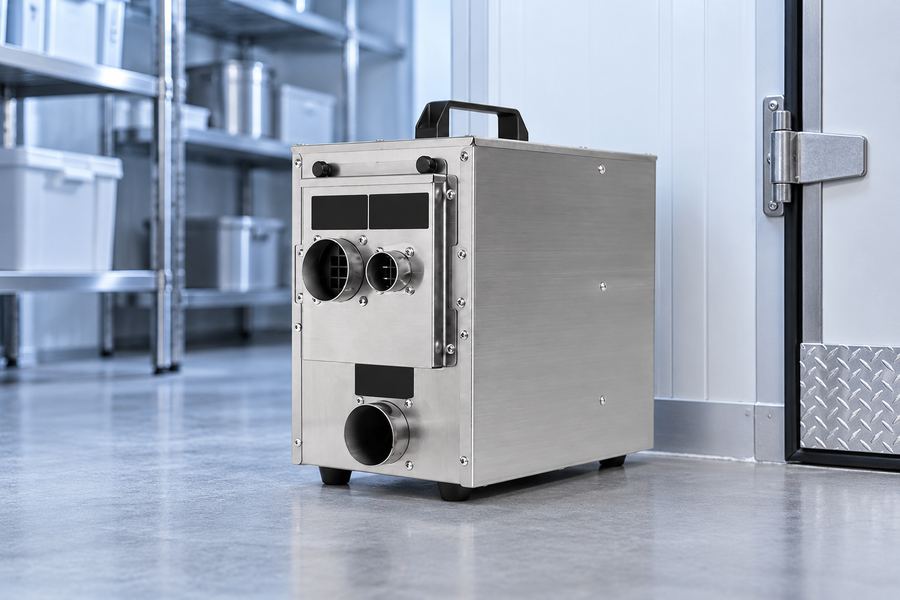
Desiccant dehumidifiers are generally recommended for cold environments or applications requiring extremely low humidity.
Choose a desiccant dehumidifier when:
- Operating temperatures are consistently low.
- The required air dryness exceeds what ordinary condensation equipment can deliver.
- Moisture-sensitive manufacturing processes require precise control.
- Condensation prevention is critical.
- Suitable regeneration energy is available.
Typical Applications
- Cold storage warehouses
- Pharmaceutical manufacturing
- Lithium battery dry rooms
- Food processing facilities
- Industrial laboratories
For example, lithium battery manufacturing may require extremely low dew points to protect moisture-sensitive materials during production.
Desiccant systems are commonly used in these environments because they can achieve humidity levels that are difficult to maintain using conventional refrigerant dehumidifiers alone.
Checks to Make Before Selecting Equipment
Assess these project requirements before committing to a commercial unit:
Operating Temperature
Determine the minimum and maximum temperatures in the installation environment. Low-temperature applications may favor desiccant technology.
Target Humidity
Identify the required relative humidity or dew point. Moderate humidity targets often favor refrigerant systems, while very low dew points typically require desiccant technology.
Moisture Removal Capacity
Calculate the moisture load based on room dimensions, ventilation, air leakage, occupancy, and process-related moisture sources.
Energy Efficiency
Compare energy consumption under equivalent operating conditions. Include regeneration heating and additional cooling costs where applicable.
Installation Requirements
Evaluate available space, electrical connections, drainage, regeneration exhaust, and ductwork requirements.
Total Cost of Ownership
Budget for the unit and its setup, then account for energy bills and servicing over its anticipated working life.
Final Selection Considerations
Refrigerant commercial dehumidifiers are generally the preferred choice for warm, humid environments requiring cost-effective moisture removal and moderate humidity control.
Desiccant commercial dehumidifiers are better suited to low-temperature environments, very low humidity requirements, and specialized industrial applications.
For demanding projects, a hybrid system combining refrigeration and desiccant technologies may provide a more efficient solution than either technology alone.
Ultimately, the best commercial dehumidifier is the one that reliably maintains the required humidity under actual operating conditions while balancing equipment investment, energy efficiency, maintenance requirements, and long-term operating costs.