
A winter boat dehumidification plan starts with leak repairs, thorough drying, and an assessment of storage conditions. Choose ventilation, passive absorbers, or suitable powered equipment according to temperature, drainage, and electricity.
For long-term protection, monitor cold surfaces and lockers, verify operation, schedule inspections, and plan for outages or blocked drains.
Start With the Boat’s Storage Conditions
Winter moisture management is not simply a matter of placing a dehumidifier in the saloon. Water intrusion, changing hull temperatures, and inaccessible compartments determine whether the plan works.
A useful survey records where the vessel will be stored, which areas remain damp, how air can circulate, and who can safely inspect equipment throughout winter.
Afloat Versus Ashore
An afloat boat remains exposed to waterline fittings, bilge ingress, changing dock conditions, and shore-power interruptions. Moisture control must never compromise seaworthiness or existing safety systems.
A boat stored ashore avoids some underwater leakage risks but may experience colder hull surfaces and wider temperature fluctuations. Covers, cockpit drainage, and trapped rainwater remain important concerns.
Indoor heated storage may provide more stable conditions, whereas outdoor storage beneath shrink-wrap depends heavily on cover design. Check whether the facility already provides humidity control before specifying equipment.
Confirm Electricity, Access, and Restrictions
Before selecting a powered unit, ask the marina or yard whether continuous electrical operation is permitted. A nearby outlet does not establish permission or safe installation conditions.
Record supply arrangements, possible outages, access restrictions, planned inspection intervals, and who receives alerts. Where unattended operation is prohibited, design around ventilation and controlled passive measures instead.
Remove Water Before Trying to Remove Humidity
Repair Leaks and Dry Wet Spaces
Inspect hatches, portlights, deck hardware, chainplate penetrations, plumbing, cockpit drains, and bilge compartments. A persistent leak can overwhelm an otherwise correctly sized moisture-control system.
Remove standing water and investigate its source rather than assuming evaporation will solve it. Verify that scuppers and approved drainage paths remain clear during rain and snowmelt.
Repair leaks and maintain appropriate ventilation to reduce the damp conditions that allow mold and mildew to develop. Complete these tasks before selecting dehumidification equipment.
Winterize engines, tanks, freshwater lines, sanitation equipment, and other water-bearing systems using appropriate vessel instructions. Neither dry cabin air nor an electrically powered heater protects trapped water during outages.
Dry Textiles and Create Internal Air Paths
Take removable bedding, towels, clothing, and vulnerable electronics to suitable dry storage when practical. Dry cushions thoroughly, then stand them where air can reach their undersides.
Empty crowded lockers and open ordinary interior locker doors where appropriate. Expose damp hull-side surfaces without defeating fire barriers, watertight closures, secured access panels, or mandatory ventilation arrangements.
A storage cover should shed precipitation while providing deliberate ventilation suited to the enclosure. An airtight cover can retain moisture, even when the cabin initially feels dry.
Ventilation is not automatically drying: humid outside air can add moisture during some weather. Favor protected airflow paths and judge their effect using actual measurements.
Do not block required fuel-system or machinery ventilation to improve humidity readings. Retain every required safety air opening and have the yard review the proposed winter ventilation arrangement.
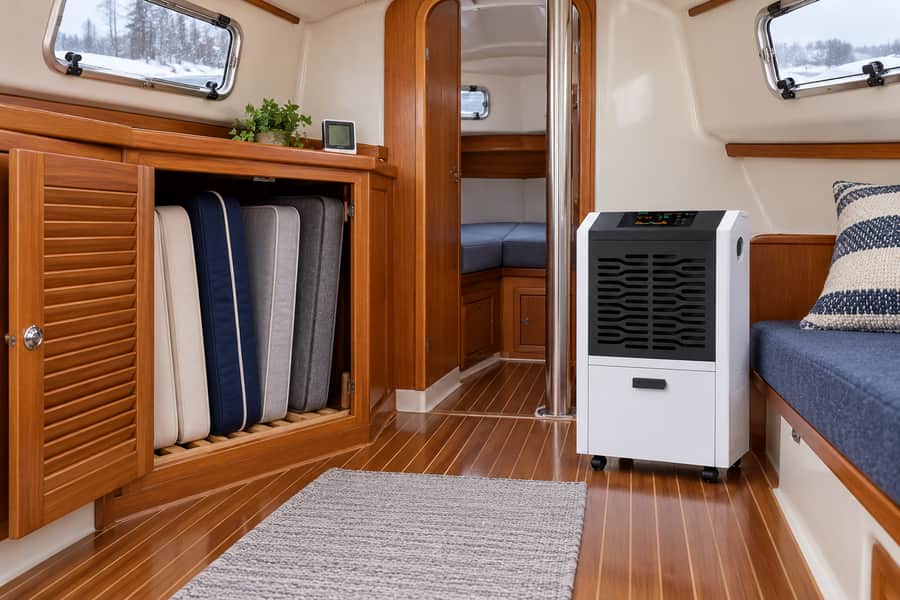
Choose a Dehumidification Method That Fits Winter Conditions
Refrigerant Dehumidifiers
Refrigerant models cool air to condense water, making them practical where temperatures remain within the particular model’s operating range. They may suit protected, relatively mild storage environments.
As temperatures fall, extraction often decreases and frost can form on the coil. Check the published low-temperature limit, defrost behavior, and restart instructions rather than assuming winter performance.
Powered Desiccant Dehumidifiers
Powered desiccant machines can be attractive where low temperatures limit refrigerant equipment, although energy requirements, heat output, and moisture-disposal arrangements vary considerably by design.
Some domestic desiccant appliances still condense extracted water into a removable tank or drain connection. They are not automatically maintenance-free or suitable for unattended marine storage.
With some industrial rotor designs, water leaves in a warm regeneration airstream that needs a dedicated exhaust connection. That arrangement needs manufacturer-designed routing and must not be improvised through hull fittings.
For initial configuration discussions, WetWells boat dehumidifier options provide a relevant product starting point. Any proposed model still requires explicit operating, electrical, installation, and marine-environment suitability checks.
Passive Absorbers When Power Is Unavailable
Passive absorbents require no electricity and can help manage residual moisture in small, reasonably closed compartments. They cannot continuously handle major leaks or heavy ventilation-related moisture loads.
Calcium-chloride products can collect salty, potentially corrosive brine. Secure containers against movement, protect nearby metalwork and fabrics, and plan how someone will empty or replace them.
Where the boatyard prohibits powered appliances, prioritize leak prevention, dry storage, ventilated covers, and accessible lockers. Passive products are supplementary, not substitutes for inspecting the vessel.
Check the absorbent manufacturer’s containment and disposal instructions before placement. Loose packets beside wiring, fasteners, or valuable textiles can introduce a new problem while absorbing moisture.
| Method | Best-fit condition | Principal limitation | Storage planning requirement |
| Refrigerant | Mild or controlled temperatures | Extraction declines in cold conditions | Verify temperature range and defrost |
| Powered desiccant, condensing | Suitable low-temperature applications | Power demand; tank or drain remains | Confirm heat, drainage, and approval |
| Industrial desiccant rotor | Engineered installations | Requires wet-air discharge arrangement | Design outlets and air balance |
| Passive absorber | Small, enclosed storage areas | Limited capacity; possible brine | Secure and inspect containers |
Specify Capacity and Decide Where Equipment Is Needed
Use Actual Conditions, Not Boat Length Alone
Cabin volume matters, but it is only one input. Air leakage, outside humidity, wet materials, temperature changes, and compartment separation all influence the moisture load.
Request performance information at temperatures and humidity levels resembling storage conditions. Supplier ratings measured under different conditions should be interpreted as comparison data, not winter extraction guarantees.
Where possible, log temperature and humidity before installation to establish a baseline. Compare similar weather periods after commissioning rather than judging performance from one afternoon.
Assess airflow separately from extraction capacity. A machine with substantial nominal capacity cannot dry a sealed locker or remote berth if air never reaches those spaces.
An illustrative hypothetical situation is a boat with a relatively dry main cabin but a persistently damp forepeak. Adding airflow or correcting hidden ingress may matter more than upsizing equipment.
One Unit or Several Moisture-Control Zones?
One suitably located unit may serve connected accommodation spaces when interior circulation is adequate. Larger vessels, isolated cabins, and closed compartments can require additional circulation or independent measures.
Map each zone by air connection, cold-surface exposure, available installation clearance, and drain access. Avoid distributing electrical equipment merely because several humidity readings differ.
For larger engineered facilities or unusual storage installations, WetWells industrial dehumidifier configurations can inform discussions about airflow and controls. Industrial catalogue capability is not evidence of marine approval.
Design the Installation Around Safety and Drainage
Electrical Supply and Physical Mounting
No powered dehumidifier should be assumed safe for unattended boat operation. Obtain approval from the marina, marine electrician, and equipment manufacturer for the proposed location and operating arrangement.
Confirm power availability, circuit protection, connection condition, cable routing, and the consequences of supply failure. Avoid improvised extension leads, overloaded circuits, and exposed electrical connections.
Do not install ordinary domestic appliances in compartments where gasoline fumes or other flammable vapors may accumulate. Equipment suitability for these hazardous spaces needs specific verification.
Secure the appliance against movement and maintain manufacturer-required clearances. A stable domestic floor position does not automatically constitute an approved mounting arrangement aboard a vessel.
Provide a Reliable Condensate Route
A collection tank is easy to understand but will eventually fill and stop extraction. Long storage periods therefore require a realistic emptying schedule or a verified continuous-drain solution.
A gravity drain must maintain the required fall without kinks or low points that trap water. A pumped arrangement adds components that can fail or lose power.
Test whether lines or discharge locations could freeze during expected weather. A blocked or frozen hose may stop extraction, spill water, or activate a fault condition.
If no safe gravity outlet exists, discuss a manufacturer-compatible condensate pump and its failure controls. Do not assume the availability of power makes pumping dependable.
Do not route condensate into the bilge as the default solution, or add a hull penetration as a casual do-it-yourself modification. Seek an approved discharge arrangement.
Position Equipment Without Restricting Airflow
Place equipment where intake and discharge paths remain open, service access is possible, and drips from overhead fittings cannot reach electrical components. Keep stored items away from vents.
Where permitted, modest interior circulation can move cabin air past exposed cold surfaces and open lockers. It does not replace actual moisture removal or outdoor ventilation.
Set Controls Using Temperature and Surface Conditions
Why One Relative-Humidity Setting Is Insufficient
Relative humidity changes as air temperature changes, even when the amount of water vapor remains similar. A cold cabin can therefore show higher relative humidity without new leakage.
Condensation can occur when a surface falls below the air’s dew point. Windows, metal fittings, and poorly insulated hull sections may become wet despite ordinary cabin readings.
Do not impose a universal 50% setting on every stored boat. Establish an initial control target only after reviewing material sensitivity, surface temperatures, operating conditions, and available equipment.
If a target is chosen for an illustrative starting trial, document it as provisional rather than guaranteed. Adjust only after checking actual condensation, readings across compartments, and energy implications.
Choose Sensor Locations and Alarm Conditions
Use at least one representative temperature-and-humidity logger where it will not be heated by discharge air or exposed directly to exterior drafts. Add sensors in suspect isolated areas.
Compare readings from the main cabin, forepeak, and known cold spots where relevant. A brief high reading matters differently from persistent wet surfaces or a rising humidity trend.
Remote monitoring can help identify power loss, high humidity, full tanks, or faults when supported. Confirm communication coverage and independent alert power before relying on notifications.
| Monitoring point | What to verify | Possible response |
| Main cabin | Temperature, humidity trend, runtime | Review settings and equipment operation |
| Cold hull-side locker | Surface dampness, stagnant air | Check ingress and permissible circulation |
| Condensate route | Flow, freezing, leakage | Clear obstruction using safe procedure |
| Power and alerts | Supply, restart, communication | Arrange inspection; restore approved operation |
| Cover and bilge | Rain entry, drainage, standing water | Repair source; dry affected areas |
Commission the System Before Leaving the Boat
Test Performance Under Representative Conditions
Run the proposed arrangement while someone can supervise it. Confirm stable mounting, intended airflow, control response, electrical behavior, and condensate collection or discharge.
Check actual temperature and humidity during operation, including in remote compartments. An initial reduction near the appliance does not prove the forepeak or concealed surfaces are dry.
An early trial in mild weather cannot establish low-temperature reliability. Plan a follow-up observation during colder representative conditions before treating the configuration as season-ready.
Examine cold fittings and hull sections directly. If wetness persists, investigate leaks, insulation, or air distribution instead of automatically lowering the humidity setting.
Record the equipment model, permissible operating range, control settings, sensor positions, drainage route, and inspection contacts. These details turn a temporary setup into a repeatable storage procedure.
Test Shutdown, Restart, and Fault Response
Where manufacturer instructions permit, simulate a controlled power interruption and verify whether the unit restarts automatically or requires manual intervention. Do not assume memory functions exist.
Test tank-full protection, drain alarms, and any remote notification using approved procedures. Check what happens when connectivity fails or an alert recipient cannot visit promptly.
Agree on a safe fallback if extraction stops: inspection, water-source correction, and revised ventilation or storage arrangements. Never rely on powered drying or heating for freeze protection.

Inspect Throughout Winter and Prepare for Spring
Adapt Inspections to Actual Risk
Set inspection frequency with the marina or caretaker according to exposure, weather, reliability, and access. Powered equipment, passive absorbers, and afloat storage create different inspection needs.
At each visit, compare logged trends, look for leaks, check bilges and scuppers, examine textiles and lockers, and verify that equipment remains secured and unobstructed.
After major storms, severe freezes, or reported power interruptions, arrange additional checks where safe. Repair newly discovered ingress before interpreting higher humidity as inadequate equipment capacity.
Inspect the collection path and nearby structure for staining or overflow, not merely whether the machine is running. A powered fan can operate without removing water.
Record faults, condensate handling, absorber replacement, and actions taken. A consistent log helps distinguish seasonal weather effects from repeated drainage or electrical problems.
Restore the Boat and Review Equipment Selection
Before spring use, inspect previously damp areas, remove temporary collectors and sensors where appropriate, and clean or service the dehumidifier according to its manual.
Confirm removal of temporary covers and any winter-only arrangements without disturbing required safety systems. Restore and commission machinery, plumbing, and other vessel systems through their separate procedures.
Confirm Procurement and Handover Requirements
- Operating envelope: Obtain model-specific cold-weather performance, electrical demand, defrost behavior, mounting requirements, and permitted unattended operating conditions.
- Condensate management: Confirm tank or discharge arrangements, freezing precautions, pump controls if applicable, and response to blocked drainage.
- Monitoring and service: Request supported restart functions, alarm behavior, maintenance instructions, and any remote monitoring limitations.
- Acceptance and ownership: Witness operation, check each sensor and drain, and assign responsibility for winter inspections, alerts, and spring removal.