
Compare marine dehumidifiers by moisture loads, operating temperatures, airflow requirements, power availability, and installation constraints rather than vessel size alone. Evaluate units under identical conditions.
Sailboats, yachts, houseboats, fishing boats, passenger vessels, and cargo ships require different approaches. The best choice protects spaces without compromising safety, ventilation, or maintenance access.
Start With the Space, Not the Vessel Label
A vessel category suggests likely operating conditions, but it cannot establish dehumidifier capacity. Two similarly sized boats may have completely different ventilation schedules, occupants, and moisture sources.
Define each controlled compartment before requesting quotations. Record its dimensions, connected openings, insulation condition, air temperature, moisture-sensitive contents, and whether the vessel operates continuously or intermittently.
Cabin comfort, electrical equipment protection, and cargo preservation are separate design objectives. A system selected for occasional damp bedding may be unsuitable for maintaining a specified process-air dew point.
Identify the Actual Moisture Sources
Sources include outdoor air entering through hatches, occupants, showers, wet clothing, cleaning operations, and damp stores. Leaks and standing bilge water require correction, not larger equipment alone.
Cold hull sections, windows, and uninsulated fittings may remain wet even when cabin humidity appears reasonable. Local surface temperatures therefore matter alongside the average room reading.
Compare the Requirements of Different Vessel Types
Sailing Boats and Compact Cruisers
Limited floor space, irregular shore power, and separated lockers usually dominate selection. A portable unit may serve the main cabin, provided it can be secured and ventilated properly.
A small dehumidifier cannot dry an enclosed forepeak or locker without an effective air path. Assess door openings, circulation fans, and whether separate moisture protection is necessary.
For sailing use, check mounting restraints, permitted operating inclination, and behavior during heel. A stationary unit intended for dockside use should not automatically be treated as underway equipment.
Yachts and Larger Recreational Vessels
Yachts may combine climate-controlled lounges with cooler guest cabins, wardrobes, and equipment spaces. Compare quiet localized units against ducted systems serving deliberately separated humidity zones.
A ducted arrangement can relocate fan noise and preserve cabin space, but requires return-air pathways and verified fan pressure. Avoid sharing air between spaces with incompatible ventilation requirements.
Consider intermittent occupancy and remote monitoring alongside full-load performance. The unit should control humidity during low moisture demand without excessive cycling, noise, or unnecessary power consumption.
Houseboats and Liveaboard Accommodation
Houseboats experience persistent domestic moisture from cooking, showers, laundry, and occupants. Continuous drainage and predictable operation commonly matter more than maximum published extraction figures.
Kitchen and bathroom exhaust should manage moisture at its source. Dehumidification supplements these measures, particularly when cool glazing and concealed wall cavities are vulnerable to condensation.
Compare operating noise near sleeping spaces, service access around built-in furniture, and electricity availability. An otherwise suitable unit becomes impractical if its tank requires frequent emptying.
Fishing Vessels and Workboats
Wet decks, frequent washdowns, open doors, and damp protective clothing create fluctuating loads. Prioritize drying designated cabins, lockers, or control spaces rather than attempting to condition exposed working decks.
Salt spray, airborne residues, and vibration challenge filters, coils, controls, and exposed fasteners. Ask for component-level material details and maintenance access rather than accepting a broad marine-grade description.
Refrigerated handling areas need separate assessment because cooling surfaces and process ventilation can dominate condensation behavior. Coordinate dehumidification with refrigeration design and sanitary operating requirements.
Passenger Ferries and Commercial Accommodation
Multiple occupied zones need coordinated HVAC, fresh-air supply, and humidity control. Equipment comparisons should include part-load operation, occupied noise, duct compatibility, and access for crew maintenance.
Changing passenger numbers and door-opening schedules affect moisture loads. A central machine may be appropriate for connected spaces, while independent zones can provide better control across differing conditions.
Electrical rooms and protected technical compartments require their own design review. Do not assume accommodation airflow, temperature, or dehumidifier controls can be extended into these areas unchanged.
Cargo Holds and Specialized Shipboard Spaces
Cargo-hold drying is an engineered cargo-specific application, not an enlarged cabin-dehumidifier purchase. Cargo properties, permissible ventilation, seawater exposure, and voyage conditions determine the moisture-control strategy.
A dry-air system may need dedicated distribution, sealing arrangements, continuous monitoring, and an agreed cargo protection criterion. Hold geometry and changing cargo arrangements can obstruct apparently adequate airflow.
Where cargo produces hazardous atmospheres or has special handling restrictions, qualified marine designers must determine equipment locations and protection measures. No general-purpose dehumidifier should be presumed approved.
Stored Boats and Vessel Lay-Up
Storage changes the duty cycle: limited occupancy lowers some moisture loads, but leaks, cool surfaces, and unreliable shore power remain significant. Specify unattended alarms and drainage arrangements.
| Vessel or space | Primary moisture concern | Configuration worth evaluating | Critical comparison point |
| Compact sailboat | Cabin dampness, isolated lockers | Secured portable or localized system | Space, power, heel limits |
| Yacht | Multiple comfort zones | Localized or ducted equipment | Noise, turndown, duct pressure |
| Houseboat | Continuous domestic moisture | Permanently drained cabin system | Drainage, part-load operation |
| Fishing boat or workboat | Wet operations, salt exposure | Protected zonal installation | Corrosion details, service access |
| Passenger or commercial accommodation | Variable occupancy across rooms | HVAC-integrated or zoned system | Ventilation and controls |
| Cargo hold | Cargo-specific condensation risk | Engineered dry-air distribution | Cargo criteria and safety review |
| Laid-up vessel | Persistent moisture during storage | Monitored, drained compartment unit | Power and unattended alarms |
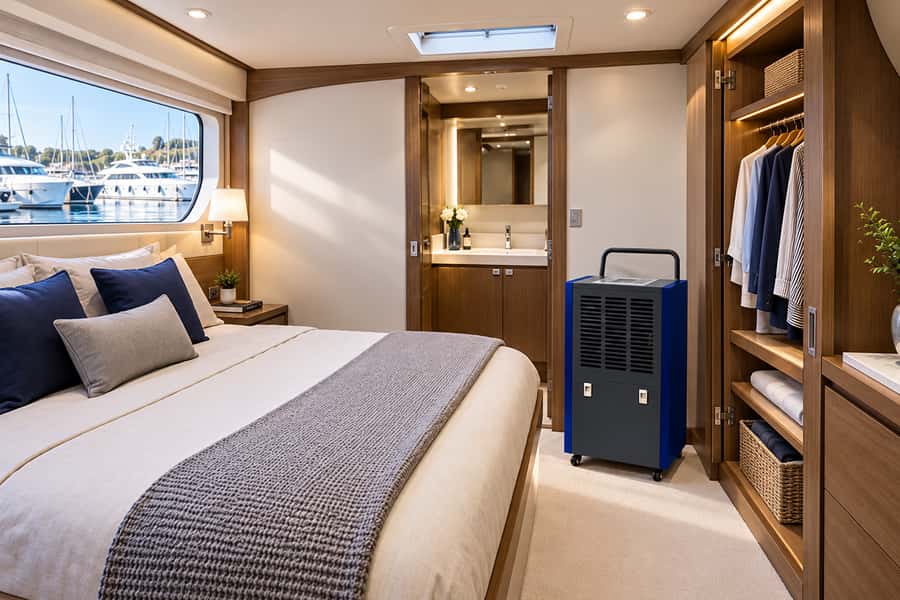
Refrigerant, Desiccant, Portable, or Ducted?
Refrigerant Dehumidifiers
Refrigerant units cool air to condense moisture and then discharge treated air. They can suit warm accommodation spaces where condensation drainage, ventilation, and electrical supply are manageable.
Extraction typically falls as air becomes cooler or drier; some systems also require defrost operation. Compare published capacity at the actual inlet conditions, not only a favorable catalog point.
Heat released into the compartment may affect comfort or cooling loads. Confirm how the selected configuration interacts with existing air conditioning rather than assuming independent systems never interfere.
Desiccant Dehumidifiers
Desiccant systems capture water vapor in a sorbent and generally require regeneration energy. They merit consideration when operating temperatures are lower or a lower supply-air dew point is needed.
Assess both the process-air path and regeneration circuit. Moist regeneration air requires an appropriate discharge route, and associated heat and energy demand must enter the design comparison.
A desiccant unit is not automatically superior offshore. Check its delivered dryness, regeneration power, filtration, and control behavior at the specified duty point and installation conditions.
Choose the Air Distribution Arrangement
Portable equipment supports accessible, localized applications and simpler retrofits. Ducted units can reach remote compartments, while larger centralized systems may serve engineered zones with compatible environmental requirements.
The WetWells boat dehumidifier range describes portable, ducted, and corrosion-resistant configuration options. Treat those as available design directions, not confirmation that every model has marine approvals.
Choose the architecture by checking physical constraints, noise, humidity zones, maintenance access, and compartment separation before comparing these practical equipment arrangements:
- Portable placement: Verify stable restraint, clearance, safe electrical connection, and reliable condensate collection or disposal.
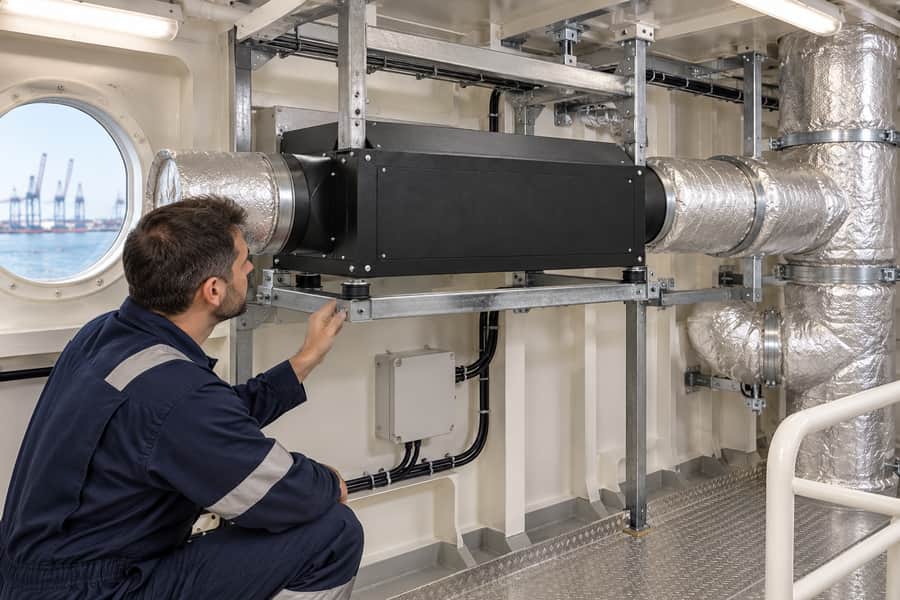
- Ducted installation: Obtain airflow at the proposed external static pressure, including returns, fittings, filters, and dampers.
- Centralized distribution: Confirm zoning, access for maintenance, and whether common ductwork conflicts with compartment isolation.
- Redundant equipment: Consider independent units where losing one device would leave critical materials or operations unprotected.
Compare Rated Performance at the Same Conditions
Match Temperature, Humidity, and Dew Point
Manufacturer capacity ratings depend on stated inlet temperature and relative humidity. Two models rated under different laboratory conditions cannot be ranked fairly using their headline liters-per-day figures.
Ask suppliers for moisture removal at identical temperatures, humidity levels, and airflow assumptions. When their published charts differ, request a documented recalculation or selection at one agreed duty point.
The dew point reading provides a condensation threshold for exposed vessel surfaces. At or below this temperature, vapor can collect as liquid, so a warmer cabin reading may conceal wet fittings.
For a hypothetical example, a cooled metal locker wall could remain damp while a sensor in a warmer berth reads satisfactorily. Measure both locations before revising the equipment specification.
No universal relative-humidity target guarantees corrosion prevention. Surface temperatures, coatings, and wetting events affect risk; deposited salt requires appropriate cleaning because dehumidification cannot remove it.
Calculate Loads and Usable Airflow
Estimate moisture gains from ventilation, infiltration, occupants, wet materials, and process activities for each zone. Include realistic operating states rather than applying a single volume-based sizing multiplier.
Ventilation air may be essential for safety and occupancy, even when it increases the moisture load. Keep required outdoor-air quantities distinct from avoidable leakage during selection calculations.
Supply airflow and dehumidification capacity describe different properties. Confirm whether the proposed fan can overcome installed duct resistance while delivering circulation to the locations that actually need drying.
Request pressure-flow data, not just a free-air volume. A high nameplate airflow cannot compensate for blocked returns, narrow passages, or long duct runs with excessive pressure loss.
Check Turndown and Control Stability
A unit selected for the worst humidity event should also behave acceptably at low load. Compare staging, variable output, cycling limits, hysteresis, and sensor placement with the intended duty cycle.
Independent temperature and humidity sensors help diagnose problems, but calibration and siting matter. Avoid controls mounted directly beside supply outlets, cooking areas, or regularly opened hatches.
Verify Marine Installation and Operational Limits
Salt, Vibration, Heel, and Mounting
Request information on coil protection, cabinet construction, fasteners, electrical enclosures, and accessible cleaning surfaces. Corrosion-resistant materials reduce exposure vulnerabilities but do not eliminate inspection requirements.
Ashore or dockside performance gives little assurance of operation during movement. Confirm allowable heel, pitch, vibration, and mounting orientation with the manufacturer for the actual operating mode.
Foot restraints, drainage traps, condensate pans, and flexible connections must remain functional under anticipated motion. Verify mount loads and structural attachment locations with the vessel’s responsible engineer.
Electrical Supply: Shore Power Versus Onboard Generation
Compare voltage, frequency, phase, running demand, startup current, and protective arrangements against both shore and onboard supplies. Generator and inverter compatibility requires specific electrical confirmation.
Check whether the equipment restarts safely after an interruption and how it responds to voltage disturbances. Unattended operation also needs alarm behavior compatible with vessel procedures.
Electrical installation must preserve existing distribution protection and critical circuits. A nominally compatible plug does not establish acceptable starting demand, grounding, or suitability for onboard use.
Drainage, Exhaust, and Compartment Safety
For refrigerant systems, specify where condensate goes during normal operation and vessel movement. Gravity drainage may fail where slopes reverse; pumps introduce additional power and alarm dependencies.
Protect against backflow, siphoning, leaks, and accidental discharge onto equipment. An unattended condensate tank is rarely a satisfactory long-term arrangement unless monitoring and servicing are dependable.
For desiccant systems, route regeneration exhaust without reintroducing moisture or compromising boundaries. Separate this duty from exhaust ventilation required for machinery, fuel systems, or occupied spaces.
Hazardous fuel or vapor spaces require professionally designed systems with appropriately approved equipment. A marine-grade label alone does not demonstrate classification approval, explosion protection, or suitability for these locations.
Confirm relevant flag-state, class, insurer, and vessel-specific requirements before ordering. Approval evidence must match the exact model, configuration, location, and intended operation, not merely the supplier’s general capabilities.
Compare Ownership Costs and Supplier Evidence
Initial purchase price omits installation labor, ductwork, electrical upgrades, drainage, controls, and potential structural changes. Compare proposals with the same scope and defined operating assumptions.
Operating cost depends on moisture load, duty cycle, regeneration demand, fan power, and interaction with cooling equipment. Ask for consumption estimates based on the selected operating conditions.
The WetWells industrial dehumidifier range illustrates ducted air distribution and configurable drainage approaches. Any proposed transfer into shipboard service still needs model-specific environmental and approval verification.
Request maintenance intervals, consumables, spare-parts availability, installation drawings, and documented restrictions. A lower-cost unit may become harder to support if servicing requires dismantling inaccessible furnishings.
Prepare a Buyer Specification Matrix Before Ordering
Use one project matrix for every bid so that equipment differences remain visible. Mark the nonnegotiable operating limits first, then invite bidders to propose alternative air paths or control arrangements within those boundaries.
| Procurement item | Data the buyer should provide | Evidence the supplier should return |
| Vessel and zones | Use, compartments, occupancy, operating mode | Proposed zoning and equipment arrangement |
| Design conditions | Temperature, humidity, dew-point concerns, infiltration | Capacity at identical stated conditions |
| Air distribution | Layout, duct lengths, access constraints | Flow and available static pressure |
| Controls | Setpoints, low-load periods, monitoring needs | Turndown, sensors, alarms, restart logic |
| Marine exposure | Salt, vibration, heel, proposed location | Materials, mounting limits, service requirements |
| Electrical service | Shore/onboard voltage, frequency, startup limits | Running and starting demand, compatibility |
| Moisture disposal | Drain route or exhaust destination | Drainage and regeneration arrangement |
| Compliance | Vessel rules and intended compartment | Applicable documentation for exact configuration |
Commission Against Measurable Acceptance Criteria
Agree on commissioning responsibilities before release of the purchase order. Record baseline moisture conditions, then evaluate the installed system under representative operating and ventilation states.
Specify acceptance criteria that can be witnessed and repeated, with adjustments defined when site conditions differ from design assumptions. A single humidity reading after startup is insufficient.
- Capacity verification: Record inlet conditions, operating mode, and condensate production or another agreed method suited to the technology.
- Distribution verification: Measure supply and return airflow, duct pressure, and conditions in remote or poorly connected compartments.
- Control verification: Test sensors, staging, alarms, restart behavior, and operation under reduced moisture demand.
- Marine installation checks: Inspect restraints, vibration response, access, drainage or exhaust routing, and designated electrical protections.
- Handover package: Obtain drawings, maintenance instructions, spare-parts details, approved configuration records, and a corrective-action process for failed tests.
Assign responsibility for logging temperature, humidity, and critical surface observations after handover. Revisit the selection if cargo, routes, ventilation patterns, or vessel use changes materially.