
Basement conditions determine which dehumidifier capacity deserves consideration. A 50-pint model may suit moderate dampness, while 70-pint and 100-pint units offer greater rated capacity.
Extra rated capacity is useful only when the basement needs it. Comparing test standards, operating conditions, efficiency, and drainage helps you select a unit that meets your basement’s needs.
What Does a Pint Rating Mean for Basement Dehumidifiers?
What Does a Pint Rating Actually Mean?
The pint figure describes a laboratory result: the volume of water collected during one day at the specified temperature and humidity. U.S. product literature typically abbreviates this daily collection figure as PPD, meaning pints per day.
For a 50-pint label, the specified laboratory test produces a daily collection equivalent to 50 pints. A 70-pint model offers a higher rated moisture-removal capacity, while a 100-pint model is designed for a greater moisture load.
A basement rarely reproduces the laboratory environment exactly. Actual performance depends on several environmental and operational factors:
- Relative humidity: Higher humidity generally provides more moisture for the dehumidifier to remove.
- Temperature: Refrigerant-based dehumidifiers typically remove less moisture as the surrounding air becomes colder.
- Air circulation: Poor airflow can prevent the unit from treating the entire basement effectively.
- Moisture sources: Leaking pipes, damp foundation walls, and groundwater intrusion can continuously increase the workload.
The date and method behind the rating deserve attention too. U.S. Department of Energy testing procedures have changed over time, so ratings on older equipment may not be directly comparable with ratings on newer models. Check the applicable test standard before comparing different capacities.
For portable units, the revised U.S. procedure uses 65°F rather than the earlier 80°F test. A lower number under the cooler test can therefore describe similar equipment.
Confirm the test basis before treating a 70-pint label as an upgrade over a 50-pint label; a change in rating method can change the number without improving actual moisture removal.
50-Pint vs. 70-Pint vs. 100-Pint Dehumidifiers: Key Differences
The main difference among these three categories is their rated moisture-removal capacity. This affects the types of environments they may serve, their potential operating requirements, and the features worth considering before purchase.
| Comparison factor | 50-pint dehumidifier | 70-pint dehumidifier | 100-pint dehumidifier |
| Rated moisture removal | Moderate | Higher | Highest of the three categories |
| Potential application | Moderately damp basements | Larger or more humid spaces | Heavy moisture loads and demanding applications |
| Initial cost | Often lower | Often higher | May be substantially higher |
| Energy consumption | Depends on efficiency and operating time | Depends on efficiency and workload | Depends on efficiency and workload |
| Drainage requirements | Tank or continuous drainage | Tank or continuous drainage | Continuous drainage may be especially useful |
| Space requirements | Often easier to accommodate | Depends on model design | May require more installation space |
| Main consideration | May be insufficient for persistent heavy moisture | Balances capacity and operating needs | Requires careful equipment and rating verification |
These categories provide general guidelines rather than fixed sizing rules. Two dehumidifiers with different pint ratings may also have different energy-efficiency levels, airflow capabilities, humidity controls, and minimum operating temperatures.
A 50-pint model may be sufficient for a well-sealed basement with a moderate moisture load. Repeated water entry can create a demanding workload even within a compact basement.
Read the capacity label alongside the temperature, dampness, and layout of the intended installation.
When Should You Choose a 50-Pint Basement Dehumidifier?
Suitable Basement Conditions
A 50-pint basement dehumidifier is worth considering when humidity is moderately elevated and the space does not have an unusually heavy moisture load.
Potential applications include:
- A finished basement with occasional musty odors.
- Storage space with mildly humid air, dry floors, and no continuing water intrusion.
- A basement used as a home office, hobby room, or additional living space.
- A smaller or moderately sized basement where humidity increases during humid weather.
- A space where the main goal is maintaining comfortable humidity rather than managing severe dampness.
Basement size alone cannot determine whether this capacity will be sufficient. A relatively small basement with damp foundation walls may require more moisture-removal capacity than a larger, well-sealed space.
Before purchasing, measure the basement and monitor relative humidity with a hygrometer. If humidity remains elevated despite reasonable moisture control, compare the model’s rated performance with the demands of the space.
Main Advantages and Limitations
A 50-pint model can offer a practical balance of capacity, purchase cost, and convenience. Depending on its design, it may be easier to move, fit into a compact area, and maintain than larger equipment.
However, a smaller capacity does not automatically guarantee lower electricity costs. If the unit runs continuously because it cannot keep up with incoming moisture, its cumulative energy consumption may be higher than expected.
A 50-pint model may be inadequate when the basement is large, humidity remains high for extended periods, or moisture continually enters through the foundation. In these situations, compare higher-capacity options rather than assuming that longer operating hours will solve the problem.
Moving Up to 70 Pints: Basements With a Heavier Moisture Load
Suitable Basement Conditions
A 70-pint basement dehumidifier can be a suitable middle option when a 50-pint model may not provide enough capacity but a larger system is not clearly necessary.
Consider this category for:
- A larger basement with persistently elevated humidity.
- A basement divided into connected areas that require consistent moisture control.
- A space that experiences substantial seasonal humidity.
- A basement containing furniture, stored belongings, or finished materials that benefit from stable humidity.
- A basement whose humidity stays elevated despite a lower-capacity machine operating regularly.
The appropriate choice depends on the model’s rated capacity and the actual moisture load. A 70-pint rating should not be interpreted as a universal recommendation for a particular floor area.
For example, a large basement with relatively stable moisture conditions may not need the same capacity as a smaller basement affected by damp soil or recurring water infiltration.
Main Advantages and Limitations
The principal advantage of a 70-pint model is its greater rated moisture-removal capacity compared with a 50-pint model when both are measured under equivalent conditions. It may manage a higher moisture load without running as continuously, provided the unit is correctly sized and the surrounding conditions are suitable.
However, the benefits depend on the model’s efficiency and the basement’s actual moisture load. A higher-capacity unit may cost more initially and occupy more space. Its electrical requirements, drainage arrangement, and noise level should also be checked.
Closed doors can isolate rooms from the airflow of a single basement unit, leaving humidity uneven between spaces. Better airflow or separate humidity-control equipment may be necessary, depending on the layout.
A 70-pint model is therefore best treated as a capacity option to investigate rather than an automatic upgrade for every basement.
Assessing a 100-Pint Unit for Demanding Basement Conditions
Suitable Basement Conditions
A 100-pint dehumidifier may be appropriate when the required moisture-removal capacity is substantially higher than what smaller units can provide. This can include large basement areas, demanding humidity-control applications, and spaces that experience persistent moisture problems.
Potential situations include:
- A large basement with consistently high relative humidity.
- A substantial storage area containing moisture-sensitive materials.
- A space where several connected areas contribute to a high overall moisture load.
- An application that requires frequent or extended dehumidifier operation.
- A basement that has been assessed and shown to require higher-capacity equipment.
Before choosing this category, identify why the basement is damp. If water is entering through cracks, leaking plumbing, damaged exterior drainage, or groundwater intrusion, installing a larger dehumidifier will not correct the underlying problem.
Dehumidification addresses the airborne portion of the moisture problem. It cannot replace repairs to leaks, improvements to drainage, or measures needed to address water entering through the building structure.
Portable, Whole-Home, and Commercial Equipment Differences
A 100-pint rating may appear on equipment intended for different applications. Understanding the equipment category is essential because installation requirements and performance characteristics can vary considerably.
Portable basement dehumidifiers are generally designed for individual spaces. They may use a collection tank or continuous drainage connection and are often relatively straightforward to install.
Whole-home dehumidifiers are commonly integrated with a building’s heating, ventilation, and air-conditioning system or connected to dedicated ductwork. Sizing such equipment requires checking how its extraction rating, duct airflow, and control arrangement work together.
Commercial or specialized dehumidifiers may be designed for demanding moisture-control applications, including larger spaces or environments requiring extended operation. They may have different drainage arrangements, electrical requirements, and operating specifications.
Do not compare these equipment types based on pint ratings alone. Check the testing conditions, intended application, airflow requirements, and operating-temperature range. A higher-capacity commercial unit may not be the most practical solution for a typical residential basement.
What Factors Determine the Right Dehumidifier Size?
Room Volume, Partitions, and Air Paths
Square footage captures only the horizontal dimensions of the space. Increasing the ceiling height increases the volume of air even when the footprint stays unchanged. Partitions, storage rooms, and closed doors can also affect air circulation.
When estimating your needs, measure the basement’s length and width, calculate its floor area, and note the ceiling height if it differs substantially from a typical residential room.
Consider whether the basement is open or divided into separate rooms. A dehumidifier located in one corner may not effectively control humidity in a closed storage room or a distant section with restricted airflow.
Compare the supplier’s recommended coverage with the dampness observed on site before settling on a capacity.
Moisture Level and Relative Humidity
Relative humidity is one of the most useful indicators for evaluating basement moisture. A hygrometer can help you determine whether the space remains damp throughout the day or becomes humid only during particular weather conditions.
For many residential spaces, a relative humidity range of approximately 30% to 50% is a useful general target, although the appropriate setting depends on temperature, comfort, and building conditions. Keeping humidity below 60% helps reduce conditions that support mold growth, but it does not eliminate the need to correct leaks or address existing mold.
Build a short humidity log covering several days so temporary fluctuations do not determine the purchase. If the basement consistently remains above your target despite reasonable moisture control, a higher-capacity model may be worth considering.
Investigate where the incoming water originates while assessing the humidity measurements. Humidity caused by seasonal outdoor air may be easier to control than moisture continually entering through a wet foundation.
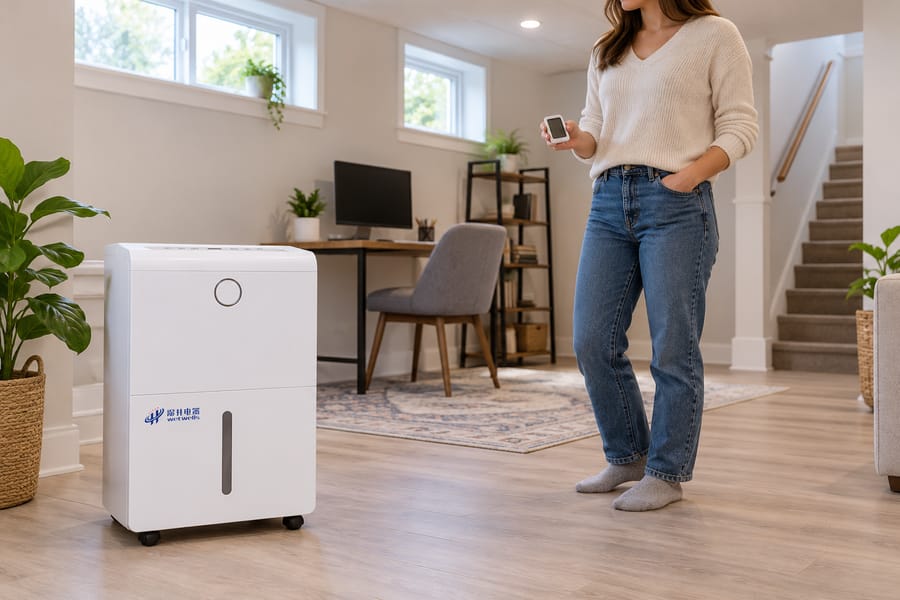
Basement Temperature
Temperature is particularly important when choosing a refrigerant-based dehumidifier. These units cool air to condense moisture, and their moisture-removal performance generally declines as air temperature falls.
Cold basement conditions may also cause frost to form on the evaporator coil. Models equipped with automatic defrost can manage certain low-temperature conditions, but they may still remove moisture less effectively than they do in warmer environments.
Check the manufacturer’s specified operating-temperature range and moisture-removal data at relevant temperatures. If your basement remains cold for much of the year, do not assume that a higher pint rating measured under warmer conditions will deliver the same performance.
For very cold environments, specialized low-temperature equipment or an alternative dehumidification technology may be more appropriate.
Existing Water Intrusion and Moisture Sources
A basement with occasional humid air does not present the same challenge as one with recurring leaks or water entering through foundation walls.
Before increasing dehumidifier capacity, inspect the basement for:
- Leaking pipes or plumbing fixtures.
- Openings in the building envelope through which water seeps.
- Poor exterior drainage or downspouts discharging near the foundation.
- Damp concrete, wet carpets, or water-damaged materials.
- Condensation on cold pipes, windows, and other surfaces.
Repairing these problems reduces the amount of moisture that the dehumidifier must remove. It can also prevent damage that a larger appliance alone cannot resolve.
Energy Efficiency and Essential Features
Energy Consumption and Operating Costs
Capacity is only one part of the operating-cost calculation. Energy efficiency, actual moisture load, humidity settings, and operating hours all influence electricity consumption.
When comparing models, review the rated power consumption and the applicable energy-efficiency metric, such as integrated energy factor (IEF), where available. Use data measured under comparable conditions rather than relying only on marketing claims.
A larger dehumidifier may consume more power while operating, but it may also remove moisture more quickly when properly matched to the workload. Insufficient extraction capacity can leave the machine operating continuously while basement humidity remains elevated.
To estimate electricity costs, multiply the unit’s power consumption in kilowatts by the number of operating hours and your electricity rate. For example, a unit drawing 0.5 kW and running for 10 hours uses approximately 5 kWh. Actual consumption varies with operating conditions and cycling behavior.
For an illustrative U.S. household calculation prepared on October 21, 2026, assume an electricity rate of USD 0.20/kWh. The example above would cost USD 1.00 per operating day, or USD 30.00 across 30 identical days.
This is an assumed energy-only scenario, not a current utility quotation or a specification for any pictured model. It excludes taxes, fixed utility charges, equipment purchase, shipping, and installation; substitute your own tariff and measured operating time.
The most economical option is the model that controls the moisture load effectively while using a reasonable amount of energy over time.
Humidity Controls and Performance in Cooler Rooms
The unit’s humidistat uses a humidity reading to call for dehumidification when the selected setting requires it. This can reduce unnecessary operation once the basement reaches the desired humidity level.
Other useful features include:
- Automatic shutoff: Stops operation when the collection tank becomes full.
- Automatic restart: Restores operation after a power interruption on models that support it.
- Automatic defrost: Helps manage frost formation under suitable low-temperature conditions.
- Adjustable fan speeds: Provide a choice of air movement and sound levels for occupied or storage areas.
- Accessible filters: Make routine cleaning and maintenance easier.
Prioritize features that match your basement’s conditions. For example, low-temperature operation is especially relevant in a cold basement, while automatic restart can be useful when continuous humidity control is important.
Drainage, Noise, and Maintenance
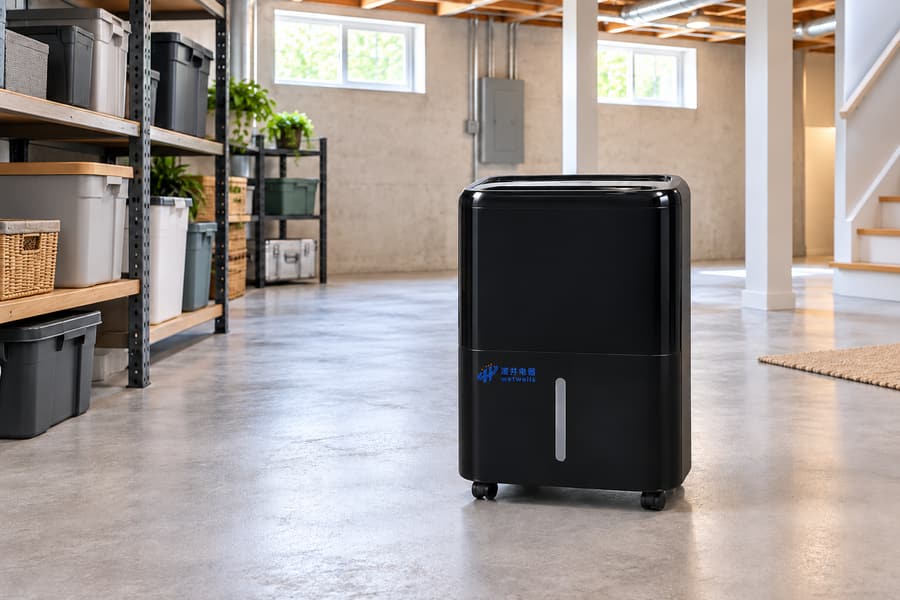
Drainage arrangements become increasingly important when a dehumidifier operates for extended periods. A collection tank requires regular emptying, and a full tank may stop the unit until it is emptied.
Continuous drainage can reduce this workload. Depending on the model and basement layout, water may flow through a gravity drain or be discharged by a built-in condensate pump. Gravity drainage requires a suitable drain location and enough elevation difference, while pump-assisted drainage can provide more flexibility.
Also consider noise, filter cleaning, and the space needed around the unit for airflow and servicing. A model that fits comfortably in the basement and is easy to maintain is more practical than one whose installation requirements make regular use inconvenient.
Which Dehumidifier Capacity Fits Your Basement?
The following table provides a starting point for comparing capacity categories against common basement conditions. Use it alongside the manufacturer’s sizing guidance rather than treating it as a fixed sizing formula.
| Basement condition | Capacity category to investigate | What to check |
| Smaller or moderately damp basement | 50-pint | Whether the rated capacity can maintain the desired humidity |
| Larger basement with consistently elevated humidity | 70-pint | Actual moisture load, airflow, and operating efficiency |
| Large basement with a heavy moisture load | 100-pint | Equipment type, rated performance, and drainage requirements |
| Cold basement with seasonal dampness | Depends on temperature and moisture load | Low-temperature performance and defrost capability |
| Basement with recurring leaks or standing water | Address the moisture source first | Foundation, plumbing, and drainage conditions |
For example, a moderately damp basement with stable humidity may be adequately served by a 50-pint model. A larger basement that stays humid for long periods may justify investigating a 70-pint model. A 100-pint model may be more suitable when the space and moisture load demand substantially greater capacity.
These examples are not interchangeable sizing rules. The final choice should reflect the product’s testing standard, operating conditions, and the amount of moisture that must be removed.
How to Choose the Right Capacity for Your Basement
Selecting a basement dehumidifier becomes easier when you follow a consistent evaluation process.
Step 1: Map the space. Note its dimensions, ceiling clearance, partitions, and door positions.
Step 2: Measure humidity. Use a hygrometer to monitor relative humidity over several days.
Step 3: Identify moisture sources. Check for condensation, leaks, and drainage problems before choosing a larger unit.
Step 4: Compare capacity ratings. Confirm that the models use comparable testing standards.
Step 5: Review essential features. Check energy efficiency, operating temperature, and drainage options.
Step 6: Select the appropriate capacity. Compare 50-pint, 70-pint, and 100-pint models against the manufacturer’s sizing recommendations and your basement’s actual moisture load.
A larger number on the capacity label does not settle the buying decision. Choose a model that can control humidity under your basement’s actual operating conditions while providing practical energy use, drainage, and maintenance requirements.