
Controlling humidity in commercial hydroponic rooms requires matching moisture removal to crop transpiration, maintaining even airflow, and monitoring conditions at canopy level. Temperature and humidity must be managed together.
This guide explains how to identify moisture sources, select equipment, coordinate controls, and address recurring humidity problems as plants mature and lighting schedules change.
Why Humidity Control Matters in Commercial Hydroponic Growing Rooms
Supporting Healthy Plant Growth and Transpiration
Humidity directly influences how plants exchange water vapor with the surrounding air. Through transpiration, plants release moisture from their leaves, helping transport water and dissolved nutrients from their roots to other parts of the plant.
When relative humidity is too high, the difference in water vapor concentration between the leaf and the surrounding air decreases. This can slow transpiration and affect nutrient movement.
When humidity is excessively low, plants may lose moisture too quickly, increasing water demand and potentially causing stress.
Commercial hydroponic systems often support large numbers of plants within a relatively small space. As the canopy develops, the total moisture released by the plants can increase substantially.
Without adequate humidity control, indoor conditions may move outside the preferred range even when irrigation and nutrient delivery remain consistent.
Reducing Mold, Mildew, and Condensation Risks
Excess humidity can create favorable conditions for certain fungal diseases, particularly when combined with poor airflow and prolonged leaf wetness. Dense plant canopies may trap moist air, allowing localized humidity to remain high even when the average room reading appears acceptable.
Condensation presents another concern. When moist air contacts a surface colder than its dew point, water droplets can form on walls, pipes, ducts, and other equipment. Persistent moisture may damage building materials, affect electrical components, and create additional sanitation challenges.
Maintaining suitable humidity, circulating air effectively, and monitoring surface temperatures help reduce these risks. Humidity control should complement proper sanitation, irrigation management, and disease prevention rather than replace them.
Maintaining Consistent Growing Conditions
Commercial growers need stable environmental conditions across different growing zones. Large fluctuations in humidity can affect transpiration, plant development, and the consistency of production.
A well-designed humidity control system helps maintain predictable conditions during changes in plant density, irrigation schedules, lighting operation, and outdoor weather. This is especially important in facilities that operate multiple growing rooms or maintain different crops at different growth stages.
Determine the Appropriate Humidity Levels for Hydroponic Crops
Understand Relative Humidity and Vapor Pressure Deficit
Relative humidity (RH) describes how much water vapor the air contains compared with the maximum amount it could hold at the same temperature. However, RH alone does not fully describe the conditions experienced by a plant.
The air vapor pressure deficit (VPD) calculation starts with temperature: determine its corresponding saturation pressure, then deduct the pressure contributed by the moisture already present. For leaf-to-air VPD, use leaf temperature for the saturation term; a cooler or warmer leaf can experience a different evaporative demand.
A high VPD generally indicates stronger evaporative demand, while a low VPD indicates weaker demand. Both extremes can create problems depending on the crop, growth stage, temperature, root-zone conditions, and other environmental factors.
Growers should establish humidity targets using crop-specific guidance and, where appropriate, VPD calculations. Temperature and humidity must be considered together because the same RH reading can produce different VPD values at different temperatures.
Adjust Humidity Targets by Growth Stage
Different stages of plant development may require different environmental conditions. Seedlings and young plants often benefit from conditions that limit excessive water loss, while established plants may tolerate or require different humidity levels depending on the species and production objective.
During vegetative growth, expanding leaves increase the total transpiring surface area. During flowering or fruit development, growers may need tighter humidity management to limit disease risks around dense flowers and fruiting structures.
Humidity targets should therefore reflect crop requirements rather than a single setting for the entire production cycle. Adjustments should also consider whether the plants are healthy, how densely the canopy is arranged, and how effectively air moves through it.
Account for Daytime and Nighttime Changes
Lighting schedules can significantly influence room temperature and humidity. When grow lights are operating, they contribute heat that affects air temperature, plant activity, and cooling demand. When the lights switch off, the room may cool while plants continue releasing moisture.
Cooling the room can push RH upward without a corresponding increase in its water vapor content. This can create nighttime humidity spikes and increase condensation risks.
Growers should monitor conditions during both lighting periods and the transition between them. Dehumidification equipment and environmental controls must be capable of responding to these changes rather than operating only during the warmest hours.
Identify the Main Sources of Excess Moisture
Plant Transpiration in High-Density Growing Rooms
Transpiration is often a major moisture source in commercial hydroponic facilities. As plants mature, their leaf area increases, and the room may receive a continuous supply of water vapor from the canopy.
The moisture load depends on crop species, plant density, lighting intensity, temperature, VPD, irrigation practices, and growth stage. A room that operates successfully during early growth may require substantially more moisture removal once the canopy becomes dense.
Equipment selection should account for the expected moisture load during peak production, not just the conditions observed when the room is first commissioned.
Evaporation from Nutrient Solutions and Wet Surfaces
Open nutrient reservoirs, exposed channels, wet floors, drainage areas, and frequently watered surfaces can contribute additional moisture to the air.
Although these sources may be smaller than plant transpiration in some facilities, their combined effect can be significant. Leaking irrigation lines and poor drainage may also create persistent wet areas that increase humidity and complicate sanitation.
Growers should cover reservoirs where appropriate, repair leaks, remove standing water, and keep drainage systems clear. Reducing avoidable evaporation lowers the moisture load that dehumidification equipment must handle.
Moisture Entering Through Ventilation and Air Leakage
Outdoor air can either help or hinder humidity control. When outdoor air contains less moisture than indoor air, ventilation may remove some of the moisture generated by plants.
When outdoor air is warm and humid, introducing it may increase the room’s moisture load.
Air leakage through doors, wall penetrations, and poorly sealed ducts can also undermine climate control. Frequent door openings may introduce humid air and cause temporary changes in temperature and RH.
Commercial growing rooms should use controlled ventilation and appropriate air sealing. Decisions about outdoor air should be based on its moisture content and the facility’s temperature requirements, not simply on outdoor relative humidity.
Choose the Right Humidity Control Equipment
Use Commercial Dehumidifiers to Remove Excess Moisture
Commercial dehumidifiers remove water vapor from indoor air and are particularly valuable when plant-generated moisture exceeds what ventilation and the existing HVAC system can manage.
In a refrigerant unit, a cold coil collects liquid water from the passing air; a drain carries this condensate out. A downstream warm coil raises the dried air temperature before discharge.
Their actual moisture-removal capacity depends on operating temperature, inlet RH, airflow, and equipment design.
Solid-desiccant dehumidifiers capture water vapor by adsorption onto a drying medium. They may suit low-humidity requirements or conditions that reduce refrigerant performance. Regeneration consumes energy, and its thermal effects must be included in the climate-control design.
For either technology, growers should evaluate moisture-removal performance under actual operating conditions rather than relying exclusively on nominal ratings measured under different temperature and humidity conditions.
Integrate Dehumidification with HVAC Systems
Heating, ventilation, and air conditioning (HVAC) systems manage temperature and air distribution, while dehumidification addresses moisture removal. A system that meets the temperature target may still leave the crop area too humid.
A cooling system may remove some moisture when its coil operates below the air’s dew point. However, it may not provide sufficient latent cooling capacity to handle peak transpiration loads.
If temperature reaches its setpoint before enough moisture is removed, RH may remain too high.
An integrated design coordinates cooling, heating, dehumidification, and airflow. Growers should assess the sensible heat load, latent moisture load, operating schedule, and acceptable temperature range together.
Use Ventilation When Outdoor Conditions Are Suitable
Ventilation can help reduce indoor moisture when the incoming air has a lower moisture content than the air being exhausted. It may also provide the outdoor air required by facility design and crop-management practices.
However, ventilation is not a dependable stand-alone humidity solution in every climate. During humid weather, exchanging indoor air for outdoor air can introduce additional water vapor and increase cooling demand.
Automated ventilation controls can use outdoor and indoor temperature and humidity measurements to determine when air exchange is beneficial. In tightly controlled commercial rooms, mechanical dehumidification is often needed to maintain targets when outdoor conditions are unfavorable.
Combine Humidity Control with Air Circulation
Circulation fans help distribute conditioned air and reduce stagnant zones around plants. Without adequate circulation, air trapped inside a dense canopy may become more humid than the air measured near the room’s return grille.
Fans should be positioned to promote even movement through the growing area without producing excessive direct airflow on sensitive plants. Air should move through the canopy as well as above it, while allowing appropriate access for maintenance and plant care.
Moving the same air around leaves the room water balance unchanged unless another process extracts moisture. It improves moisture distribution and helps conditioned air reach areas where humidity tends to accumulate.
Calculate the Required Dehumidification Capacity
Estimate Moisture Loads from Plants and Growing Systems
The required dehumidification capacity depends on the total amount of water entering the air over time. A useful design assessment includes:
- Plant transpiration during peak growth and lighting conditions.
- Evaporation from exposed nutrient solutions and wet surfaces.
- Moisture entering through ventilation and uncontrolled air leakage.
- Changes caused by irrigation schedules, room occupancy, and operating procedures.
- Moisture that existing HVAC equipment can reliably remove.
Where possible, use measured moisture-removal data from comparable growing rooms or conduct a detailed engineering assessment. Plant counts alone are not sufficient because different crops, canopy sizes, and environmental conditions produce different moisture loads.
Evaluate Different Operating Conditions
A growing room does not experience a constant moisture load throughout the day. Transpiration may increase under some lighting and environmental conditions, while RH can rise quickly when lights switch off and the room cools.
Equipment sizing should consider peak moisture generation, nighttime operation, startup after downtime, and seasonal changes. A design based only on average conditions may leave insufficient capacity during periods of high plant activity.
At the same time, excessive oversizing can increase initial costs and create control challenges if the system cannot modulate effectively at low loads. Equipment staging, variable-capacity operation, and appropriate control sequences can help match moisture removal to changing conditions.
Check Performance at the Planned Temperature and RH
Use these design inputs to compare equipment for the proposed growing room.
| Selection factor | Why it matters |
| Moisture load | Determines how much water must be removed over a given period. |
| Room temperature | Influences dehumidifier performance and the need for heating or cooling. |
| Target RH and VPD | Establish the environmental conditions the system must maintain. |
| Airflow distribution | Affects whether moisture is removed consistently throughout the growing room. |
| Operating schedule | Determines the capacity required during peak and nighttime conditions. |
| Drainage and maintenance access | Supports reliable condensate removal, cleaning, and servicing. |
| Energy consumption | Helps compare operating costs across different equipment configurations. |
The selected equipment should have sufficient moisture-removal capacity at the expected room conditions. Designers should also confirm electrical requirements, condensate drainage, installation clearances, and compatibility with the facility’s existing climate-control system.
Optimize Airflow and Prevent Condensation
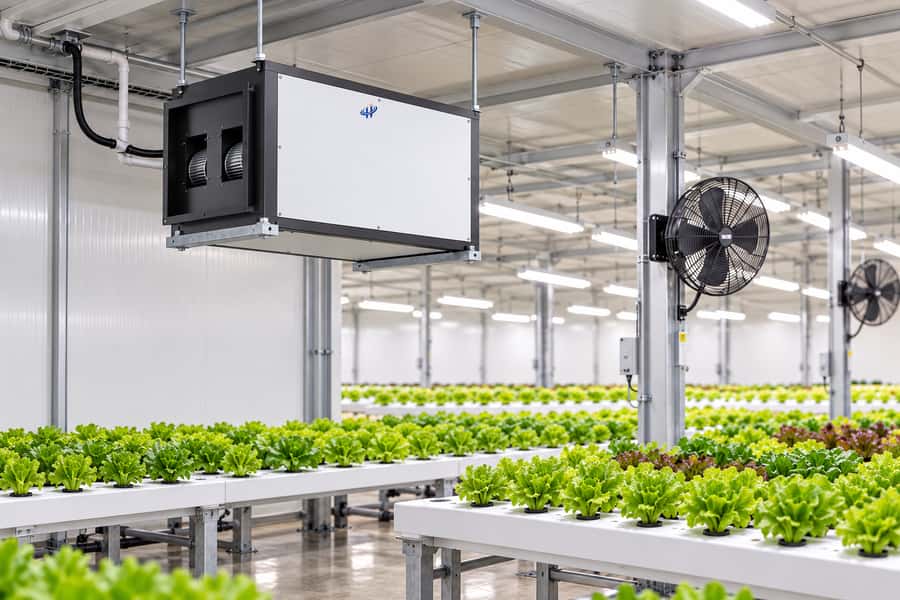
Distribute Air Evenly Across the Growing Canopy
Uneven airflow can create localized humidity problems that are not obvious from a single sensor reading. Dense foliage, narrow aisles, shelving, and equipment enclosures may restrict circulation and allow moist air to accumulate.
Review fan locations, supply-air outlets, return-air paths, and obstructions. Measure conditions at representative points, including areas inside or near the canopy where airflow is weakest.
The goal is to distribute air without creating damaging drafts or excessive differences in temperature between growing zones. Fan placement should support both plant health and the performance of the dehumidification system.
Check Pipes and Building Surfaces for Condensation Risk
A surface at or below the local dew point can collect liquid water from humid room air. This can happen on chilled-water pipes, cold supply ducts, exterior walls, or other surfaces exposed to moist room air.
Growers should compare surface temperatures with the room’s dew point, especially in areas where water droplets have appeared previously. Insulating cold surfaces, sealing air leaks, and improving humidity control can reduce condensation risks.
Inspect insulation joints and vapor barriers for discontinuities that could let moisture collect out of sight. If condensation persists, investigate both the surface temperature and the surrounding air conditions rather than assuming that higher dehumidifier output alone will resolve the problem.
Control Moisture Around Roots and Nutrient Systems
Hydroponic facilities need adequate moisture in the root zone, but uncontrolled water accumulation around the growing area can create avoidable problems. Standing water, clogged drains, leaking fittings, and wet floors should be addressed promptly.
Reservoir covers and suitable drainage designs can reduce evaporation while preserving access for nutrient management and cleaning. Keeping these areas dry supports cleaning routines and avoids adding an unnecessary evaporation load.
Install Humidity Sensors and Automated Controls
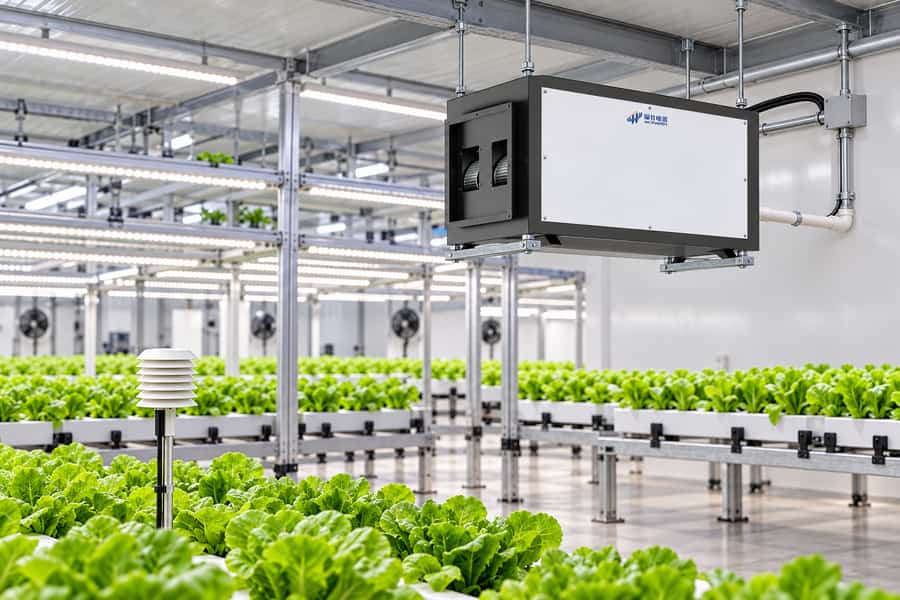
Measure Temperature and Humidity at Multiple Locations
A single wall-mounted sensor may not represent the conditions experienced by plants throughout a large commercial room. Sensors should be placed in representative crop zones, with additional measurements in areas known to have poor circulation or unusual thermal conditions.
Avoid placing sensors directly beside supply-air outlets, humidifiers, open water surfaces, or heat-producing equipment unless those specific conditions are being monitored intentionally.
Regular calibration and comparison between sensors help identify inaccurate readings. Monitoring should include both temperature and RH so that operators can evaluate VPD and dew point when needed.
Configure Automated Dehumidification Setpoints
Automated controls can activate dehumidifiers when RH exceeds the selected target and coordinate operation with HVAC equipment. More advanced systems may use temperature, VPD, lighting schedules, and other environmental measurements to adjust operating strategies.
Setpoints should reflect crop requirements and avoid rapid, unnecessary cycling. Where appropriate, separate daytime and nighttime settings can account for changes in temperature and plant activity.
Controls should also include appropriate delays, operating limits, and alarms. These safeguards help prevent conflicting commands between cooling and dehumidification equipment.
Set Alarms and Track Environmental Trends
Data logging helps growers understand when and where humidity problems occur. Useful records include temperature, RH, dehumidifier runtime, lighting schedules, and relevant HVAC operating conditions.
Alerts can identify sustained high humidity, unusual nighttime spikes, sensor failures, and equipment that runs longer than expected. Reviewing trends over several days can reveal recurring issues that are difficult to diagnose from occasional manual readings.
Troubleshoot Common Humidity Control Problems
High Humidity After Grow Lights Turn Off
If RH rises after lights switch off, check whether room temperature is falling faster than moisture is being removed. Continued transpiration, reduced cooling-coil operation, and insufficient nighttime dehumidification may contribute to the increase.
Review the control sequence and verify that dehumidification remains available during the transition. If the problem persists, assess actual moisture-removal capacity and nighttime airflow rather than simply lowering the RH setpoint.
Uneven Humidity Between Growing Zones
Different readings across a room may indicate restricted airflow, varying canopy density, inconsistent supply-air distribution, or incorrect sensor placement.
Compare measurements from several locations and inspect circulation fans, return-air paths, and obstructions. If one zone remains consistently humid, consider adjusting airflow or providing more targeted moisture removal rather than increasing the entire room’s output unnecessarily.
Dehumidifiers Running Continuously
Continuous operation may indicate a high moisture load, inadequate equipment capacity, poor air sealing, a clogged filter, drainage problems, or an incorrect sensor reading.
Check the unit’s operating condition, clean filters as required, verify condensate drainage, and inspect potential moisture sources. Confirm the equipment’s actual performance under the room’s operating temperature and RH before deciding whether additional capacity is necessary.
Excessively Dry Conditions
Humidity that falls below the desired range may indicate excessive moisture removal, unsuitable control settings, or a mismatch between equipment output and the current crop load.
Review setpoints, operating schedules, and sensor accuracy. Young plants or rooms with lower transpiration may require a different operating strategy from mature, densely planted areas. Any humidity increase should follow crop-specific requirements and maintain appropriate disease-prevention practices.
Maintain Efficient and Reliable Humidity Control
Clean Filters and Inspect Drainage Systems
Routine maintenance helps preserve airflow and moisture-removal performance. Set the filter inspection interval using the equipment manual and the dust levels observed in the facility, then clean or renew filters as specified.
Condensate drains, collection pans, pumps, and discharge lines should be checked for blockages, leaks, and standing water. Heat exchangers and other components should also receive scheduled inspections to maintain reliable operation.
Maintenance records make it easier to identify recurring faults and determine whether declining performance results from equipment condition rather than changing crop requirements.
Review Humidity Data and Seasonal Changes
As plants mature, transpiration loads may increase, and the original environmental settings may no longer be appropriate. Outdoor temperature and moisture conditions can also change ventilation effectiveness throughout the year.
Review recorded data regularly and compare performance across different crop stages and operating periods. When humidity repeatedly exceeds the target, investigate the underlying cause before changing settings or replacing equipment.
Balance Energy Consumption and Environmental Stability
Dehumidification can consume substantial energy in commercial hydroponic facilities, particularly when moisture loads are high and systems operate for long periods. Energy use is affected by how the room controller sequences cooling, heating, air exchange, circulation, and moisture extraction.
Practical measures include reducing unnecessary evaporation, sealing unwanted air leaks, maintaining clean filters, optimizing airflow, and using controls that respond to actual room conditions.