
Summer greenhouse management requires coordinated temperature and humidity control. Excessive heat can stress crops, while high humidity may restrict transpiration, encourage condensation, and increase disease risks.
Combine ventilation, shading, evaporative cooling, air circulation, and mechanical dehumidification according to crop requirements and outdoor conditions. Coordinating these systems helps maintain suitable growing conditions while managing energy and water consumption.
Why Greenhouse Cooling and Dehumidification Must Work Together
The Impact of High Temperatures on Crop Growth
Greenhouses can accumulate heat rapidly during summer as sunlight warms plants, growing media, equipment, and structural surfaces. Without adequate heat removal, the crop can experience temperatures above its preferred growing range.
Excessive heat can cause several problems:
- Reduced photosynthesis: Heat stress can interfere with photosynthetic processes and limit plant growth.
- Increased water demand: Higher temperatures may increase transpiration and irrigation requirements.
- Flower and fruit damage: Sensitive crops may experience poor fruit set, flower abortion, or reduced product quality.
- Root zone stress: Overheated growing media can impair roots and restrict the water supplied to shoots.
Ventilation, shading, and suitable cooling equipment help reduce these risks. However, lowering air temperature alone does not guarantee a suitable greenhouse environment.
The Risks of Excessive Greenhouse Humidity
Greenhouse humidity increases when moisture released by plants, irrigation, wet surfaces, and growing media accumulates faster than it can be removed.
High relative humidity can reduce the vapor pressure gradient between leaves and surrounding air, limiting transpiration under certain conditions. Check crop leaves and glazing against the measured dew point: any colder surface is a potential site for water droplets.
Common risks include:
- Increased disease pressure when humid conditions and prolonged leaf wetness favor certain pathogens.
- Localized moisture accumulation in dense crop canopies with insufficient airflow.
- Condensation on leaves, structural components, and equipment.
- Reduced transpiration under unsuitable vapor pressure deficit (VPD) conditions.
Humidity targets should reflect crop species, growth stage, and production requirements rather than a single universal percentage.
Why Cooling and Humidity Control Can Conflict
Some cooling methods introduce moisture into greenhouse air. Evaporative cooling systems, including fan-and-pad equipment and fogging systems, lower air temperature by evaporating water.
These methods can work well in hot, dry weather but become less effective when outdoor humidity is high. Excessive fogging may also increase indoor humidity and create unfavorable conditions for crops.
Mechanical dehumidifiers remove water vapor but consume energy, and refrigerant models typically release heat into the surrounding space. Cooling equipment must also handle the heat discharged by these units.
Growers must therefore consider temperature and humidity together when choosing equipment and establishing operating schedules.
How to Determine Greenhouse Temperature and Humidity Targets
Set Climate Targets Based on Crop Requirements
Different crops have different environmental preferences. A climate suitable for leafy vegetables may not be appropriate for flowering crops, fruiting vegetables, or ornamental plants.
Before adjusting equipment, consider:
- Crop species: Establish suitable temperature and humidity ranges for the specific plants being grown.
- Growth stage: Seedlings, vegetative plants, flowering crops, and fruiting plants may require different settings.
- Day and night conditions: Solar radiation increases daytime heat loads, while nighttime cooling can increase condensation risk.
- Production system: Hydroponic and soil-based greenhouses may have different moisture sources and management requirements.
- Local climate: Outdoor temperature, humidity, sunlight, and wind influence the effectiveness of ventilation and evaporative cooling.
Review these factors regularly and adjust control settings as crop requirements and weather conditions change.
Monitor Relative Humidity, Dew Point, and VPD
Three measurements help growers understand greenhouse conditions more accurately.
- Relative humidity (RH): Expresses measured water vapor pressure as a percentage of the saturation value for the same air temperature.
- Dew point: Gives the cooling threshold at which an air sample, with unchanged pressure and moisture content, first reaches saturation.
- Vapor pressure deficit (VPD): Quantifies the vapor pressure gap driving evaporation. Air VPD uses air temperature; estimating leaf-to-air VPD also requires leaf temperature.
Heating or cooling shifts the RH reading without necessarily adding or extracting any water. Decisions about heat removal and drying need temperature and moisture information together.
Identify Temperature and Humidity Imbalances
A single sensor may not represent conditions throughout a large greenhouse. Install sensors at representative canopy locations, near known problem areas, and in zones with different sunlight exposure or airflow.
Position sensors away from direct sunlight and irrigation spray unless those conditions are specifically being measured.
Multiple monitoring points help identify stagnant-air zones, uneven cooling, and localized humidity problems before they affect a larger crop area.
Choose the Right Greenhouse Cooling Methods for Summer
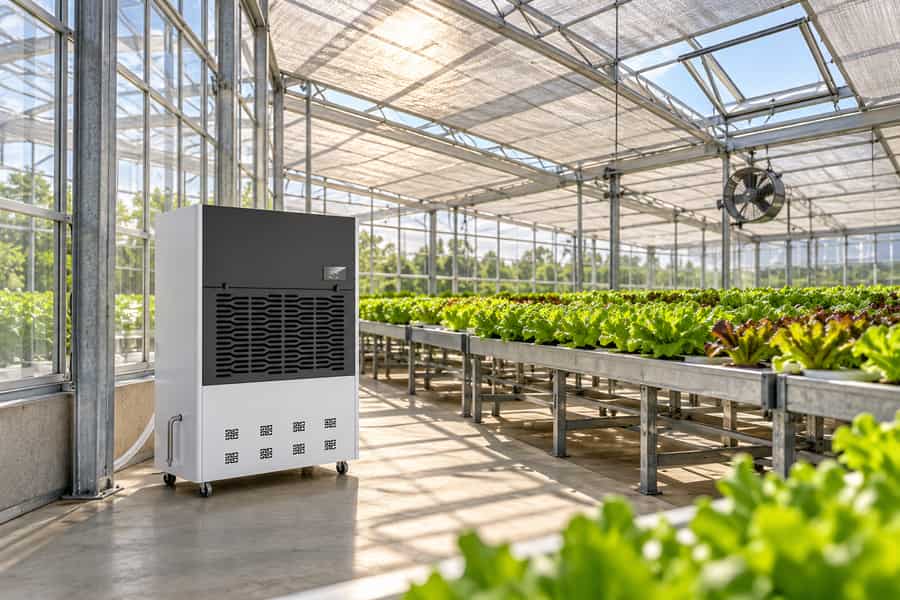
Use Natural and Mechanical Ventilation
Ventilation exchanges warm greenhouse air with outdoor air, helping remove accumulated heat and potentially excess moisture.
Common options include roof vents, side vents, exhaust fans, and strategically positioned air inlets. Their effectiveness depends on vent area, fan capacity, wind conditions, and resistance from crops and greenhouse structures.
However, ventilation may provide insufficient cooling during extreme heat. Moisture can accumulate instead of leaving if replacement air has a higher humidity ratio.
Before increasing ventilation to control humidity, compare indoor and outdoor dew points or humidity ratios.
Reduce Solar Heat Gain with Greenhouse Shading
Shading limits incoming solar radiation, reducing the amount of heat that cooling equipment must remove.
Common options include external shade materials, internal curtains, and suitable greenhouse coverings.
Benefits include:
- Lower heat accumulation during intense sunlight.
- Reduced temperature peaks in exposed crop areas.
- Lower demand on cooling equipment.
- More stable conditions during periods of strong solar radiation.
Excessive shading, however, can reduce the light available for photosynthesis. Adjustable curtains allow growers to balance temperature control with crop light requirements throughout the day.
Apply Evaporative Cooling When Conditions Are Suitable
Fan-and-pad systems draw air through wetted pads, cooling it as water evaporates. Fogging systems release fine droplets that evaporate within the greenhouse.
Both methods can reduce temperatures, particularly in hot, dry climates. Their performance depends on outdoor humidity, airflow, evaporation time, and system design.
To improve results:
- Check outdoor humidity before activating evaporative cooling.
- Maintain clean pads and functioning nozzles.
- Ensure adequate air movement through crop areas.
- Monitor humidity and leaf wetness during operation.
- Reduce or suspend fogging if moisture accumulates excessively.
The objective is to obtain useful cooling without introducing more moisture than the greenhouse can manage.
Control Greenhouse Humidity Without Compromising Cooling
Use Ventilation for Moisture Removal
Ventilation is often the simplest way to remove excess moisture when outdoor air conditions support drying. Humid indoor air leaves the greenhouse while replacement air enters.
Before increasing air exchange, evaluate indoor and outdoor temperature, humidity, dew point, and cooling demand.
Relative humidity alone can be misleading because warm air with a lower RH may still contain substantial moisture. Comparing dew point or humidity ratio provides a better indication of whether outdoor air can help reduce indoor moisture.
Apply Mechanical Dehumidification When Needed
Mechanical dehumidification is useful when outdoor air is too humid for effective moisture removal or when the greenhouse requires tighter environmental control.
Refrigerant dehumidifiers cool moist air across a coil, causing water vapor to condense. A desiccant unit captures moisture on a sorbent and then regenerates that material, providing another option where the required dryness and operating conditions justify it.
When selecting equipment, consider:
- Capacity: Match moisture removal performance to the greenhouse’s actual moisture load.
- Operating conditions: Verify performance across expected temperatures and humidity levels.
- Energy consumption: Evaluate electricity requirements and operating costs.
- Heat output: Account for heat released by refrigerant equipment.
- Drainage: Provide reliable condensate removal.
- Control compatibility: Ensure the unit can operate alongside ventilation and cooling systems.
The following table summarizes the main methods.
| Method | Primary Function | Main Limitation |
| Ventilation | Removes heat and potentially moisture | Depends on outdoor conditions |
| Shade curtains | Reduces solar heat gain | May reduce available light |
| Fan-and-pad cooling | Lowers incoming air temperature | Adds moisture |
| Fogging | Cools air through evaporation | May increase humidity and leaf wetness |
| Mechanical dehumidifiers | Removes water vapor | Consumes energy and may add heat |
| Horizontal airflow fans | Improves air distribution | Does not independently remove moisture |
Improve Air Circulation and Prevent Condensation
Horizontal airflow fans distribute air through crop rows and canopy areas, reducing stagnant zones and localized differences in temperature and humidity.
However, air circulation alone does not remove water vapor. It must work alongside ventilation or dehumidification when overall moisture levels are excessive.
To reduce condensation risk:
- Maintain airflow through dense crop canopies.
- Avoid excessive air velocity around sensitive plants.
- Monitor leaf and surface temperatures as nighttime cooling begins.
- Manage irrigation and misting schedules to avoid unnecessary moisture accumulation.
- Use dew point measurements to identify surfaces at risk of condensation.
Coordinate Cooling and Dehumidification Systems
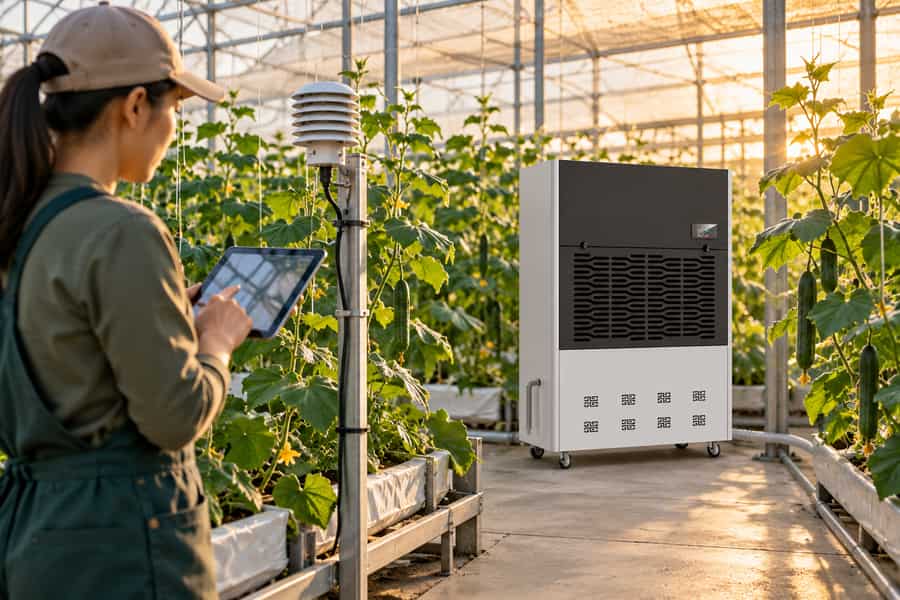
Establish Temperature and Humidity Control Priorities
A coordinated control strategy should respond to temperature and moisture conditions simultaneously. When temperatures rise but humidity remains suitable, shading, ventilation, or evaporative cooling may be appropriate.
For simultaneous overheating and excess moisture, first check whether the proposed air exchange can export water under the current outdoor conditions. Mechanical dehumidification may be necessary when ventilation cannot achieve the required balance.
| Greenhouse Condition | Preferred Response | Key Consideration |
| High temperature, low humidity | Ventilation or evaporative cooling | Check outdoor cooling potential |
| High temperature, high humidity | Shading and suitable cooling with moisture control | Avoid unnecessary moisture addition |
| Acceptable temperature, high humidity | Effective ventilation or dehumidification | Compare indoor and outdoor moisture content |
| Falling nighttime temperature, high humidity | Reduce moisture inputs and manage humidity | Monitor condensation risk |
| Stable temperature and humidity | Maintain circulation and monitoring | Avoid unnecessary equipment operation |
Actual operating decisions should reflect crop requirements, outdoor conditions, and equipment limitations.
Coordinate Fans, Cooling Pads, Fogging, and Dehumidifiers
Independent equipment controls can work against one another. For example, fogging may continue adding moisture while a dehumidifier removes it. Exhaust fans may also discharge conditioned air, increasing the load on cooling equipment.
A greenhouse controller can reduce these conflicts by using sensor data and defined operating rules.
Recommended practices include:
- Set separate temperature and humidity thresholds for equipment activation.
- Use suitable deadbands to prevent rapid cycling.
- Apply interlocks when simultaneous operation would be inefficient.
- Coordinate ventilation, evaporative cooling, and dehumidification according to current conditions.
- Monitor equipment performance and review energy and water consumption.
More advanced controllers can also incorporate outdoor weather data and solar radiation to improve operating decisions.
Adjust Equipment Operation Throughout the Day
Greenhouse conditions change with sunlight, outdoor weather, and plant water use.
Morning
- Check overnight humidity and condensation.
- Remove accumulated moisture when outdoor conditions support drying.
- Prepare shading and ventilation for increasing solar radiation.
Midday
- Prioritize heat management during strong sunlight.
- Adjust shading without unnecessarily limiting crop light.
- Use evaporative cooling when conditions are suitable.
- Monitor humidity and activate dehumidification when necessary.
Evening and nighttime
- Reduce unnecessary fogging and moisture inputs.
- Monitor falling temperatures and dew point.
- Maintain suitable canopy airflow.
- Use ventilation or dehumidification when conditions support effective moisture removal.
Common Mistakes in Summer Greenhouse Climate Control
Running Evaporative Cooling Without Monitoring Humidity
Continuous fogging or fan-and-pad operation may increase humidity beyond the crop’s preferred range.
Improvement: Monitor temperature and humidity together, adjusting evaporative cooling to current outdoor conditions.
Ventilating Without Checking Outdoor Moisture
Outdoor air may contain more water vapor than indoor air, even when its relative humidity is lower.
Improvement: Compare dew point or humidity ratio before using ventilation primarily for moisture removal.
Selecting Dehumidifiers Based Only on Greenhouse Area
Floor area alone does not determine moisture removal requirements. Crop density, irrigation, ventilation, and outdoor humidity also affect the moisture load.
Improvement: Estimate moisture generation and verify equipment capacity under actual operating conditions.
Ignoring Sensor Placement and Nighttime Condensation
Poorly positioned sensors may not reflect crop-level conditions. Meanwhile, nighttime cooling can raise relative humidity and cause surfaces to reach the dew point.
Improvement: Monitor representative crop zones, review nighttime trends, and adjust airflow and moisture removal accordingly.
How to Develop a Practical Summer Climate Control Plan
Assess Greenhouse Conditions and Equipment Capacity
Record greenhouse dimensions, crop requirements, indoor and outdoor climate data, irrigation schedules, and existing equipment specifications. Identify whether the primary problem is excessive heat, moisture accumulation, uneven airflow, or insufficient equipment capacity.
Establish Operating Setpoints and Control Sequences
Define crop-specific temperature and humidity targets, then determine when ventilation, shading, evaporative cooling, and dehumidification should operate.
Specify equipment priorities, suitable start-and-stop thresholds, and responses to simultaneous high temperature and humidity. Review the settings as crop growth and seasonal weather change.
Track Performance and Refine Settings
Monitor temperature stability, humidity trends, condensation, energy use, water consumption, and crop condition.
If humidity repeatedly rises after afternoon fogging, adjust the fogging schedule or operating threshold. If nighttime condensation persists, review canopy airflow and moisture removal.
Regular evaluation helps growers refine control settings and maintain a more stable greenhouse environment without operating every system continuously.