
20L dehumidifiers generally suit smaller rooms with moderate humidity, 30L units offer more capacity for medium-sized spaces, and 50L models are better suited to larger or wetter environments.
Assess the space itself—its dimensions and temperature—then consider where moisture comes from, how air enters and leaves, and how humidity varies through the day. Comparing rated capacities alone cannot guarantee suitable performance.
What Do 20L, 30L, and 50L Dehumidifier Capacities Mean?
The numbers 20L, 30L, and 50L indicate a dehumidifier’s rated moisture removal capacity, measured in liters per 24 hours under specified testing conditions.
Higher-capacity models can potentially remove more moisture, but actual performance depends on temperature, relative humidity, and equipment efficiency.
Daily Dehumidification Capacity
Each capacity rating represents a different level of moisture removal:
- 20L Dehumidifier: Rated to remove 20 liters of moisture per day.
- 30L Dehumidifier: The rating describes 30 liters extracted during a 24-hour test, with the test environment specified by the manufacturer.
- 50L Dehumidifier: Rated to remove 50 liters of moisture per day.
These figures describe performance under specified test conditions rather than guaranteed water removal in every environment.
For example, a 30L dehumidifier may collect substantially less than 30 liters daily in a cool room with moderate humidity.
Dehumidification Capacity vs. Water Tank Capacity
Dehumidification capacity and water tank capacity are different specifications, although both use liters as their measurement unit.
- Dehumidification Capacity: The amount of moisture removed within 24 hours under specified conditions.
- Water Tank Capacity: The amount of condensed water the collection tank can hold before emptying.
A 30L dehumidifier does not necessarily have a 30-liter water tank. Its collection tank may be considerably smaller.
For continuous operation, models with drainage hoses or condensate pumps can discharge collected water without frequent manual emptying.
Why Testing Conditions Matter
Manufacturers measure dehumidification capacity under specified temperature and humidity conditions. Different testing standards may produce different rated capacities for comparable equipment.
A unit operating in warm, humid air generally removes more water than the same machine operating in cooler, drier conditions.
When comparing capacities, check these specifications:
- Testing Temperature: The air temperature used during capacity measurement.
- Testing Humidity: The relative humidity maintained during testing.
- Operating Range: The temperature and humidity conditions supported by the equipment.
Comparing products under equivalent testing conditions provides a more accurate understanding of their moisture removal capabilities.
20L vs. 30L vs. 50L Dehumidifiers: Key Differences
The main difference between these dehumidifiers is their rated daily moisture removal capacity. Higher-capacity units generally suit environments with greater moisture loads.
However, equipment dimensions, energy consumption, operating noise, and drainage requirements also influence which capacity is most appropriate.
| Comparison Factor | 20L Dehumidifier | 30L Dehumidifier | 50L Dehumidifier |
| Rated Capacity | 20 L/day | 30 L/day | 50 L/day |
| Space Suitability | Smaller rooms | Medium-sized rooms | Larger spaces |
| Moisture Load | Moderate | Moderate to high | Higher |
| Common Applications | Bedrooms, offices | Living rooms, basements | Large basements, storage |
| Equipment Size | Often compact | Often medium-sized | Often larger |
| Energy Consideration | Check efficiency for lighter loads | Balance capacity and runtime | Compare efficiency under heavier loads |
| Installation Priority | Compact placement | Capacity and airflow | Drainage and airflow |
| Drainage | Tank or hose | Tank or hose | Continuous drainage often useful |
These comparisons are general guidelines. Actual performance and suitable room size depend on environmental conditions and product specifications.
Moisture Removal Performance
A 50L dehumidifier has 2.5 times the rated daily capacity of a 20L model when both ratings use comparable testing conditions.
However, higher rated capacity does not guarantee proportionally greater moisture removal during normal operation.
The actual amount of water collected depends on available moisture, room temperature, and how frequently humid air enters the space.
- 20L: Suitable for relatively low or moderate moisture loads.
- 30L: Provides additional capacity for changing humidity conditions.
- 50L: Better suited to substantial or persistent moisture loads.
A larger dehumidifier may offer little additional benefit if a smaller unit already maintains the desired humidity efficiently.
Equipment Size and Installation
Higher-capacity dehumidifiers may require larger compressors, heat exchangers, and fans, although the exact dimensions depend on equipment design.
Before choosing a model, consider:
- Installation Space: Available floor area and equipment dimensions.
- Airflow Clearance: Space around air inlets and outlets.
- Electrical Supply: Compatible voltage, frequency, and electrical load.
- Drainage: Convenient water collection or continuous discharge.
- Noise: Acceptable sound levels for the intended environment.
Capacity should match the moisture load while remaining compatible with the room’s installation and operating requirements.
Which Dehumidifier Capacity Is Best for Your Space?
The appropriate capacity depends on room dimensions, moisture generation, ventilation, and environmental conditions. Different rooms of similar size may require different dehumidification capacities.
20L Dehumidifiers: Best for Smaller Spaces
A 20L dehumidifier is generally suitable for smaller residential areas with moderate humidity and relatively limited daily moisture generation.
These models are commonly considered for spaces where compact dimensions and convenient operation are important.
Typical Applications
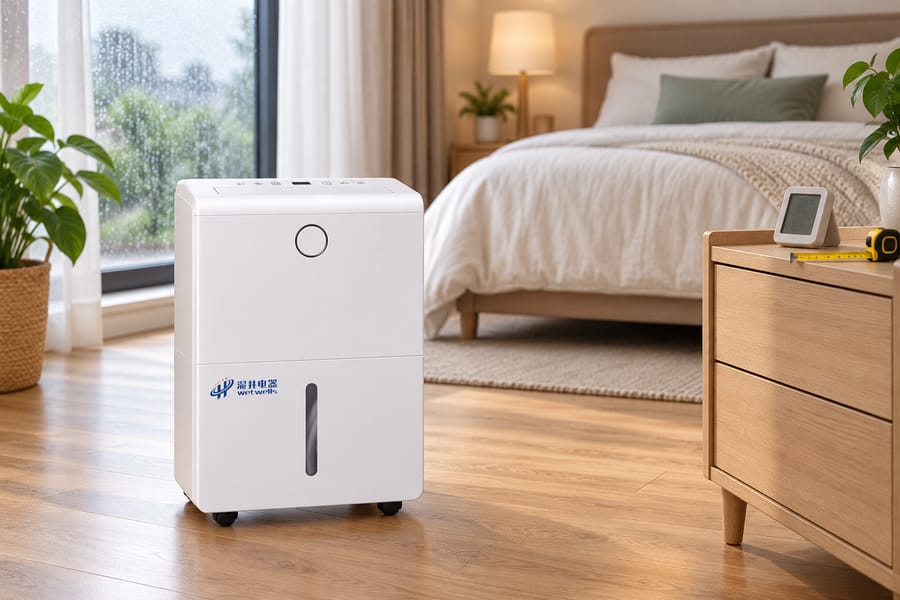
- Bedrooms: Managing seasonal humidity in sleeping areas.
- Home Offices: Controlling moisture in smaller workspaces.
- Guest Rooms: Maintaining suitable humidity during occasional occupancy.
- Small Apartments: Supporting moisture control in compact living spaces.
Key Advantages
- Often available in compact, portable designs.
- Suitable for many lower-moisture residential applications.
- Can provide sufficient capacity without unnecessarily large equipment.
- Convenient for occasional or seasonal humidity control.
Limitations
A 20L unit may struggle when moisture generation exceeds its actual removal capacity, particularly in damp basements or poorly ventilated rooms.
If the equipment operates continuously without reaching the selected humidity level, additional capacity or correction of moisture sources may be necessary.
Best Choice: Select a 20L dehumidifier when the room is relatively small and the expected moisture load is moderate.
30L Dehumidifiers: Best for Medium-Sized Spaces
A 30L dehumidifier provides greater rated moisture removal than a 20L model, making it suitable for some medium-sized rooms and more humid residential environments.
It can also provide additional capacity where humidity changes because of daily activities or outdoor weather conditions.
Typical Applications
- Living Rooms: Managing humidity in frequently occupied spaces.
- Apartments: Supporting moisture control across suitable connected rooms.
- Medium-Sized Basements: Reducing persistent humidity.
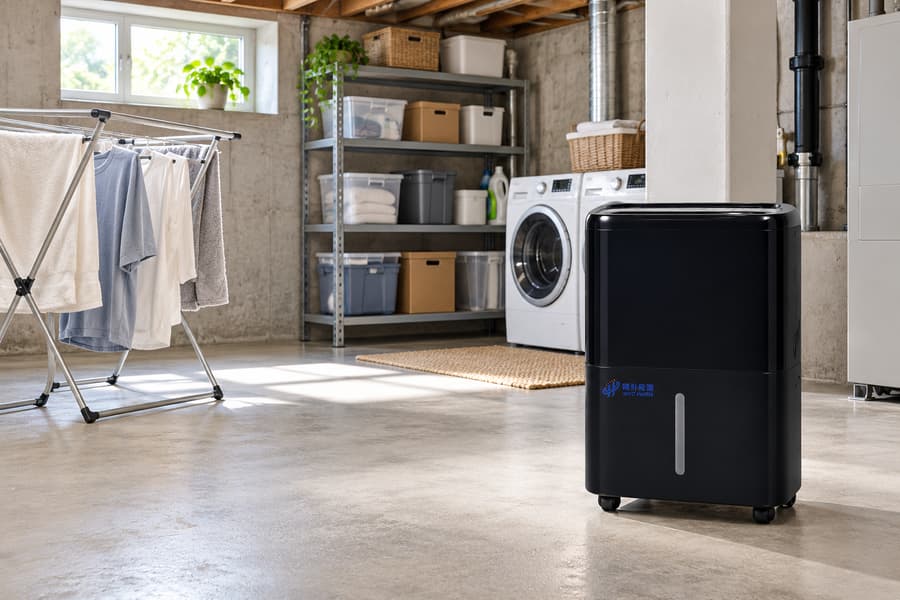
- Laundry Areas: Managing moisture from indoor clothes drying.
- Storage Rooms: Maintaining suitable conditions for stored items.
Key Advantages
- Greater rated capacity than 20L models.
- Suitable for moderate to elevated moisture loads.
- Additional capacity for fluctuating humidity conditions.
- Flexible application across different residential environments.
Limitations
A 30L dehumidifier may be unnecessarily large for a compact room with low moisture generation, while substantial dampness may exceed its capability.
Its actual performance also depends on operating temperature and the manufacturer’s testing conditions.
Best Choice: Choose a 30L model when a 20L unit provides insufficient moisture removal or the room experiences more frequent humidity increases.
50L Dehumidifiers: Best for Larger or High-Humidity Spaces
A 50L dehumidifier offers higher daily moisture removal capacity and is commonly considered for larger spaces or environments experiencing significant moisture accumulation.
These models may be suitable for residential and selected commercial applications requiring greater dehumidification capability.
Typical Applications
- Large Basements: Managing persistent moisture accumulation.
- Storage Facilities: Supporting humidity control for stored materials.
- Commercial Spaces: Handling suitable commercial moisture loads.
- Laundry Rooms: Removing moisture from frequent clothes drying.
- Large Residential Areas: Managing humidity in extensive enclosed spaces.
Key Advantages
- Higher rated moisture removal capability.
- Suitable for some persistent humidity problems.
- Additional capacity during periods of substantial moisture generation.
- Potentially shorter operating periods for comparable moisture removal tasks.
Limitations
A 50L unit may require more installation space and higher instantaneous electrical power than smaller models, depending on its design.
It may also be unnecessary in a large but relatively dry room where a smaller unit already maintains suitable humidity.
Best Choice: Consider a 50L dehumidifier when the expected moisture load exceeds the practical capacity of smaller equipment.
For demanding commercial environments, a calculated moisture load may indicate the need for an engineered dehumidification system instead.
How Do 20L, 30L, and 50L Dehumidifiers Compare in Energy Consumption?
Energy consumption is important when comparing dehumidifiers because equipment may operate for several hours daily during humid weather.
Although larger-capacity models often have higher instantaneous power requirements, daily electricity consumption depends on efficiency and operating duration.
Rated Power vs. Daily Electricity Consumption
Rated power indicates the electricity a dehumidifier consumes while operating under specified conditions.
Daily electricity consumption depends on both power and operating hours:
Energy (kWh) = Power (W) × Hours ÷ 1,000
Hypothetical Example
Consider two machines with different power requirements:
- Dehumidifier A: 350 W × 8 hours = 2.8 kWh.
- Dehumidifier B: 600 W × 5 hours = 3.0 kWh.
These calculations demonstrate electricity consumption only. They do not establish that both units remove the same quantity of moisture.
A higher-capacity dehumidifier may complete a moisture removal task faster, but lower operating time does not automatically guarantee lower total electricity consumption.
Moisture Removal Efficiency
Energy efficiency can be evaluated by measuring how much water a dehumidifier removes per kilowatt-hour of electricity consumed.
This performance indicator is expressed as liters per kilowatt-hour (L/kWh).
Higher values indicate greater moisture removal efficiency when products are compared under equivalent testing conditions.
Important efficiency factors include:
- Compressor Efficiency: Electrical energy required for moisture removal.
- Operating Temperature: Influence on condensation performance.
- Humidity Settings: Impact on operating duration.
- Airflow: Effectiveness of air circulation through the equipment.
A 20L dehumidifier is not automatically more efficient than a 50L model simply because its rated electrical power is lower.
Operating Time and Humidity Control
An undersized dehumidifier may operate continuously without reaching the desired humidity, increasing electricity consumption while delivering insufficient moisture removal.
A correctly sized unit can reduce compressor operation when the selected humidity level is reached.
To improve efficiency:
- Select a capacity appropriate for the moisture load.
- Avoid unnecessarily low humidity settings.
- Keep air inlets and filters clean.
- Reduce avoidable humid air infiltration.
- Compare manufacturer efficiency ratings under consistent conditions.
The objective is to maintain stable humidity with reasonable energy consumption rather than simply choosing the smallest or largest available machine.
How to Choose the Right Dehumidifier Capacity
Choosing between 20L, 30L, and 50L models requires evaluating the environment, moisture load, and equipment specifications.
A practical selection process can be divided into three main steps.
Consider Room Size and Humidity Levels
Room area provides a starting point, but ceiling height, air circulation, and moisture entry influence actual dehumidification requirements.
A smaller, damp basement may require more capacity than a larger room with controlled ventilation and limited moisture sources.
Measure the Space
Start by recording:
- Floor Area: Measure the room’s length and width.
- Ceiling Height: Consider total room volume.
- Room Layout: Identify connected areas and open doorways.
- Ventilation: Check whether humid outside air frequently enters.
Room dimensions alone cannot determine the required daily water removal because indoor moisture is continuously generated or exchanged with outside air.
Check Existing Humidity
Use a hygrometer to measure indoor relative humidity during normal activities and changing weather conditions.
For many residential environments, maintaining approximately 30–50% relative humidity is a practical general target, although specific applications may require different settings.
Take measurements at different times to identify persistent humidity rather than relying on one reading.
Evaluate Humidity Patterns
Consider whether humidity:
- Remains consistently high throughout the day.
- Increases during cooking or laundry drying.
- Rises during rainy or humid weather.
- Creates condensation on windows or walls.
Persistent elevated humidity may indicate higher moisture removal requirements or underlying building moisture problems.
Evaluate Temperature and Moisture Sources
Temperature affects refrigerant dehumidifier performance because the equipment removes moisture by cooling air and condensing water vapor.
In cooler conditions, actual moisture removal may be substantially lower than the rated capacity measured under warmer laboratory conditions.
Check Operating Conditions
Review the manufacturer’s specifications for:
- Temperature Range: Suitable operating temperatures.
- Defrost Function: Frost management during cooler operation.
- Humidity Range: Conditions supported by the equipment.
- Capacity Ratings: Moisture removal under relevant test conditions.
For cool basements or storage areas, low-temperature performance may be particularly important when selecting a model.
Identify Moisture Sources
The amount of moisture entering the space directly affects the required dehumidification capacity.
Common sources include:
- Laundry Drying: Water evaporating from wet clothing.
- Cooking: Steam released during food preparation.
- Occupancy: Moisture generated through everyday activities.
- Outdoor Air: Humid air entering through ventilation or leakage.
- Building Materials: Moisture released from damp walls or floors.
- Water Intrusion: Plumbing leaks or foundation seepage.
Correcting water leaks and uncontrolled moisture sources should take priority over simply increasing dehumidifier capacity.
A 50L model cannot permanently solve dampness caused by continuous water intrusion.
Check Drainage and Installation Requirements
Water drainage and installation conditions can affect the practicality of different dehumidifier capacities, especially during extended operation.
Choose the Right Drainage Method
Common options include:
- Water Tank: Convenient for accessible rooms with occasional operation.
- Gravity Drainage: Condensate can leave through a hose continuously if the route slopes down to a suitable drain.
- Pump Drainage: Supports water discharge where gravity drainage is impractical, depending on equipment configuration.
Continuous drainage is particularly useful in basements, storage facilities, and other spaces requiring uninterrupted operation.
Confirm Installation Requirements
Before purchasing, verify:
- Dimensions: Equipment fits the available space.
- Noise: Operating sound is acceptable.
- Power Supply: Electrical specifications match the installation.
- Airflow: Adequate clearance around the unit.
- Maintenance: Filters and drainage components remain accessible.
These factors are important for ensuring that the selected dehumidifier operates reliably and remains convenient to maintain.
Dehumidifier Capacity Selection by Application
The following table summarizes typical starting points for selecting 20L, 30L, and 50L dehumidifiers across different environments.
| Application | Capacity to Consider | Main Consideration |
| Small bedroom | 20L | Moderate humidity |
| Home office | 20L | Compact size and noise |
| Medium-sized living room | 20L–30L | Room volume and moisture |
| Apartment | 20L–30L | Layout and ventilation |
| Medium-sized basement | 30L | Persistent humidity |
| Large basement | 30L–50L | Moisture entry and temperature |
| Laundry area | 30L–50L | Moisture generation |
| Large storage room | 30L–50L | Storage conditions |
| Commercial space | 50L or engineered system | Calculated moisture load |
These capacities are general starting points rather than guaranteed sizing recommendations. Actual requirements depend on temperature, humidity, ventilation, and manufacturer performance ratings.
Verify Capacity Before Purchasing
Once you identify a suitable capacity range, compare products under consistent testing conditions and verify their installation requirements.
Use this final checklist:
- Capacity: Rated moisture removal in liters per day.
- Test Conditions: Temperature and humidity used for the rating.
- Efficiency: Moisture removal per unit of electricity.
- Noise: Suitability for the intended environment.
- Drainage: Water tank, gravity hose, or pump options.
- Controls: Adjustable humidity settings and automatic operation.
- Maintenance: Filter cleaning and drainage access.
For smaller rooms with moderate humidity, a 20L model may provide sufficient performance. A 30L unit offers additional capacity for medium-sized spaces.
A 50L dehumidifier is generally better suited to higher moisture loads, but room conditions and actual removal requirements should determine the final choice.
After installation, monitor humidity during normal operation to confirm that the equipment maintains the desired level without excessive runtime.