
Choosing the right dehumidifier is not about buying the largest model. A 30-pint unit suits smaller, moderately damp rooms, while 50-pint and 70-pint models fit larger or wetter spaces.
The right size depends on room area, humidity, temperature, moisture sources, and operating conditions to avoid undersizing and unnecessary energy use.
What Does “Pint” Mean on a Dehumidifier?
A dehumidifier’s pint rating indicates how much moisture it can remove within 24 hours under specified test conditions. A 50-pint model, for example, can remove about 50 pints of water per day under those conditions.
This number is different from the collection tank size. A 50-pint machine may have a much smaller water tank because the rating refers to daily moisture removal rather than storage capacity.
Many units also support continuous drainage through a hose or condensate pump. In these applications, moisture-removal capacity matters much more than bucket size.
Understanding Current vs. Older Pint Ratings
Dehumidifier capacity ratings have changed as testing standards have been updated. Older models were often tested under warmer conditions, which generally allowed them to remove more moisture during testing.
As a result, an older model carrying a 70-pint rating may not be directly comparable with a newer 70-pint model. The same equipment can receive a lower pint rating when tested under different temperature and humidity conditions.
When comparing 30-pint, 50-pint, and 70-pint models, ensure they use the same testing standards, especially when comparing older and newer products.
30-Pint vs. 50-Pint vs. 70-Pint Dehumidifiers: Quick Comparison
The main difference between these capacities is how quickly they can remove moisture. Higher-capacity units are generally better for larger areas, wetter conditions, or spaces where moisture continuously enters.
| Feature | 30-Pint | 50-Pint | 70-Pint |
| Moisture Removal | Low–Medium | Medium–High | High |
| Typical Space | Small–Medium | Medium–Large | Large |
| Humidity Conditions | Mild–Moderate | Moderate–High | High–Severe |
| Common Applications | Bedrooms, laundry rooms | Basements, apartments | Large basements, garages |
| Power Demand | Generally Lower | Medium | Generally Higher |
| Physical Size | Compact | Medium | Larger |
| Best For | Local humidity | General home use | Heavy moisture loads |
A 600-square-foot basement with damp walls may require more dehumidification than a 1,000-square-foot living room with only slightly elevated humidity.
What Is a 30-Pint Dehumidifier Best For?
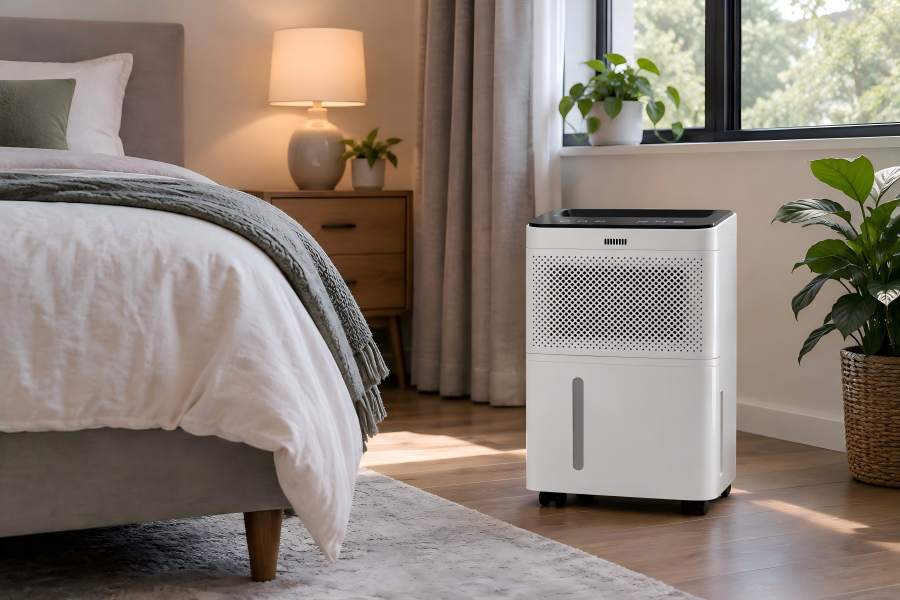
A 30-pint dehumidifier is generally suitable for smaller residential spaces with mild to moderate humidity. It works especially well when moisture is limited to one room rather than affecting the entire home.
Typical applications include:
- Bedrooms
- Home offices
- Laundry rooms
- Small apartments
- Small basements
- Storage rooms
- Moderately damp residential areas
For example, a bedroom that reaches around 60% RH during humid summer weather but has no condensation or water intrusion may be adequately controlled by a 30-pint unit.
Advantages of a 30-Pint Dehumidifier
One advantage is its smaller footprint. Compact units are easier to place in bedrooms, offices, laundry rooms, and other areas where available floor space is limited.
They may also use less electricity while running and are generally easier to move between rooms. For localized or seasonal humidity, this flexibility can be useful.
When 30 Pints May Not Be Enough
A 30-pint unit can become undersized when moisture continuously enters the space. Damp foundations, groundwater, indoor laundry drying, or RH levels above 70% can significantly increase the moisture load.
In these conditions, the unit may run almost continuously without reaching the selected RH. Moving to a 50-pint model may provide better moisture control and reduce excessive runtime.
What Is a 50-Pint Dehumidifier Best For?
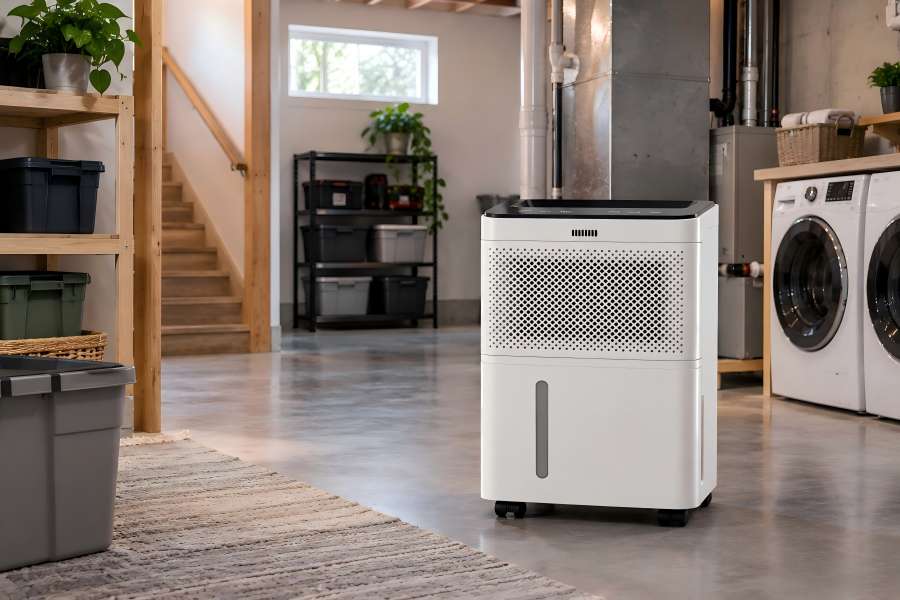
A 50-pint dehumidifier provides a useful balance between moisture-removal capacity, equipment size, and residential energy use. It can handle more demanding conditions without requiring a very large machine.
Typical applications include:
- Medium and large basements
- Apartments
- Living areas
- Garages
- Laundry rooms
- Storage spaces
- Multi-purpose residential areas
A 50-pint unit is particularly useful when humidity changes significantly throughout the year. The additional capacity can help handle summer humidity peaks more effectively than a smaller model.
Why 50-Pint Models Are a Popular Middle Ground
Consider two 800-square-foot basements. Basement A stays around 55–60% RH and has no visible moisture problems, while Basement B reaches 75% RH and develops damp walls after heavy rain.
Even though their floor areas are identical, Basement B has a much higher moisture load. A 30-pint model may work in Basement A, while Basement B may require 50 pints or more.
This is why dehumidifier sizing should consider both room size and moisture conditions rather than relying entirely on square-foot coverage.
What Is a 70-Pint Dehumidifier Best For?
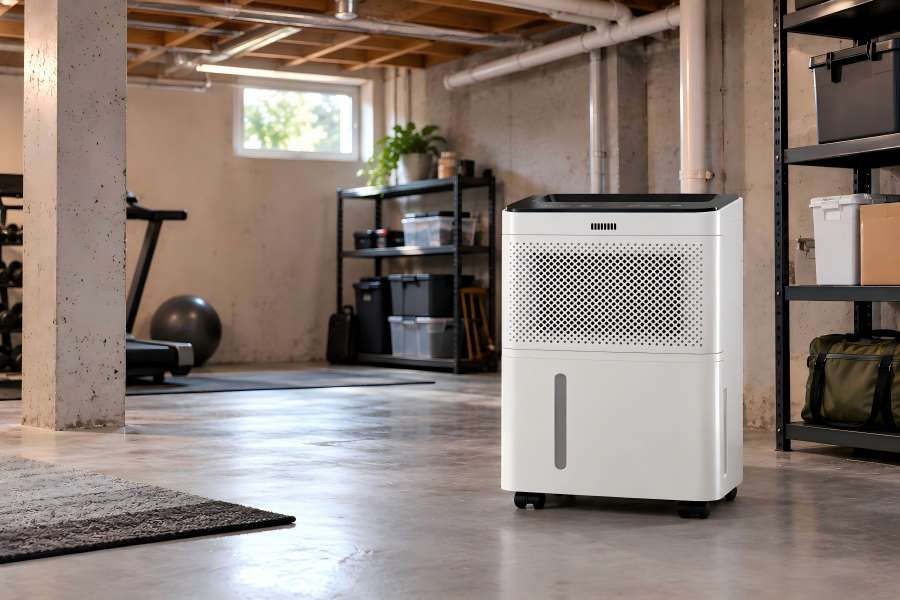
A 70-pint dehumidifier is intended for heavier moisture loads. When compared under the same rating conditions, its higher capacity allows it to remove more water over the same operating period.
Typical applications include:
- Large basements
- Very damp garages
- Large open-plan areas
- Storage rooms
- High-humidity environments
- Areas with significant moisture infiltration
Higher capacity can be particularly useful where moisture enters continuously through foundation walls, humid outdoor air, frequent door opening, or other ongoing sources.
Advantages of Higher Capacity
The biggest advantage is faster moisture removal. After several days of humid weather, a larger dehumidifier can generally bring elevated RH down faster than a smaller unit operating under similar conditions.
Additional capacity also provides a reserve for unusually wet weather. A unit that performs well under normal conditions may struggle when outdoor humidity remains high for several days.
When a 70-Pint Unit May Be Too Large
Higher capacity is not automatically better. Larger units may cost more, occupy more floor space, move more air, and produce more noticeable operating noise.
For a small bedroom with only mildly elevated humidity, a 70-pint unit would normally provide little practical advantage. The goal is to match capacity to the moisture load rather than simply choosing the highest rating.
How Much Area Can Each Dehumidifier Handle?
Manufacturers often advertise dehumidifiers using maximum square-foot coverage. These figures are useful for comparison, but actual capacity requirements can change significantly depending on humidity conditions.
| Room Condition | 30-Pint | 50-Pint | 70-Pint |
| Mildly Damp | Small–Medium Space | Medium–Large Space | Large Space |
| Moderately Damp | Small–Medium Space | Medium–Large Space | Large Space |
| Very Damp | Limited | Medium Space | Medium–Large Space |
| Extremely Wet | Usually Undersized | May Be Suitable | Better for Heavy Loads |
A mildly damp 1,000-square-foot room may need less capacity than a wet 500-square-foot basement. Moisture load should therefore always be considered together with floor area.
Room Size Is Not the Only Factor
Square footage is easy to measure, but it does not tell the whole story. Relative humidity, temperature, water sources, air leakage, and ceiling height can all change the amount of moisture a dehumidifier needs to remove.
Current Relative Humidity
Start by measuring RH with a hygrometer. The same room can require very different capacity depending on whether humidity is 55%, 70%, or above 80%.
As a simple reference:
- 50–60% RH: Mildly elevated humidity
- 60–70% RH: Moderate humidity problem
- 70–80% RH: High humidity
- Above 80% RH: Severe moisture conditions
Higher RH generally means the machine must remove more moisture before reaching the target. Very damp materials can also continue releasing moisture back into the room after the air begins to dry.
Room Temperature
Most portable household dehumidifiers use refrigeration. Moist air moves across a cooled evaporator coil, where water vapor condenses and is then collected or drained.
In cooler rooms, refrigerant dehumidifiers may remove less moisture, and frost can develop on the evaporator coil. Automatic defrost is therefore particularly useful in basements, garages, and other cool spaces.
Water and Moisture Sources
Identifying where the moisture comes from is just as important as choosing the dehumidifier capacity.
Common moisture sources include:
- Damp foundations
- Groundwater
- Plumbing leaks
- Laundry drying
- Bathrooms and showers
- Cooking
- Outdoor humid air
- Wet building materials
A dehumidifier can control water vapor in the air, but it should not replace repairs to active leaks or serious water intrusion. Reducing the original moisture source can significantly lower the dehumidification load.
Air Leakage and Ventilation
Rooms are rarely completely sealed. Moist outdoor air can infiltrate through doors, windows, cracks, ventilation openings, and other leaks.
A basement with frequent outdoor-air infiltration may require the dehumidifier to run much longer than a tightly sealed basement of exactly the same size.
Ceiling Height
Square footage measures floor area but does not account for total room volume.
For example:
1,000 ft² × 8 ft = 8,000 ft³
With a 12-foot ceiling:
1,000 ft² × 12 ft = 12,000 ft³
The second room has 50% more air volume. High ceilings, open staircases, and connected rooms should therefore be considered when sizing the equipment.
How to Choose the Right Pint Capacity
Instead of selecting a dehumidifier entirely from a square-foot chart, use a simple step-by-step process that considers both the space and its moisture conditions.
Step 1: Measure the Space
Calculate the floor area:
Length × Width = Floor Area
For example:
30 ft × 25 ft = 750 ft²
For rooms with unusually high ceilings, calculate the approximate volume as well:
Length × Width × Height = Room Volume
Step 2: Measure the Humidity
Use a digital hygrometer to measure RH before operating the dehumidifier. This gives you a more reliable sizing reference than simply deciding whether the room feels humid.
If possible, take readings at different times. Humidity can change considerably overnight, after heavy rain, or when laundry and other moisture-producing activities are taking place.
Step 3: Identify the Moisture Condition
Look at the physical condition of the room as well as the RH number. Mild dampness may only produce occasional musty odors, while severe conditions can cause condensation, wet walls, or water seepage.
The more severe these conditions become, the more moisture-removal capacity you are likely to need.
Step 4: Consider the Room Type
Different spaces can produce very different moisture loads even when they have the same floor area.
A 400-square-foot bedroom may have relatively little moisture generation, while a 400-square-foot laundry room may receive moisture from washing, wet clothing, plumbing, and frequent activity.
Basements often need additional capacity because moisture can also enter through foundation walls and floors.
Step 5: Add Capacity for Difficult Conditions
Consider moving toward a higher-capacity unit when the space has:
- High outdoor humidity
- Frequent door opening
- Poor air sealing
- Indoor laundry drying
- Damp foundation walls
- High ceilings
- Several connected rooms
- Persistent RH above the target
Some additional capacity can also help the machine handle unusually humid summer conditions without operating continuously.
30-Pint vs. 50-Pint: Which Should You Choose?
The choice between 30 and 50 pints usually comes down to room size, moisture severity, and how much reserve capacity you want.
| Factor | 30-Pint | 50-Pint |
| Capacity | Lower | Higher |
| Equipment Size | Smaller | Usually Larger |
| Portability | Better | Moderate |
| Heavy Humidity | Limited | Better |
| Runtime Under High Load | Longer | Potentially Shorter |
| Best Application | Local Moisture | Broader Residential Use |
Choose a 30-pint model when the room is smaller and humidity is only mildly or moderately elevated.
Choose a 50-pint model when the area is larger, conditions are wetter, or humidity frequently rises during humid weather. It can also provide useful reserve when a 30-pint unit would operate near its limit.
50-Pint vs. 70-Pint: Is Bigger Better?
Moving from 50 to 70 pints makes sense when there is a genuinely heavier moisture load. A large basement that repeatedly reaches 75–80% RH after rain, for example, may benefit from additional capacity.
A higher-capacity unit can also work well when several connected areas need humidity control, provided sufficient airflow allows moist air to reach the dehumidifier.
However, if a 50-pint unit can already reach and maintain the desired RH without excessive runtime, upgrading to 70 pints may provide little practical benefit.
Also remember that pint ratings can vary according to the test standard. When comparing older and newer machines, always check whether their capacity ratings were measured under comparable conditions.
Does a Larger Dehumidifier Use More Electricity?
A larger dehumidifier usually draws more power while running, but that does not automatically mean it costs more to operate every day. Total runtime also affects energy consumption.
The basic formula is:
Energy Consumption = Power × Runtime
Suppose Dehumidifier A uses 400 watts and runs for 12 hours:
0.4 kW × 12 hours = 4.8 kWh/day
Suppose Dehumidifier B uses 600 watts but reaches the target RH in 7 hours:
0.6 kW × 7 hours = 4.2 kWh/day
At an electricity rate of $0.18/kWh:
Dehumidifier A:
4.8 × $0.18 = $0.86/day
Monthly cost:
$0.86 × 30 = approximately $25.80/month
Dehumidifier B:
4.2 × $0.18 = $0.76/day
Monthly cost:
$0.76 × 30 = approximately $22.80/month
These are simplified examples, but they show why the smallest machine is not always the most economical. A properly sized, efficient unit can sometimes use less energy by reaching the target RH sooner.
Signs Your Dehumidifier Is Too Small
An undersized dehumidifier may still collect plenty of water. The real question is whether it can reach and keep the desired humidity level.
Common signs that a dehumidifier is too small include:
- Running almost continuously
- RH remaining above the selected setting
- Persistent condensation
- Musty odors continuing
- Damp walls or surfaces
- Humidity quickly returning after shutdown
For example, if a machine operates continuously for several days while basement RH remains around 68–70% despite a 50% setting, its capacity may be too low for the actual moisture load.
Signs Your Dehumidifier Is Properly Sized
A correctly sized dehumidifier should reduce humidity toward the target and maintain reasonably stable conditions once the room has dried.
During the first few days, longer runtime is normal because walls, flooring, furniture, wood, and other materials may continue releasing stored moisture into the air.
Once conditions stabilize, a properly sized unit should:
- Reach the target RH
- Maintain relatively stable humidity
- Reduce condensation
- Control musty odors
- Respond to seasonal humidity increases
- Cycle rather than constantly struggling at full load
For many residential spaces, approximately 45–55% RH provides a practical range for comfort and moisture control, although the ideal setting depends on climate and building conditions.
Other Features to Consider Besides Pint Capacity
Capacity is important, but two machines with the same pint rating can offer very different installation and operating experiences.
Continuous Drainage
A dehumidifier can collect a substantial amount of water each day in humid conditions. Repeatedly emptying the bucket can become inconvenient, especially in basements or unattended rooms.
Continuous drainage allows condensate to flow directly to a suitable drain and is useful for long-term operation.
Built-In Pump
Gravity drainage requires the drain point to be lower than the machine. When water needs to move upward or across a longer distance, a built-in condensate pump offers more installation flexibility.
This feature can be particularly useful in basements without a nearby floor drain.
Automatic Humidity Control
A built-in humidistat automatically responds to changing RH. If the target is set at 50%, the machine can operate when humidity rises and reduce operation once the desired level is restored.
This avoids the need to manually turn the unit on and off.
Automatic Defrost
Cool environments can cause frost to form on the evaporator coil of a refrigerant dehumidifier. Automatic defrost helps manage this condition and maintain operation.
It is particularly useful in cooler basements, garages, and storage areas.
Noise Level
Dehumidifiers use fans and compressors, so noise should be considered when the unit will operate in bedrooms, offices, living rooms, or other frequently occupied spaces.
A higher-capacity unit may also move more air, making noise specifications worth comparing before purchase.
Energy Efficiency
Do not compare dehumidifiers based on wattage alone. Consider how much moisture each unit can remove for the electricity it consumes.
A more efficient 50-pint machine can sometimes be more economical than a smaller unit that needs to run almost continuously.
30-Pint, 50-Pint, or 70-Pint: Final Recommendation
There is no single capacity that works best for every home. The right choice depends on room size, RH, temperature, moisture sources, airflow, and how difficult the operating conditions are.
| Choose | Best When |
| 30-Pint | Smaller space with mild to moderate humidity |
| 50-Pint | Medium-to-large residential space or higher seasonal humidity |
| 70-Pint | Large space or consistently heavy moisture load |
A 30-pint dehumidifier is a practical choice for smaller rooms and localized humidity problems where moisture levels are not severe.
A 50-pint dehumidifier provides a useful balance for basements, apartments, garages, laundry rooms, and other medium-to-large residential areas.
A 70-pint dehumidifier is better suited to large or persistently damp spaces where smaller units struggle to reach the desired RH.
The most important rule is to match the dehumidifier to the actual moisture load rather than choosing capacity based on square footage alone.