
Commercial dehumidifiers often run for long hours in demanding environments. Without regular maintenance, small issues can reduce moisture-removal capacity, increase energy use, and shorten equipment life.
Understanding the most common failures makes it easier to prevent downtime and maintain stable humidity control.
1. Coil Corrosion
Evaporator and condenser coils are continuously exposed to humid air, condensation, dust, and airborne contaminants. Over time, these conditions can corrode metal surfaces and reduce heat-transfer efficiency.
The risk is higher in indoor pools, coastal areas, chemical plants, food facilities, and other environments containing salt, chlorine, acids, or corrosive vapors.
Why Dehumidifier Coils Corrode
Moisture alone may not cause rapid corrosion, but condensation combined with contaminants can aggressively attack coil surfaces.
Common causes include:
- Continuous condensation
- Chlorine and chemical vapors
- Coastal salt exposure
- Dust trapped on wet coils
- Damaged protective coatings
- Poor maintenance
Common Signs
Early corrosion may appear as discoloration or oxidation. More severe damage can cause pitting, damaged fins, reduced heat transfer, and eventually refrigerant leakage.
Typical signs include:
- White or green deposits
- Corroded copper tubing
- Damaged aluminum fins
- Falling dehumidification capacity
- Longer compressor runtime
- Refrigerant leakage
How to Prevent Coil Corrosion
Keep coils clean so moisture and contaminants cannot remain on the surface for long periods. Regular visual inspections can identify corrosion before serious damage develops.
For corrosive environments, consider:
- Epoxy-coated coils
- Hydrophilic coatings
- Anti-corrosion fin treatments
- Stainless steel cabinets
- Corrosion-resistant components
Indoor pool dehumidifiers should be selected specifically for chlorinated environments rather than treated like standard commercial units.
2. Refrigerant Leaks
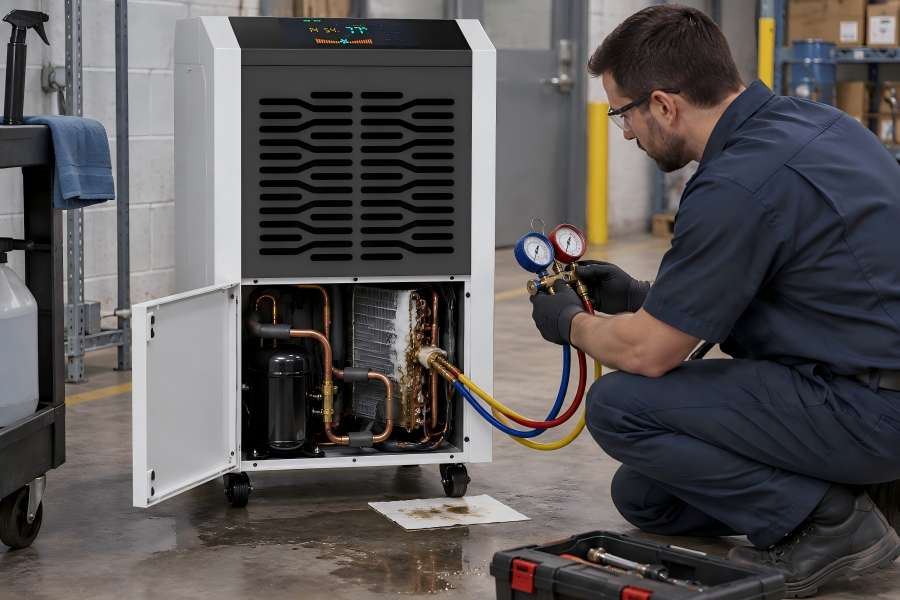
A compressor dehumidifier relies on refrigerant to cool the evaporator coil below the air’s dew point. When refrigerant charge drops, moisture-removal performance also falls.
Small leaks often develop gradually, so declining performance may initially be mistaken for normal equipment aging.
What Causes Refrigerant Leaks?
Leaks can develop in coils, copper tubing, joints, valves, and fittings after long periods of operation.
Common causes include:
- Coil corrosion
- Equipment vibration
- Loose fittings
- Damaged copper tubing
- Poor brazed joints
- Material fatigue
- Excessive operating pressure
Commercial dehumidifiers may run thousands of hours each year, making vibration control and pipe support especially important.
Warning Signs
A machine with a small leak may continue operating while removing much less water than before.
Possible symptoms include:
- Reduced condensate production
- Longer operating cycles
- Difficulty reaching target RH
- Evaporator icing
- Abnormal system pressures
- Higher energy consumption
If a warehouse previously maintained 50% RH but suddenly struggles to stay below 60%, the refrigeration system should be checked.
How to Prevent Refrigerant Leaks
Inspect refrigerant lines, joints, and coils for corrosion, oil stains, vibration, or mechanical damage. Operating pressures and temperatures should also be checked during scheduled service.
If the system has low refrigerant, the leak must be located and fixed before adding refrigerant back into the system.
3. Humidity Sensor Drift
Commercial dehumidifiers depend on RH sensors to determine when to start, stop, or adjust capacity. If the sensor becomes inaccurate, the machine may control the room to the wrong humidity level.
This gradual loss of accuracy is commonly called sensor drift.
What Is Sensor Drift?
For example, the controller may display 50% RH while a calibrated reference instrument shows an actual room humidity of 58%.
An 8% difference can be significant in laboratories, electronics production, warehouses, pharmaceutical areas, museums, and battery facilities.
What Causes Sensor Drift?
Common causes include:
- Sensor aging
- Dust buildup
- Condensation
- Chemical contamination
- High-temperature exposure
- Long periods at high RH
- Poor sensor placement
A sensor positioned directly beside the dry-air outlet may read much lower RH than the actual room average.
How to Prevent Sensor Problems
Compare the dehumidifier reading periodically with a calibrated hygrometer. If the difference becomes consistent, recalibration or sensor replacement may be required.
Recommended practices include:
- Keep sensors clean
- Prevent direct condensation
- Compare readings periodically
- Recalibrate when necessary
- Replace aging sensors
- Avoid direct supply-air locations
For precision applications, checking calibration every 6–12 months is generally a practical starting point.
4. Blocked Drainage Systems
Every refrigerant dehumidifier produces condensate, and that water must leave the unit reliably. Drainage problems can cause shutdowns, leaks, odors, and water damage.
Commercial units may use gravity drainage, condensate pumps, collection tanks, or permanent drain connections.
Common Drainage Problems
Typical failures include:
- Blocked drain hoses
- Incorrect hose slope
- Kinked tubing
- Dirty drain pans
- Algae buildup
- Mineral deposits
- Pump failure
- Blocked floor drains
Gravity drainage requires a continuous downward slope. Raised sections or loops can trap water and cause backup.
Possible Consequences
Poor drainage may result in:
- Water leakage
- Overflow alarms
- Automatic shutdown
- Mold growth
- Drain odors
- Cabinet corrosion
- Interrupted humidity control
For unattended warehouses or equipment rooms, a blocked drain can leave the area uncontrolled for hours before anyone notices.
How to Prevent Drainage Failures
Inspect drain pans, hoses, pumps, and final drainage points regularly.
Key actions include:
- Flush drain lines
- Clean drain pans
- Maintain proper hose slope
- Remove kinks
- Test condensate pumps
- Inspect float switches
- Keep floor drains clear
For pump systems, always confirm the recommended pumping height and discharge distance.
5. Restricted Airflow and Dirty Filters
A dehumidifier cannot remove moisture efficiently without sufficient airflow across the evaporator and condenser coils.
Insufficient airflow is a major cause of reduced performance and extended compressor runtime.
Why Airflow Matters
Humid room air must pass across the cold evaporator coil so moisture can condense. If airflow falls, less air reaches the coil and less water is removed.
Restricted airflow can cause:
- Lower moisture removal
- Longer runtime
- Higher energy use
- Reduced room circulation
- Coil icing
- Higher internal temperatures
Common Causes
Typical causes include:
- Dirty filters
- Dust-covered coils
- Blocked air inlets
- Obstructed outlets
- Poor equipment placement
- Dirty fan blades
- Fan motor problems
- Poor duct design
Storage areas are especially vulnerable because boxes or materials may gradually be placed too close to the machine.
How to Prevent Airflow Problems
Filters should be inspected based on actual operating conditions rather than only following a fixed calendar schedule.
Recommended actions include:
- Inspect filters every few weeks
- Clean reusable filters
- Replace restricted filters
- Keep intake and outlet areas clear
- Clean coils
- Clean fan blades
- Check duct resistance
Dusty industrial environments may require much more frequent filter maintenance than clean offices.
6. Evaporator Coil Icing
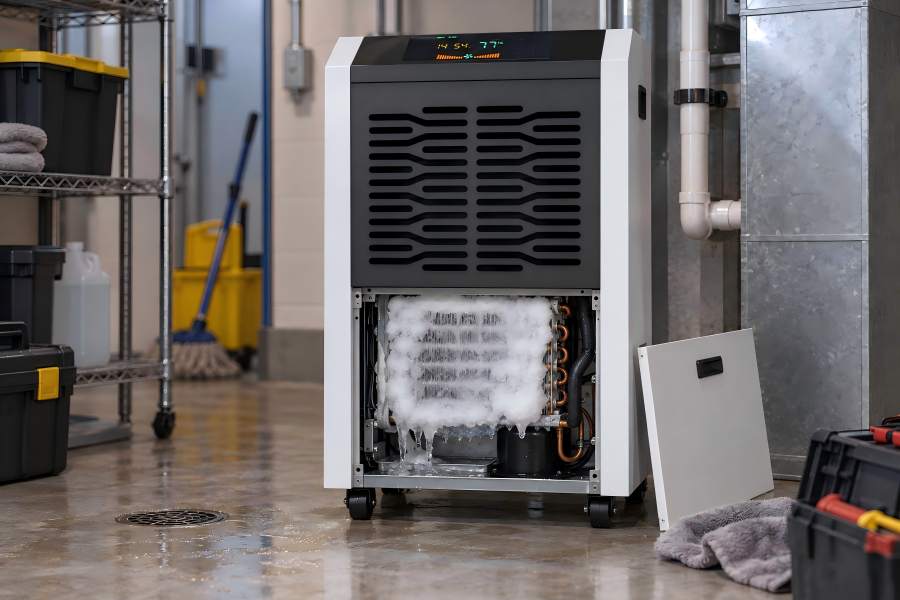
The evaporator coil operates at a low temperature, but it should not remain covered in thick ice during normal operation.
Persistent icing blocks airflow, lowers moisture removal, increases runtime, and can eventually force the dehumidifier to shut down.
Why Dehumidifier Coils Freeze
Several problems can cause icing.
Low room temperature can push the evaporator surface below freezing, causing condensed moisture to become ice instead of draining away.
Dirty filters or coils restrict airflow and limit the flow of warmer room air across the evaporator.
Low refrigerant charge can also create abnormal pressure and temperature conditions inside the refrigeration system.
A failed defrost sensor, controller, or hot-gas defrost system may allow ice to accumulate faster than the machine can remove it.
What Happens When the Coil Ices?
As ice grows between the fins, airflow becomes increasingly restricted.
Possible results include:
- Reduced airflow
- Lower water removal
- Longer compressor operation
- Frequent defrost cycles
- Increased compressor stress
- Complete shutdown
How to Prevent Coil Icing
Operate the machine within its specified temperature range and maintain clean airflow paths.
Also check:
- Air filters
- Evaporator cleanliness
- Refrigerant charge
- Defrost sensors
- Control settings
- Defrost valves
For cold storage, winter restoration, or very low-temperature applications, a desiccant dehumidifier may be more suitable.
7. Compressor and Fan Wear
Compressors and fans are mechanical components, so some wear is unavoidable. Preventive maintenance helps stop abnormal operating conditions from shortening their service life.
Extended operating hours are not a problem by themselves if the system is correctly sized and maintained.
Common Causes of Compressor Wear
Typical causes include:
- Dirty condenser coils
- High operating temperature
- Incorrect refrigerant charge
- Frequent start-stop cycles
- Voltage problems
- Poor ventilation
- Excessive moisture load
- Refrigeration system faults
Short cycling is particularly harmful because repeated starts increase both mechanical and electrical stress.
Common Causes of Fan Wear
Fan problems may result from:
- Dust accumulation
- Bearing wear
- Blade imbalance
- Loose mounting
- Motor overheating
- Damaged fan blades
A dirty or damaged fan also lowers airflow, which can affect the refrigeration system as a whole.
Warning Signs
Look for changes such as:
- Rattling
- Grinding noise
- Excessive vibration
- Reduced airflow
- Frequent cycling
- High operating temperature
- Intermittent fan operation
Changes in sound are often among the earliest signs that mechanical components need attention.
How to Prevent Mechanical Failure
Keep filters and coils clean, maintain correct refrigerant charge, and ensure sufficient airflow around the machine.
An undersized dehumidifier should also be avoided. If the unit runs continuously but never reaches the RH setpoint, capacity may be too low for the actual moisture load.
Commercial Dehumidifier Preventive Maintenance Checklist
| Component | What to Check | Recommended Action |
| Air Filter | Dust and blockage | Clean or replace |
| Evaporator Coil | Dirt, corrosion, icing | Clean and inspect |
| Condenser Coil | Dust and corrosion | Clean regularly |
| Drain Pan | Dirt and standing water | Clean and flush |
| Drain Hose | Slope and blockage | Inspect and clear |
| Condensate Pump | Pump operation | Test regularly |
| Refrigerant Circuit | Leakage and pressure | Inspect and test |
| RH Sensor | Reading accuracy | Calibrate |
| Fan | Noise and airflow | Clean and inspect |
| Compressor | Noise and cycling | Monitor operation |
| Electrical System | Loose or hot connections | Inspect terminals |
| Cabinet | Damage and corrosion | Clean and fix |
How Often Should You Service a Commercial Dehumidifier?
Maintenance frequency depends heavily on the operating environment. A clean office running eight hours per day does not require the same service schedule as an indoor pool unit operating continuously.
A practical starting schedule is:
Every 2–4 Weeks
Check:
- Filters
- Air intake
- Air outlet
- Drainage
- Visible leakage
Dusty warehouses and production areas may require weekly filter inspections.
Every 3–6 Months
Inspect:
- Evaporator coil
- Condenser coil
- Drain pan
- Drain hose
- Fan
- Condensate pump
- Cabinet condition
Clean components whenever contamination begins affecting airflow or drainage.
Every 6–12 Months
Check:
- Humidity sensor calibration
- Electrical connections
- Compressor cycling
- Refrigerant condition
- Fan bearings
- Defrost function
- Control operation
Precision humidity applications may require more frequent sensor verification.
Maintenance Requirements by Application
Different environments create different risks, so maintenance should match the actual application.
Indoor Swimming Pools
Pool environments expose equipment to warm humid air and chlorine compounds.
Priority areas include:
- Coil corrosion
- Cabinet corrosion
- Drainage
- Continuous operation
Anti-corrosion protection should be considered during equipment selection.
Warehouses
Warehouses often experience dust, changing storage layouts, and long unattended operating periods.
Focus on:
- Filter condition
- Airflow clearance
- Drainage
- Sensor accuracy
Grow Rooms
Grow rooms create heavy moisture loads and may contain plant debris or nutrient particles.
Frequent inspection of filters, coils, airflow, and drainage can help maintain stable RH throughout the growing cycle.
Industrial Facilities
Industrial environments may contain dust, oil, chemical vapors, or metal particles.
Correct filtration, cabinet materials, and coil coatings should therefore be considered before installation.
How to Know When a Commercial Dehumidifier Needs Repair or Replacement
Not every fault justifies replacing the entire machine. Problems involving sensors, drain pumps, fans, filters, or individual controls can often be repaired economically.
Replacement becomes more reasonable when several major systems begin failing repeatedly.
Consider:
- Equipment age
- Repair frequency
- Compressor condition
- Coil condition
- Refrigerant leakage
- Spare-part availability
- Energy consumption
- Remaining dehumidification capacity
For example, replacing one inaccurate RH sensor is usually straightforward. A much older unit with a leaking coil, worn compressor, obsolete controller, and repeated repairs may be better replaced.
How Maintenance Affects Dehumidifier Performance
Maintenance directly influences moisture-removal capacity, not just equipment reliability.
Suppose a commercial dehumidifier is rated at 100 L/day under specified conditions. If dirty filters, contaminated coils, and poor airflow reduce effective performance by 20%, actual removal may fall to roughly 80 L/day.
If the room moisture load remains close to 100 L/day, the dehumidifier may never reach its RH setpoint.
Operators may assume the machine is undersized when the real problem is airflow and maintenance. Cleaning the system can restore useful capacity without replacing the equipment.