
Dehumidifier control is moving beyond basic local settings toward remote monitoring, automatic control, alarm reporting, data logging, and system integration.
Bluetooth, Wi-Fi, Modbus, and BACnet serve different control needs. The best option depends on control range.
Bluetooth Control
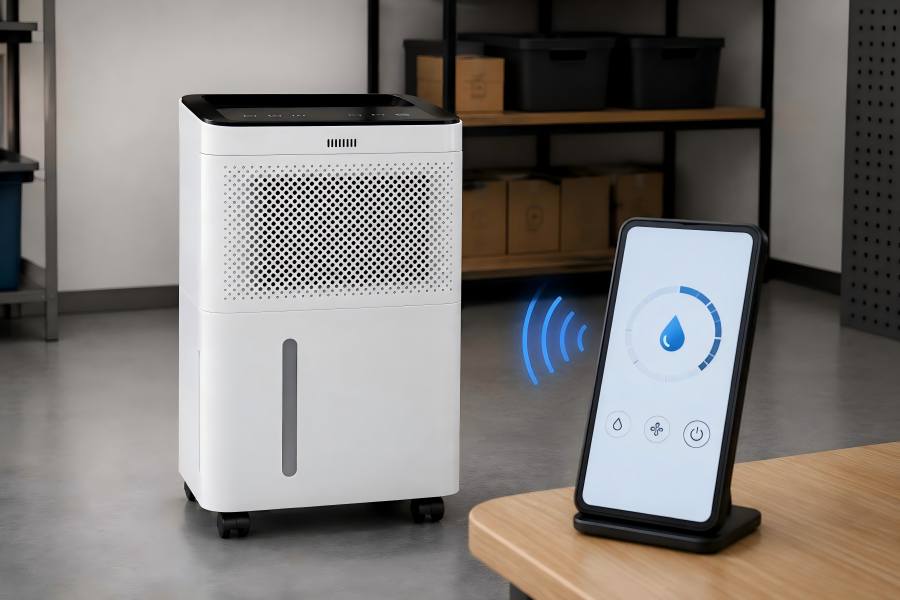
Bluetooth allows a dehumidifier to connect wirelessly to a nearby smartphone or tablet over a short distance. It generally does not require internet or network access.
For smaller systems, it provides easy local access without adding unnecessary control complexity.
How Bluetooth Dehumidifier Control Works
A Bluetooth module communicates with the main dehumidifier controller. After pairing a mobile device, supported parameters can be viewed or adjusted through an app or local interface.
Typical functions include:
- Start and stop
- RH setpoint adjustment
- Fan mode selection
- Timer settings
- Operating mode selection
- RH and temperature display
- Operating status
- Basic alarm monitoring
Bluetooth is also practical during equipment setup because operating parameters can be checked without remaining directly in front of the control panel.
Where Bluetooth Works Best
Bluetooth is suitable for portable dehumidifiers, household units, small offices, basements, storage rooms, and other applications where users normally remain close to the equipment.
It is also useful in locations without internet access where wireless local adjustment is still required.
Main Limitation of Bluetooth
Communication distance remains the biggest restriction. Concrete walls, metal panels, machinery, and electrical cabinets can all reduce usable range.
For large warehouses, factories, multiple floors, or off-site monitoring, Bluetooth usually needs to be combined with another communication method.
Wi-Fi Control
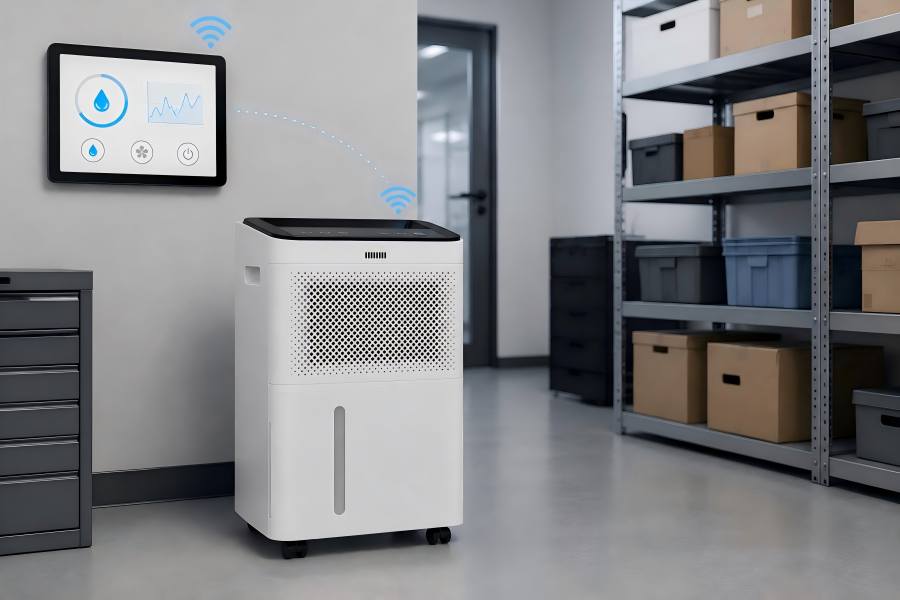
Wi-Fi connects the dehumidifier to a local network, allowing operating information to be accessed through a mobile app, web interface, or cloud platform.
Unlike Bluetooth, users do not need to remain close to the machine, making Wi-Fi more practical for equipment installed in areas that are not frequently visited.
Common Wi-Fi Control Functions
Depending on the controller and software platform, Wi-Fi can provide both remote adjustment and operating information.
Common functions include:
- Real-time RH and temperature
- Start and stop control
- RH setpoint adjustment
- Operating mode selection
- Timer and scheduling
- Alarm notifications
- Historical humidity data
- Runtime and maintenance information
For basements, equipment rooms, warehouses, or other unattended areas, these functions can reduce the need for frequent manual inspections.
Typical Wi-Fi Applications
Wi-Fi is particularly suitable for residential and light commercial applications, including:
- Homes and basements
- Offices
- Hotels
- Storage facilities
- Commercial buildings
- Equipment rooms
- Remote storage areas
- Small warehouses
Its main advantage is convenient remote access rather than deep industrial automation.
Network Stability Must Be Considered
Wi-Fi performance depends on router coverage, signal strength, network settings, and sometimes cloud availability.
The dehumidifier should therefore continue normal RH control if Wi-Fi is interrupted. Network communication should provide additional monitoring rather than become essential for basic operation.
Modbus
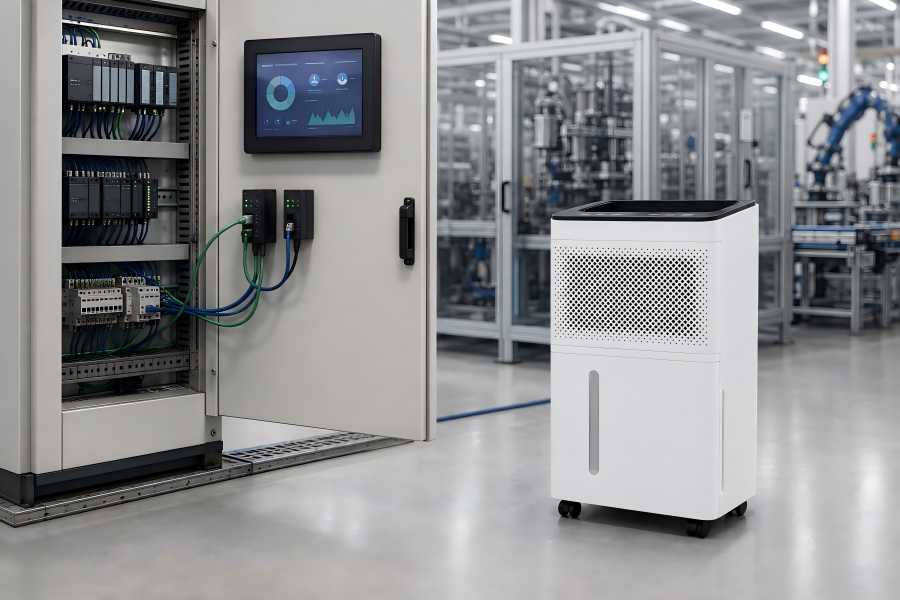
Modbus is widely used in industrial automation because it allows different types of equipment to exchange operating data through a relatively simple communication structure.
For dehumidifiers, it is commonly used to communicate with PLCs, HMIs, SCADA platforms, and other industrial controllers.
Modbus RTU
Modbus RTU is commonly implemented through RS-485 communication. Multiple dehumidifiers can share one communication network while using separate device addresses.
This makes it practical for factories or warehouses with several units because one PLC can read data from multiple dehumidifiers through the same network.
Proper cable routing, termination, communication settings, and device addressing remain important for stable operation.
Modbus TCP
Modbus TCP transfers Modbus messages through Ethernet.
It is useful where industrial Ethernet infrastructure already exists or where dehumidifiers need to communicate between several control cabinets, equipment rooms, or production areas.
What Can Be Monitored Through Modbus?
The available parameters depend on the controller register map provided with the dehumidifier.
Common control points may include:
- Current RH and temperature
- RH setpoint
- Machine operating status
- Fan or compressor status
- Rotor or heater status
- Defrost condition
- Alarm and sensor faults
- Equipment runtime
Some registers are used only for monitoring, while writable registers can allow the PLC to change setpoints, operating modes, or start/stop commands.
For example, a production process can automatically switch to a lower RH setpoint during a moisture-sensitive manufacturing stage.
Where Modbus Is Most Useful
Modbus is most valuable when dehumidification forms part of a larger automated process.
Typical applications include:
- Electronics manufacturing
- Lithium battery dry rooms
- Pharmaceutical production
- Food processing
- Industrial warehouses
- Production workshops
- Material storage
- Automated drying systems
In these environments, humidity control may need to respond to production status, room temperature, airflow, door operation, or changes in process moisture load.
BACnet
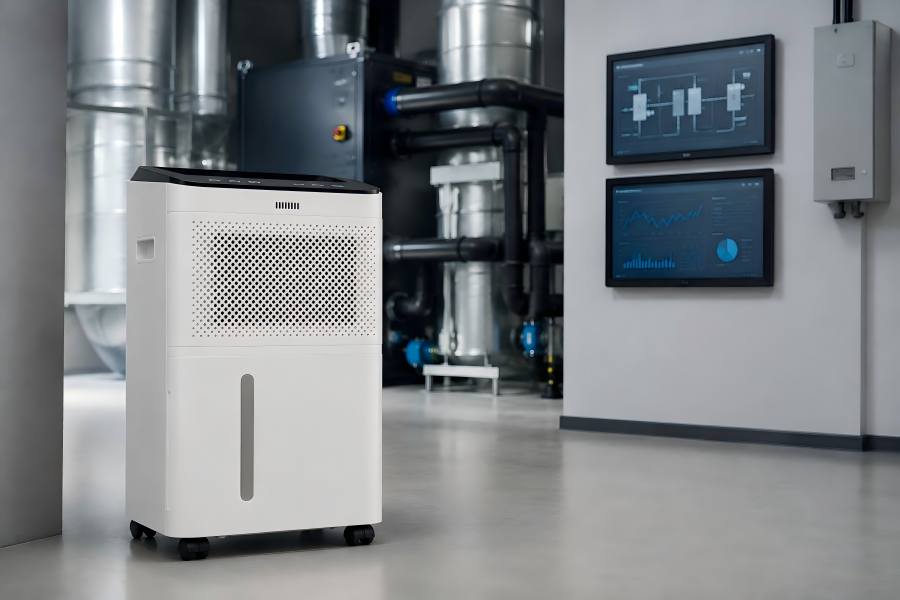
BACnet is widely used in building automation and HVAC systems. It provides a standardized way for different building equipment to exchange operating information.
A BACnet-enabled dehumidifier can therefore be integrated into a Building Management System rather than being managed only through its local controller.
How BACnet Integration Works
The dehumidifier makes selected operating points available to the BMS. These may include RH, temperature, setpoints, operating status, modes, and alarms.
The dehumidifier can then be monitored alongside air handling units, chillers, ventilation systems, pumps, and other HVAC equipment.
This becomes particularly useful when many humidity-control units are installed throughout one building.
Typical BACnet Applications
BACnet is widely used in large commercial and institutional facilities, including:
- Hotels
- Hospitals
- Universities
- Office buildings
- Data centers
- Laboratories
- Commercial complexes
- Large HVAC projects
In these applications, humidity control is normally one part of a wider indoor environmental control strategy.
Better Coordination With HVAC Systems
BACnet allows the BMS to coordinate dehumidification with other building systems.
For example, the control strategy can respond to occupancy schedules, ventilation rates, cooling operation, or supply-air conditions instead of relying only on the RH sensor inside one dehumidifier.
Bluetooth vs. Wi-Fi vs. Modbus vs. BACnet
These four technologies operate at different control levels.
| Feature | Bluetooth | Wi-Fi | Modbus | BACnet |
| Typical Connection | Local wireless | Wireless network | RS-485/Ethernet | Building network |
| Control Range | Short | Local or remote | Facility-wide | Building/campus |
| Internet Required | No | Sometimes | No | No |
| Smartphone Control | Excellent | Excellent | Limited | Limited |
| PLC Integration | Rare | Limited | Excellent | Possible |
| BMS Integration | Limited | Possible | Possible | Excellent |
| Multi-Unit Control | Limited | Good | Excellent | Excellent |
| Best Use | Local control | Remote monitoring | Industrial automation | Building automation |
These technologies do not necessarily replace each other. One dehumidifier may support several interfaces when local users, automation systems, and building management platforms all require access.
Which Control Technology Fits Different Applications?
The correct communication method depends mainly on the installation environment and existing control infrastructure.
Residential Dehumidifiers
Bluetooth and Wi-Fi normally provide enough functionality for residential equipment.
Typical requirements include RH adjustment, scheduling, status monitoring, and smartphone access rather than PLC or BMS integration.
Wi-Fi is especially useful for basements, garages, holiday homes, and whole-house dehumidifiers that are not checked every day.
Commercial Dehumidifiers
Wi-Fi, Modbus, and BACnet can all be suitable depending on the scale of the project.
A small warehouse may only need remote Wi-Fi monitoring, while a hotel or large office building may benefit from direct BMS integration.
Industrial Dehumidifiers
Modbus is generally more suitable for factories where PLC-based control is already installed.
It allows the dehumidifier to respond directly to process requirements rather than operating independently around one fixed humidity setting.
Large HVAC Projects
BACnet is a practical option where the building already operates a BACnet-based BMS.
Dehumidification can then be monitored together with heating, cooling, ventilation, and other HVAC functions.
Remote Facilities
Wi-Fi or another network-based platform can provide useful access to units installed in unattended spaces.
Alarm reporting is particularly valuable where a rapid rise in humidity could affect materials, products, or production conditions.
Multi-Protocol Control Is Becoming More Important
Modern dehumidifier projects often involve several control requirements.
Local users may need touchscreen or Bluetooth access, while remote operators need Wi-Fi. A factory PLC may require Modbus, while a building management platform may use BACnet.
Common combinations include:
- Bluetooth + Wi-Fi
- Wi-Fi + Modbus
- Modbus + BACnet
- Touchscreen + RS-485
- Local control + Ethernet
- PLC control + remote monitoring
Supporting more than one protocol also makes future expansion easier.
If the facility later adds new dehumidifiers, sensors, PLCs, or a BMS, compatible communication interfaces can reduce the amount of control hardware that needs to be replaced.
Smart Sensors Improve Automatic Humidity Control
Communication alone cannot provide good humidity control if sensor data does not represent actual room conditions.
A sensor located inside the dehumidifier may work well for small spaces, but large warehouses, dry rooms, laboratories, and production areas often have different RH levels in different locations.
External RH and temperature sensors can be placed near critical production areas, doors, storage racks, return-air points, or other locations where humidity needs to be monitored.
Using several sensors also helps identify humidity differences caused by uneven airflow, frequent door openings, outdoor air infiltration, or changing process moisture loads.
Centralized Multi-Dehumidifier Management
Large projects often use several dehumidifiers instead of relying on one oversized machine.
Each unit may serve a separate room, production zone, storage area, or duct system. Without centralized communication, every machine has to be checked individually.
Through Modbus, BACnet, or another networked platform, each unit can use a separate device address.
A centralized system may monitor:
- RH and temperature
- Equipment status
- RH setpoints
- Operating mode
- Runtime
- Alarm status
- Sensor condition
- Individual unit availability
Centralized control can also support staged operation.
One unit may handle the normal moisture load, while additional units start only when RH rises or moisture load increases. This avoids operating every machine at full capacity when it is not required.
How Connected Control Can Reduce Energy Use
Connected control does not reduce energy consumption by itself. The benefit comes from operating dehumidifiers according to actual humidity demand.
A control system can reduce unnecessary runtime by adjusting setpoints, scheduling operation, and staging multiple units according to RH conditions.
Integration with HVAC can also prevent cooling, ventilation, and dehumidification systems from operating against one another.
Operating data adds another benefit. If one unit suddenly runs much longer than normal, it may indicate a dirty filter, restricted airflow, sensor problem, increased moisture load, or equipment fault.
Fault Monitoring and Maintenance
Connected control makes equipment problems easier to identify before room humidity moves far outside the required range.
Instead of checking every dehumidifier locally, alarms and operating conditions can be viewed through a central system.
Common monitored conditions include:
- Filter service intervals
- Fan and compressor runtime
- Rotor or heater condition
- High-temperature alarms
- Sensor failures
- Drainage problems
- Communication failures
- General equipment faults
Runtime information can also support maintenance planning.
Filters and other service items can be checked according to actual operating hours rather than relying only on fixed monthly or quarterly schedules.
Historical RH, alarm, and runtime data can also make troubleshooting easier by showing what changed before the problem occurred.
Cybersecurity and Network Reliability
Once a dehumidifier is connected to a building, industrial, or IT network, network security becomes part of the control design.
This is particularly important for Wi-Fi, Ethernet, cloud platforms, and systems that allow external access.
Important measures include:
- Strong passwords
- Controlled user permissions
- Secure remote connections
- Network segmentation
- Firmware management
- Restricted external access
- Event logging
- Backup local control
Communication failure must also be considered.
The dehumidifier should continue basic automatic RH control from its local controller if communication with Wi-Fi, a PLC, cloud platform, or BMS is temporarily interrupted.
Factors to Consider When Choosing Dehumidifier Controls
Several practical factors should be checked before deciding on the communication configuration.
Number of Dehumidifiers
A single unit may only require local control, while a facility with many dehumidifiers benefits more from centralized monitoring and individual device addressing.
Monitoring Distance
Bluetooth is suitable for nearby access. Wi-Fi, Ethernet, Modbus, or BACnet are more practical when information must travel across a facility or to a remote location.
Existing Automation System
Matching the existing platform usually simplifies integration.
PLC-based factories often use Modbus, while commercial buildings with an existing BMS may prefer BACnet.
Required Control Points
Some projects only require RH and run status.
More complex systems may need temperature, setpoints, alarms, compressor status, fan status, runtime, and maintenance data.
Wired or Wireless Communication
Wireless communication can simplify installation, while wired systems often provide more predictable communication in industrial environments.
Site layout and electrical conditions should guide the choice.
Remote Access
Determine whether information is needed only on-site or from a remote location.
This affects whether a local industrial network or internet-connected monitoring platform is necessary.
Data Logging
Dry rooms, laboratories, warehouses, and controlled production areas may need historical RH records for process review and environmental monitoring.
Future Expansion
The control architecture should allow additional dehumidifiers, sensors, or zones to be added without replacing the complete communication system.
The Future of Dehumidifier Control
Future dehumidifiers will increasingly combine local control, remote access, industrial communication, and building automation in one platform.
Multi-protocol support and multiple RH sensors can improve control across different zones, while operating data such as humidity trends, runtime, and alarms can support better maintenance and energy management.
More advanced systems may also use indoor and outdoor conditions, ventilation, and operating schedules to adjust dehumidification more accurately.