
Humidity control is essential for commercial buildings. Excess moisture can cause mold growth, equipment corrosion, and structural damage, making reliable dehumidification important for maintaining safe and efficient environments.
Commercial dehumidifiers and HVAC dehumidification systems offer different moisture-control solutions. Understanding their performance, installation requirements, energy efficiency, and costs helps businesses choose the right system.
What Is a Commercial Dehumidifier?
A commercial dehumidifier is a specialized device designed to remove excess moisture from indoor air. Unlike conventional air-conditioning systems, commercial dehumidifiers primarily focus on humidity control rather than space cooling.
These units are widely used in warehouses, commercial basements, manufacturing workshops, storage facilities, and other environments requiring stable humidity levels.
How Does a Commercial Dehumidifier Work?
Refrigeration provides the drying mechanism in many commercial models.
The process generally involves:
- Air Intake: A fan draws humid indoor air into the dehumidifier.
- Cooling and Condensation: The evaporator chills incoming air so that droplets form on its cold surface.
- Water Removal: Condensed water collects in a tank or flows through a drainage system.
- Air Reheating: The air passes through the condenser, increasing its temperature.
- Dry Air Distribution: Dehumidified air returns to the indoor environment.
Some commercial dehumidifiers use desiccant technology instead of refrigeration. These systems remove moisture through adsorption and are especially suitable for low-temperature environments or applications requiring extremely low humidity.
Main Types of Commercial Dehumidifiers
Commercial dehumidifiers are available in several configurations:
- Portable Commercial Dehumidifiers: Compact equipment designed for temporary or localized moisture removal.
- Floor-Standing Commercial Dehumidifiers: Higher-capacity units commonly used in warehouses, workshops, and commercial buildings.
- Ducted Commercial Dehumidifiers: Systems connected to ductwork to distribute dehumidified air across multiple areas.
- Desiccant Commercial Dehumidifiers: Equipment designed for low-temperature applications or demanding humidity requirements.
The appropriate type depends on moisture removal capacity, installation conditions, and the required humidity level.
What Is HVAC Dehumidification?
HVAC dehumidification refers to moisture removal through a heating, ventilation, and air-conditioning system.
Unlike standalone commercial dehumidifiers, HVAC systems generally combine temperature regulation, air circulation, ventilation, and humidity management within a building’s climate-control infrastructure.
How Does HVAC Dehumidification Work?
Conventional HVAC systems remove moisture during the cooling process.
When warm, humid air passes over a cooling coil operating below the air’s dew point, water vapor condenses into liquid water. The collected moisture is then discharged through a drainage system.
The process typically includes:
- Humid indoor or outdoor air enters the HVAC system.
- The coil chills the incoming airstream until condensation begins.
- Moisture condenses on the coil surfaces.
- Condensate drains from the system.
- Conditioned air is distributed throughout the building.
However, conventional HVAC systems may struggle to maintain humidity when cooling demand is low.
For example, during mild but humid weather, an air-conditioning system may reach the desired indoor temperature before removing sufficient moisture.
To address this problem, some commercial HVAC installations incorporate dedicated humidity controls, reheat systems, or additional dehumidification equipment.
Main Types of HVAC Dehumidification Systems
Conventional HVAC Systems
Standard air-conditioning equipment removes moisture during cooling. Dehumidification performance depends on cooling demand, coil temperature, airflow, and operating time.
HVAC Systems with Dedicated Humidity Controls
These systems use humidity sensors, specialized control strategies, and sometimes reheat equipment to improve moisture removal.
Dedicated Outdoor Air Systems (DOAS)
DOAS equipment independently conditions ventilation air before supplying it to occupied spaces. It is particularly useful in buildings with substantial outdoor-air requirements.
HVAC Systems with Desiccant Dehumidification
These systems incorporate desiccant technology to handle high moisture loads or achieve lower humidity levels than conventional cooling systems can efficiently maintain.
Commercial Dehumidifier vs. HVAC Dehumidification: Key Differences
Although both systems remove moisture from indoor air, they differ in humidity control, installation requirements, operating efficiency, and building coverage.
| Comparison Factor | Commercial Dehumidifier | HVAC Dehumidification |
| Primary Function | Dedicated moisture removal | Integrated temperature and humidity management |
| Humidity Control | Independent humidity settings | Depends on HVAC design and controls |
| Installation | Generally simpler for standalone units | May require extensive system integration |
| Initial Investment | Usually lower for localized applications | Often higher for major upgrades |
| Energy Efficiency | Designed for dedicated moisture removal | Depends on cooling loads and system configuration |
| Coverage Area | Individual rooms or multiple ducted zones | Multiple zones or entire buildings |
| Maintenance | Filters, coils, drainage, and components | Coils, filters, controls, and mechanical equipment |
| Flexibility | Portable or permanently installed | Usually permanently installed |
| Main Advantage | Targeted humidity control | Centralized climate management |
Humidity Control Performance
Commercial dehumidifiers are designed specifically to maintain selected humidity levels.
Many units feature adjustable humidistats, automatic operation, and continuous drainage systems. They can operate independently of building cooling demand, making them suitable for facilities where moisture control is more important than temperature reduction.
Conventional HVAC systems, by comparison, primarily regulate indoor temperature. Moisture removal often occurs as a secondary function of cooling.
However, properly designed HVAC systems with dedicated dehumidification controls can also maintain precise humidity levels.
Commercial dehumidifiers are generally advantageous when independent, continuous moisture removal is required, while HVAC dehumidification is suitable for facilities needing coordinated temperature and humidity management.
Installation and Flexibility
Standalone commercial dehumidifiers are generally easier to install.
Smaller models may require only an electrical outlet and drainage connection. Larger equipment may need dedicated electrical circuits, permanent drainage, or ductwork.
HVAC dehumidification systems can involve more extensive installation requirements, including:
- Air distribution ductwork
- Cooling and heating equipment
- Humidity sensors and controllers
- Condensate drainage
- Electrical and building automation integration
For existing commercial buildings, installing a dedicated dehumidifier may be more practical than modifying the entire HVAC system.
Commercial dehumidifiers also offer greater flexibility because equipment can often be relocated, replaced, or expanded as operating requirements change.
Energy Efficiency
Energy efficiency depends on equipment design, moisture removal capacity, operating hours, and environmental conditions.
Commercial dehumidifiers consume electricity specifically to remove moisture. However, refrigerant models also release heat into the surrounding space, potentially increasing air-conditioning demand.
HVAC systems can be efficient when cooling and moisture removal are required simultaneously.
When additional dehumidification is needed without significant cooling demand, conventional HVAC systems may require overcooling and reheating, increasing energy consumption.
For facilities with substantial moisture loads, a dedicated dehumidifier or properly designed HVAC dehumidification system may offer better overall performance.
Maintenance Requirements
Commercial dehumidifiers typically require routine maintenance involving air filters, evaporator coils, drainage systems, fans, and compressors.
HVAC dehumidification systems may require more extensive maintenance because they contain interconnected heating, cooling, ventilation, and control components.
Standalone dehumidifiers are often simpler to service individually, while centralized HVAC systems can provide more convenient building-wide monitoring.
Ultimately, maintenance complexity depends on equipment capacity, installation configuration, and operating conditions.
Commercial Dehumidifier vs. HVAC Dehumidification: Cost Comparison
Cost is a major consideration when selecting humidity-control equipment for commercial facilities.
Businesses should evaluate equipment purchase prices, installation expenses, electricity consumption, and maintenance requirements rather than focusing exclusively on initial investment.
Equipment and Installation Costs
Commercial dehumidifiers generally have lower upfront costs for localized applications.
Equipment prices depend on capacity, construction, controls, and ducting requirements; obtain a model-specific quotation before setting the purchase budget.
Installation expenses are often relatively low for portable units but increase when equipment requires permanent drainage, electrical upgrades, or duct connections.
HVAC dehumidification costs vary considerably depending on the existing building infrastructure.
Upgrading an HVAC system may require additional cooling equipment, humidity controls, reheat components, ductwork modifications, or dedicated outdoor-air treatment.
Estimated Cost Comparison
The following worksheet uses explicit assumptions for a hypothetical U.S. facility budget in USD, prepared October 15, 2026. It does not represent supplier prices or typical market ranges.
| Cost Category | Commercial Dehumidifier | HVAC Dehumidification Upgrade |
| Equipment Cost | Request a model-specific quotation | Request a project-specific quotation |
| Installation Cost | Quote electrical work, drainage, and any duct connections | Quote ductwork, controls, coil or reheat changes, and commissioning |
| Annual Electricity Example | 1.2 kW × 12 h/day × 365 days × $0.15/kWh = $788.40 | 3.0 kW × 12 h/day × 365 days × $0.15/kWh = $1,971.00 |
| Annual Maintenance Cost | Obtain a service plan for the selected unit | Obtain a service plan covering the modified system |
| Five-Year Electricity Only | $3,942.00 at unchanged assumptions | $9,855.00 at unchanged assumptions |
The two electrical inputs are assumed examples, not equivalent-capacity equipment ratings or evidence that one technology is more efficient. The HVAC example represents assumed additional electrical demand for humidity control, excluding baseline building heating and cooling. The worksheet excludes equipment purchase, installation, tax, freight, maintenance, repairs, and any separate reheat fuel; request written quotations for those items. The electricity tariff is a planning assumption rather than a current utility rate. Replace the assumptions with measured or manufacturer-supported average loads and the facility’s actual tariff.
Operating Costs and Total Cost of Ownership
Power bills can account for a substantial share of the recurring budget for moisture-control equipment.
For example, consider a commercial dehumidifier operating at an average electrical input of 1.2 kW for 12 hours per day.
Annual electricity consumption:
1.2 kW × 12 hours × 365 days = 5,256 kWh
At an electricity rate of $0.15 per kWh:
5,256 kWh × $0.15 = $788.40 per year
Actual electricity consumption depends on equipment cycling, humidity conditions, operating temperature, and efficiency.
Businesses should also consider the total cost of ownership:
Total Cost = Equipment + Installation + Energy + Maintenance + Repairs
A commercial dehumidifier may offer lower total costs for localized applications, while an integrated HVAC solution can be more economical for facilities requiring centralized temperature control, ventilation, and humidity management.
Which System Is Better for Different Commercial Applications?
Different commercial environments have different moisture sources, ventilation requirements, and humidity-control targets.
The following applications illustrate where commercial dehumidifiers or HVAC dehumidification systems may be more appropriate.
Warehouses and Storage Facilities
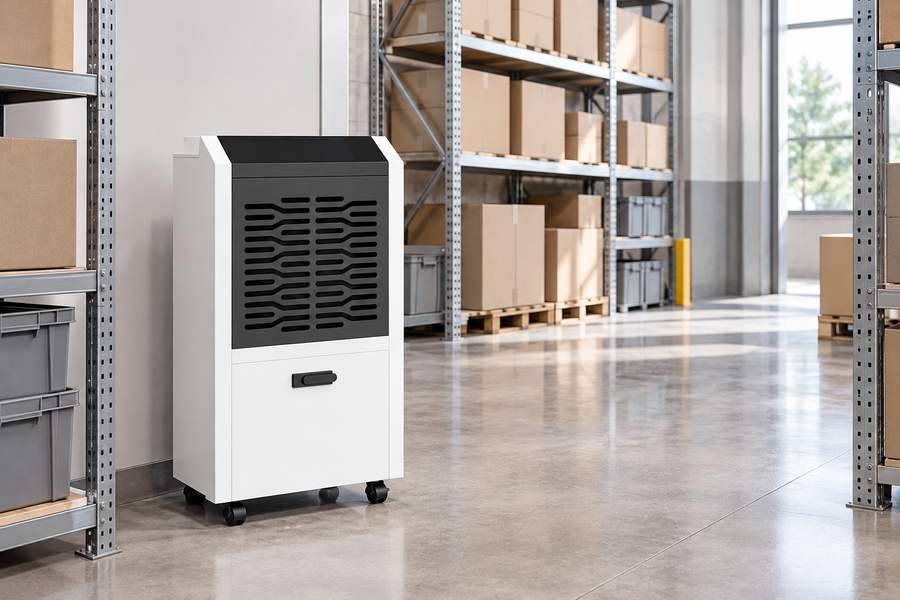
Warehouses frequently experience humidity fluctuations caused by outdoor air infiltration, loading dock operations, and seasonal weather conditions.
Excess moisture can damage packaging materials, electronic components, metal products, and stored goods.
Commercial dehumidifiers are often suitable for warehouses requiring targeted moisture control. Larger facilities may benefit from high-capacity ducted dehumidification equipment or centrally integrated systems.
Offices and Shopping Malls
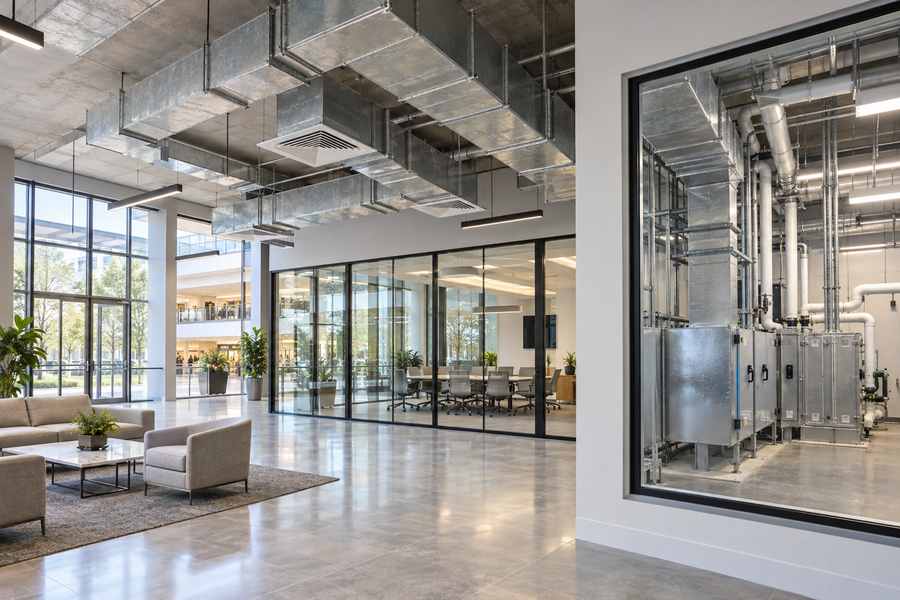
Office buildings and shopping malls generally require simultaneous temperature regulation, ventilation, and humidity management.
HVAC dehumidification is often more appropriate because it supports centralized climate control across multiple occupied areas.
Buildings with substantial outdoor-air requirements may benefit from dedicated outdoor air systems that manage ventilation-related moisture loads.
Indoor Swimming Pools and Fitness Centers
Indoor swimming pools generate considerable moisture through water evaporation.
Without adequate humidity control, condensation can damage windows, ceilings, walls, and building structures.
Dedicated pool dehumidification equipment integrated with HVAC and ventilation systems is generally the preferred solution.
These installations are designed to manage high moisture loads while maintaining comfortable indoor conditions.
Manufacturing and Industrial Facilities
Manufacturing environments may require strict humidity control to protect raw materials, machinery, and finished products.
Common examples include:
- Electronics manufacturing
- Pharmaceutical processing
- Food production
- Packaging operations
- Precision machinery manufacturing
Commercial or industrial dehumidifiers are often suitable when production processes require humidity conditions different from general building comfort requirements.
Hotels, Hospitals, and Large Commercial Buildings
Hotels, hospitals, and large commercial facilities typically have multiple occupied zones with varying temperature, ventilation, and humidity requirements.
With suitable controls and integration, a central HVAC installation can coordinate humidity management through the building automation platform.
However, specialized areas such as storage rooms, equipment rooms, or moisture-sensitive spaces may require supplemental dehumidification.
Recommended Systems by Application
| Commercial Application | Recommended Solution | Primary Reason |
| Commercial Basement | Commercial Dehumidifier | Localized moisture control |
| Warehouse | Commercial or Ducted Dehumidifier | Protection of stored products |
| Office Building | HVAC Dehumidification | Integrated climate management |
| Shopping Mall | HVAC Dehumidification | Centralized multi-zone control |
| Indoor Swimming Pool | Dedicated Dehumidification with HVAC Integration | High continuous moisture load |
| Manufacturing Workshop | Commercial or Industrial Dehumidifier | Process-specific humidity requirements |
| Hotel | HVAC Dehumidification | Centralized comfort and ventilation |
| Moisture-Sensitive Storage Room | Dedicated Commercial Dehumidifier | Independent humidity control |
These recommendations are general guidelines. Final equipment selection should consider moisture loads, facility layout, indoor temperature, ventilation rates, and required humidity levels.
Can Commercial Dehumidifiers Work with HVAC Systems?
Commercial dehumidifiers and HVAC systems do not always need to operate as competing solutions.
In many commercial buildings, combining dedicated dehumidification equipment with existing HVAC infrastructure provides a more flexible approach to moisture management.
Benefits of a Combined System
Independent Temperature and Humidity Control
The HVAC system handles temperature regulation and ventilation, while dedicated dehumidifiers provide additional moisture removal.
Improved Humidity Stability
Commercial dehumidifiers can continue operating when the HVAC system has limited cooling demand.
Targeted Moisture Management
High-humidity rooms can receive additional dehumidification without requiring major modifications to the entire building.
Potential Energy Optimization
Properly coordinated systems may reduce unnecessary cooling and reheating, although actual energy savings depend on equipment selection and control strategies.
When Is a Hybrid Solution Suitable?
A combined system may be appropriate when:
- Existing HVAC equipment cannot maintain target humidity levels.
- Different areas require different humidity conditions.
- Moisture loads fluctuate significantly throughout the year.
- Specialized storage or production rooms need independent control.
- Replacing the existing HVAC system would be unnecessarily expensive.
For example, a commercial warehouse may use its existing HVAC system for temperature management while installing dedicated dehumidifiers in moisture-sensitive storage areas.
Successful integration requires appropriate airflow distribution, drainage arrangements, humidity sensor placement, and coordinated equipment controls.
How to Choose Between a Commercial Dehumidifier and HVAC Dehumidification
Selecting the right dehumidification solution requires evaluating the facility’s operating conditions, moisture loads, existing equipment, and long-term requirements.
Evaluate Facility Size and Moisture Load
Smaller commercial rooms may be adequately served by standalone dehumidifiers, while large buildings with multiple occupied zones may benefit from centralized systems.
However, floor area alone cannot determine the required dehumidification capacity.
Important factors include:
- Total floor area and ceiling height
- Outdoor air infiltration
- Ventilation rates
- Internal moisture generation
- Indoor temperature and relative humidity
- Daily operating hours
Commercial dehumidifier capacity is commonly measured in liters per day, pints per day, or kilograms per hour.
For accurate sizing, businesses should calculate the expected moisture load under relevant design conditions.
Determine the Required Humidity Level
Different commercial applications require different humidity conditions.
EPA moisture-control guidance recommends keeping indoor relative humidity below 60%, ideally 30%–50% where feasible. A facility-specific setpoint should also account for its occupants, process requirements, climate, and building envelope.
Storage rooms, manufacturing facilities, and moisture-sensitive production areas may require lower or more tightly controlled humidity levels.
If independent humidity management is essential, a dedicated commercial dehumidifier may be preferable.
For general building comfort applications, properly designed HVAC dehumidification may be sufficient.
Assess Existing HVAC Infrastructure
Before investing in new equipment, businesses should evaluate their current HVAC system.
If the system provides adequate cooling but struggles with moisture removal, adding commercial dehumidification equipment may be more economical than replacing the entire system.
If the existing HVAC equipment is outdated or inadequate for both temperature and humidity management, an integrated system upgrade may offer better long-term value.
Consider Climate and Operating Conditions
Climate significantly influences dehumidification performance.
Facilities in hot, humid regions often experience substantial moisture loads from outdoor air.
In these environments, HVAC systems with dedicated humidity controls or integrated dehumidification equipment may be suitable.
For cold environments or applications requiring very low humidity, desiccant dehumidification may provide better performance than conventional refrigerant systems.
Evaluate Long-Term Requirements
Businesses should also consider maintenance resources, equipment lifespan, and potential facility expansion.
Commercial dehumidifiers provide flexibility because additional units can be installed as moisture-control requirements increase.
HVAC dehumidification systems may be more practical for buildings with stable layouts, centralized management requirements, and extensive ventilation infrastructure.
The best choice should balance humidity-control performance, energy efficiency, installation feasibility, and total operating cost.