
Commercial and industrial dehumidifiers both remove excess moisture from indoor environments, but they differ in capacity, durability, operating requirements, and cost. Selecting the right equipment is essential for maintaining effective humidity control.
Understanding these differences helps facility managers and business owners choose suitable dehumidification solutions, improve efficiency, and reduce long-term expenses.
What Is a Commercial Dehumidifier?
A commercial dehumidifier extracts unwanted water vapor from the air in business premises, including offices and storage buildings. These systems generally offer higher moisture removal capacities and greater durability than standard household dehumidifiers.
Commercial dehumidifiers are available in portable, floor-standing, and ducted configurations, making them suitable for different facility sizes and humidity control requirements.
How Does a Commercial Dehumidifier Work?
Refrigeration is the moisture-removal method used by many commercial models.
A typical operating cycle follows this sequence:
- Air Intake: The inlet fan pulls room air into the cabinet.
- Cooling: The evaporator chills the incoming airstream.
- Condensation: Moisture forms droplets on the chilled coil surface.
- Drainage: Collected water flows into a tank or drainage system.
- Air Discharge: The treated air is reheated and returned to the room.
Many commercial models include automatic humidistats, continuous drainage, and defrost systems for convenient operation.
Key Features of Commercial Dehumidifiers
- Moderate to high capacity: Suitable for various commercial moisture loads.
- Durable construction: Designed for regular use in business environments.
- Automatic humidity control: Maintains selected humidity levels.
- Flexible installation: Available as portable or fixed systems.
- Convenient maintenance: Typically features accessible filters and drainage connections.
Common Applications
Commercial dehumidifiers are widely used in:
- Office buildings
- Hotels and shopping centers
- Commercial basements
- Retail stores
- Small and medium-sized warehouses
- Commercial storage facilities
These systems are particularly useful where general humidity control is needed to protect building materials, equipment, and stored products.
What Is an Industrial Dehumidifier?
An industrial dehumidifier is a heavy-duty moisture removal system designed for demanding industrial environments. These units are commonly used in manufacturing plants, processing facilities, industrial warehouses, and specialized production areas.
Industrial dehumidifiers often provide higher capacities, advanced humidity controls, and configurations designed for continuous operation.
Depending on the application, industrial systems may use refrigeration, desiccant adsorption, or hybrid dehumidification technologies.
How Does an Industrial Dehumidifier Work?
Industrial dehumidifiers use different moisture removal methods depending on operating conditions.
Refrigerant Industrial Dehumidifiers
Inside these units, a chilled coil turns airborne moisture into droplets that the drainage system carries away.
They are commonly used in warm, humid industrial environments.
Desiccant Industrial Dehumidifiers
These systems use moisture-adsorbing materials, such as silica gel, to remove water vapor from incoming air.
This approach is useful in cold spaces and processes that need exceptionally dry air.
Hybrid Dehumidification Systems
Hybrid systems combine refrigeration and desiccant technologies to achieve demanding humidity requirements while optimizing energy consumption.
Key Features of Industrial Dehumidifiers
- High moisture removal capacity: Suitable for substantial humidity loads.
- Heavy-duty construction: Designed for demanding industrial conditions.
- Extended operation: Many systems support continuous operation.
- Precise humidity control: Can maintain specific humidity or dew point requirements.
- Advanced integration: May connect with industrial ventilation and automation systems.
- Customized configurations: Available for specialized installation and process requirements.
Common Applications
Industrial dehumidifiers are frequently used in:
- Manufacturing plants
- Large industrial warehouses
- Pharmaceutical production
- Food processing facilities
- Cold storage warehouses
- Electronics manufacturing
- Industrial drying operations
These applications often require reliable moisture control to protect materials, maintain product quality, and support production processes.
Commercial vs. Industrial Dehumidifiers: Key Differences at a Glance
The following table summarizes the main differences between commercial and industrial dehumidifiers.
| Comparison Factor | Commercial Dehumidifier | Industrial Dehumidifier |
| Moisture Removal Capacity | Moderate to high | Often very high |
| Coverage Area | Commercial buildings and storage spaces | Large or demanding industrial facilities |
| Construction | Durable commercial-grade materials | Heavy-duty industrial construction |
| Operating Hours | Regular or extended operation | Frequently designed for continuous operation |
| Humidity Control | General humidity management | May provide precise process humidity control |
| Technology | Primarily refrigerant, with other options | Refrigerant, desiccant, or hybrid |
| Energy Consumption | Generally lower total power demand | Often higher total power demand |
| Installation | Portable, floor-standing, or ducted | Portable, fixed, or integrated systems |
| Maintenance | Generally straightforward | May require specialized servicing |
| Equipment Price | Generally lower | Generally higher |
| Typical Applications | Offices, hotels, warehouses | Factories, production facilities, industrial storage |
Although industrial dehumidifiers often provide greater capacity and more advanced features, commercial and industrial equipment classifications overlap.
A category name cannot replace checking how a particular model performs at the proposed site.
What Are the Main Differences Between Commercial and Industrial Dehumidifiers?
Dehumidification Capacity and Performance
Dehumidification capacity indicates how much moisture a machine can remove within 24 hours. It is commonly measured in liters per day (L/day) or pints per day (PPD).
Commercial Dehumidifiers
- Suitable for moderate to substantial moisture loads.
- Commonly used in offices, hotels, and commercial warehouses.
- Designed for general indoor humidity management.
- Available in different capacities depending on facility requirements.
Industrial Dehumidifiers
- Often available with significantly higher moisture removal capacities.
- Suitable for substantial or continuously generated moisture loads.
- May support specialized low-humidity applications.
- Can be designed for centralized industrial dehumidification.
However, capacity ratings depend on temperature and relative humidity.
For accurate comparisons, buyers should evaluate equipment under equivalent test conditions.
A machine rated at high temperature and humidity may remove considerably less moisture when operating in a cooler or drier environment.
Coverage Area and Airflow
Coverage area and airflow are important factors when selecting dehumidifiers for different facilities.
Commercial dehumidifiers generally serve individual commercial rooms, offices, basements, and storage areas.
Industrial systems may serve large production spaces or multiple zones through centralized air distribution.
Factors Affecting Coverage Requirements
- Floor area and ceiling height
- Indoor temperature and humidity
- Ventilation and air leakage
- Moisture generated by industrial processes
- Required humidity levels
- Airflow distribution and circulation
For example, a factory with high ceilings, frequent ventilation, and moisture-producing equipment may require substantially greater dehumidification capacity than a commercial warehouse of similar floor area.
Airflow Capacity
Airflow specifications report the volume moved over time, using CFM for cubic feet per minute or m³/h for cubic meters per hour.
Industrial systems often provide stronger airflow or connections to ducted air distribution systems.
However, higher airflow alone does not guarantee effective humidity control. Equipment must be sized according to the actual moisture load.
Construction Quality and Durability
Commercial and industrial dehumidifiers are commonly designed with different operating environments in mind.
Commercial Dehumidifier Construction
- Durable metal or plastic housings
- Portable wheels and handles
- Compact equipment configurations
- Convenient maintenance access
- Components suitable for regular commercial operation
Industrial Dehumidifier Construction
- Reinforced structural frames
- Heavy-duty compressors and fans where required
- Industrial-grade electrical components
- Optional corrosion-resistant construction
- Specialized protection for demanding environments
Industrial systems may operate in facilities exposed to dust, vibration, high temperatures, or corrosive conditions.
However, not every industrial dehumidifier is suitable for every harsh environment. Specialized protection must be specified according to the installation conditions.
Equipment durability also depends on manufacturing quality, maintenance, and operating hours.
Continuous Operation and Humidity Control
Commercial facilities often require humidity management during business hours or throughout the day.
Industrial facilities may need precise humidity control during continuous manufacturing or storage operations.
Commercial Dehumidifiers
- Adjustable humidistats
- Automatic start and stop functions
- Continuous drainage options
- Automatic defrost features
- Basic digital controls
Industrial Dehumidifiers
- Continuous or extended operating capabilities
- Precise humidity and dew point monitoring
- Programmable control systems
- Remote monitoring and alarms
- Integration with building management or industrial automation systems
For example, pharmaceutical manufacturing may require carefully controlled environmental conditions to protect moisture-sensitive products.
In contrast, a commercial office building may only need to maintain comfortable indoor humidity.
The required level of control should determine equipment selection.
Energy Efficiency and Power Consumption
Energy consumption is a major consideration for facilities operating dehumidification equipment over extended periods.
Industrial dehumidifiers often have higher total power demands because they may use larger compressors, fans, and additional moisture removal components.
However, higher electricity consumption does not necessarily indicate lower energy efficiency.
A larger industrial system may remove significantly more moisture than several smaller commercial units.
Commercial Dehumidifier Energy Characteristics
- Generally lower total power demand for smaller installations.
- Often efficient in warm, humid environments.
- Energy consumption depends on compressor operation and airflow.
- Suitable for moderate moisture loads.
Industrial Dehumidifier Energy Characteristics
- Often higher power demand due to greater capacity.
- Energy consumption depends on equipment technology.
- Desiccant systems may require regeneration heating.
- Advanced controls can help optimize operation.
Buyers should compare energy consumption relative to moisture removal performance under equivalent operating conditions.
Estimated Monthly Electricity Costs
For a hypothetical U.S. facility budget in USD, the following examples assume an electricity rate of $0.17/kWh, 30 operating days, and the stated average electrical power consumption throughout the operating period.
| Operating Scenario | Average Power | Daily Hours | Monthly Electricity Cost |
| Commercial – Moderate Use | 800 W | 10 | $40.80 |
| Commercial – Extended Use | 1,500 W | 16 | $122.40 |
| Industrial – Extended Use | 3,000 W | 16 | $244.80 |
| Industrial – Continuous Use | 5,000 W | 24 | $612.00 |
These figures are illustrative calculations rather than measured costs for specific equipment.
Actual energy expenses depend on machine capacity, compressor cycling, operating conditions, electricity rates, and humidity requirements.
For industrial desiccant systems using gas, steam, or other thermal energy sources, total operating costs must also include regeneration heating expenses.
Installation and Maintenance Requirements
Installation requirements vary depending on equipment capacity, configuration, and facility conditions.
Commercial Dehumidifier Installation
Commercial systems generally require:
- Suitable electrical connections
- Adequate airflow clearance
- Condensate drainage
- Accessible maintenance space
- Appropriate indoor operating conditions
Portable models often require minimal installation, while larger commercial systems may need ductwork.
Industrial Dehumidifier Installation
Industrial systems may require:
- Dedicated electrical connections
- Centralized ductwork
- Industrial ventilation integration
- Advanced drainage arrangements
- Regeneration air connections for desiccant systems
- Specialized control systems
These requirements can increase installation complexity and overall project costs.
Routine Maintenance
Commercial Dehumidifiers
- Clean air filters.
- Inspect evaporator and condenser coils.
- Check drainage hoses.
- Inspect humidity sensors.
- Verify electrical connections.
Industrial Dehumidifiers
- Inspect compressors, fans, and electrical systems.
- Maintain filters and heat exchangers.
- Check desiccant rotors where applicable.
- Inspect humidity monitoring equipment.
- Verify control systems and safety functions.
Regular maintenance helps maintain dehumidification efficiency, reduce unexpected downtime, and extend equipment service life.
Equipment Price and Long-Term Operating Costs
Initial equipment price is another major difference between commercial and industrial dehumidifiers.
Commercial dehumidifiers are generally more affordable because they often have lower capacities and simpler installation requirements.
Industrial systems may require larger components, advanced controls, customized configurations, and specialized installation.
Long-Term Ownership Costs
Beyond equipment purchase prices, buyers should evaluate:
- Electricity costs: Determined by energy consumption and operating hours.
- Installation expenses: Including wiring, drainage, ductwork, and commissioning.
- Maintenance costs: Routine inspections, cleaning, and replacement components.
- Repair expenses: Depending on system complexity and spare-parts availability.
- Equipment lifespan: Influenced by maintenance and operating conditions.
- Operational downtime: Equipment failure may interrupt production or storage operations.
For industrial facilities, humidity control reliability can be more important than the lowest purchase price.
A properly sized industrial system may offer better long-term value when it reduces maintenance problems, protects production processes, and maintains required environmental conditions.
Commercial vs. Industrial Dehumidifiers: Which Should You Choose?
Choosing between commercial and industrial dehumidifiers depends on facility size, moisture load, operating conditions, and humidity requirements.
Neither category is automatically superior. The best equipment is the one that meets the facility’s performance requirements efficiently and reliably.
When to Choose a Commercial Dehumidifier
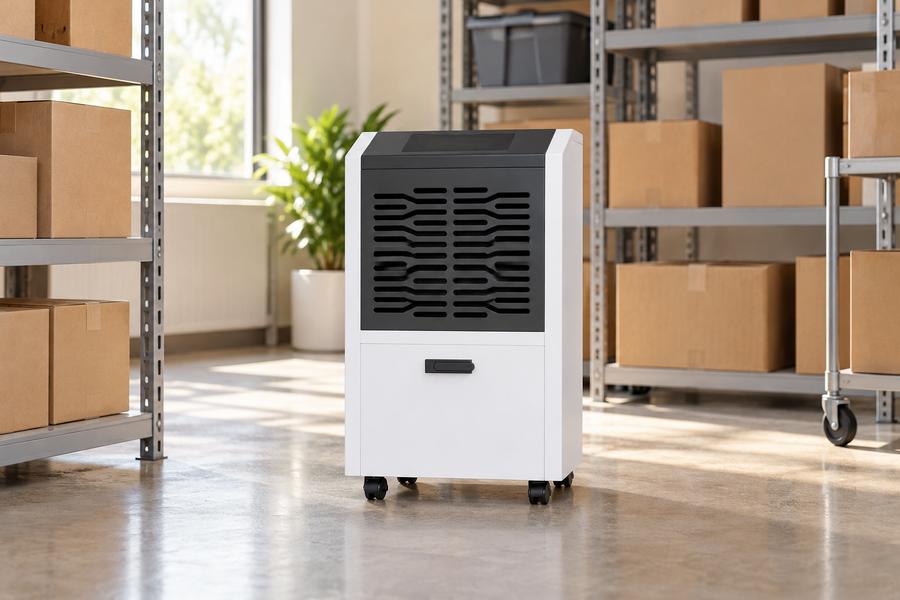
Commercial dehumidifiers are generally recommended for buildings requiring moderate humidity control without specialized industrial processes.
Choose a commercial dehumidifier when:
- The facility has moderate moisture removal requirements.
- Indoor temperatures are suitable for standard refrigeration systems.
- Humidity control is needed for general building protection.
- Simpler installation and maintenance are preferred.
- Lower initial equipment costs are important.
Typical Applications
- Office buildings
- Shopping centers
- Hotels and hospitality facilities
- Commercial basements
- Small and medium-sized warehouses
- Retail storage areas
For example, a commercial storage facility operating at approximately 25°C with a target relative humidity of 50% may be suitable for a refrigerant commercial dehumidifier.
A correctly sized system can provide effective moisture removal without requiring complex industrial equipment.
When to Choose an Industrial Dehumidifier
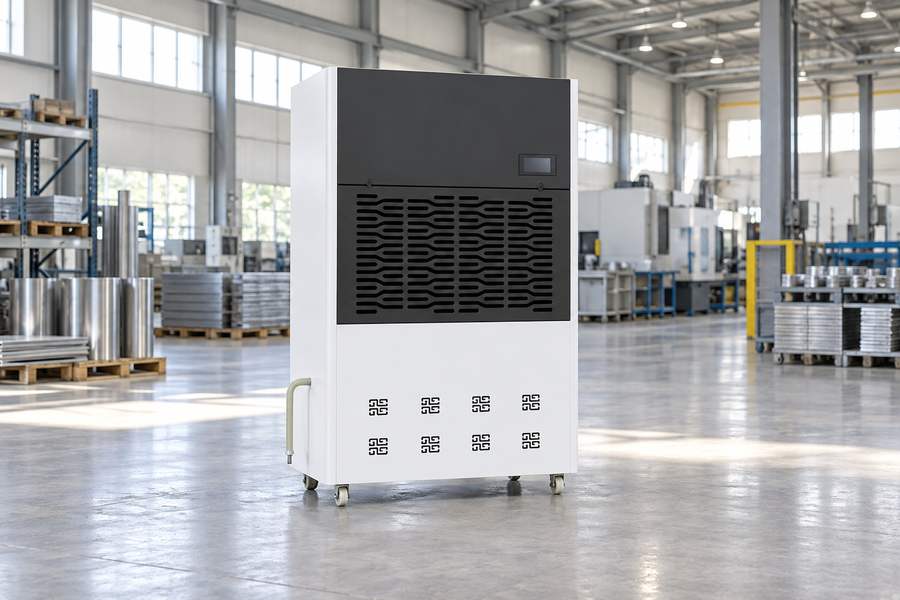
Industrial dehumidifiers are generally recommended for facilities with substantial moisture loads, demanding operating conditions, or specialized humidity requirements.
Choose an industrial dehumidifier when:
- Large amounts of moisture must be removed.
- Extended or continuous operation is necessary.
- Precise humidity or dew point control is required.
- Specialized industrial processes generate substantial moisture.
- Centralized or customized dehumidification systems are needed.
Typical Applications
- Manufacturing factories
- Industrial warehouses
- Pharmaceutical production facilities
- Food processing plants
- Cold storage warehouses
- Electronics manufacturing
- Industrial drying operations
For example, pharmaceutical manufacturing may require strict humidity control to protect moisture-sensitive materials and maintain consistent production conditions.
Industrial dehumidification equipment may be better suited to these requirements because of its specialized controls, operating capabilities, and system integration options.
The final choice still needs to match the amount of water entering the space and the dryness the process demands.
Key Factors to Consider Before Buying
Before purchasing a commercial or industrial dehumidifier, buyers should evaluate the following factors.
Facility Size
Consider floor area, ceiling height, and the distribution of moisture throughout the facility.
Large spaces may require centralized systems or multiple units to achieve consistent humidity control.
Moisture Removal Capacity
Determine the required capacity based on temperature, humidity, ventilation, and moisture generation.
Select equipment capable of maintaining target conditions under expected operating loads.
Operating Temperature
Refrigerant dehumidifiers generally perform well in warm, humid conditions.
Low-temperature or very low-humidity applications may benefit from desiccant technology.
Target Humidity
Identify the required relative humidity or dew point.
General commercial facilities often have moderate humidity targets, while specialized industrial processes may require tighter control.
Operating Schedule
Determine whether the equipment will operate intermittently, during business hours, or continuously.
Confirm the permitted duty cycle with the manufacturer before committing to round-the-clock use or the shorter daily schedule specified in your project brief.
Energy Efficiency
Compare power consumption and moisture removal performance under equivalent conditions.
Consider additional heating or cooling requirements for specialized systems.
Total Cost of Ownership
Include the initial unit and setup costs, then budget for energy and servicing throughout its anticipated working life.
For industrial applications, also consider the potential financial impact of equipment downtime.
Final Selection Considerations
Commercial dehumidifiers are generally suitable for offices, hotels, storage facilities, and other business environments requiring reliable moisture control at a reasonable cost.
Industrial dehumidifiers are better suited to manufacturing plants, large industrial facilities, and specialized applications requiring substantial moisture removal or precise humidity management.
The difference is not simply equipment size or purchase price. Industrial systems often provide specialized operating capabilities, advanced controls, and integration options that support demanding applications.
Ultimately, choosing the right dehumidifier requires balancing moisture removal capacity, environmental conditions, energy efficiency, installation requirements, and long-term ownership costs.
A properly selected system can maintain consistent humidity, protect valuable equipment and materials, and support reliable facility operations.