
Commercial and residential dehumidifiers both remove excess moisture from indoor air, but they differ in capacity, durability, energy consumption, and operating costs. The equipment selected should suit the moisture conditions and daily use of the building it serves.
Understanding the key differences between commercial and residential dehumidifiers can help buyers select suitable equipment, improve moisture control, and reduce long-term expenses.
What Is a Commercial Dehumidifier?
A commercial dehumidifier is a high-performance moisture removal system designed for commercial buildings, large spaces, and environments with demanding humidity control requirements.
Compared with typical household models, commercial dehumidifiers generally provide greater moisture removal capacity, stronger airflow, and more durable construction.
Key Features of Commercial Dehumidifiers
- High moisture removal capacity: Designed to handle substantial humidity loads.
- Heavy-duty construction: Robust assemblies support use in challenging commercial settings.
- Continuous drainage: Supports automatic water removal through hoses or condensate pumps.
- Extended operation: Suitable models can operate for long periods.
- Advanced controls: May include digital humidistats, automatic defrost, and remote monitoring.
Common Applications
Commercial dehumidifiers are widely used in:
- Warehouses and storage facilities
- Offices and commercial buildings
- Hotels and hospitality facilities
- Construction and restoration projects
- Commercial basements and workshops
These units are particularly valuable where consistent humidity control is necessary to protect inventory, equipment, and building materials.
What Is a Residential Dehumidifier?
A residential dehumidifier is designed to remove excess moisture from homes, apartments, and other living spaces. In a home, it makes damp rooms more comfortable and limits the condensation that can damage furnishings and finishes.
Most portable residential models prioritize compact design, quiet operation, and easy maintenance.
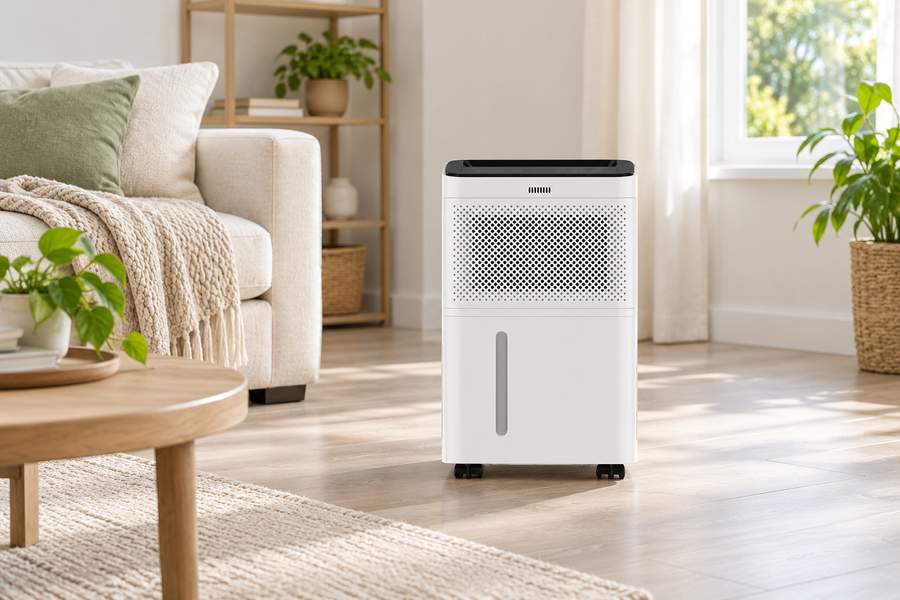
Key Features of Residential Dehumidifiers
- Compact design: Suitable for bedrooms, living rooms, and home basements.
- Quiet operation: Designed to minimize noise in occupied spaces.
- Simple controls: Commonly include adjustable humidity settings and timers.
- Portable structure: Many models feature handles and caster wheels.
- Convenient drainage: Usually equipped with water tanks and optional continuous drainage.
Common Applications
Residential dehumidifiers are commonly installed in bedrooms, bathrooms, laundry rooms, apartments, and home basements.
EPA guidance sets an indoor relative-humidity ceiling of 60%; when feasible, its preferred range is 30–50%.
Commercial vs. Residential Dehumidifiers: Key Differences at a Glance
The following table compares the main characteristics of commercial and residential dehumidifiers.
| Comparison Factor | Commercial Dehumidifier | Residential Dehumidifier |
| Moisture Removal Capacity | Generally higher | Low to moderate |
| Coverage Area | Larger or more demanding spaces | Individual rooms and homes |
| Construction | Heavy-duty materials | Lightweight household materials |
| Continuous Operation | Commonly designed for extended use | Depends on model |
| Power Consumption | Often higher total power demand | Generally lower for portable units |
| Noise Level | Often louder | Usually quieter |
| Drainage | Continuous drainage commonly supported | Water tank or continuous drainage |
| Installation | Portable, ducted, or fixed | Primarily portable |
| Purchase Price | Generally higher | Generally lower |
| Main Applications | Commercial and industrial facilities | Residential environments |
While these differences are typical, some high-capacity residential models overlap with smaller commercial systems. Buyers should always compare actual specifications and operating conditions.
Seven Practical Ways Commercial and Household Models Differ
Dehumidification Capacity and Performance
Dehumidification capacity determines how much moisture a machine can remove within 24 hours. Capacity labels typically express this daily output as PPD (pints) or L/day (liters).
Commercial Dehumidifiers
- Generally provide greater moisture removal capacity.
- Handle demanding humidity conditions and larger moisture loads.
- Suitable for warehouses, restoration projects, and commercial facilities.
- May use refrigeration or desiccant technology, depending on the application.
Residential Dehumidifiers
- Common portable capacities include 20–50 PPD under current U.S. testing standards.
- Designed for ordinary household moisture loads.
- Suitable for bedrooms, apartments, and residential basements.
- Whole-home models can provide significantly greater capacity.
Important consideration: Rated capacity depends on temperature and relative humidity. Commercial and residential specifications should be compared under equivalent testing conditions, since different rating methods can produce substantially different figures.
Coverage Area and Airflow
Coverage area influences how effectively a dehumidifier can manage moisture throughout a space.
Commercial dehumidifiers typically feature larger fans and stronger airflow. Some models support duct connections for distributing dry air across multiple areas.
Residential dehumidifiers generally use smaller airflow systems suitable for individual rooms or limited household areas.
Factors affecting coverage requirements include:
- Room size and ceiling height
- Indoor temperature and humidity
- Ventilation and air leakage
- Moisture sources within the building
- Required humidity levels
For example, a warehouse with frequently opened loading doors may require substantially more dehumidification than an enclosed storage room of similar size.
Buyers should therefore evaluate both airflow capacity, measured in CFM or m³/h, and the actual moisture load rather than relying exclusively on advertised coverage area.
Construction Quality and Durability
Commercial dehumidifiers are often designed for more demanding working environments.
Commercial Construction Features
- Reinforced metal or heavy-duty plastic housings
- Durable wheels and transportation handles
- Components suitable for extended operation
- Construction designed for demanding jobsite conditions
Residential Construction Features
- Lightweight plastic housings
- Compact and visually appealing designs
- Convenient handles and caster wheels
- Easy-access filters and collection tanks
Commercial equipment may offer greater durability in demanding environments, but how long a unit lasts also reflects its build quality, upkeep, and the environment in which it runs.
For businesses, choosing equipment with accessible replacement parts and reliable technical support can reduce downtime and long-term maintenance expenses.
Continuous Operation and Drainage Systems
Commercial facilities often require humidity control throughout the day, making extended operation and automatic drainage particularly important.
Commercial Dehumidifiers
- Frequently support extended operating schedules.
- Commonly feature continuous drainage connections.
- May include built-in condensate pumps.
- Can provide automatic humidity regulation and defrost functions.
Residential Dehumidifiers
- Often collect water in removable tanks.
- Automatically stop moisture collection when tanks become full.
- May offer continuous drainage through gravity hoses or pumps.
- Usually include basic humidity controls and automatic shutoff.
Continuous drainage is especially useful in warehouses, commercial basements, and unattended spaces where manually emptying water tanks would be impractical.
However, buyers should verify the manufacturer’s operating limits before assuming any model is suitable for uninterrupted operation.
Energy Efficiency and Power Consumption
Commercial dehumidifiers often consume more electricity per hour because they generally use larger compressors and fans. However, higher power consumption does not automatically indicate lower efficiency.
A larger unit may remove significantly more moisture for each hour of operation.
How to Compare Energy Efficiency
- Power consumption (W): Indicates the equipment’s electrical power demand.
- Energy consumption (kWh): Measures electricity used over time.
- Integrated Energy Factor (IEF): Measures moisture removal efficiency in liters per kilowatt-hour.
- Operating hours: Directly influence monthly electricity costs.
For equipment rated using IEF, a higher value indicates greater moisture removal per unit of electricity under specified test conditions.
Estimated Monthly Electricity Costs
The following examples assume an electricity rate of $0.17/kWh, 30 operating days, and the stated power draw throughout the scheduled operating hours.
| Operating Scenario | Power | Daily Hours | Monthly Cost |
| Residential – Light Use | 300 W | 8 | $12.24 |
| Residential – Extended Use | 500 W | 12 | $30.60 |
| Commercial – Extended Use | 900 W | 16 | $73.44 |
| Commercial – Continuous Use | 1,200 W | 24 | $146.88 |
These are illustrative calculations, not measured costs for specific products. Actual expenses depend on equipment efficiency, compressor cycling, local electricity rates, and humidity conditions.
Noise Levels and Portability
Noise and equipment mobility are important considerations, particularly when dehumidifiers are installed in occupied environments.
Residential Dehumidifiers
- Generally prioritize quieter operation.
- Often include adjustable fan speeds.
- Designed for convenient movement between rooms.
- Better suited to bedrooms and living areas.
Commercial Dehumidifiers
- May generate more noise because of stronger airflow.
- Often include robust handles and large wheels.
- Some models require permanent installation.
- Commonly used in warehouses and equipment rooms.
Commercial units can still be suitable for offices, hotels, and other occupied buildings when their noise characteristics meet project requirements.
Buyers should compare published decibel ratings, measured under comparable conditions, rather than selecting equipment based only on its commercial or residential classification.
Purchase Price and Maintenance Costs
Purchase price is another significant difference between commercial and residential dehumidifiers.
Commercial equipment generally requires a larger initial investment because of its higher capacity, heavy-duty components, and additional operating features.
Commercial vs. Residential Dehumidifier Prices
| Equipment Type | Illustrative U.S. Retail Prices | Main Cost Considerations |
| Portable Residential Dehumidifier | $140–$250 | Capacity, noise, controls, and drainage |
| Portable Commercial Dehumidifier | $530–$5,100 | Capacity, durability, pumps, and advanced controls |
These ranges represent illustrative U.S. retail prices rather than comprehensive market averages. Actual prices vary depending on brand, capacity, features, and supplier. Higher-capacity and specialized systems can cost more.
Long-Term Ownership Costs
Beyond purchase price, buyers should consider several ongoing expenses:
- Electricity: Depends on power consumption, operating hours, and local tariffs.
- Maintenance: Includes filter cleaning, drainage inspection, and servicing.
- Installation: Fixed or ducted commercial systems may require professional installation.
- Repairs: Replacement components and service availability influence long-term costs.
- Equipment replacement: Durability and operating conditions affect replacement frequency.
A business purchasing equipment should weigh lifetime expenditure alongside the amount paid upfront.
A higher-priced commercial unit may provide better long-term value if it delivers the required capacity efficiently and reduces maintenance or equipment downtime.
Commercial vs. Residential Dehumidifiers: Which One Should You Choose?
Choosing the right dehumidifier depends on the intended application, moisture load, operating schedule, and available budget.
Neither category is automatically better. The most suitable equipment is the one that meets the required humidity conditions efficiently and reliably.
When to Choose a Commercial Dehumidifier
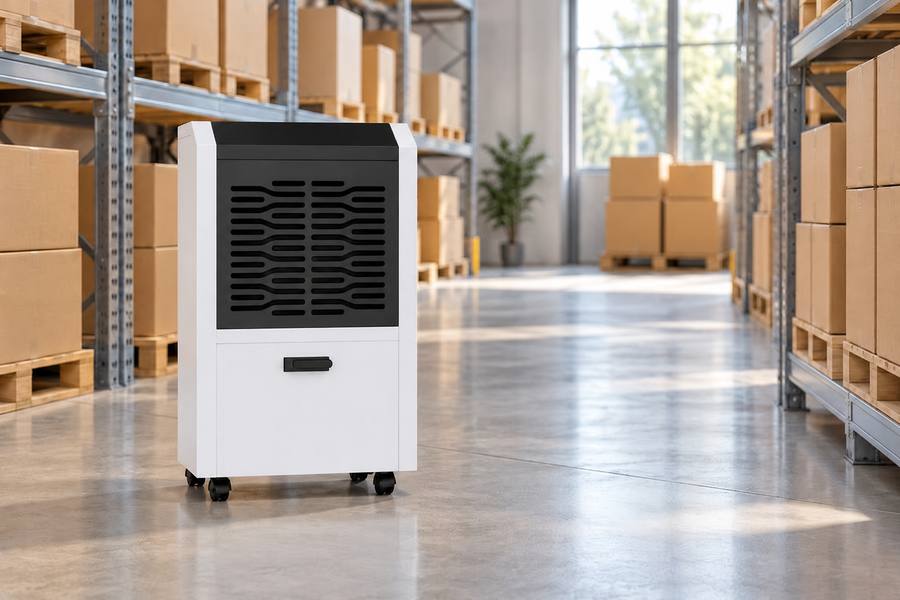
Commercial dehumidifiers are generally recommended for large spaces or environments with demanding moisture control requirements.
Choose a commercial dehumidifier when:
- The facility experiences substantial or persistent humidity.
- Extended operation is necessary.
- High moisture removal capacity and airflow are required.
- Automatic drainage and advanced controls are important.
- Durable equipment is needed for demanding conditions.
Typical Applications
- Warehouses storing moisture-sensitive products
- Commercial storage facilities
- Construction and water-damage restoration sites
- Hotels and commercial buildings
- Industrial workshops and large basements
For example, a warehouse storing paper products, textiles, or electronic components may require commercial dehumidification equipment to maintain consistent storage conditions.
Facility managers should calculate the moisture load and evaluate ventilation, indoor temperature, and humidity requirements before choosing a model.
When to Choose a Residential Dehumidifier
Residential dehumidifiers are typically more practical for homeowners who need convenient humidity control without complex installation.
Choose a residential dehumidifier when:
- The space is a bedroom, apartment, or ordinary living area.
- Moisture levels can be managed with household equipment.
- Quiet operation and portability are priorities.
- Simple maintenance and convenient controls are preferred.
- A lower initial equipment cost is important.
Typical Applications
- Bedrooms and living rooms
- Apartments and residential buildings
- Laundry rooms
- Small and medium-sized basements
- Other humidity-prone household spaces
For example, a portable residential dehumidifier may be sufficient to manage seasonal humidity in a bedroom or reduce dampness in a home basement.
However, larger homes or spaces with persistent moisture problems may require high-capacity residential or whole-home systems.
Key Factors to Consider Before Buying
Regardless of the equipment category, buyers should evaluate five essential factors:
- Moisture removal capacity: Choose equipment that can handle the actual humidity load.
- Operating conditions: Consider indoor temperature, relative humidity, and ventilation.
- Energy efficiency: Compare moisture removal performance against electricity consumption.
- Installation requirements: Evaluate drainage, noise, available space, and power supply.
- Long-term costs: Consider purchase price, electricity, maintenance, and service support.
Commercial dehumidifiers generally offer advantages in capacity, durability, and demanding operating environments, while residential dehumidifiers prioritize convenience, quieter operation, and affordability.
By matching equipment specifications to actual humidity control requirements, both residential and commercial buyers can achieve reliable moisture removal while managing energy consumption and long-term operating expenses.