
Choosing the right home dehumidifier depends on room size, climate conditions, humidity levels, and operating requirements. Different technologies provide different advantages in moisture removal, energy efficiency, noise control, and application suitability.
Compressor, desiccant, and thermoelectric dehumidifiers are the three main options for residential use. The useful comparison is how each system handles the actual room temperature and moisture load, rather than its size or wattage alone.
How Different Home Dehumidifier Technologies Work
Compressor Dehumidifiers
Compressor dehumidifiers are the most widely used type for home humidity control. They work through refrigeration technology, using a compressor, evaporator coil, condenser coil, and fan to remove moisture from indoor air.
Inside the cabinet, forced airflow brings the room’s water vapor into contact with a metal coil chilled by the refrigerant circuit. Once the coil is cool enough for that air’s dew point, a film of liquid develops on its fins. Droplets run into a collection tray, then into the removable reservoir or an attached drain hose. The dry air then passes through the condenser coil, where it is slightly reheated before returning to the room.
Due to their strong moisture removal capability, compressor dehumidifiers are commonly used in:
- Bedrooms
- Living rooms
- Basements
- Bathrooms
- Large residential areas
They perform best in warm and humid environments, generally between 15°C and 35°C. In a cool room, the refrigerated surface can ice up; time spent defrosting then reduces the amount of water collected.
| Advantages | Limitations |
| High moisture removal capacity for medium and large rooms | Performance decreases in colder temperatures |
| Energy efficient in warm and humid climates | Compressor operation creates some noise |
| Suitable for continuous humidity control | Larger size compared with compact models |
Desiccant Dehumidifiers
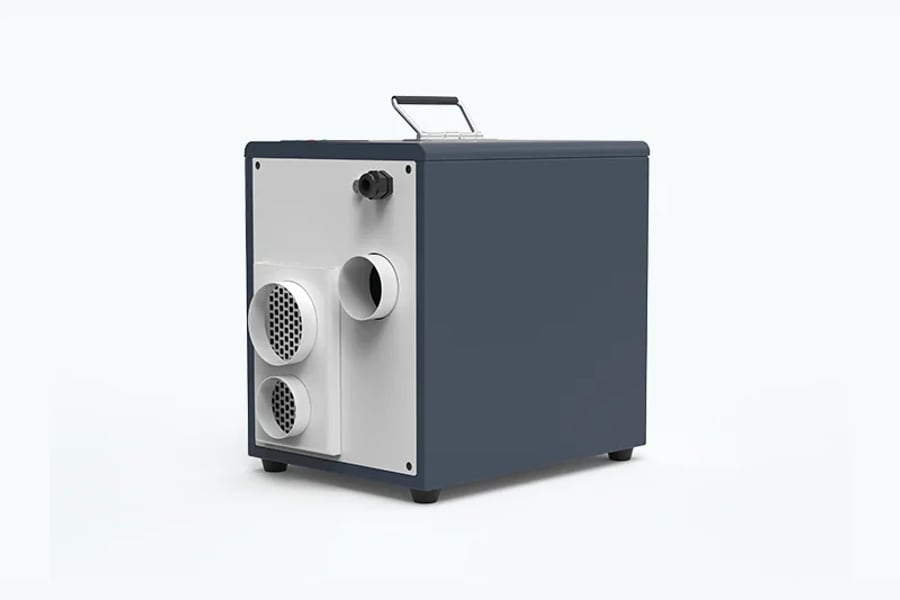
In a solid-desiccant unit, water molecules adhere to the internal surfaces of a porous drying medium through adsorption. They use solid adsorbents such as silica gel to capture water vapor directly from the air.
During operation, humid air passes through the desiccant material, where moisture is adsorbed. A regeneration process then uses heat to remove the collected moisture, allowing the desiccant material to continue working.
Unlike compressor models, desiccant dehumidifiers do not rely on cooling coils. Their drying stage therefore avoids the cold-coil icing limitation, although output still depends on the model and room conditions.
They are commonly used in:
- Cold climate homes
- Winter basements
- Storage areas
- Garages
- Low-temperature rooms
Desiccant technology is also suitable when users need stable humidity control because it can continue removing moisture even when temperatures drop.
| Advantages | Limitations |
| Effective at low temperatures | Higher energy consumption due to regeneration heating |
| Provides stable humidity control | Higher purchase cost |
| Quiet operation without compressor vibration | Produces warm exhaust air |
Thermoelectric Dehumidifiers
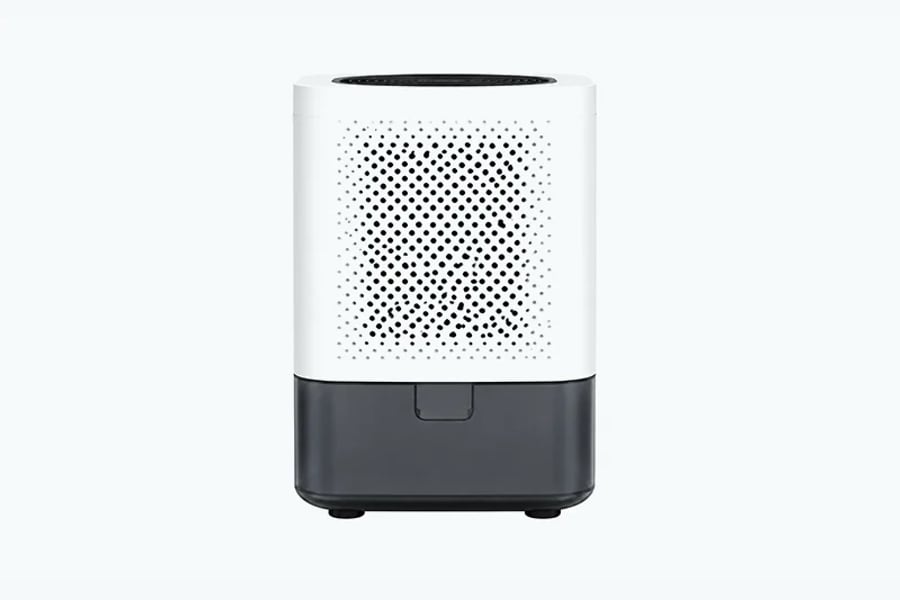
Thermoelectric dehumidifiers, also called Peltier dehumidifiers, use a thermoelectric cooling module to remove moisture.
When electricity passes through the Peltier module, one side becomes cold while the other side releases heat. Humid air contacts the cold surface, causing moisture to condense into liquid water.
Compared with compressor and desiccant models, thermoelectric units have fewer components, smaller dimensions, and quieter operation. However, their moisture removal capacity is limited.
They are mainly suitable for:
- Closets
- Small bedrooms
- Cabinets
- Small bathrooms
- Personal offices
Thermoelectric dehumidifiers are not recommended for large rooms or areas with high humidity levels.
| Advantages | Limitations |
| Compact and lightweight design | Limited moisture removal capacity |
| Very quiet operation | Not suitable for large rooms |
| Low initial purchase cost | Slow dehumidification performance |
Compressor vs. Desiccant vs. Thermoelectric Dehumidifiers: Key Differences
Different dehumidifier technologies provide different performance characteristics based on their operating principles.
*Temperature bands are broad selection guides, not operating limits for every product. Verify the model datasheet: for example, the Meaco DD8L Junior manual lists 1–37°C, 330/650W drying modes, and 39–48 dB. Actual extraction and power depend on temperature, humidity, and mode; capacity ratings from different test conditions are not directly comparable.
| Selection Factor | Refrigerated Compressor System | Regenerated Desiccant System | Peltier Cooling System |
| Water Extraction in Household Use | Suited to substantial room moisture loads | Useful room-scale output, including cool conditions | Limited output for local moisture control |
| Indicative Temperature Guide* | 15–35°C | 1–35°C | 15–30°C |
| Energy Efficiency | High in warm climates | Better in cold climates | Low power but limited output |
| Noise Level | Medium | Low to Medium | Very Low |
| Size | Medium | Medium | Compact |
| Best Application | Large rooms and high humidity | Cold areas and storage | Small spaces |
Compressor models are usually the best choice for general home use because they provide strong moisture removal with reasonable energy consumption. Desiccant models are more suitable for cold conditions, while thermoelectric models are ideal for small spaces.
Moisture Removal Performance Comparison
Compressor Dehumidifier Performance
Compressor dehumidifiers generally provide the highest moisture removal capacity among residential models. Depending on size, household units can remove approximately 10–50 pints of moisture per day.
They are suitable for areas with continuous humidity problems, such as basements, living rooms, and large bedrooms. Their refrigeration system allows them to quickly reduce indoor moisture levels.
However, compressor performance depends strongly on temperature. When room temperatures drop below approximately 15°C, the evaporator coil may become less effective, resulting in lower moisture extraction performance.
Desiccant Dehumidifier Performance
Desiccant dehumidifiers maintain better performance in cold conditions because they do not depend on refrigeration technology.
They can continue adsorbing moisture during winter, making them suitable for cold homes, basements, and storage rooms. They are also useful where stable humidity levels are required.
The main limitation is that regeneration requires additional energy, which increases operating costs compared with compressor models.
Thermoelectric Dehumidifier Performance
Thermoelectric dehumidifiers are designed for localized moisture control rather than whole-room humidity management.
Their moisture removal capacity is much lower than compressor and desiccant units. They are effective for small enclosed spaces but are not suitable for severe humidity problems.
Energy Efficiency Comparison
Compressor Dehumidifier Energy Consumption
Compressor dehumidifiers are generally the most energy-efficient choice in warm and humid climates.
Typical residential models consume approximately 200–700W depending on capacity. Although larger units use more electricity, they remove significantly more moisture, improving overall efficiency.
For homes in humid regions, compressor technology often provides the lowest operating cost per amount of moisture removed.
Desiccant Dehumidifier Energy Consumption
Desiccant models require additional energy because moisture must be removed from the desiccant material through heating regeneration.
Typical household units consume approximately 300–1000W depending on capacity and operating mode.
Although energy consumption is higher, desiccant models provide better performance in cold environments where compressor units may lose efficiency.
Thermoelectric Dehumidifier Energy Consumption
Thermoelectric models usually consume the least electricity, commonly around 20–100W.
However, their low power consumption is related to their smaller capacity. They are suitable for small areas where only limited moisture control is needed.
Noise Level and Comfort Comparison
Compressor Dehumidifiers
Compressor models produce noise from the compressor and fan. Most residential units operate around 40–55 dB depending on capacity and fan speed.
They are commonly installed in:
- Basements
- Living rooms
- Laundry rooms
where moderate operating noise is acceptable.
Desiccant Dehumidifiers
Desiccant units avoid compressor vibration, resulting in quieter operation. Their main noise source is the fan and airflow system.
They also release warm air, which can provide additional comfort during colder seasons.
Thermoelectric Dehumidifiers
Thermoelectric units are usually the quietest option because they do not contain compressors.
For example, Eva-Dry lists approximately 33 dB for its EDV-1100. Compare noise ratings at the same fan setting and measurement conditions before choosing a unit near a bed or desk.
Best Choice for Different Home Applications
| Application | Recommended Type | Reason |
| Basement | Compressor / Desiccant | Handles high moisture levels |
| Bedroom | Quiet Compressor / Thermoelectric | Lower noise requirements |
| Bathroom | Compressor | Removes moisture quickly |
| Closet | Thermoelectric | Compact design |
| Cold Climate Home | Desiccant | Performs well at low temperatures |
| Large Living Room | Compressor | Higher moisture capacity |
Basement
Basements often experience high humidity because of underground temperatures and limited ventilation. Compressor dehumidifiers are usually preferred due to their strong moisture removal capability.
In colder regions, desiccant models may provide better results because they continue working efficiently at low temperatures.
Bedroom
Bedrooms require a balance between comfort and humidity control. Quiet compressor models are suitable for medium-sized bedrooms, while thermoelectric models should be reserved for small spaces with a light moisture load.
Bathroom
Bathrooms experience short periods of high humidity after showers. Compressor units can quickly remove moisture and reduce condensation problems.
Closet and Storage Areas
Small enclosed spaces usually require limited moisture control. Compact thermoelectric models can provide sufficient performance without taking up much space.
How to Choose the Best Home Dehumidifier
Consider Room Size
Room size directly affects the required dehumidification capacity.
- Small spaces: Thermoelectric dehumidifiers
- Medium rooms: Compressor dehumidifiers
- Large areas: High-capacity compressor models
Selecting an undersized unit may result in longer operation times and insufficient humidity reduction.
Consider Climate Conditions
Climate plays an important role in technology selection.
- Warm and humid climates → Compressor dehumidifiers
- Cold environments → Desiccant dehumidifiers
Homeowners should consider both seasonal temperature changes and average humidity levels.
Consider Humidity Requirements
Different humidity conditions require different solutions.
- Mild moisture problems → Thermoelectric
- High humidity conditions → Compressor
- Cold-room humidity regulation → Consider desiccant
Choose the humidity setting to suit the room and season, and lower it if moisture still condenses on cold windows or walls.
Consider Noise Requirements
Noise-sensitive areas require careful selection.
- Bedrooms → Thermoelectric or quiet compressor models
- Basements → Compressor models
- Storage areas → Desiccant models
Cost Comparison: Purchase Price and Operating Cost
The total cost of a dehumidifier includes the initial purchase price and long-term electricity consumption.
| Type | Verified Retail Example (USD)* | Illustrative Power Band for Calculation | Estimated Annual Electricity Cost* | Best Value |
| Compressor | $329.99 | 200–700W | About $44–$153/year | Most homes |
| Desiccant | $299.99 | 300–1000W | About $66–$219/year | Cold regions |
| Thermoelectric | $59.95 | 20–100W | About $4–$22/year | Small spaces |
Compressor dehumidifiers offer the best overall value for most homes due to their strong moisture removal capacity and balanced operating costs. Desiccant models are suitable for cold environments, while thermoelectric units are a low-cost option for small spaces.