
Humidity control is critical in industries requiring stable conditions. The desiccant dehumidifier working principle uses moisture adsorption technology to achieve low humidity, especially in cold environments and industrial processes where traditional refrigerant dehumidifiers may not provide sufficient performance.
What Is a Desiccant Dehumidifier?
A desiccant dehumidifier is an industrial humidity control system that removes moisture through adsorption. Its core component is a desiccant rotor filled with moisture-absorbing materials such as silica gel or molecular sieve.
When humid air passes through the rotor, moisture molecules are attracted and retained by the desiccant material. The treated dry air is then delivered back into the controlled environment.
However, the moisture absorption capacity of the desiccant material is limited. To maintain continuous operation, the absorbed moisture must be removed through a regeneration process. Therefore, a desiccant dehumidifier typically operates with two separate airflow paths:
- Process air section
- Regeneration air section
These two airflow systems work together to achieve continuous dehumidification.
In our view, the biggest advantage of this design is that it separates moisture removal from temperature reduction. This allows desiccant dehumidifiers to maintain stable humidity control even when air temperatures are low.
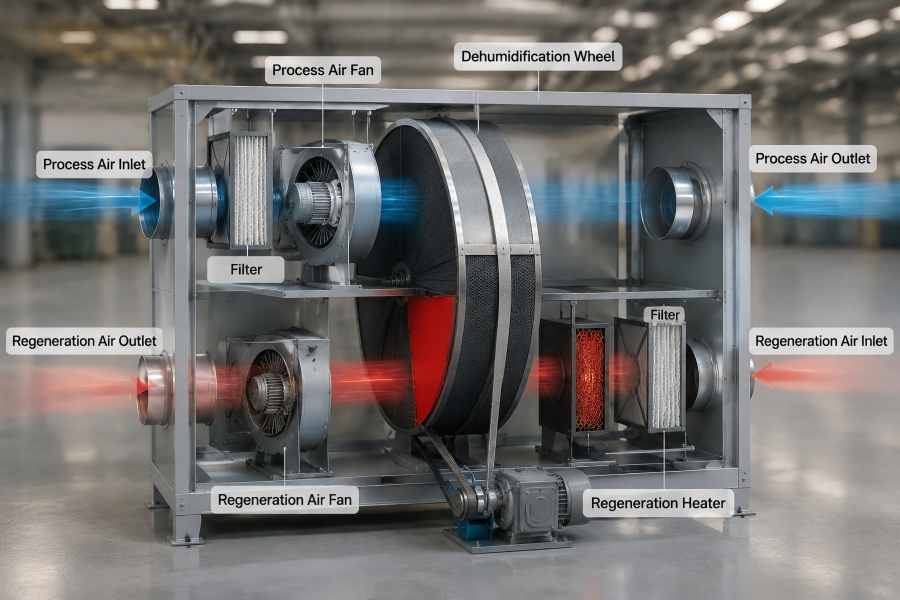
Desiccant Dehumidifier Working Principle: Step-by-Step Process
The operation of a desiccant dehumidifier can be divided into four main stages: adsorption, rotation, regeneration, and moisture discharge.
Moist Air Enters the Dehumidification Process Section
The working process begins when humid air enters the dehumidifier through the process air inlet.
This air may come from:
- Pharmaceutical production rooms
- Battery manufacturing areas
- Cold storage facilities
- Electronic component production lines
- Warehouse environments
The air passes through filters first to remove dust and particles before reaching the desiccant rotor.
This filtration stage is often underestimated. In industrial applications, clean airflow is essential because dust accumulation can reduce the moisture absorption performance of the rotor over time.
Moisture Adsorption Through the Desiccant Rotor
The filtered humid air then passes through the rotating desiccant wheel.
Inside the rotor, countless small channels increase contact area between air and desiccant material. Water vapor molecules are captured by the desiccant surface through adsorption.
The important point is that adsorption is different from absorption.
- Absorption means moisture enters into another material.
- Adsorption means moisture attaches to the surface of a material.
Because adsorption does not depend on cooling air below its dew point, desiccant dehumidifiers can continue removing moisture even in cold environments.
For example:
A refrigerated warehouse operating at 0–10°C may have difficulty achieving low humidity using a standard refrigerant dehumidifier because the evaporator can easily freeze. A desiccant system can continue operating because moisture removal is not dependent on coil temperature.
Continuous Rotor Rotation Transfers Moisture
The desiccant rotor slowly rotates between the process section and regeneration section.
One side of the rotor continuously absorbs moisture from humid air, while another side enters the regeneration area to release collected moisture.
This continuous rotation allows the equipment to operate without stopping for defrosting or water drainage.
From an industrial design perspective, this continuous cycle is one of the key reasons desiccant dehumidifiers are preferred for 24/7 production environments. Manufacturing lines cannot always stop because of humidity fluctuations.
Stable operation is often more valuable than simply achieving a lower initial equipment cost.
Regeneration Removes Stored Moisture
After absorbing moisture, the desiccant rotor moves into the regeneration zone.
Here, heated air passes through the rotor and releases the trapped moisture.
The regeneration process usually includes:
- Heating regeneration air
- Removing moisture from the desiccant material
- Exhausting humid regeneration air outside
After regeneration, the desiccant material becomes dry again and returns to the process section.
This cycle repeats continuously.
The regeneration energy consumption is an important factor when selecting a desiccant dehumidifier. In our experience, customers should not only focus on dehumidification capacity but also evaluate heat source options, airflow design, and system efficiency.
Main Components of a Desiccant Dehumidifier
Understanding the components helps customers better evaluate different equipment designs.
Desiccant Rotor
The rotor is the core component of the system.
Its performance is determined by:
- Desiccant material type
- Rotor structure
- Moisture absorption capacity
- Air contact efficiency
Different applications require different rotor designs. Pharmaceutical environments requiring extremely stable humidity control may need high-performance rotors, while general industrial storage may use standard configurations.
Process Air Fan
The process fan controls the airflow passing through the humidity-controlled area.
A properly selected airflow rate ensures:
- Stable moisture removal
- Uniform humidity distribution
- Reduced energy waste
Too much airflow may increase operating costs, while insufficient airflow may create humidity differences inside the room.
Regeneration Heating System
The regeneration heater provides the thermal energy required to remove moisture from the rotor.
Common heating methods include:
- Electric heating
- Steam heating
- Hot water heating
- Thermal oil heating
For large industrial projects, selecting the right regeneration heat source can significantly influence long-term operating costs.
Control System
Modern desiccant dehumidifiers usually include intelligent control systems.
Functions may include:
- Humidity monitoring
- Automatic capacity adjustment
- Remote communication
- Alarm functions
- BMS integration
For industrial customers, automatic control is becoming increasingly important because manual adjustment cannot always respond quickly to production changes.
Why Desiccant Dehumidifiers Are Widely Used in Industrial Applications
Low Humidity Capability
One major advantage of desiccant technology is achieving very low humidity levels.
Typical applications requiring low humidity include:
- Lithium battery production
- Pharmaceutical manufacturing
- Precision electronics
- Semiconductor processes
These environments often require humidity levels below what conventional cooling dehumidifiers can efficiently provide.
Reliable Performance at Low Temperature
Traditional refrigerant systems become less efficient as temperature decreases.
Desiccant dehumidifiers maintain moisture removal performance in environments such as:
- Cold storage rooms
- Freezer areas
- Winter production facilities
This makes them valuable for industries where temperature and humidity conditions are challenging.
Continuous Operation Without Water Drainage Problems
Because moisture is removed through regeneration air, there is no large amount of condensed water requiring collection.
This provides advantages for:
- Remote warehouses
- Automated production lines
- Long-term unattended operation
Industrial Applications of Desiccant Dehumidifiers
Pharmaceutical Manufacturing
Pharmaceutical production requires strict humidity control to protect moisture-sensitive materials and maintain stable manufacturing conditions. Excess humidity can affect powder flowability, cause material caking, and impact product quality.
Desiccant dehumidifiers ensure accurate humidity control in:
- Tablet and capsule production rooms
- Raw material storage areas
- Pharmaceutical cleanrooms
- R&D laboratories and testing areas
Battery Manufacturing
Battery production is one of the most demanding applications for desiccant dehumidification technology. Moisture control is critical because excessive humidity can affect sensitive materials and reduce production consistency.
Desiccant systems provide stable low-humidity environments for:
- Electrode manufacturing areas
- Battery assembly rooms
- Material storage facilities
- Dry rooms requiring continuous humidity control
Food Processing
Many food products are highly sensitive to moisture changes during processing, storage, and packaging. Uncontrolled humidity may cause clumping, texture changes, and reduced shelf stability.
Desiccant dehumidifiers help control humidity in:
- Powder material processing areas
- Dry food storage rooms
- Packaging environments
- Production areas requiring stable moisture conditions
Cold Storage
Cold storage environments often face condensation, frost, and moisture-related issues due to temperature fluctuations and frequent door openings.
Desiccant dehumidifiers help reduce:
- Frost formation on refrigeration equipment
- Surface condensation on walls and products
- Packaging moisture damage
- Ice buildup in low-temperature storage areas
By maintaining stable humidity levels, desiccant systems improve storage conditions and help protect temperature-sensitive products.