
Desiccant dehumidifiers rely on regeneration heat sources to continuously remove moisture from the desiccant rotor and maintain stable low dew point conditions. Electric, steam, and gas regeneration methods have different impacts on energy consumption, operating costs, installation requirements, and application suitability. Matching the heat source to the facility can limit unnecessary energy use and keep recurring expenses under control.
How Regeneration Works in Desiccant Dehumidifiers

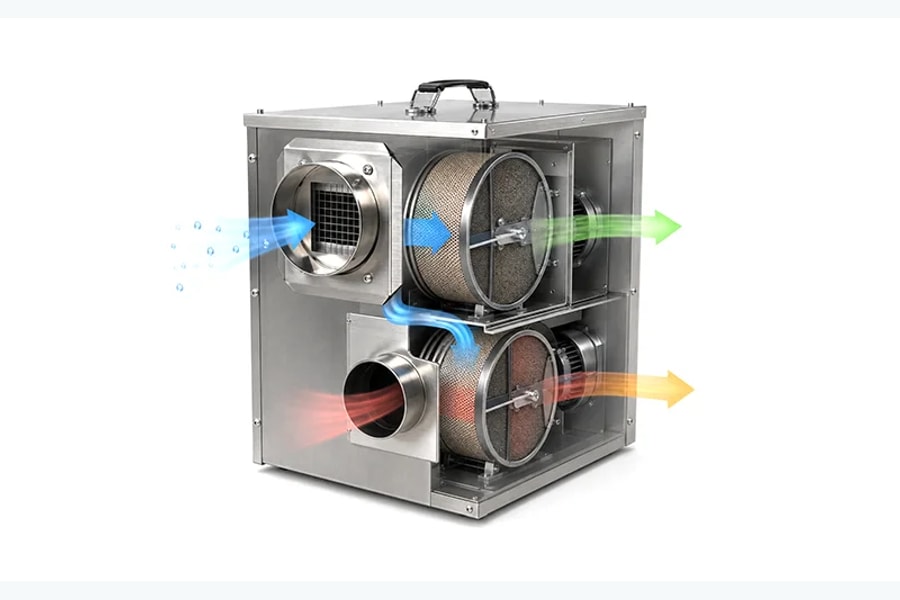
Regeneration is the process that restores the moisture adsorption capacity of a desiccant rotor in desiccant dehumidifiers. During operation, the rotor adsorbs moisture from process air and gradually becomes saturated. A separate regeneration airflow heated by an external energy source passes through the rotor section, releasing the adsorbed moisture and preparing the rotor for continuous dehumidification.
The regeneration system directly affects:
- Moisture removal capacity
- Outlet dew point performance
- Energy consumption
- Operating stability
- Equipment efficiency
Different regeneration methods use different heat sources:
- Electric regeneration uses electrical heating elements to heat regeneration air.
- Steam regeneration uses steam coils connected to industrial steam systems.
- Gas regeneration uses natural gas or other fuels to generate regeneration heat.
The most suitable regeneration method depends on several factors, including available energy sources, dehumidifier capacity, operating hours, installation conditions, and long-term operating costs.
Key Factors Affecting Regeneration Performance
Before selecting a regeneration method, several important factors should be evaluated.
Regeneration Temperature Stability
The regeneration temperature must remain stable to effectively release moisture from the desiccant rotor. Insufficient temperature reduces moisture removal performance, while excessive temperature increases energy consumption.
Heat Transfer Efficiency
Efficient heat transfer allows the system to provide enough regeneration energy while reducing unnecessary losses.
Energy Availability
The availability and price of electricity, steam, and gas directly influence the overall operating cost of the desiccant dehumidifier.
Operating Cost
Since industrial desiccant dehumidifiers often operate continuously, energy consumption can represent a significant portion of lifecycle costs. A regeneration method with a lower initial investment may not always provide the lowest long-term operating cost.
Application Requirements
Different industries have different requirements. Pharmaceutical facilities, battery factories, electronics manufacturing plants, and cleanrooms may prioritize humidity accuracy, energy efficiency, or installation flexibility.
Electric Regeneration Desiccant Dehumidifiers
How Electric Regeneration Works
Electric regeneration desiccant dehumidifiers use electrical heating elements to heat regeneration air before it passes through the desiccant rotor. The heated air removes moisture from the rotor, allowing continuous adsorption operation.
Electric heaters are controlled by temperature sensors and control systems to maintain accurate regeneration conditions.
Its appeal lies in a straightforward heater arrangement that supports dependable operation and closely regulated air temperature.
Advantages and Disadvantages of Electric Regeneration
| Advantages | Disadvantages |
| Simple installation without additional heating infrastructure | Higher energy cost for large-capacity systems |
| Excellent temperature control accuracy | Requires sufficient electrical capacity |
| Clean operation without combustion emissions | Electricity prices directly affect operating costs |
| Easy maintenance and system adjustment | Less economical for continuous large-scale operation |
| Suitable for small and medium systems | Higher power consumption at high regeneration loads |
Typical Applications
Electric regeneration is commonly used in:
- Laboratories
- Electronics manufacturing
- Pharmaceutical facilities
- Cleanrooms
- Research facilities
- Small industrial drying systems
Electric Regeneration Energy Cost Considerations
Draft fact-check note: The prices, annual costs, and savings percentages below are retained from the supplied draft and have not been verified for a specific market, date, system size, or tariff. They are not confirmed quotations or guaranteed savings. Confirm currency, steam ton basis, applicable taxes, installation and delivery charges, and operating assumptions before publication.
Electric regeneration is usually easier to install but may have higher long-term energy costs.
Typical industrial electricity prices vary by region, but many facilities operate within approximately:
- Electricity cost: $0.08–$0.25/kWh
For example, a medium-size electric regeneration desiccant dehumidifier consuming 15–40 kW of regeneration power and operating 4,000–8,000 hours/year may have annual regeneration energy costs approximately:
- $5,000–$80,000/year
The actual cost depends on operating hours, electricity rates, regeneration temperature, and system capacity.
Electric regeneration is usually preferred when installation simplicity and precise control are more important than minimizing energy costs.
Steam Regeneration Desiccant Dehumidifiers
How Steam Regeneration Works
Steam regeneration systems use steam generated by boilers or existing industrial processes. Steam passes through a heating coil or heat exchanger and transfers heat to the regeneration air before it enters the desiccant rotor.
A plant with an established steam network can often integrate this heating arrangement into its existing utilities.
Advantages and Disadvantages of Steam Regeneration
| Advantages | Disadvantages |
| Lower operating cost when steam is available | Requires existing steam infrastructure |
| Suitable for large-capacity systems | Higher installation complexity |
| Efficient for continuous operation | Requires steam pressure control |
| Reduces electrical power consumption | Steam components need regular maintenance |
| Can utilize existing industrial energy systems | Not suitable without steam supply |
Typical Applications
Steam regeneration is widely used in:
- Pharmaceutical production
- Chemical processing
- Food manufacturing
- Large factories
- Industrial drying processes
Steam Regeneration Energy Cost Considerations
Draft fact-check note: Steam prices, annual costs, and savings percentages in this section remain unverified; see the cost note in the electric regeneration section.
Steam regeneration can provide significant savings when a factory already operates boilers or has waste steam available.
Typical industrial steam costs are often approximately:
- Steam cost: $5–$20 per ton of steam
Depending on system size and operating conditions, steam regeneration may reduce regeneration energy costs by:
- 20%–50% compared with electric regeneration
For a large industrial desiccant dehumidifier operating continuously, annual regeneration energy costs may typically range:
- $10,000–$100,000/year
The actual cost depends on:
- Steam generation efficiency
- Steam pressure
- Boiler fuel cost
- Operating hours
- Required regeneration temperature
Steam regeneration provides the greatest economic advantage when steam is already available as part of the production process.
Gas Regeneration Desiccant Dehumidifiers
How Gas Regeneration Works
Gas regeneration desiccant dehumidifiers use natural gas or other fuels to generate heat for regeneration. A gas burner heats the regeneration air, which then passes through the desiccant rotor to remove adsorbed moisture.
This method is generally used for high-capacity industrial systems requiring continuous operation.
Advantages and Disadvantages of Gas Regeneration
| Advantages | Disadvantages |
| Potential fuel savings when local gas tariffs are competitive | Needs a suitable gas connection and associated supply equipment |
| Suitable for large continuous operations | Requires combustion safety systems |
| Reduces dependence on electricity | Requires exhaust management |
| Provides high regeneration heat output | Higher maintenance requirements |
| Suitable for high-volume drying applications | More complex installation |
Typical Applications
Gas regeneration is commonly used in:
- Large industrial facilities
- Warehouses
- Heavy manufacturing
- High-volume drying applications
- Large process environments
Gas Regeneration Energy Cost Considerations
Draft fact-check note: Gas prices, annual costs, and savings percentages in this section remain unverified; see the cost note in the electric regeneration section.
Where the delivered price of gas is low relative to electricity, fuel-fired regeneration may be less expensive to run.
Typical natural gas prices may range approximately:
- Natural gas cost: $3–$15/MMBtu
For large industrial desiccant systems, gas regeneration may reduce energy costs by approximately:
- 30%–60% compared with electric regeneration
Annual regeneration energy costs for large systems may typically range:
- $15,000–$150,000/year
However, users should consider additional costs related to:
- Burner maintenance
- Gas supply installation
- Exhaust systems
- Safety inspections
Gas regeneration is often selected for large-scale continuous applications where energy savings justify the additional system complexity.
Electric vs. Steam vs. Gas Regeneration Comparison
| Factor | Electric Regeneration | Steam Regeneration | Gas Regeneration |
| Heat Source | Electricity | Industrial steam | Natural gas/fuel |
| Installation Difficulty | Low | Medium–High | High |
| Temperature Control | Excellent | Good | Good |
| Initial Investment | Low–Medium | Medium–High | Medium–High |
| Draft Energy Cost Figures — Unverified | $0.08–$0.25/kWh | $5–$20/ton steam | $3–$15/MMBtu |
| Maintenance Level | Low | Medium | Medium–High |
| Best Application | Small and medium systems | Large facilities with steam supply | Large continuous operations |
Energy Efficiency and Operating Cost Analysis
Energy consumption is one of the most important factors when selecting a regeneration method. Because industrial desiccant dehumidifiers often operate thousands of hours per year, regeneration energy can significantly influence total ownership cost.
Electric Regeneration Cost Analysis
Electric regeneration provides excellent flexibility but has higher sensitivity to electricity prices.
Advantages:
- Lower installation cost
- Simple operation
- Accurate temperature control
Challenges:
- Higher operating cost for large systems
- Increased electrical demand
Electric regeneration is generally suitable for smaller systems or applications requiring precise control.
Steam Regeneration Cost Analysis
Steam regeneration is highly cost-effective when steam is already available.
Advantages:
- Lower energy cost
- Suitable for continuous operation
- Reduced electrical consumption
Challenges:
- Requires steam infrastructure
- Higher installation requirements
For factories with existing boiler systems, steam regeneration may provide the lowest lifecycle cost.
Gas Regeneration Cost Analysis
Gas regeneration can provide competitive operating costs for large systems.
Advantages:
- Lower fuel cost in many regions
- Suitable for high-capacity applications
Challenges:
- Requires combustion equipment
- Requires additional safety management
Large facilities should compare fuel prices, maintenance costs, and installation requirements before selecting gas regeneration.
Selecting a Regeneration Heat Source for Your Desiccant System
Available Energy Source
The first consideration is the existing energy infrastructure.
- Electricity is widely available and easy to install.
- Steam is ideal for facilities with boiler systems.
- Gas is suitable where fuel supply is economical.
Required Dehumidification Capacity
Capacity strongly affects regeneration selection.
- Small and medium systems usually use electric regeneration.
- Large industrial systems often benefit from steam or gas regeneration.
Operating Schedule
For equipment operating:
- Less than 2,000 hours/year: electric regeneration may be practical.
- 4,000–8,000 hours/year: energy cost becomes more important.
- 8,000+ hours/year: steam or gas options may provide better economics.
Environmental Requirements
Industries requiring clean operation may prefer:
- Electric regeneration
- Steam regeneration
Industries focused on large-scale drying may consider:
- Gas regeneration
Installation Conditions
Consider:
- Available installation space
- Energy infrastructure
- Safety requirements
- Maintenance capability
Common Regeneration Problems and Maintenance Considerations
Electric Regeneration Issues
Common problems:
- Heater failure
- Electrical overload
- Temperature sensor errors
Maintenance:
- Check heating elements
- Inspect electrical connections
- Verify temperature control accuracy
Steam Regeneration Issues
Common problems:
- Unstable steam pressure
- Steam coil scaling
- Valve failures
Maintenance:
- Monitor steam pressure
- Clean heat exchangers
- Inspect valves regularly
Gas Regeneration Issues
Common problems:
- Burner malfunction
- Fuel supply problems
- Combustion control failures
Maintenance:
- Inspect burners
- Check safety systems
- Maintain exhaust components
Electric, Steam, or Gas Regeneration: Which One Is Best?
There is no single best regeneration method for all desiccant dehumidifier applications. The optimal choice depends on energy availability, system capacity, operating hours, and lifecycle cost.
Electric Regeneration Is Best When:
- Precise humidity control is required
- Clean operation is important
- Small or medium systems are used
- No steam or gas infrastructure exists
Steam Regeneration Is Best When:
- A factory already has steam supply
- Large-scale operation is required
- Reducing operating costs is a priority
Gas Regeneration Is Best When:
- Natural gas is economical
- High-capacity drying is required
- Electrical power availability is limited
Choosing the correct regeneration method allows industrial users to achieve better desiccant dehumidifier performance, lower energy consumption, and more reliable long-term humidity control.