
Finished basements usually prioritize quiet operation and protection of interior finishes. Unfinished spaces often emphasize drainage, access, and performance in cooler conditions. Neither automatically needs a larger dehumidifier.
The right choice depends on measured dampness, basement size, temperature, room layout, and drainage options. Comparing these factors helps match the equipment to the space.
What Are the Differences Between Finished and Unfinished Basements?
Start with how the basement is built and used, since those details shape the requirements for humidity control. Their construction and daily use influence where moisture accumulates and which equipment features matter most.
Finished Basements
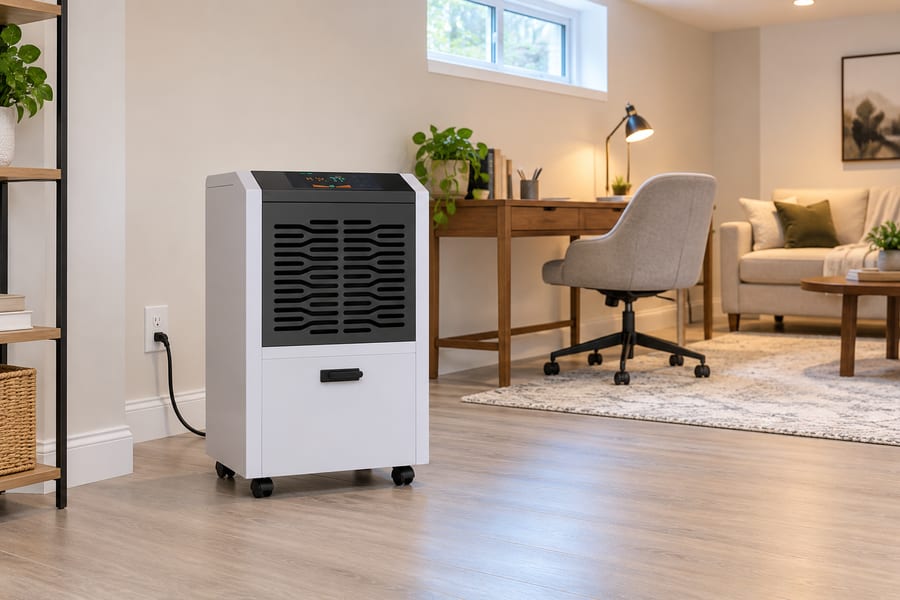
A finished basement is designed to function as usable indoor living space. It may include drywall, insulation, carpet, laminate or wood flooring, furniture, lighting, and entertainment equipment. Common uses include family rooms, home offices, guest bedrooms, and recreational areas.
These materials can be sensitive to prolonged exposure to excess humidity. Moisture may contribute to musty odors, condensation, peeling paint, swollen wood products, and conditions that encourage mold growth. Dampness behind drywall or beneath flooring can also be difficult to identify before visible damage appears.
For these reasons, a dehumidifier for a finished basement should provide consistent humidity control while operating quietly enough for occupied spaces. Adjustable humidity settings, automatic operation, and convenient drainage are useful features, especially when the basement is used daily.
Unfinished Basements
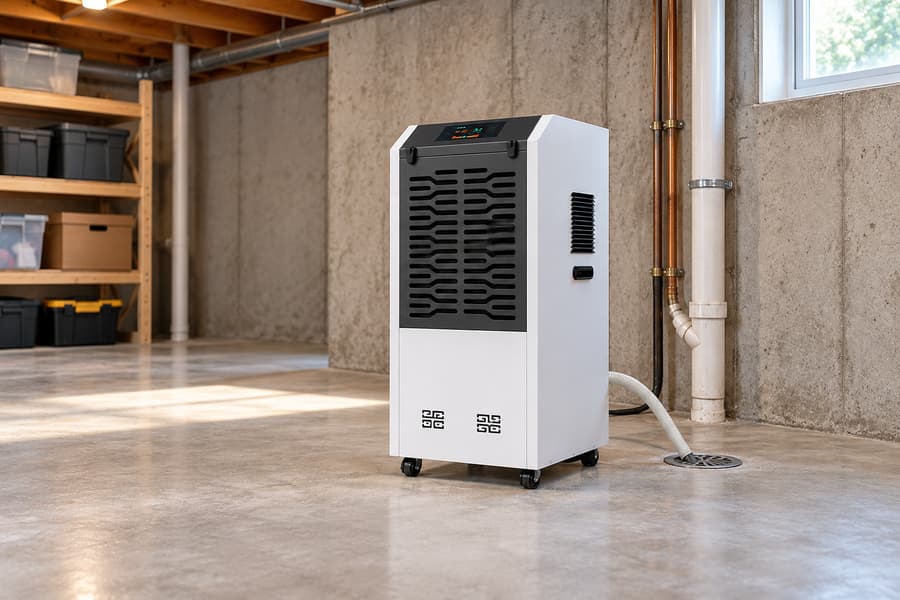
An unfinished basement typically has exposed concrete walls, concrete flooring, visible pipes, open ceilings, and utility equipment. It is commonly used for laundry, mechanical systems, seasonal storage, and general household storage.
Concrete and masonry surfaces can release moisture into the indoor environment, while groundwater intrusion, foundation seepage, and inadequate drainage may introduce additional moisture. Cardboard boxes, clothing, tools, and other stored items can be affected when humidity remains elevated.
Compared with finished spaces, unfinished basements often place greater emphasis on practical operation, moisture-removal capacity, drainage, and maintenance accessibility. Noise and appearance may be less important when the unit is located away from occupied rooms.
However, an unfinished basement does not automatically require a more powerful dehumidifier. A dry, well-sealed unfinished basement may need less moisture removal than a large finished basement with persistent dampness.
Finished vs. Unfinished Basement Dehumidifiers: Key Differences
Although both basement types need effective moisture control, their priorities can differ. The following table summarizes the main considerations when comparing dehumidifiers for these environments.
| Comparison Factor | Finished Basement | Unfinished Basement |
| Main priority | Comfort and protection of interior finishes | Moisture management and protection of stored items |
| Capacity requirements | Based on area, dampness, and room layout | Based on area, dampness, and moisture entering the space |
| Noise level | Quiet operation is important near living areas | Noise may be less important in utility spaces |
| Humidity control | Helps protect flooring, furniture, and drywall | Helps reduce dampness, condensation, and musty odors |
| Drainage | Continuous drainage reduces frequent bucket emptying | Continuous drainage is useful for persistent moisture |
| Placement | Balances airflow, accessibility, and occupant comfort | Prioritizes airflow, maintenance access, and drainage |
| Maintenance | Convenient filter access without disrupting daily use | Easy access for cleaning and routine inspection |
| Moisture detection | Hidden moisture behind walls and beneath floors may require investigation | Exposed surfaces can make some moisture problems easier to identify |
These differences describe typical priorities rather than separate equipment categories. A single dehumidifier model may work well in either environment if its capacity, operating temperature, controls, and drainage arrangements suit the basement.
How to Choose a Dehumidifier for a Finished Basement
Finished basements require attention to more than moisture removal. Because people spend time in these spaces, the equipment should also support comfortable operation and help protect interior materials.
Match Daily Water Removal to Basement Conditions
A capacity label states how much water the equipment removes in a day during a defined test, commonly using pints as the unit. The appropriate capacity depends on the basement’s square footage, relative humidity, dampness level, and moisture sources.
A finished basement with carpeting, several enclosed rooms, and limited airflow may require a different solution from an open basement of the same size. Bathrooms, laundry areas, and frequently used exterior doors can also affect humidity levels.
When selecting a unit, consider:
- Basement size: Measure the total area the dehumidifier needs to serve.
- Moisture conditions: Look for condensation, damp surfaces, musty odors, or consistently high humidity.
- Room layout: Multiple enclosed rooms may restrict airflow from a centrally positioned unit.
- Occupancy and use: Laundry, showers, and other activities can introduce additional moisture.
Avoid choosing capacity based on finished status alone. A properly sized unit should manage the actual moisture load at the basement’s usual temperature and humidity.
Prioritize Quiet Operation
Noise can be a significant consideration when the basement serves as a home office, bedroom, family room, or entertainment area. Compressor vibration and fan airflow can become distracting during conversations, work, or sleep.
Compare published noise ratings when available, and check whether the manufacturer provides multiple fan speeds or a low-noise operating mode. Lower fan speeds may reduce noise, although they can also affect moisture removal and air circulation.
Placement matters as well. Positioning the dehumidifier away from seating areas and sleeping spaces may reduce disruption, provided that the unit still has adequate airflow and convenient drainage.
Look for Automatic Humidity Controls
A built-in humidistat measures relative humidity and allows the unit to regulate operation around a selected target. This is useful in finished basements because humidity can change with outdoor weather, occupancy, and seasonal temperature differences.
With humidity-based control, users do not need to switch the equipment on and off whenever the room becomes damper. Some models also include automatic restart after a power interruption, which can be useful when the basement is unoccupied for extended periods.
A practical starting point is to maintain relative humidity between 30% and 50%, adjusting the setting according to comfort, condensation, and the manufacturer’s operating guidance. Once the basement reaches an appropriate humidity range, demanding further drying may add electricity use without solving an additional moisture problem.
Consider Drainage and Appearance
A collection bucket may be suitable for a lightly damp basement, but it requires regular emptying. If the dehumidifier runs frequently, continuous drainage can simplify maintenance.
A gravity-drain hose works when the drainage point is below the unit’s outlet and the hose can maintain a suitable downward slope. If the available drain is higher than the dehumidifier, a model with a built-in condensate pump may be more practical.
Finished basements also benefit from equipment that fits the available space without obstructing walkways or creating an unattractive installation. However, appearance should not take priority over airflow, service access, or safe drainage.
How to Choose a Dehumidifier for an Unfinished Basement
Unfinished basements often serve as utility and storage areas, so their selection criteria tend to focus on reliable moisture removal, practical installation, and straightforward maintenance.
Account for Persistent Moisture Sources
Exposed concrete walls and floors can reveal dampness that might otherwise remain hidden. However, visible moisture should not automatically be treated as a problem that a dehumidifier can solve by itself.
Humidity may come from several sources, including moisture moving through foundation materials, inadequate exterior drainage, plumbing leaks, or water entering through cracks. A dehumidifier can remove water vapor from the air, but it cannot repair these underlying problems.
Before selecting equipment, check for:
- Damp patches on foundation walls or floors.
- Water stains around windows, pipes, and wall joints.
- Water droplets collecting on chilled pipework or nearby cold surfaces.
- Musty odors near storage areas.
- Recurring moisture after heavy rain.
Correcting leaks and drainage problems first can reduce the amount of work required from the dehumidifier. It also helps prevent continued water damage that humidity control alone cannot address.
Check Low-Temperature Performance
Unfinished basements can remain relatively cool throughout the year, especially during winter. This makes the manufacturer’s minimum operating temperature an important selection factor.
Many conventional compressor-based dehumidifiers become less effective as the air temperature drops. Under sufficiently cold conditions, frost may form on the evaporator coil, requiring a defrost cycle. Some units may stop operating when temperatures fall outside their specified range.
Check the product specifications for its permitted operating temperature and defrost features rather than assuming that every basement dehumidifier works equally well in cold conditions.
For particularly cold spaces, a model specifically designed for low-temperature operation may be more appropriate. Desiccant dehumidifiers can also be considered for certain cold environments, although their energy consumption and operating characteristics differ from those of compressor-based models.
Prioritize Continuous Drainage
An unfinished basement may need dehumidification for long periods, especially during humid seasons. In this situation, continuous drainage can save time and reduce the risk of the collection bucket filling and stopping the unit.
The choice between gravity drainage and pump-assisted drainage depends on the installation. A drain beneath the outlet may allow condensate to flow through a hose without a pump. A pump can move collected water upward or toward a more distant drainage point, subject to the model’s pumping specifications.
Before purchasing, check the drain hose connection, pump lift capability if applicable, and location of the nearest suitable drain. Use the equipment manual to plan the connection, and confirm that the proposed discharge arrangement complies with local plumbing rules.
Make Maintenance Accessible
Unfinished basements often contain dust, lint, and other airborne particles from storage, laundry, or utility equipment. A washable or easily replaceable filter can make routine maintenance simpler.
Leave sufficient clearance around the air intake and outlet, and avoid placing the dehumidifier directly against a wall or behind stored boxes. Blocked intake or discharge openings leave less basement air moving through the machine and can interfere with its operation.
Allow enough working room to remove the filter, examine the collection bucket, inspect the hose, and carry out servicing. A practical installation is easier to maintain consistently, which is particularly important when the basement is rarely visited.
Assessing the Moisture Load Before Selecting Capacity
Start the comparison by checking how much water different basement dehumidifiers can remove under comparable conditions. A unit that is too small may struggle to control humidity, while an unnecessarily large unit may increase the initial purchase cost without providing a proportional benefit.
Use the checks below to build a picture of the space the equipment will serve.
| Factor | What to Check | How It Affects Selection |
| Space to be served | Measured floor area | Check capacity against both the measured area and the observed dampness |
| Relative humidity | Current and recurring humidity readings | Higher humidity may increase the required capacity |
| Dampness | Condensation, damp surfaces, and musty odors | Persistent dampness can indicate a higher moisture load |
| Temperature | Typical winter and summer basement temperatures | Low temperatures can affect equipment performance |
| Room layout | Open areas, partitions, and closed doors | Restricted airflow may limit how effectively one unit serves the space |
| Moisture sources | Leaks, seepage, laundry, and outside air | Ongoing moisture sources can increase operating demand |
Compare Capacity Ratings Consistently
Dehumidifier capacity ratings depend on the test conditions used to measure water removal. Two units with the same advertised pint-per-day rating may perform differently in an actual basement if the rating methods or operating conditions differ.
Compare products using the same applicable testing standard whenever possible. Also review the operating temperature range, energy consumption, and any available performance information at lower temperatures.
Do not rely on a single capacity number without checking the conditions under which it was measured.
Consider Large or Divided Basements
A large basement with several enclosed rooms may be difficult to manage using a single centrally positioned unit. Moist air may not circulate efficiently between rooms, especially when doors remain closed.
Possible solutions include repositioning the unit, improving air circulation where appropriate, or using multiple units if the layout and moisture load justify them.
For a basement with persistent dampness, investigate the moisture source before simply increasing capacity. A larger dehumidifier cannot compensate for every foundation leak or drainage defect.
Proper Placement and Humidity Management
Even a correctly sized dehumidifier may perform poorly if it is installed in an unsuitable location. Proper placement allows air to circulate, simplifies drainage, and makes maintenance easier.
Where to Place the Dehumidifier
For a finished basement, choose an accessible location that minimizes noise disruption while allowing the unit to serve the intended area. Choose a spot where cabinetry and furnishings leave the intake and discharge paths open.
For an unfinished basement, a utility area may be suitable if the unit has adequate clearance, a stable surface, and access to drainage. Select a dry location, then check the manual’s positioning and electrical-safety instructions before connecting the equipment.
In both environments, avoid positioning the unit where its exhaust air is immediately drawn back into the intake. Keep filters and air passages unobstructed, and consider whether doors or partitions will prevent air from circulating throughout the basement.
What Humidity Level Should You Maintain?
A relative humidity range of approximately 30% to 50% is a useful general target for many indoor spaces. The appropriate setting depends on temperature, occupant comfort, building conditions, and the risk of condensation.
A separate hygrometer can help verify humidity in areas away from the dehumidifier. This is particularly useful in a divided finished basement, where one room may remain more humid than another.
If humidity stays elevated despite continuous operation, check the following:
- Whether the unit is correctly sized for the moisture load.
- Whether filters and air passages need cleaning.
- Whether the basement is too cold for the selected equipment.
- Whether the drain hose is blocked or improperly positioned.
- Whether water is entering through the foundation, plumbing, or exterior drainage system.
Consistently monitoring humidity can help identify operating problems before they lead to more serious moisture damage.
Moisture Problems That Require Repairs
Drying basement air addresses airborne water vapor; it does not stop liquid water entering the building. It is not a substitute for waterproofing, foundation repairs, plumbing repairs, or effective exterior drainage.
In an unfinished basement, recurring water stains, visible seepage, and standing water may indicate a drainage or structural issue. These problems should be investigated and corrected rather than managed solely by running a larger dehumidifier.
Finished basements can present additional challenges because drywall, insulation, and flooring may conceal moisture. Persistent musty odors, warped flooring, peeling paint, or recurring damp patches warrant further inspection, even if the displayed relative humidity appears acceptable.
The following steps can help address the underlying causes:
- Repair leaks: Fix plumbing problems and seal appropriate entry points using suitable repair methods.
- Improve exterior drainage: Check gutters, downspouts, and ground grading to reduce water accumulation near the foundation.
- Inspect affected materials: Investigate recurring dampness behind finished walls or beneath flooring.
- Control indoor moisture: Use appropriate ventilation and manage moisture-producing activities where practical.
- Continue humidity monitoring: Confirm that humidity remains within the desired range after repairs.
Addressing the moisture source first can improve the effectiveness of a dehumidifier and help protect both finished surfaces and stored belongings.
How to Choose the Right Option for Your Basement
The best dehumidifier for a basement is determined by the environment it must manage, not simply by whether the space is finished or unfinished.
For a finished basement, prioritize appropriate moisture-removal capacity, quiet operation, reliable humidity controls, and protection for moisture-sensitive materials. These features are particularly important when the space serves as a bedroom, home office, or family room.
For an unfinished basement, focus on actual moisture levels, low-temperature performance, continuous drainage, and easy maintenance. If the basement has exposed foundation walls or recurring dampness, investigate the source of the moisture before deciding whether greater capacity is necessary.
Before purchasing, compare the following specifications:
- Capacity: Confirm that the moisture-removal rating suits the basement’s size and dampness level.
- Operating temperature: Check whether the unit can operate effectively under typical basement conditions.
- Drainage: Match the discharge route to the outlet height, using a pump where gravity cannot carry the collected water.
- Controls: Look for adjustable humidity settings and automatic operation.
- Noise: Consider the unit’s published noise rating if nearby rooms are occupied.
- Maintenance: Check filter access, cleaning requirements, and service clearance.
- Energy use: Compare power consumption and relevant efficiency information for expected operating conditions.
Ultimately, finished and unfinished basements do not necessarily require different categories of dehumidifiers. The right choice is a unit that can manage the space’s moisture load, operate reliably at its typical temperature, and fit the available drainage and installation arrangements.
By evaluating these factors together, homeowners can select equipment that controls humidity effectively while avoiding unnecessary operating costs and maintenance.