
Fresh-air dehumidifiers and standard whole-house dehumidifiers both control indoor moisture, but they handle airflow differently. One combines ventilation with moisture removal, while the other mainly dries recirculated indoor air.
The better choice depends on climate, ventilation requirements, home airtightness, HVAC design, indoor moisture load, and installation conditions.
What Is a Fresh-Air Dehumidifier?
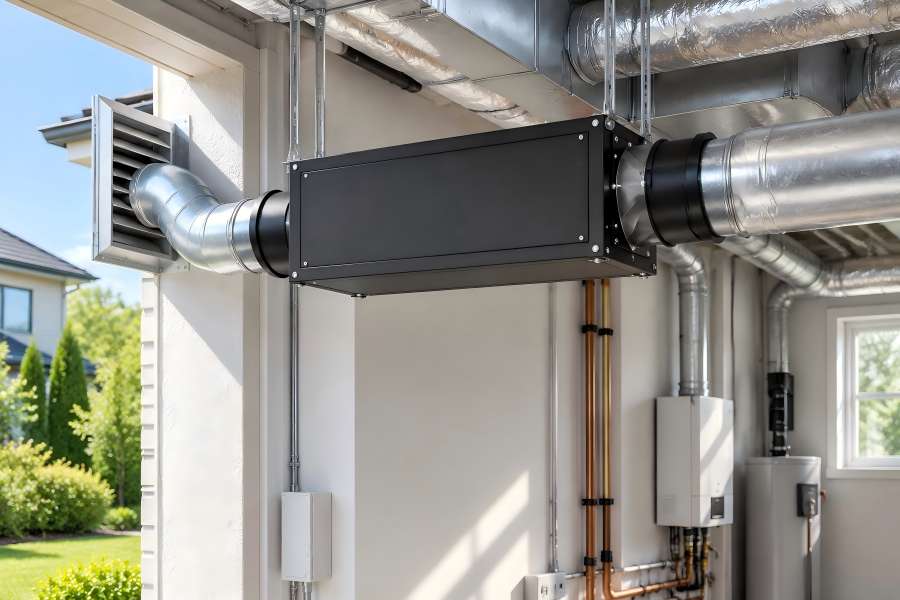
A fresh-air dehumidifier introduces a controlled amount of outdoor air while removing excess moisture before or as that air enters the home.
Unlike a basic ventilation fan, it helps prevent humid outdoor air from creating an additional indoor moisture problem.
Typical Functions
- Introduces outdoor air
- Filters incoming air
- Removes moisture
- Supplies conditioned dry air indoors
- Helps maintain controlled ventilation
- Can operate independently or with HVAC
- May include heat-recovery functions depending on design
Fresh-air dehumidifiers are especially useful in tightly sealed homes where natural infiltration is limited and mechanical ventilation is required.
They can also be valuable in warm, humid climates because outdoor ventilation air may contain a significant moisture load.
Typical Applications
- Airtight homes
- Humid climates
- New construction
- Homes requiring mechanical ventilation
- Basements and whole-home ventilation systems
- Buildings where outdoor humidity is high
For example, bringing hot, humid summer air directly into an air-conditioned home increases both cooling and latent loads. Treating that air first can reduce the amount of moisture entering the living space.
What Is a Standard Whole-House Dehumidifier?
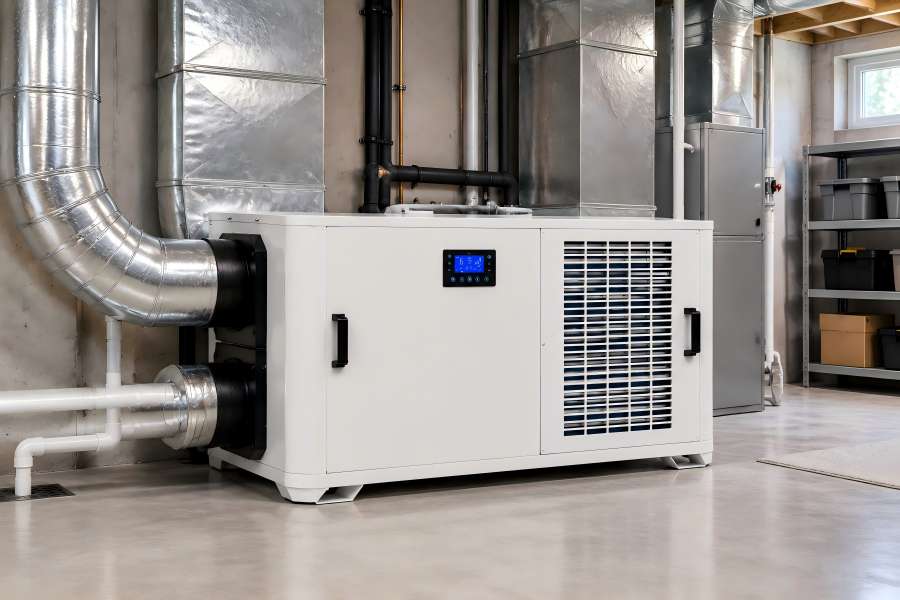
A standard whole-house dehumidifier mainly removes moisture from indoor air and maintains a selected RH throughout the home.
It usually draws humid return air through the unit, condenses moisture on a cold coil, and returns warmer, drier air through dedicated or existing ductwork.
Typical Functions
- Draws humid indoor air into the unit
- Cools the air below its dew point
- Condenses and drains moisture
- Reheats and returns drier air
- Maintains a whole-home RH set point
- Connects to HVAC ductwork or dedicated ducts
These systems are useful where excess humidity affects several rooms and portable dehumidifiers would be inconvenient or difficult to manage.
Typical Applications
- Humid homes
- Basements
- Large residential spaces
- Homes with existing HVAC systems
- Buildings where ventilation is handled separately
A whole-house unit can also operate when the air conditioner does not run long enough to remove sufficient moisture, such as during mild but humid weather.
Some models can accept limited outdoor air, but their main function remains indoor humidity control rather than dedicated mechanical ventilation.
Fresh-Air vs. Whole-House Dehumidifier: Key Differences
The main difference is the source of the air being treated and whether ventilation is part of the system’s primary function.
| Factor | Fresh-Air Dehumidifier | Standard Whole-House Dehumidifier |
| Main Air Source | Outdoor + Indoor Air | Mainly Indoor Air |
| Ventilation | Yes | Usually No |
| Moisture Removal | Yes | Yes |
| Outdoor Air Treatment | Yes | Limited / Optional |
| Indoor Air Recirculation | Often | Yes |
| Filtration | Incoming + Recirculated Air | Mainly Recirculated Air |
| Best For | Ventilation + Humidity Control | Whole-Home Humidity Control |
| Ductwork Complexity | Higher | Moderate |
| Climate Sensitivity | Higher | Moderate |
| Typical Installation | Dedicated or HVAC-Integrated | HVAC-Integrated or Dedicated |
A fresh-air system addresses both ventilation and the moisture brought in with outdoor air. A standard whole-house unit focuses mainly on maintaining indoor RH.
Both can provide effective humidity control when properly sized, but they solve slightly different building problems.
How Do Fresh-Air and Whole-House Dehumidifiers Work?
Both systems may use refrigeration-based moisture removal, but the airflow path is different.
How a Fresh-Air Dehumidifier Works
A typical process is:
- Outdoor air enters the unit
- Incoming air passes through a filter
- Air is cooled below its dew point
- Moisture condenses and drains away
- The air is reheated or conditioned
- Dry fresh air is supplied indoors
- Indoor air may also be recirculated through the unit
The key difference is that outdoor air is deliberately introduced and treated before being distributed through the home.
Depending on the system, fresh air may be mixed with indoor return air or handled through a dedicated airflow path.
How a Whole-House Dehumidifier Works
A standard whole-house unit usually follows this process:
- Humid indoor air enters the unit
- Air passes over a cold evaporator coil
- Water vapor condenses
- Condensate drains away
- Air passes through the condenser
- Warm, dry air returns to the home
The unit gradually reduces indoor moisture by continuously recirculating and drying indoor air.
A humidistat or RH sensor typically starts and stops the dehumidifier according to the selected humidity set point.
Ventilation System
Ventilation is the clearest difference between these two systems.
A fresh-air dehumidifier combines:
- Ventilation
- Dehumidification
A standard whole-house dehumidifier mainly provides:
- Dehumidification
- Indoor air circulation
This distinction matters more in modern airtight homes. Better insulation, sealed windows, and improved air barriers reduce uncontrolled infiltration and may increase the need for mechanical ventilation.
In humid climates, simply bringing outdoor air indoors can add a significant moisture load. A fresh-air dehumidifier treats that air before it affects the indoor environment.
A standard whole-house system can still remove the resulting moisture, but fresh-air ventilation normally needs to be handled separately.
Which System Provides Better Humidity Control?
Both systems can maintain indoor RH when properly sized. The main question is whether ventilation air should be included in the humidity-control strategy.
Fresh-Air Dehumidifier
Better when:
- Outdoor air must be introduced
- Outdoor air is humid
- The home needs controlled ventilation
- Ventilation air would otherwise increase indoor RH
A tightly sealed home in a humid climate may require mechanical ventilation but also needs to prevent that outdoor air from increasing indoor moisture.
Treating incoming air before distribution can reduce the latent load placed on the rest of the HVAC system.
Whole-House Dehumidifier
Better when:
- Indoor humidity is the main problem
- Ventilation is already handled by another system
- Outdoor air introduction is not required
- Simple whole-home RH control is the priority
For example, a home may already have an ERV or other ventilation system but still experience 60%–65% RH during humid weather.
A standard whole-house dehumidifier can handle that excess indoor moisture without replacing the existing ventilation equipment.
How Outdoor Climate Affects the Choice
Outdoor climate has a major influence because fresh-air dehumidifiers directly process outdoor air.
Hot and Humid Climate
Warm outdoor air can carry a high moisture load. Bringing it directly indoors increases the work required from both the air conditioner and dehumidifier.
A fresh-air dehumidifier can remove part of that moisture before the ventilation air reaches occupied spaces.
This can be especially useful when cooling demand is moderate but outdoor humidity remains high.
Mild or Dry Climate
In a relatively dry climate, outdoor ventilation air may add little moisture and can sometimes help dilute indoor humidity.
A standard whole-house dehumidifier may therefore be sufficient when indoor moisture sources are the main concern.
Those sources may include showers, laundry, cooking, basements, crawl spaces, occupants, and moisture infiltration.
Cold Climate
Cold outdoor air usually contains relatively little absolute moisture, even when its RH is high.
Once heated indoors, the air may become quite dry, so ventilation heat loss and winter comfort can become more important than active dehumidification.
In these climates, ERVs or HRVs may play a larger role, while dedicated dehumidification may be needed mainly during warmer seasons.
Indoor Air Quality and Filtration Comparison
Humidity control and indoor air quality are related, but a dehumidifier is not automatically a complete ventilation or air-purification system.
A fresh-air dehumidifier can improve ventilation by bringing filtered outdoor air indoors while controlling the associated moisture load.
Potential benefits include:
- Diluting indoor pollutants
- Reducing stale air
- Removing some airborne particles through filtration
- Controlling humid outdoor air
- Supporting ventilation requirements
Actual filtration performance depends on the filter type and system design.
A standard whole-house dehumidifier also filters recirculated air, primarily to protect the coils and internal components from dust.
9. Installation and Ductwork Differences
Fresh-air dehumidifiers usually require more complex ductwork because they must handle an outdoor-air connection as well as indoor supply and return air.
Fresh-Air Dehumidifier
May require:
- Outdoor air intake
- Fresh-air duct
- Return-air duct
- Supply duct
- Motorized damper
- Filter
- Drain line
- Control wiring
The outdoor intake should be positioned carefully to avoid drawing in exhaust air, excessive contaminants, rain, or other unwanted sources.
Controls may also need to coordinate ventilation airflow with the central HVAC system.
Whole-House Dehumidifier
May require:
- Return-air connection
- Supply-air connection
- Drain line
- Humidistat
- HVAC integration
- Dedicated ducting where required
Installation is generally simpler because the system mainly recirculates indoor air.
However, duct sizing still matters. Restrictive ducts or excessive static pressure can reduce airflow and lower moisture-removal performance.
Energy Efficiency
Neither system is automatically more energy-efficient. Energy use depends on how much air is treated and how difficult that air is to condition.
Important factors include:
- Outdoor temperature
- Outdoor RH
- Ventilation airflow
- Indoor RH target
- Dehumidifier efficiency
- HVAC runtime
- Fan power
- Duct pressure
A fresh-air unit may use more energy because it must process outdoor air that can be warmer and wetter than indoor air.
However, if mechanical ventilation is required anyway, pre-treating the outdoor air may reduce some of the moisture load placed on the main HVAC system.
A standard whole-house unit can be more efficient where ventilation is already handled separately and only indoor moisture needs to be removed.
The better comparison is therefore total HVAC + ventilation + dehumidification energy, rather than dehumidifier wattage alone.
Cost Comparison: Fresh-Air vs. Whole-House Dehumidifier
Fresh-air systems generally cost slightly more because they require additional intake ductwork, dampers, and controls.
Illustrative Cost Range
| System | Equipment + Basic Installation |
| Fresh-Air Dehumidifier | $1,000–$2,800 |
| Whole-House Dehumidifier | $800–$2,200 |
These are illustrative estimates only. Actual cost depends on capacity, duct layout, controls, building conditions, and local installation rates.
A lower-priced whole-house system may still require a separate ERV, HRV, or ventilation system, so total project cost should be considered rather than dehumidifier price alone.
Can a Fresh-Air Dehumidifier Replace an ERV or HRV?
Not always. These systems overlap in ventilation functions but use different methods to manage heat and moisture.
Fresh-Air Dehumidifier
Main functions:
- Outdoor air ventilation
- Active moisture removal
- Indoor RH control
A fresh-air dehumidifier actively removes water vapor and drains the collected moisture from the system.
ERV / HRV
Main functions:
- Ventilation
- Heat recovery
- In some ERVs, partial moisture transfer
An HRV primarily transfers sensible heat between exhaust and incoming air streams.
An ERV can transfer both heat and some moisture, but it does not normally provide the same active moisture removal as a dehumidifier.
In very humid climates, an ERV may reduce ventilation moisture load without being able to maintain the desired indoor RH by itself.
Possible system arrangements include:
- ERV + whole-house dehumidifier
- HRV + whole-house dehumidifier
- Fresh-air dehumidifier
- HVAC + dedicated dehumidification
The best arrangement depends on climate, home airtightness, ventilation demand, humidity target, and HVAC design.
Fresh-Air or Whole-House Dehumidifier: Which One Should You Choose?
A fresh-air dehumidifier is generally more suitable when a home needs both mechanical ventilation and active moisture control.
Choose a Fresh-Air Dehumidifier When
- The home is tightly sealed
- Mechanical ventilation is required
- Outdoor air is humid
- Fresh air and humidity control should be combined
- Outdoor air must be filtered and dried before entering
This is particularly useful for new energy-efficient homes in warm, humid climates where ventilation air itself creates a significant moisture load.
A standard whole-house dehumidifier is more suitable when indoor humidity is the main concern and fresh-air ventilation is already handled separately.
Choose a Whole-House Dehumidifier When
- Indoor humidity is the main concern
- Ventilation is already handled separately
- The home has an existing HVAC system
- Simpler duct integration is preferred
- Whole-home RH control is the priority
For example, an existing home with an ERV may simply need additional moisture-removal capacity during humid seasons.