
Humidity plays an important role in automotive painting because it influences paint evaporation, surface conditions, coating appearance, and production consistency. Both excessive and insufficient humidity can create problems during application and drying.
Understanding these effects helps automotive paint shops maintain stable working conditions, reduce coating defects, and improve finished vehicle quality.
Understanding Humidity in Automotive Painting
Relative Humidity and Its Effect on Paint Application
Relative humidity (RH) describes the amount of water vapor in the air compared with the maximum amount the air can hold at the same temperature. Paint-shop operators track this percentage when checking whether the booth is ready for the selected coating.
Humidity affects different coating systems in different ways. For example, waterborne basecoats depend partly on water evaporation, while solventborne coatings rely on the evaporation of their solvents. Changes in ambient moisture can influence drying behavior, application timing, and film formation.
When humidity moves outside the recommended operating range, painters may experience longer drying periods, inconsistent finishes, or changes in how a coating flows and levels. However, humidity should not be evaluated alone.
Paint formulation, film thickness, airflow, application technique, and temperature also influence the final result.
Checking Panels for Condensation Before Painting
Panel preparation needs a temperature check as well as a visual inspection for dirt and water. Dew point identifies the cooling threshold for saturation in an air sample at unchanged pressure and moisture content.
If a metal panel is sufficiently cold, moisture can form on its surface even when condensation is not immediately visible. Applying primer or paint over this moisture can interfere with adhesion and contribute to coating failure.
Before painting, operators should check the relationship between air temperature, panel temperature, and dew point. Panels should be clean, dry, and within the environmental limits specified for the coating system.
Monitoring these parameters is particularly important in workshops where vehicles move between cold storage areas, outdoor environments, and heated paint booths.
How High Humidity Affects Automotive Paint and Coating Quality
Slower Drying and Extended Flash-Off Times
High humidity can slow the evaporation of water from waterborne automotive coatings. When moisture leaves the applied film more slowly, the coating may require additional time before the next layer can be applied.
This can affect production schedules, especially when several vehicles pass through the same preparation, painting, and drying areas. If operators follow an unsuitable flash-off schedule, the next coat may be applied before the previous layer has reached the required condition.
The consequences depend on the coating chemistry and the complete application process. Excessively short flash-off periods can contribute to trapped moisture, uneven appearance, or other film defects.
To manage these risks, paint shops should:
- Follow the manufacturer’s recommended flash-off times and environmental limits.
- Monitor booth temperature, relative humidity, and airflow during application.
- Avoid advancing to the next coating stage solely because the surface appears dry.
- Adjust production timing according to actual conditions and product instructions.
High humidity does not always cause slow drying in every coating system, but it can be a significant factor when moisture evaporation is part of the drying process.
Blushing, Cloudiness, and Uneven Appearance
Moisture-related cloudiness can affect the appearance of certain automotive coatings, particularly under unsuitable combinations of humidity, temperature, and evaporation rate. Blushing is commonly associated with moisture condensation during solvent evaporation in susceptible coating systems.
The affected surface may appear milky, hazy, or less glossy than expected. Waterborne basecoats can also develop uneven visual characteristics when drying conditions are poorly controlled, particularly when metallic or pearlescent pigments require consistent orientation.
Several factors may contribute to these problems, including insufficient airflow, inappropriate thinner selection, unsuitable application temperature, and excessive film thickness.
When cloudiness appears, operators should review environmental records and application parameters before changing the coating formulation. Adjusting humidity alone may not resolve a problem caused by incorrect material mixing or spraying technique.
Condensation and Coating Adhesion Problems
Condensation is one of the most important moisture-related risks in automotive painting. Water on a prepared metal panel can interfere with the contact between the substrate and the coating, potentially weakening adhesion.
In some cases, coating failure may become visible only after the paint has dried or the vehicle has entered service. Possible symptoms include peeling, blistering, or localized delamination, although these defects can also arise from contamination, inadequate surface preparation, or incorrect curing.
Make the interval between cleaning and priming a specific checkpoint for panel dryness. They should also verify that compressed air and cleaning materials do not introduce moisture or other contaminants.
If condensation is suspected, painting should be postponed until the panel has returned to suitable conditions and its surface is confirmed dry.
How Low Humidity Affects Automotive Paint and Coating Quality
Rapid Evaporation and Reduced Flow and Leveling
Low humidity can accelerate water evaporation from some waterborne coatings, although temperature and airflow also play major roles. When evaporation occurs too quickly, painters may have less time to achieve the intended film formation and appearance.
Depending on the coating and application method, rapid drying can contribute to poor leveling, uneven coverage, or visible differences between adjacent spray passes. The effect may be especially noticeable on large body panels, where consistent appearance is important.
Solventborne coatings behave differently because their evaporation characteristics depend on the solvent blend, temperature, airflow, and formulation. Therefore, low humidity should not automatically be treated as the cause of every rapid-drying defect.
Paint shops can improve consistency by maintaining recommended environmental conditions, following the specified spray technique, and avoiding unapproved changes to reducers or other coating components.
Static Electricity and Dust Contamination
Dry environments can increase electrostatic buildup under certain conditions, particularly when insulating materials, synthetic clothing, or plastic components are involved. Static charges can attract airborne dust and other particles toward prepared panels or freshly painted surfaces.
Contamination may create small bumps, visible particles, or imperfections that require polishing or repainting. These defects affect appearance and can increase rework.
Effective prevention requires more than humidity adjustment. Operators should maintain suitable booth cleanliness, use appropriate grounding and antistatic procedures, and inspect filtration systems regularly.
Before painting, surfaces should be cleaned using approved methods. Tack cloths and other preparation materials must also be suitable for the coating process to avoid introducing residues.
Inconsistent Film Formation Under Unsuitable Conditions
Low humidity can influence film formation when a coating depends on controlled water evaporation. If environmental conditions are unsuitable, the coating may not develop the intended appearance or application characteristics.
However, film formation also depends on the material’s chemistry, mixing accuracy, application thickness, and curing conditions. A defect that resembles excessive evaporation may actually result from incorrect gun settings or uneven spray overlap.
Operators should therefore compare the observed defect with the coating manufacturer’s guidance and review process records before making adjustments.
How Humidity Affects Different Stages of Automotive Coating
Surface Preparation and Primer Application
Surface preparation establishes the foundation for the coating system. Panels must be free from moisture, oil, dust, sanding residue, and other contaminants before primer is applied.
Humidity control is particularly important when temperature changes could cause condensation on metal surfaces. Operators should inspect panels after washing, cleaning, and moving vehicles into the paint area.
Primer application should follow the specified environmental conditions, film thickness, and drying schedule. If moisture contamination is suspected, the surface should be evaluated and prepared again as necessary rather than simply covered with another coat.
Basecoat Application and Color Consistency
Basecoats determine much of the vehicle’s visible color and effect. Humidity and airflow can influence the drying behavior of waterborne basecoats and affect the consistency of metallic or pearlescent finishes.
If different panels dry under different conditions, the resulting color appearance may vary. Metallic flakes can also appear different when application technique, film thickness, or drying behavior changes.
To maintain consistency, technicians should use the prescribed spray distance, overlap, gun settings, and flash-off procedure. Environmental conditions should remain stable across panels that need to match visually.
Clearcoat Application and Film Formation
Clearcoat provides gloss and contributes to surface protection. Its behavior depends on the specific resin system, hardener, mixing ratio, and application conditions.
Although clearcoats do not all respond to humidity in the same way, unsuitable environmental conditions can affect appearance, flow, and drying. Excessive moisture may also become a concern when condensation occurs on the substrate or between coating stages.
Technicians should follow the specified mixing ratio, application thickness, flash-off period, and curing schedule. They should avoid adding extra solvent or hardener to compensate for environmental problems unless the product instructions explicitly permit the adjustment.
Drying and Final Curing
Drying and curing are related but distinct processes. Drying generally describes the removal of volatile components or the formation of a surface that can be handled, while curing involves the development of the coating’s intended properties through physical or chemical changes.
Some automotive coatings require controlled baking, while others cure under specified ambient conditions. Humidity may influence certain stages, but temperature, time, film thickness, and coating chemistry often determine the overall process.
| Coating stage | Main humidity-related concern | Recommended control |
| Surface preparation | Condensation on panels | Check panel temperature and dew point |
| Primer application | Moisture contamination and drying variation | Confirm surface dryness and follow product instructions |
| Basecoat application | Uneven evaporation and color appearance | Maintain stable airflow and flash-off conditions |
| Clearcoat application | Surface defects under unsuitable conditions | Follow specified mixing and application procedures |
| Final curing | Inconsistent process conditions | Use the approved curing schedule and verify conditions |
How to Control Humidity in Automotive Paint Booths
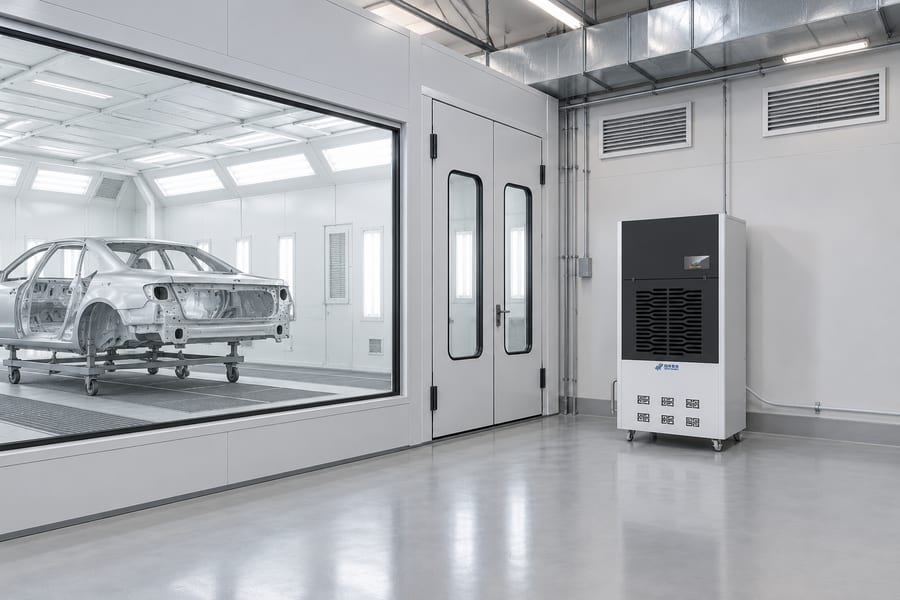
Maintain Suitable Temperature and Humidity Ranges
Automotive paint shops should establish operating limits based on the technical data sheets for their primers, basecoats, clearcoats, and other coating materials.
A single humidity target is not suitable for every coating system. Waterborne and solventborne products may respond differently to the same conditions, and their requirements can vary between application and curing stages.
Environmental readings should be checked before painting begins and whenever weather, production load, or booth conditions change significantly.
Use Dehumidification and Humidity Regulation
Industrial dehumidification can help remove excess moisture from incoming air when ambient humidity exceeds the requirements of the painting process. Its value is greatest where weather-driven moisture changes repeatedly push the supply air beyond the coating process limits.
A properly selected dehumidification system can support more consistent booth conditions and help reduce moisture-related production interruptions. Equipment selection should consider the incoming air’s temperature and moisture content, required supply-air conditions, ventilation rate, and operating schedule.
In very dry environments, humidification may sometimes be appropriate if the coating specifications require it. However, moisture should never be added without considering condensation risks and the needs of the complete coating process.
Optimize Ventilation and Airflow
Ventilation helps remove airborne contaminants and supports the movement of conditioned air through the paint booth. Poor airflow can create uneven drying conditions, even when the average humidity reading appears acceptable.
Booth design and maintenance should support balanced airflow, effective filtration, and appropriate exhaust performance. Include filter condition checks and scheduled replacement in the booth maintenance plan.
Operators should also avoid uncontrolled airflow changes that could disturb spray patterns or accelerate evaporation in some areas more than others.
Control Moisture in Compressed Air
Compressed air can introduce water, oil, and particles into painting equipment if the air-treatment system is inadequate. Such contamination may affect the coating surface and undermine the benefits of humidity control.
Paint shops should select suitable air dryers, moisture separators, and filters based on the compressed-air system’s requirements. Drainage points and filters should be checked regularly.
Before spraying, operators should verify that the air supply meets the required cleanliness and moisture specifications. Compressed-air quality should be treated as a separate control point rather than assumed to be acceptable because the paint booth itself is dry.
How to Monitor Humidity and Troubleshoot Coating Problems
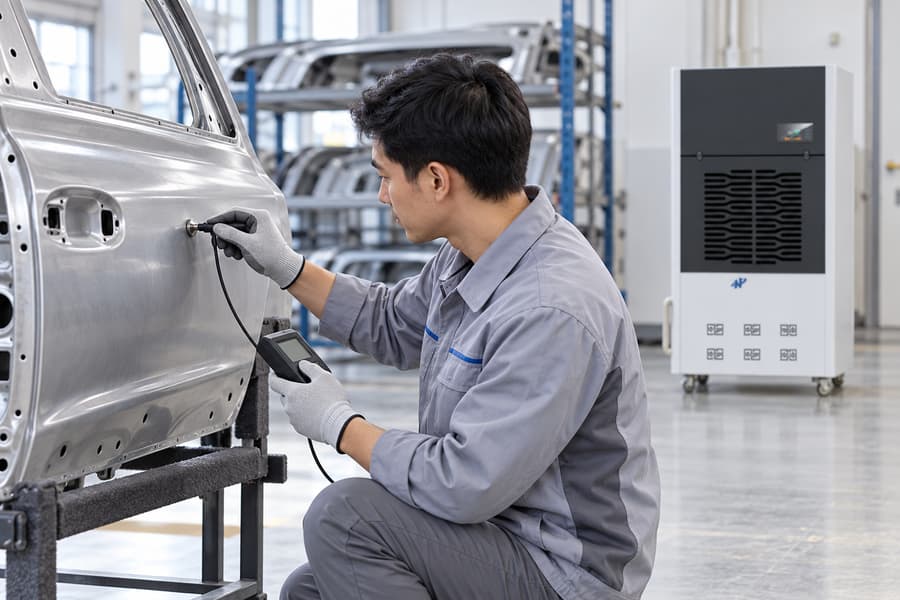
Measure Relative Humidity, Temperature, and Dew Point
Reliable environmental monitoring helps technicians identify conditions that may contribute to coating defects. At minimum, they should measure relative humidity and air temperature, while also checking panel temperature and dew point when condensation is a concern.
Measurements should reflect conditions near the actual painting area rather than relying entirely on readings from a distant room or general building sensor. Assign each measuring instrument a documented service and calibration schedule based on its specified use.
Record Environmental Conditions During Production
Recording environmental data helps paint shops connect changes in conditions with changes in coating quality. Useful records include humidity, air and panel temperatures, material batches, application times, flash-off periods, and curing conditions.
When defects occur, these records can help distinguish a humidity-related issue from incorrect mixing, contamination, or inconsistent spraying.
Identify Humidity-Related Paint Defects
The table below provides a practical starting point for investigating common problems. Each defect can have multiple causes, so environmental readings should be considered alongside material and process checks.
| Observed problem | Possible contributing factor | Recommended investigation |
| Slow drying | High humidity or unsuitable temperature | Check environmental readings and flash-off time |
| Cloudy or hazy finish | Moisture effects or unsuitable evaporation conditions | Review coating specifications and application conditions |
| Poor adhesion | Condensation or inadequate preparation | Inspect the substrate and preparation records |
| Dust contamination | Static buildup or poor booth cleanliness | Check grounding, filtration, and cleaning procedures |
| Uneven basecoat appearance | Inconsistent drying or spray technique | Review airflow, gun settings, and flash-off conditions |
When a problem is identified, operators should correct the confirmed cause before changing paint formulations or application settings. If the defect persists, further inspection may be necessary to assess contamination, film thickness, equipment performance, and curing conditions.
Consistent humidity management, accurate environmental measurements, and systematic troubleshooting help automotive paint shops maintain coating quality while reducing avoidable rework and production delays.