
Preventing moisture-related problems in pharmaceutical production requires stable humidity control, effective dehumidification, proper ventilation, and continuous environmental monitoring. These measures protect moisture-sensitive materials, reduce contamination risks, and maintain consistent manufacturing conditions.
A well-designed humidity control system also supports product quality, equipment reliability, and Good Manufacturing Practice (GMP) compliance.
Where Does Uncontrolled Moisture Disrupt Pharmaceutical Manufacturing?
Incoming ingredients, intermediate processing, and finished-product packing can each suffer when moisture exposure is not controlled. Because ingredients respond differently to ambient water vapor, their moisture sensitivity must guide the controls used to keep products and processing consistent.
Powder Clumping and Poor Flowability
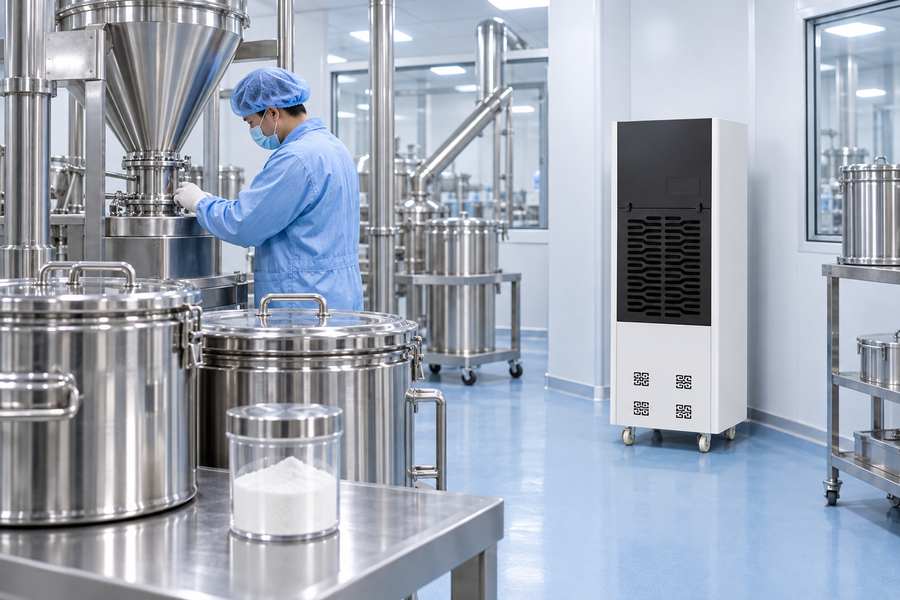
Pharmaceutical powders often contain hygroscopic ingredients that absorb moisture from the surrounding air. When humidity increases, powder particles may stick together, forming lumps and reducing flowability.
Poor powder flow can create several manufacturing problems:
- Inconsistent material feeding during production.
- Blockages in hoppers, pipes, and conveying systems.
- Uneven powder distribution during mixing.
- Reduced accuracy during weighing and filling.
- Increased material waste and equipment cleaning requirements.
These problems are particularly important in tablet manufacturing, capsule filling, and dry powder processing, where consistent powder movement is essential.
Tablet and Capsule Quality Problems
Excessive moisture can change the physical and chemical properties of pharmaceutical tablets and capsules.
During tablet compression, moisture-sensitive formulations may experience sticking, picking, or inconsistent compression behavior. Some active ingredients may also undergo moisture-related degradation, affecting product stability.
Capsule production requires careful humidity management because capsule shells respond to surrounding moisture. Excess humidity may cause gelatin capsules to soften or deform, while excessively dry conditions can make them brittle.
Maintaining suitable humidity levels helps protect product integrity and ensures consistent manufacturing performance.
Microbial Growth and Contamination
Moisture accumulation can contribute to microbial contamination risks in pharmaceutical manufacturing environments.
Condensation, standing water, and damp equipment surfaces may create conditions favorable for bacterial or fungal growth. These problems can be particularly serious in controlled production areas where environmental cleanliness is essential.
Potential consequences include:
- Increased contamination risks on equipment and surfaces.
- Additional cleaning and disinfection requirements.
- Production interruptions and quality investigations.
- Greater difficulty maintaining controlled manufacturing conditions.
Humidity control must therefore operate alongside appropriate sanitation, air filtration, and contamination prevention procedures.
Equipment Corrosion and Production Downtime
High humidity and condensation can accelerate corrosion on susceptible equipment surfaces, metal components, and electrical connections.
Pharmaceutical manufacturing facilities often depend on specialized machinery, including mixers, tablet presses, filling equipment, and packaging lines. Moisture-related equipment damage may increase maintenance requirements and disrupt production schedules.
Maintaining controlled humidity and preventing condensation can help protect equipment reliability and reduce avoidable downtime.
Packaging and Storage Problems
Moisture exposure can also affect pharmaceutical packaging materials and stored products.
Cardboard packaging may weaken in damp environments, while moisture-sensitive medicines can experience changes in stability if packaging protection is inadequate.
Inappropriate storage humidity may also contribute to:
- Moisture absorption by exposed raw materials.
- Changes in product appearance or physical properties.
- Increased packaging defects.
- Reduced stability of moisture-sensitive formulations.
Effective moisture control should cover both manufacturing operations and associated material storage areas.
How Does Unwanted Water Vapor Enter Pharmaceutical Workspaces?
Start the control assessment by tracing where water vapor enters the room and where operations generate it. Even facilities equipped with modern HVAC systems may experience humidity problems when internal moisture generation and external environmental conditions are not properly managed.
Outdoor Humid Air Infiltration
Outdoor air is a major source of moisture in pharmaceutical manufacturing facilities, particularly in regions with hot and humid climates.
Humid air can enter production areas through open doors, loading bays, ventilation systems, and poorly sealed building structures. Frequent movement of personnel and materials between different zones may also introduce unwanted moisture.
Without adequate dehumidification, these additional moisture loads can cause indoor humidity fluctuations and affect sensitive manufacturing processes.
Moisture Generated During Manufacturing and Cleaning
Certain pharmaceutical production activities release moisture into the surrounding environment.
Common sources include:
- Wet granulation and other moisture-generating processes.
- Equipment washing and sanitation procedures.
- Evaporation from process water and cleaning solutions.
- Personnel occupancy and activities.
- Improperly drained or insufficiently dried equipment.
Production areas may experience temporary humidity increases following cleaning or wet processing. Adequate drying and environmental recovery procedures help prevent moisture accumulation before manufacturing resumes.
Inadequate HVAC Humidity Control
Conventional HVAC systems are primarily designed to manage ventilation, temperature, and air quality. Although cooling equipment can remove moisture, temperature control alone may not provide adequate humidity management for moisture-sensitive pharmaceutical processes.
For example, an HVAC system may maintain the required room temperature while the relative humidity remains above the approved operating limit.
Facilities with demanding moisture control requirements may therefore need dedicated dehumidification equipment integrated with their HVAC systems.
Cold Surfaces and Local Moisture Deposition
A surface colder than the surrounding air’s dew point can collect liquid water as vapor condenses against it.
Cold pipes, cooling coils, poorly insulated ductwork, and refrigerated equipment can become condensation points.
Accumulated condensate can damage equipment, increase microbial contamination risks, and compromise environmental cleanliness.
Poor Insulation and Air Leakage
Damaged insulation, poorly sealed doors, and leakage around ventilation ducts can reduce the effectiveness of humidity control systems.
These problems introduce additional moisture loads and may force dehumidification equipment to operate longer than necessary.
Regular building inspections and proper sealing help reduce uncontrolled moisture entry and improve overall environmental stability.
How Should a Pharmaceutical Area’s Humidity Limits Be Set?
There is no single ideal relative humidity level suitable for every pharmaceutical production area. The appropriate humidity range depends on the materials being processed, manufacturing methods, product stability requirements, and environmental control specifications.
Pharmaceutical manufacturers should establish humidity limits based on product characteristics, process validation, and quality risk assessments rather than relying on one universal setting.
Humidity Requirements for Different Pharmaceutical Processes
Different manufacturing processes have different moisture sensitivities.
For example, dry powder processing may require relatively low humidity to minimize moisture absorption, while gelatin capsule manufacturing requires balanced moisture conditions to prevent both softening and brittleness.
The following table summarizes typical humidity control considerations for pharmaceutical facilities.
Table 1: Humidity Control Requirements for Different Pharmaceutical Production Areas
| Production Area | Main Moisture Risks | Humidity Control Requirements |
| Powder Processing | Clumping, sticking, poor flowability | Low, stable humidity based on material sensitivity |
| Tablet Compression | Sticking, moisture absorption, product defects | Controlled humidity suitable for the formulation |
| Capsule Production | Shell softening, deformation, brittleness | Balanced, material-specific humidity conditions |
| Pharmaceutical Packaging | Moisture absorption and packaging defects | Stable humidity with limited exposure to ambient air |
| Cleanrooms | Condensation and microbial contamination | Validated environmental conditions |
| Raw Material Storage | Moisture absorption and material degradation | Humidity limits based on storage specifications |
These requirements are application-specific rather than fixed industry-wide humidity standards.
Effects of Temperature, Relative Humidity, and Dew Point
Effective pharmaceutical humidity control requires an understanding of three environmental parameters.
Temperature: Temperature influences air moisture capacity, product stability, and equipment operating conditions. Changes in room temperature can also change relative humidity even when the actual moisture content of the air remains constant.
Relative Humidity (RH): This percentage compares the actual water-vapor pressure with the saturation vapor pressure at the measured temperature. It is commonly used to establish and monitor pharmaceutical environmental conditions.
Dew Point: Cooling air at constant pressure without changing its water-vapor content brings it to saturation at the dew point. It is particularly useful when evaluating condensation risks and designing low-humidity production environments.
For pharmaceutical facilities, controlling relative humidity without considering temperature and dew point may result in unstable conditions.
A properly designed environmental control system should evaluate these parameters together to maintain suitable manufacturing conditions throughout production.
How to Prevent Moisture-Related Problems in Pharmaceutical Production Areas
Preventing moisture-related problems requires a combination of equipment, facility design, environmental monitoring, and operating procedures.
The following measures help pharmaceutical manufacturers maintain stable conditions, protect sensitive materials, and reduce moisture-related production disruptions.
Maintain Stable Temperature and Humidity Levels
Stable environmental conditions are essential for consistent pharmaceutical manufacturing.
Rapid humidity fluctuations can affect the physical properties of hygroscopic powders, capsules, and other moisture-sensitive materials. Even short periods of excessive humidity may create processing difficulties.
Manufacturers should establish appropriate temperature and humidity limits for each production area based on process requirements.
Recommended practices include:
- Define upper and lower humidity limits for critical production zones.
- Maintain consistent temperature settings during manufacturing.
- Minimize frequent door opening between areas with different humidity conditions.
- Adjust environmental control capacity according to seasonal changes.
- Use automated controls to maintain stable operating conditions.
Humidity control systems should also respond effectively to changing production loads and ventilation requirements.
Instead of relying on occasional manual adjustments, automated temperature and humidity control can help maintain more consistent conditions during continuous manufacturing.
Install an Effective Industrial Dehumidification System
Industrial dehumidifiers are an important component of moisture control in pharmaceutical production areas.
These systems remove water vapor from the air, helping manufacturers maintain the required humidity conditions even when outdoor humidity or internal moisture loads increase.
Industrial dehumidification systems can be used in:
- Pharmaceutical powder processing rooms.
- Tablet compression and capsule filling areas.
- Raw material preparation and storage facilities.
- Pharmaceutical packaging rooms.
- Other controlled manufacturing environments requiring moisture removal.
For moisture-sensitive processes, dedicated dehumidification may offer better humidity control than conventional air conditioning alone.
Correct dehumidifier sizing is particularly important.
The required moisture removal capacity depends on several factors, including room volume, outdoor air conditions, ventilation rates, infiltration, internal moisture generation, and the target humidity level.
A system selected only according to room size may fail to maintain the required conditions during peak moisture loads.
Manufacturers should calculate the total moisture load before selecting equipment.
The dehumidification system must also be compatible with the facility’s air filtration, airflow, cleaning, and contamination-control requirements.
Improve HVAC Ventilation and Airflow Management
Effective ventilation helps maintain environmental conditions and supports contamination control in pharmaceutical production areas.
However, ventilation systems can also introduce moisture when untreated outdoor air enters the facility.
HVAC systems should therefore provide adequate air exchange while controlling the moisture content of incoming air.
Important measures include:
- Condition outdoor air before introducing it into controlled production areas.
- Maintain appropriate airflow patterns between adjacent rooms.
- Use suitable filtration to control airborne particles.
- Minimize uncontrolled air infiltration through doors and building openings.
- Coordinate HVAC operation with dehumidification equipment.
Pressure differentials are another important consideration.
Pharmaceutical facilities may use positive or negative room pressure depending on product protection, containment, and cross-contamination risks.
Humidity control strategies must be compatible with these pressure requirements rather than compromising established airflow patterns.
Prevent Condensation on Equipment and Surfaces
Condensation prevention is essential for protecting pharmaceutical production equipment and maintaining hygienic operating conditions.
When warm, humid air contacts cold surfaces, water droplets may form on pipes, ducts, machinery, or building structures.
A satisfactory room-average reading does not rule out wet spots that present a contamination concern near colder equipment.
To minimize condensation:
- Insulate cold water pipes and refrigeration lines.
- Maintain appropriate surface temperatures.
- Control room dew point through effective dehumidification.
- Inspect cooling coils and condensate drainage systems.
- Repair damaged insulation and identify moisture accumulation points.
Particular attention should be given to areas surrounding HVAC equipment and process cooling systems.
Condensate drainage must function properly to prevent standing water inside air-handling equipment.
Regular condensation inspections can identify problems before they affect manufacturing operations.
Monitor Humidity and Temperature Continuously
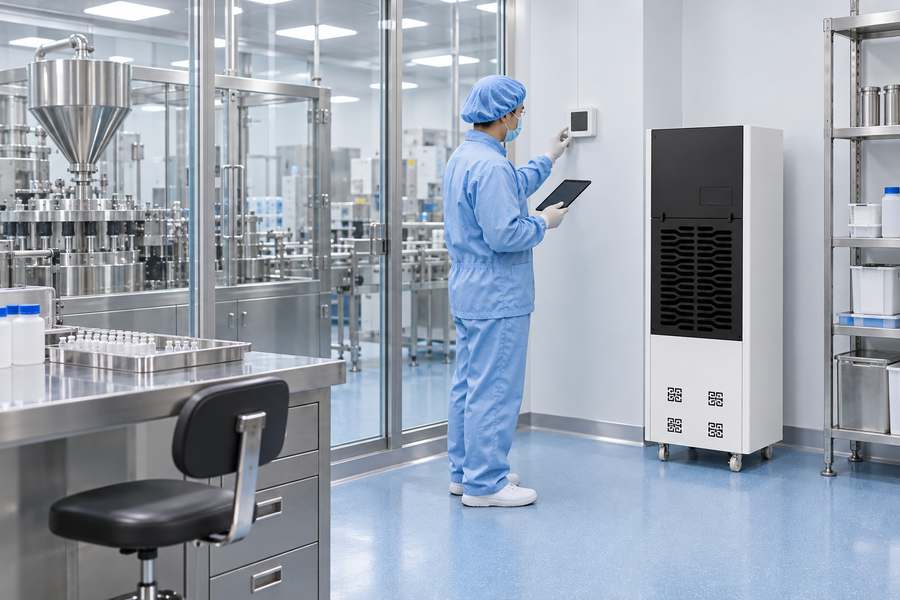
Continuous environmental monitoring allows pharmaceutical manufacturers to identify humidity fluctuations before they develop into major production problems.
Humidity sensors, temperature sensors, and automated monitoring systems can provide real-time information about production conditions.
Depending on facility requirements, monitoring systems may be integrated with building management systems or pharmaceutical environmental monitoring platforms.
Effective monitoring practices include:
- Install calibrated sensors in representative and critical locations.
- Record environmental conditions throughout manufacturing operations.
- Establish alert and action limits based on approved specifications.
- Investigate humidity excursions and assess potential product impact.
- Review historical environmental data to identify recurring problems.
Sensor location is important. Measurements taken near a supply air outlet may not represent conditions around production equipment or exposed materials.
Facilities should therefore evaluate airflow patterns and process sensitivity when determining monitoring locations.
For critical manufacturing environments, monitoring records should be maintained according to applicable quality procedures.
Implement Regular Cleaning and Preventive Maintenance
Even well-designed dehumidification and HVAC systems can experience performance problems without proper maintenance.
Dirty filters, blocked drainage lines, damaged insulation, and malfunctioning sensors may reduce environmental control effectiveness.
A preventive maintenance program should include regular inspection of:
- Dehumidifier components and operating performance.
- HVAC filters and cooling coils.
- Condensate drainage systems.
- Temperature and humidity sensors.
- Air ducts, insulation, and door seals.
- Electrical connections and control systems.
Cleaning procedures should also avoid introducing unnecessary moisture into production areas.
After wet cleaning, facilities should allow adequate drying and confirm that approved environmental conditions have been restored before restarting moisture-sensitive operations.
Combining maintenance, cleaning controls, and environmental monitoring helps reduce unexpected humidity problems and maintain reliable production conditions.
How to Choose the Right Dehumidifier for Pharmaceutical Manufacturing
Selecting the appropriate dehumidifier is important because pharmaceutical production areas can have substantially different humidity requirements.
Two commonly used industrial dehumidification technologies are refrigerant dehumidifiers and desiccant dehumidifiers.
Each technology offers different advantages depending on operating temperature, required humidity level, and moisture removal demands.
Condensation-Based Refrigerant Equipment
A refrigerated coil provides a cold surface on which moisture from the process air can condense and be collected.
As the air stream contacts an evaporator sufficiently cold for its moisture content, droplets accumulate on the coil surface. The collected condensate is drained away, and the air is reheated before being supplied to the controlled space.
Refrigerant dehumidifiers are commonly suitable for moderate-temperature environments where extremely low humidity is not required.
Their advantages include:
- Effective moisture removal under favorable temperature and humidity conditions.
- Relatively straightforward installation and operation.
- Potentially lower energy consumption than desiccant systems in suitable applications.
- Compatibility with some commercial and industrial HVAC arrangements.
However, refrigerant dehumidifiers become less effective as air temperature and dew point decrease.
For pharmaceutical processes requiring very low humidity, conventional refrigeration-based systems may not achieve the necessary conditions without additional treatment.
Desiccant Dehumidifiers
Desiccant dehumidifiers remove moisture through adsorption using moisture-attracting materials, commonly contained in a rotating desiccant wheel.
In the process-air section, water molecules adhere to the desiccant’s sorbing surfaces. A separate heated air stream releases and carries away the retained water during regeneration, restoring the material for another drying cycle.
This technology is particularly useful for pharmaceutical processes requiring low relative humidity or low dew-point conditions.
Desiccant systems may be appropriate for:
- Hygroscopic pharmaceutical powder handling.
- Moisture-sensitive tablet manufacturing.
- Certain active pharmaceutical ingredient processing operations.
- Specialized low-humidity production rooms.
Their primary advantage is the ability to achieve low moisture levels across a wider range of operating temperatures.
However, desiccant dehumidifiers typically require additional energy for regeneration and may involve more complex installation and maintenance requirements.
Table 2: Refrigerant vs. Desiccant Dehumidifiers for Pharmaceutical Production
| Comparison Factor | Refrigerant Dehumidifier | Desiccant Dehumidifier |
| Moisture Removal Method | Cooling and condensation | Moisture adsorption |
| Suitable Operating Temperature | Moderate to warm conditions | Wide temperature range |
| Low-Humidity Performance | Limited at very low dew points | Suitable for very low humidity |
| Energy Requirements | Often efficient under favorable conditions | Requires regeneration energy |
| Installation Complexity | Generally simpler | May require additional ductwork and regeneration arrangements |
| Typical Applications | General production and storage areas | Low-humidity processing and moisture-sensitive materials |
| Main Limitation | Reduced performance at low temperatures and dew points | Higher system complexity and regeneration requirements |
Key Factors to Consider When Selecting a Pharmaceutical Dehumidifier
The best dehumidifier depends on the specific requirements of the pharmaceutical production area.
Before purchasing equipment, manufacturers should evaluate the following factors.
Required humidity level: Determine the approved humidity range and whether the process requires conventional humidity control or very low dew-point conditions.
Moisture removal capacity: Calculate the expected moisture load from ventilation, infiltration, personnel, cleaning, and production activities.
Operating temperature: Evaluate the temperature range throughout the year because temperature affects dehumidification performance.
Energy efficiency: Compare electricity consumption and the additional energy required for heating, cooling, or desiccant regeneration.
System integration: Ensure that the dehumidifier can operate effectively with existing HVAC equipment, filtration systems, and room pressure requirements.
Maintenance requirements: Consider cleaning accessibility, component reliability, drainage design, and routine maintenance procedures.
For pharmaceutical applications, equipment selection should also account for materials of construction, potential contamination sources, and compatibility with facility qualification requirements.
A suitable industrial dehumidifier should provide reliable moisture control without introducing new risks to pharmaceutical manufacturing operations.
How to Maintain GMP-Compliant Humidity Control in Pharmaceutical Facilities
Humidity control is not only a technical requirement but also an important element of pharmaceutical quality management.
Good Manufacturing Practice (GMP) frameworks require manufacturers to maintain suitable environmental conditions where necessary to protect product quality and prevent contamination.
Humidity control systems should therefore be designed, monitored, and maintained according to the risks associated with each manufacturing process.
Follow Relevant Pharmaceutical Environmental Control Requirements
Pharmaceutical manufacturers should consider applicable regulatory requirements and relevant industry guidance when establishing humidity control procedures.
For example, FDA 21 CFR 211.46 requires appropriate environmental control equipment for factors including humidity and temperature when necessary for drug manufacturing, processing, packaging, or holding.
The World Health Organization also provides guidance on HVAC systems for non-sterile pharmaceutical products, including environmental conditions, system qualification, and maintenance.
These requirements do not establish one universal humidity target for every pharmaceutical production area.
Instead, manufacturers must determine suitable conditions according to product characteristics, process requirements, and quality risks.
Humidity control specifications should be documented and supported by appropriate technical justification.
Establish Environmental Monitoring and Documentation Procedures
Environmental monitoring records provide evidence that pharmaceutical production areas have operated within approved conditions.
Manufacturers should establish written procedures defining how humidity is measured, recorded, reviewed, and controlled.
These procedures should include:
- Approved humidity and temperature operating limits.
- Monitoring locations and measurement frequency.
- Sensor calibration and verification requirements.
- Environmental alarm and response procedures.
- Investigation and documentation of humidity excursions.
- Assessment of potentially affected materials and products.
Automated monitoring systems can improve data collection and help identify environmental changes promptly.
However, reliable sensors, suitable record controls, and trained personnel remain essential.
Monitoring data should be reviewed as part of routine quality oversight, particularly when environmental excursions occur during moisture-sensitive manufacturing activities.
Validate Humidity Control Systems
Pharmaceutical humidity control systems should undergo appropriate qualification and performance verification to demonstrate that they can maintain required operating conditions.
The extent of qualification should reflect the intended application, product sensitivity, and associated quality risks.
Important activities may include:
Installation Qualification (IQ): Verify that the dehumidification and associated control equipment are installed according to approved specifications.
Operational Qualification (OQ): Confirm that the system operates correctly within established operating parameters and that essential controls and alarms function as intended.
Performance Qualification (PQ): Demonstrate that the integrated system can maintain acceptable environmental conditions during representative operations.
Periodic performance reviews should also consider seasonal changes, equipment aging, and modifications to manufacturing processes.
When humidity conditions exceed approved limits, manufacturers should investigate the cause, evaluate potential product impact, and implement appropriate corrective and preventive actions.
A risk-based approach consistent with ICH Q9(R1) can help manufacturers determine the appropriate level of environmental control, monitoring, and qualification.
By combining qualified dehumidification equipment, effective HVAC management, continuous environmental monitoring, and documented operating procedures, pharmaceutical manufacturers can maintain stable production environments while reducing moisture-related quality risks and operational disruptions.