
Even with the cooling switched on, a facility can reach its temperature setpoint while the humidity reading remains stubbornly above target. Meanwhile, cartons are losing their stiffness or moisture is appearing on metal surfaces. This is a familiar problem in facilities where cooling and drying requirements do not match.
An Industrial Dehumidifier is generally the better choice when moisture removal needs to continue after the room has reached its temperature target. An air conditioner may be enough when its cooling operation also removes the moisture entering the space.
Before buying another machine, look at when the problem occurs. High humidity during loading, after cleaning, or overnight can point to different causes. Those patterns are often more useful than a single reading on the wall controller.
How an Industrial Dehumidifier Removes Moisture
A dedicated dehumidifier responds to a moisture-control requirement. The controls may track RH, or use a dew-point limit where the application calls for one.
It can therefore continue drying when the room does not need further cooling. This becomes useful during mild weather, overnight storage, or production periods that release moisture without generating much heat.
Refrigerant Dehumidifiers
A refrigerant dehumidifier pulls air across a cold evaporator coil. Water vapor condenses on the coil when its surface is below the incoming air’s dew point. The collected water then leaves through a drain or pump.
In a typical self-contained unit, the air passes across the warm condenser before returning to the room. The discharge air is drier and usually warmer than the air entering the machine.
That warmer discharge is worth considering before installation. It may be acceptable in a cool warehouse but create an additional cooling load in an already warm production area.
Performance also changes with operating conditions:
- Inlet temperature: Cooler conditions can reduce extraction capacity and make defrost operation more important.
- Inlet humidity: The machine generally collects less water as the air becomes drier.
- Airflow: Dirty filters, blocked grilles, or unsuitable ducts can reduce the amount of air being treated.
- Required target: Maintaining a low humidity level can be more demanding than removing excess moisture from a very damp room.
A large extraction figure on a specification sheet does not settle the selection. Ask what temperature and humidity produced that figure, then compare those conditions with the facility.
Desiccant Dehumidifiers
A desiccant dehumidifier removes water vapor using a moisture-adsorbing material. Many industrial models use a rotating wheel that moves between a drying section and a regeneration section.
Regeneration releases the collected moisture so the material can be used again. In common industrial arrangements, a separate heated airstream carries that moisture outside through wet-air ducting.
Desiccant systems are worth assessing where temperatures are low or the required dew point is beyond the useful range of a refrigerant unit. The correct choice still depends on the application.
Installation details matter here. Regeneration energy, exhaust routing, and the temperature of the dry discharge air all affect the finished system. Some applications also need cooling after the drying stage.
How an Air Conditioner Removes Moisture
An air conditioner removes moisture when water vapor condenses on its cold cooling coil. The water drains away, and the cooled air returns to the room.
The difficulty is often the control signal. A conventional air conditioner usually responds to temperature, so it may stop cooling once the thermostat is satisfied—even if humidity remains above the required level.
This does not make air conditioning unsuitable for moisture control. It means its ability to dry the space must be checked against the actual moisture load and operating schedule.
Several details affect the result:
- Coil temperature: The coil must be cold enough to condense moisture from the entering air.
- Operating time: Short cooling cycles can limit the amount of moisture removed.
- Airflow: Air volume across the coil influences both cooling and drying performance.
- Control settings: Humidity-responsive controls can offer more flexibility than a temperature setting alone.
- System design: Variable-capacity equipment, reheat, and outdoor-air treatment can improve humidity control.
A basic split air conditioner and a purpose-designed industrial HVAC system should not be treated as equivalent. Both cool air, but their ability to maintain humidity can be very different.
For an existing installation, start with the operating records. Does humidity remain acceptable while cooling runs, then rise when the compressor stops? That is a useful clue about the relationship between the two loads.
Industrial Dehumidifier vs. Air Conditioner: Key Differences
The main difference is what causes the equipment to run. A dedicated dehumidifier responds to a drying requirement, while a conventional air conditioner responds mainly to a cooling requirement.
| Comparison point | Industrial dehumidifier | Conventional air conditioner |
|---|---|---|
| Main purpose | Maintain a moisture target | Maintain a temperature target |
| Typical control signal | Relative humidity or dew point | Room temperature |
| Effect on room temperature | Often adds heat; configuration matters | Removes heat |
| Drying when cooling demand is low | Can continue when humidity calls for it | May be limited by reduced runtime |
| Moisture discharge | Condensate drain or regeneration exhaust | Condensate drain |
| Main selection factors | Moisture load, inlet conditions, and target humidity | Sensible and latent cooling loads |
| Common application | Storage or production needing dedicated moisture control | Spaces where cooling is the main requirement |
Some industrial systems combine these functions in one installation. These comparisons cover common configurations; a particular HVAC design may combine or modify the functions shown.
When comparing proposals, ask how each system will behave after the room reaches its temperature target. That question often reveals more than comparing rated capacity alone.
Why a Room Can Feel Cool but Still Be Humid
A comfortable temperature does not confirm that the moisture problem is under control. The cooling system may remove heat faster than it removes water vapor.
Relative humidity also changes with temperature. If air cools without enough moisture being removed, the RH can remain high or increase even though the room feels colder.
The Air Conditioner Stops Too Soon
An oversized fixed-capacity air conditioner can lower the room temperature quickly. The thermostat stops the compressor, leaving limited time for moisture removal.
This is one reason a larger cooling unit does not automatically solve a humidity complaint. The extra cooling capacity may shorten operating cycles rather than improve drying.
Check the runtime before changing the equipment. Frequent short cycles, particularly during mild weather, deserve investigation. Controls, airflow, and sensor placement can also contribute to that pattern.
Moisture Keeps Entering the Space
The moisture load does not stop when the thermostat is satisfied. Damp packaging, wet floors, open doors, and required ventilation can continue adding water vapor.
A warehouse may perform well overnight and struggle during dispatch. A production room may show the opposite pattern, with humidity rising after evening cleaning when the cooling demand has fallen.
Look for these conditions:
- Loading activity: Humidity rises while external doors are open.
- Cleaning periods: Wet floors and equipment continue releasing moisture after washing ends.
- Nighttime changes: The room needs less cooling, but moisture remains above target.
- Incoming materials: Damp pallets, packaging, or products add moisture to the space.
- Uneven readings: Conditions behind racks differ from those near the main controller.
I would check these patterns before lowering the thermostat again. A colder setting may extend cooling, but it can also leave staff working in an unnecessarily cold room without addressing the source of the moisture.
If condensation is limited to one cold pipe or surface, investigate that location separately. Insulation or a local temperature issue may need attention rather than more drying capacity across the whole building.
When an Industrial Dehumidifier Is the Better Choice
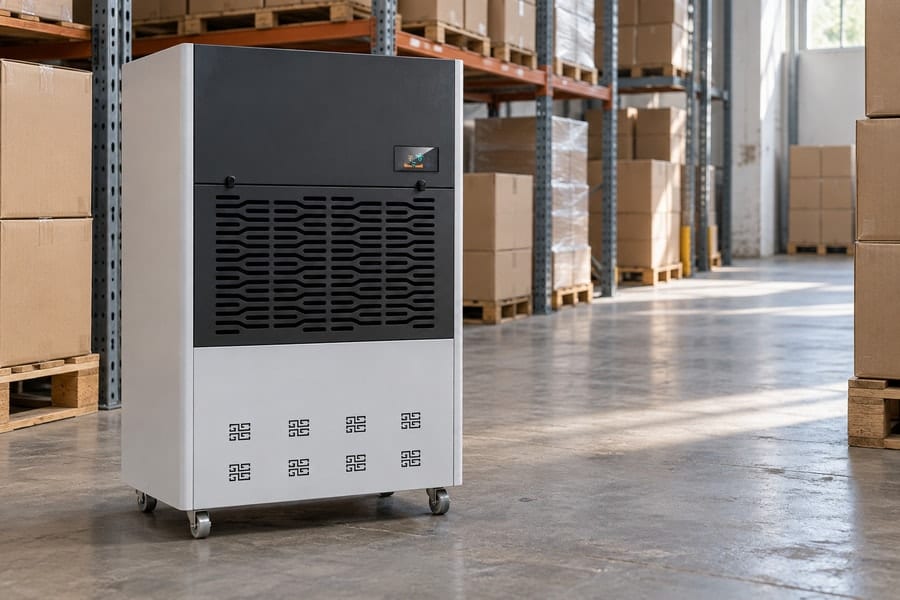
Dedicated drying is useful when the moisture target must be maintained independently of temperature. The room may already be cool enough, while the materials or process still need drier conditions.
Storage facilities are a common example. The requirement to protect packaging or components continues during cooler nights and seasons when the air conditioner runs less often.
Consider a dedicated unit where the following conditions apply:
- Humidity stays high at an acceptable temperature: Further cooling is not needed, but moisture removal is.
- Stored materials have defined limits: Packaging, powders, components, or finished products need controlled storage conditions.
- Production adds substantial moisture: Washing or processing creates a load that the cooling system cannot consistently handle.
- Problems appear in mild weather: Humidity rises when there is little demand for air conditioning.
- The process needs a low dew point: Existing cooling equipment cannot practically achieve the required drying condition.
- Overcooling causes problems: Lower thermostat settings make the space too cold before humidity reaches its target.
There is little value in adding capacity while leaving avoidable water sources untouched. Repair leaks, remove standing water, and review unnecessary door opening first.
Then calculate the remaining requirement. Floor area is only one part of the assessment. Ceiling height, air exchange, production activity, wet materials, and the required recovery time can all affect selection.
The equipment also needs access to the humid air. A correctly sized unit placed behind stacked goods may perform poorly because the air cannot circulate through the area being protected.
When an Air Conditioner May Be Enough
A separate dehumidifier is not necessary in every industrial space. A cooling system can satisfy both requirements when its moisture-removal capacity matches the load under the expected conditions.
This is more likely where cooling and drying are needed at the same time. A warm production area with a suitable cooling system may already have enough operating time and latent capacity.
Before adding equipment, check the following:
- Recorded conditions: Temperature and humidity stay within the required range throughout normal operation.
- Moisture-removal capacity: The system can handle the expected load at the intended room conditions.
- Cooling runtime: Operating cycles provide sufficient opportunity for moisture removal.
- Ventilation allowance: Required outdoor air and replacement air are included in the design.
- Control capability: The system can respond appropriately as temperature and humidity change.
- Room coverage: Acceptable conditions extend to storage corners, perimeter zones, and other relevant locations.
A good reading during a quiet afternoon is not enough. Check the periods that place the greatest demand on the system, including deliveries, cleaning, and seasonal weather changes.
If the installation previously worked well, investigate what changed. Dirty coils, drainage problems, altered fan settings, or additional production activity may explain the deterioration without requiring a different type of equipment.
When to Use Both Systems Together
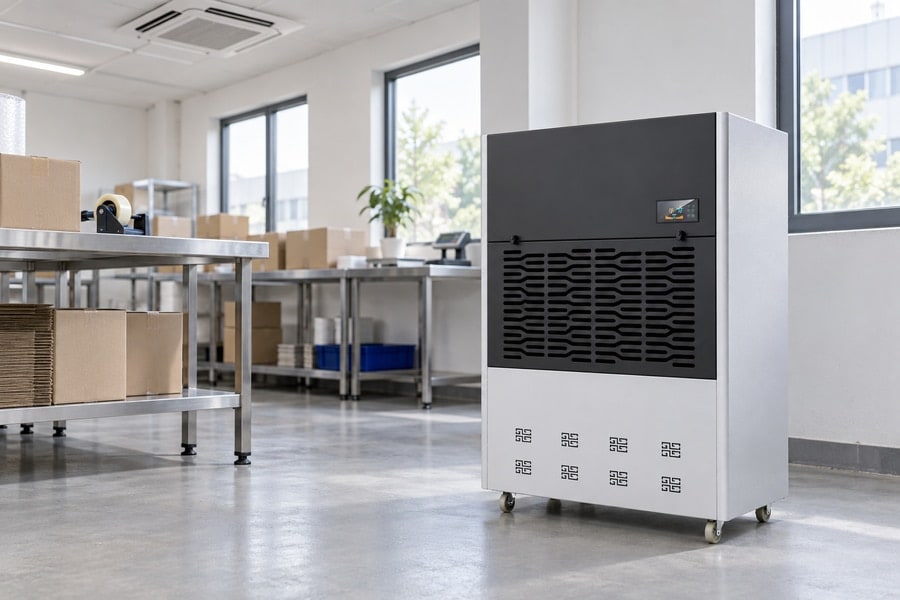
Some facilities need cooling and drying to respond separately. A combined arrangement allows the air conditioner to manage temperature while the dehumidifier handles moisture that remains outside the cooling cycle.
That can work well, but the two systems need to be selected together. Allow for the heat released during drying when calculating how much cooling the installation will need.
The installation should address these points:
- Control coordination: Define how each system starts, stops, and responds to changing conditions.
- Added heat: Include the dehumidifier’s heat output in the cooling assessment.
- Sensor placement: Measure representative conditions away from direct discharge air.
- Air distribution: Provide a route from humid areas to the equipment and back into the controlled space.
- Moisture discharge: Make sure condensate or regeneration exhaust leaves reliably.
- Operating hours: Match availability to production, cleaning, and storage requirements.
Consider a warehouse that needs cooling during daytime dispatch. After evening cleaning, the room temperature falls, but moisture continues evaporating from the floor.
In that situation, dedicated dehumidification could continue after cooling demand drops. The arrangement would still need assessment for capacity, airflow, and the heat introduced by drying.
Simply placing both machines in the same room does not guarantee a good result. Poorly coordinated settings can cause unnecessary cycling or leave one unit responding to conditions created by the other.
Which Option Uses Less Energy?
Neither option is always cheaper to run. Running costs only become meaningful once each proposal is assessed against the facility’s actual cooling and drying duties.
If air conditioning already provides necessary cooling and keeps humidity within specification, additional drying equipment may offer little benefit. If cooling is being extended mainly to force humidity down, a different arrangement may be more practical.
Compare the options on the same basis:
- Temperature and humidity targets: Both proposals should maintain the same required conditions.
- Actual inlet conditions: Use realistic temperature and moisture levels rather than unrelated catalogue ratings.
- Total energy use: Include compressors, fans, pumps, regeneration heat, and any extra cooling or reheat.
- Operating schedule: Account for nights, weekends, and seasonal changes.
- Useful moisture removal: Compare performance at the conditions the facility needs to maintain.
- Control behavior: Look for avoidable cycling, conflicting commands, and operation when the space does not need treatment.
Nameplate power is a poor shortcut. A smaller machine can consume less electricity each hour but run much longer, possibly without reaching the required condition.
For desiccant equipment, the regeneration heat source also matters. Electrical consumption alone may not represent the full energy cost if another fuel or heat source is used.
Maintenance belongs in the comparison as well. Dirty filters, fouled coils, and damaged ductwork can increase operating time and reduce useful output from either system.
My first energy-saving question would be whether the moisture load can be reduced. Correcting unnecessary air leakage or a recurring water source can benefit both cooling and dehumidification.
How to Choose the Right System for Your Facility
Start with the needs of the stored product or industrial process. A humidity target should have a practical reason behind it, rather than being chosen simply because a controller allows a lower setting.
Next, record temperature and humidity together. Include locations where damage or condensation occurs, not just the wall beside the equipment.
Prepare these details before requesting a recommendation:
- Required conditions: State the temperature range, RH limit, and any dew-point requirement.
- Moisture sources: Identify ventilation, door traffic, washing, wet processes, and incoming materials.
- Existing equipment: Record models, capacities, settings, and maintenance history.
- Problem periods: Note when humidity rises and what the cooling equipment is doing at that time.
- Performance requirements: Ask for capacity at the expected inlet conditions and target humidity.
- Installation constraints: Review power, drainage, ducting, exhaust routes, and maintenance access.
- Acceptance checks: Agree on how performance will be measured after installation.
Ask the supplier to explain what happens during low cooling demand. If moisture still needs to be removed, the proposed system must have a workable way to respond without driving the room below its temperature limit.
For a WetWells application review, provide a simple layout, recent temperature and humidity records, and the production or cleaning schedule. Those details help establish whether the next step is dedicated drying, an adjustment to the existing cooling system, or coordinated operation of both.