Working Principle
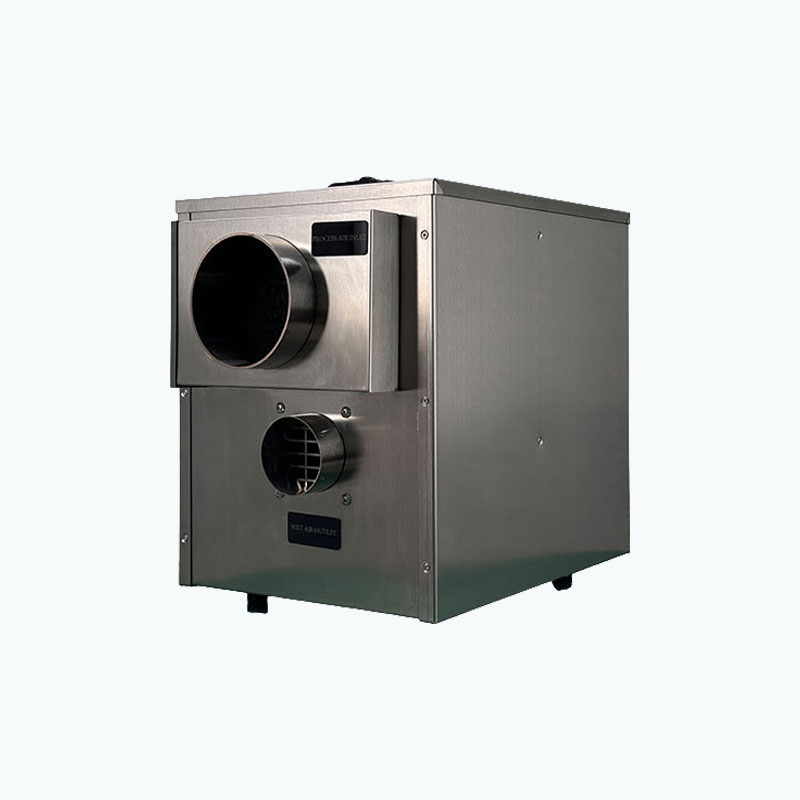
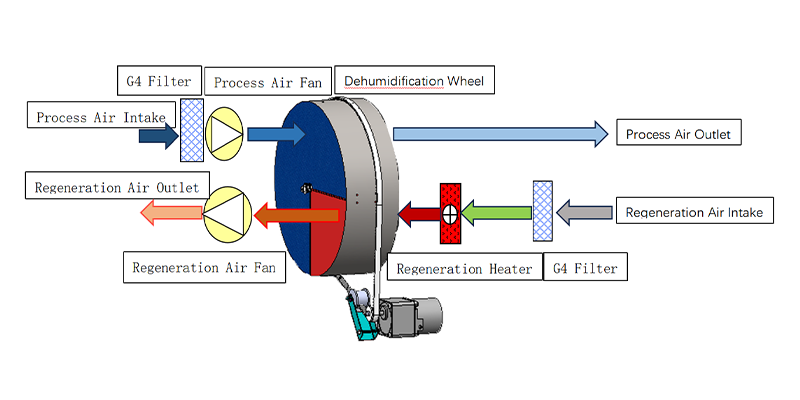
The system uses independent process and reactivation fans to maintain controlled airflow through both sides of the rotating desiccant wheel.
- Process Side: Filtered humid air is driven through the desiccant wheel, where moisture is adsorbed before dry air is supplied.
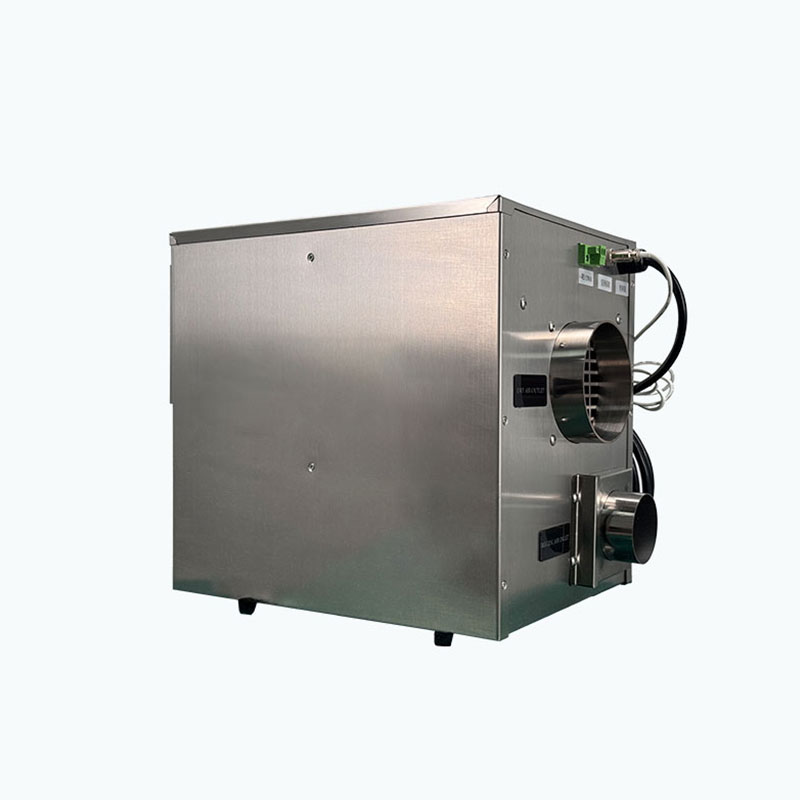
- Reactivation Side: A separate fan draws filtered air through the heater to regenerate the moisture-loaded wheel.
- Moisture Discharge: Released moisture is carried away through the reactivation air outlet.
- Continuous Cycle: Independent airflow and continuous rotor rotation maintain stable adsorption and regeneration.
Product Parameters
| Model | Dehumidification Capacity (20°C, 60% RH) | Power Supply | Rated Power | Rated Current |
| MCH-200XF-03 | 0.8 kg/h | 220V / 50Hz | 1 kW | 4.6 A |
| Process Airflow | Reactivation Airflow | Process Air External Static Pressure | Reactivation Air External Static Pressure | Process Air Duct Diameter |
| 10–200 m³/h | 80 m³/h | 100 Pa | 60 Pa | Φ100 mm × 2 |
| Reactivation Air Duct Diameter | Desiccant Rotor Size | Operating Temperature | Dimensions (L×W×H) | Weight |
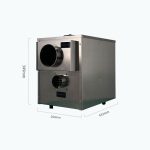
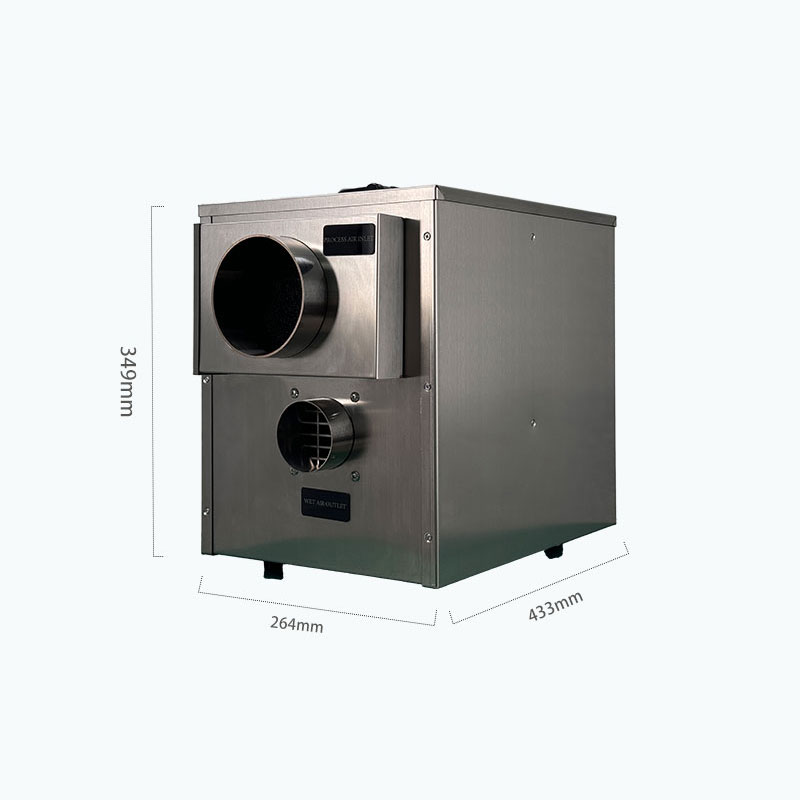
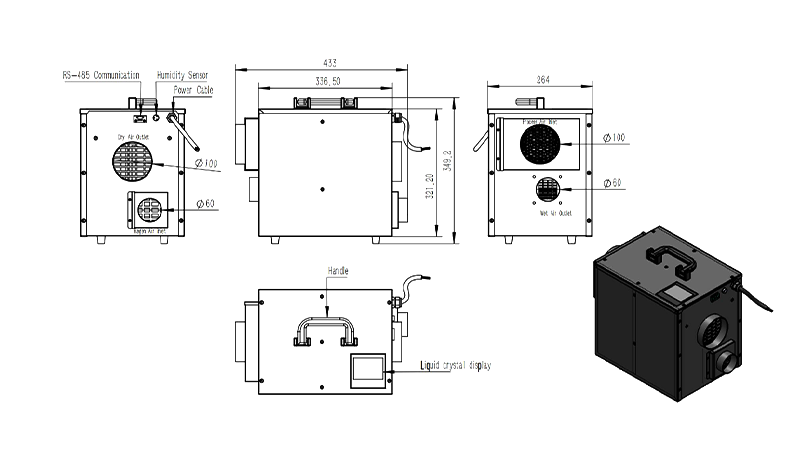
| Φ60 mm × 2 | 200 × 50 mm | -10°C–50°C | 433 × 264 × 349 mm | 15 kg |
Manufacturing Quality
- ER70S-6 Welding Wire: Supports stable weld quality and joint strength.
- Uniform Welds: Free from pores, slag inclusions, and cracks.
- Flatness Control: Post-weld flatness maintained within ≤ 1.0 mm.
- Surface Finish: Weld areas ground and polished to Ra ≤ 3.2 μm.
- Tolerance Control: Follows GB/T 1804-m, with weld-length tolerance of ±1 mm.
- Strength Verification: Structural strength reaches ≥ 350 MPa.
- Assembly Accuracy: Component gap ≤ 0.5 mm and overall flatness ≤ 1.5 mm.
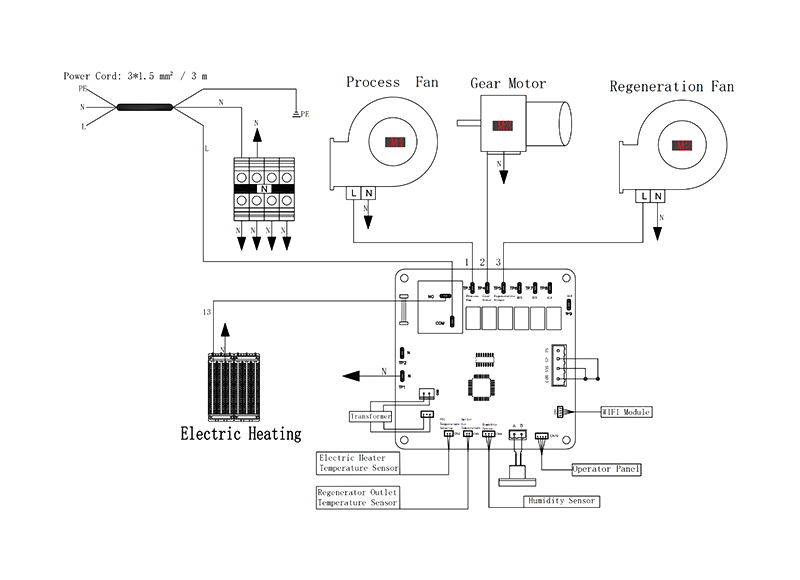
Circuit Diagram