
Portable office dehumidifiers generally suit single rooms, temporary moisture problems, and retrofits without duct access. Their main advantages are flexible placement and simpler installation.
Ducted dehumidifiers better serve multiple rooms continuously when air paths are properly designed and balanced. Neither arrangement guarantees lower energy use; performance depends on moisture loads.
How Portable and Ducted Office Dehumidifiers Differ
A portable dehumidifier pulls air from its immediate surroundings, removes moisture, and discharges air back into the same occupied space. Its effectiveness depends heavily on local circulation.
A ducted dehumidifier connects to designated air pathways, potentially collecting humid air from several locations and delivering drier air elsewhere. That coverage requires suitable fan pressure and distribution design.
| Decision Factor | Portable Unit | Ducted System |
| Primary service area | One room or open local zone | Designed zones connected by ducts |
| Installation | Floor placement and power | Equipment space, ducts, controls |
| Air movement | Room circulation | Engineered supply and return paths |
| Noise location | Usually in occupied area | Can be remote from occupants |
| Condensate | Tank or dedicated drain | Planned drain with safeguards |
| Maintenance | Accessible at unit | Requires permanent service access |
| Modifications | Relocate or add units | Rebalance or modify distribution |
The distinction is distribution, not an inherent difference in moisture-removal technology. Refrigerant-based equipment may be available in either arrangement, and operating conditions govern its performance.
For individual spaces, WetWells describes portable and floor-standing office dehumidifier options. Selection still requires confirmation of the particular model, operating conditions, and installation details.
Size the System for Moisture Load, Not Just Office Area
Identify Where Moisture Enters
Office floor area is useful for planning equipment locations, but it does not establish the required moisture-removal capacity. Two similarly sized rooms can experience very different latent loads.
Outdoor ventilation, leakage around doors, damp construction materials, wet cleaning, and occupants all contribute moisture. The contribution from each source changes with weather and operating schedules.
Before requesting equipment, inspect recurring damp spots, condensate on cold surfaces, plumbing routes, and adjacent wet areas. Correct active water intrusion rather than asking a dehumidifier to compensate indefinitely.
Record occupancy, ventilation schedules, indoor temperature, and humidity during representative periods. Observations taken only after closing may miss daytime moisture peaks or morning ventilation effects.
Compare Rated Capacity With Actual Conditions
Manufacturers commonly publish extraction capacity at specified air temperature and relative humidity. That rating is not the daily removal volume guaranteed under every office condition.
As incoming air becomes cooler or drier, refrigerant dehumidification performance can fall. Compare candidate models at conditions relevant to the proposed installation, not just headline capacity.
Ask suppliers for the capacity test conditions, input power, airflow, control range, and operating limits. A rated liter-per-day figure without test conditions is incomplete for engineering comparison.
Cooling equipment also removes moisture when its cooling coil condenses water vapor, but sensible cooling and latent removal do not always match. Check moisture readings during periods when the thermostat has stopped requesting cooling.
Choose a Humidity Target That Fits the Building
Relative humidity should be selected for the office’s temperature, envelope, occupancy, and material sensitivity. Avoid adopting a single target without evaluating cold surfaces and seasonal conditions.
The US Environmental Protection Agency’s moisture guidance advises keeping indoor humidity below 60% where possible, ideally 30–50%. Office comfort criteria still require a separate review of the workspace and its occupants.
A room sensor also cannot reveal every condensation risk. The dew point relates air moisture content to the temperature at which condensation can begin on sufficiently cold surfaces.
Match the Dehumidifier to the Office Layout
Single Rooms, Open Plans, and Temporary Problems
A portable unit is a practical starting point for a private office, occasional meeting-room humidity, or a temporary retrofit where opening ceilings would disrupt daily work.
Open-plan offices may accommodate several portable units, but this introduces multiple power connections, condensate points, controls, and maintenance responsibilities. Staff movement can also affect equipment placement.
Closed Doors and Return-Air Paths
A dry-air supply grille does not guarantee effective room control. Air entering an enclosed office needs a suitable return or transfer path without creating unacceptable pressure differences.
Closed doors, sealed partitions, and inadequate transfer openings can obstruct circulation. A ducted branch may deliver less air than planned even when the central unit is operating.
Placing supply and return grilles too close together can create an air short circuit. Dry supply air returns immediately while damp corners receive little effective air exchange.
Noise, Comfort, and Appearance
Portable machines put compressor and fan noise near desks or meeting participants. Acoustic acceptability depends on operating speed, distance, room finishes, and background noise.
For any published sound figure, request the measurement conditions, distance, operating mode, and whether it represents sound pressure or sound power. Labels are not automatically comparable.
Ducted equipment can move machinery away from occupants, but fan noise, duct breakout, grille turbulence, and vibration may remain audible. Silencers and isolation require design space.

Installing Portable Dehumidifiers in Working Offices
Locate each portable unit where its intake and discharge remain clear during ordinary furniture arrangements. Confirm the manufacturer’s clearances rather than assuming a wall-adjacent position is acceptable.
Check the electrical circuit, plug requirements, cable routing, and potential trip hazards. Extensions or shared power strips should not substitute for a suitable permanent electrical arrangement.
Water collection is the most consequential day-to-day choice. A removable tank suits monitored intermittent operation, while continuous drainage better supports unattended schedules when properly installed.
Where gravity drainage is used, confirm a continuous suitable fall to an approved destination. Where pumping is necessary, verify lift capability, routing, and how failures are signaled.
Inspect filters and accessible coils according to the applicable manual. Dust loading can restrict airflow, while blocked drains or full tanks can interrupt moisture removal.
Portable installation also needs an operating procedure. Decide who checks alarms, empties tanks, restores settings after outages, and prevents equipment from being moved into obstructed corners.
Designing and Installing Ducted Office Dehumidification
Equipment Location and Service Access
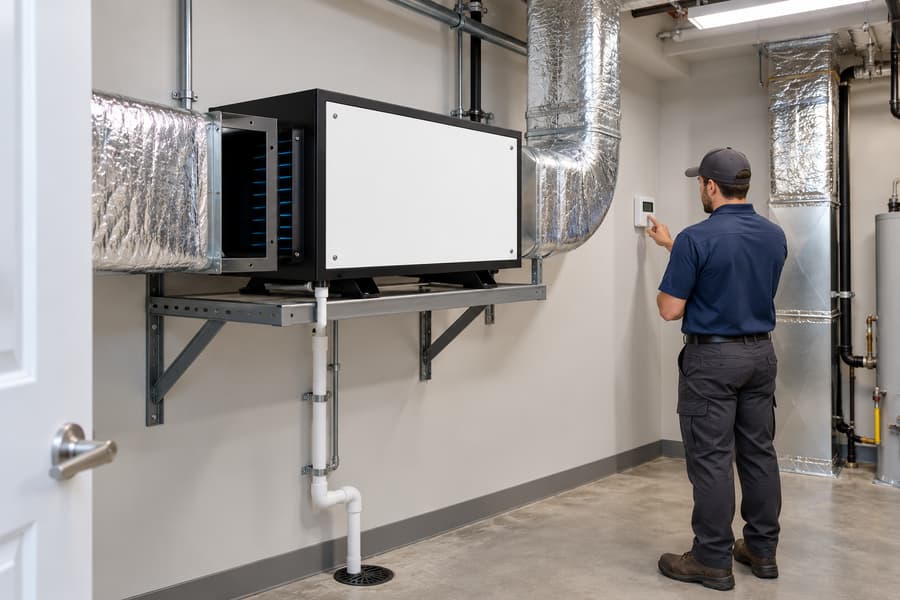
Ducted equipment may be located in a mechanical room or suitable ceiling space, subject to structure, noise, drainage, and service requirements. Concealment must not eliminate maintainability.
WetWells lists ceiling-mounted dehumidifier configurations with ducted installation options. Before ordering, compare the selected cabinet dimensions and connection drawings with the measured installation space.
Reserve space for filter removal, inspection panels, electrical isolation, condensate access, and major component replacement. A unit squeezed above fixed ceilings can become expensive to service.
Check supporting structure, mounting orientation, vibration isolation, and any access restrictions before ordering. Coordinate installation with sprinklers, lights, cable trays, and existing building services.
Duct Resistance and Air Distribution
The dehumidifier fan must overcome external static pressure from ducts, fittings, grilles, filters, and accessories. Advertised airflow at a different pressure may not be available after installation.
Request the fan performance information needed to compare the proposed duct resistance with available airflow. Undersized ducts, tight bends, and restrictive grilles can undermine the original selection.
Design supply and return routes around the rooms actually requiring humidity control. Avoid assuming that a corridor return will adequately extract air from every closed office.
Include balancing provisions and accessible measurement points. Where several branches compete for airflow, commissioning should verify each branch instead of checking total fan operation alone.
Insulate ducts where surface temperatures and surrounding conditions create condensation risk. Examine unconditioned cavities and ceiling voids, not only the air delivered to occupants.
Condensate Drainage and Failure Protection
Condensate piping needs a suitable route, slope where gravity is used, and access for inspection or clearing. Follow the equipment instructions for any required trap arrangement.
Where the unit is above occupied ceilings, consider overflow detection, secondary containment where appropriate, and a defined shutdown or alarm response. Drain faults must not silently damage finishes.
If a condensate pump is specified, review power loss behavior, reservoir alarms, and maintenance access. Test the complete discharge route rather than merely confirming pump operation.
Coordination With Existing HVAC
Integration should begin with the existing air-handling design, not simply a connection to the nearest return duct. Fan operation and pressure differences can redirect intended airflow.
Review outdoor-air delivery, temperature control, operating schedules, and whether the dehumidifier can function when cooling demand is low. Avoid unintentionally changing required ventilation performance.
Because moisture removal and space cooling interact, dehumidifier discharge heat may affect cooling requirements. Controls should prevent opposing equipment responses and unnecessary simultaneous operation.
Specify how sensors, occupancy schedules, alarms, and building controls communicate. A standalone control may be sufficient, but shared ductwork requires clear sequences and interlocks.
Which Configuration Fits Common Office Applications?
The appropriate choice depends on how many independently enclosed spaces need control and whether the building can accommodate ductwork. Treat the following options as screening recommendations, not performance certifications.
| Office Condition | Practical Starting Option | Critical Verification |
| One private office | Portable | Air circulation and noise |
| Temporary moisture issue | Portable | Source repair and drainage |
| Meeting room with intermittent use | Portable or dedicated zone | Runtime and acoustic impact |
| Open office floor | Either | Load, placement, coverage |
| Multiple enclosed offices | Ducted or separate units | Return paths and room balance |
| Limited floor space | Ducted if feasible | Ceiling access and maintenance |
| Different room requirements | Zoned or hybrid design | Independent sensors and controls |
| Basement office | Either after source repair | Envelope moisture and surface temperatures |
Consider a hypothetical office with enclosed meeting rooms and a shared open work area. A single corridor-mounted portable unit might not manage humidity behind closed doors.
A properly designed ducted system could serve those rooms through balanced branches. Alternatively, separate portable units may better suit a short lease where construction access is limited.
A hybrid arrangement can combine ducted service for common areas with portable equipment for temporary local issues. It should not disguise persistent leaks or inadequate ventilation design.
Compare Total Ownership Cost, Not Purchase Price Alone
Portable equipment generally avoids major duct construction, but several units may require additional electrical outlets, drain connections, floor space, and more frequent staff attention.
Ducted systems usually introduce design, ductwork, access panels, controls, balancing, and installation labor. Their centralized arrangement may simplify oversight while making individual component failures more consequential.
Operating cost must account for moisture removed at actual conditions, compressor runtime, fan electricity, and interactions with heating and cooling. No configuration has a universal efficiency advantage.
Include filter replacements, drain cleaning, repairs, sensor checks, access labor, and downtime consequences. A hard-to-reach ceiling unit may have lower visual impact but higher service disruption.
Lease duration and future partitions also matter. Portable units can follow layout changes, whereas a ducted network may need branch modifications and renewed airflow balancing.
Commissioning and Acceptance Checks
Verify Installation Before Startup
Confirm the installed model, electrical supply, mounting, air clearances, filter access, and condensate routing against approved project details. Resolve obvious leaks or obstructions before functional testing.
For ducted systems, inspect joints, access panels, insulation, and branch dampers. Confirm that each intended room has a workable supply and return or transfer route.
Test Capacity Delivery and Control Response
Record indoor temperature and relative humidity at representative occupied locations before operation. Include closed rooms and known trouble spots rather than relying on the controller display.
Check startup, shutdown, humidity-control response, defrost where applicable, and recovery after a permitted power interruption. Confirm alarm behavior using manufacturer-approved testing methods.
Measure duct airflow or pressure at agreed commissioning points and compare results with the design. Correct imbalanced branches before interpreting poor room humidity readings as undersizing.
Confirm drainage by observing condensate discharge under appropriate operating conditions and testing safeguards safely. An empty pan at startup is not evidence of reliable long-term drainage.
Measure occupied-area sound under documented operating conditions where acoustics are critical. Compare the observed condition with project acceptance criteria, not an unrelated catalog sound figure.
Humidity trends should be assessed over representative occupied and unoccupied schedules. A short test may verify controls but cannot establish performance through every seasonal moisture condition.
Investigate Underperformance Systematically
Uneven humidity: Check closed doors, blocked transfers, misplaced grilles, and short-circuiting return air before increasing capacity or lowering the humidity setting.
Slow moisture removal: Compare entering-air conditions with published performance data, then review ventilation load, infiltration, filters, and unexpected water sources.
Repeated cycling or alarms: Examine sensor location, control deadband, condensate safeties, and interactions with the air-conditioning schedule before replacing major components.
Unexpected noise: Identify whether the source is the compressor, fan, mounts, ducts, or terminal grilles, then investigate the operating conditions involved.
What to Specify When Requesting an Office Dehumidifier
Give prospective suppliers a room schedule showing floor areas, heights, partitions, occupancy, and intended humidity-control zones. Add a marked plan with proposed equipment and drainage locations.
Provide measured temperature and humidity records alongside local outdoor conditions when available. Identify moisture sources, operating hours, seasonal concerns, and unresolved building defects separately.
Request proposals that identify rated moisture removal and its test conditions, available airflow, fan pressure capability, electrical requirements, acoustic measurement conditions, and applicable service clearances.
Ask for a defined scope covering controls, duct accessories, drainage safeguards, installation labor, balancing, and startup responsibility. State clearly which work the equipment supplier excludes.
Agree on acceptance criteria before purchase: relevant room conditions, measurement locations, airflow checks, drain-fault responses, operating modes, and the monitoring period needed for initial verification.
At handover, obtain final drawings, settings, maintenance instructions, filter information, alarm procedures, and recorded commissioning results. Assign responsibility for trend reviews and corrective action after occupancy changes.