
Refrigerant selection directly affects dehumidifier efficiency, safety, and environmental performance. R32, R410A, R134a, and R290 differ in cooling performance, GWP, pressure, and application suitability.
Understanding these differences helps users choose the right refrigerant for commercial and industrial dehumidifiers.
Why Refrigerant Selection Matters in Dehumidifiers
A refrigerant is a key component of a refrigerant-based dehumidifier. It circulates through the refrigeration system to absorb heat from humid air and remove moisture through condensation.
The basic dehumidification process includes:
- Humid air enters the dehumidifier
- The evaporator coil lowers air temperature below its dew point.
- Water vapor condenses into liquid water
- Moisture is collected and drained
- Dry air is reheated and returned to the environment
The refrigerant directly affects several important factors:
- Cooling efficiency
- Moisture removal capacity
- Operating temperature range
- Energy consumption
- Equipment size
- Environmental performance
- Maintenance requirements
As environmental regulations become stricter, refrigerants with lower environmental impact are gradually replacing traditional options. However, performance, safety, and application requirements must also be considered when selecting a refrigerant.
Overview of R32, R410A, R134a, and R290 Refrigerants
R32, R410A, R134a, and R290 represent different stages of refrigerant development.
Traditional refrigerants like R134a and R410A offer stable performance and mature technology, but their higher GWP has driven the development of alternatives such as R32 and R290.
| Refrigerant | Refrigerant Type | GWP Value | Main Characteristics |
| R32 | HFC refrigerant | 675 | High efficiency, lower environmental impact than R410A |
| R410A | HFC blend | 2088 | Mature technology, stable performance |
| R134a | HFC refrigerant | 1430 | Reliable operation, widely used in medium-temperature systems |
| R290 | Natural refrigerant (Propane) | 3 | Very low environmental impact, high efficiency |
The best refrigerant depends on the specific dehumidifier design, operating conditions, capacity requirements, and application environment.
R32 Refrigerant for Dehumidifiers
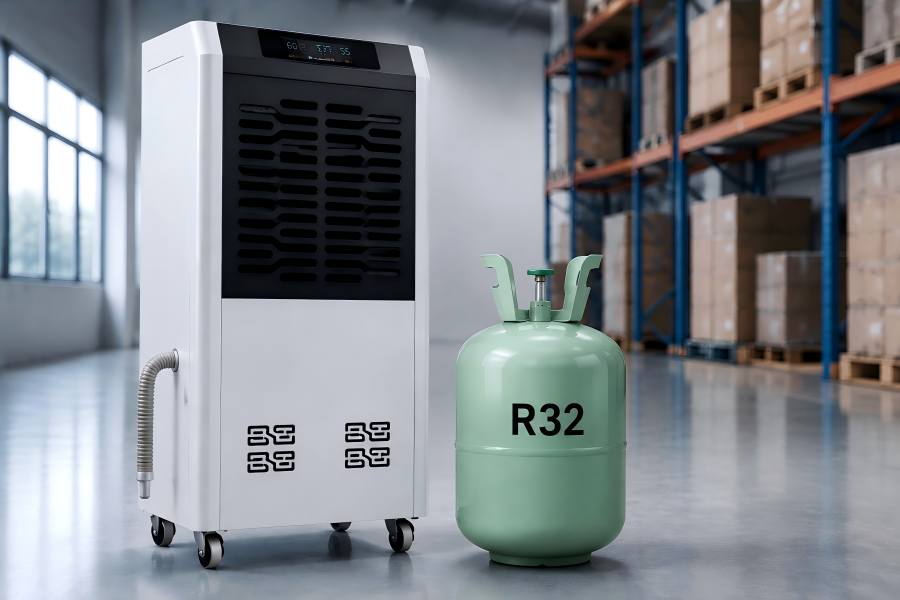
R32 has become one of the most widely discussed refrigerant alternatives because it offers improved efficiency and lower environmental impact compared with many traditional refrigerants.
Advantages of R32
Higher Energy Efficiency
R32 has excellent heat transfer performance, allowing refrigeration systems to achieve high cooling efficiency.
In dehumidifiers, this can improve:
- Moisture removal efficiency
- Compressor performance
- Overall energy consumption
Compared with R410A systems, R32 equipment can often achieve similar cooling performance with a smaller refrigerant charge.
Lower Environmental Impact
One of the main advantages of R32 is its lower GWP compared with R410A.
Environmental benefits include:
- Reduced greenhouse effect impact
- Compliance with stricter refrigerant regulations
- Better long-term sustainability
This makes R32 an attractive choice for next-generation commercial and industrial dehumidifiers.
Compact System Design
Because R32 provides strong refrigeration performance, systems using R32 may require less refrigerant volume.
This can help manufacturers design:
- Smaller refrigeration circuits
- More compact equipment structures
- Improved energy performance
Limitations of R32
Although R32 provides many advantages, it also has some challenges.
Mild Flammability
R32 belongs to the A2L refrigerant class, which denotes mild flammability.
Therefore, equipment design must consider:
- Refrigerant charge limits
- Safety controls
- Installation requirements
- Leakage prevention
Higher Operating Pressure
R32 operates at relatively high pressure compared with some traditional refrigerants.
This requires suitable:
- Compressors
- Heat exchangers
- Refrigeration components
For industrial dehumidifier manufacturers, proper system design is essential.
R32 Applications in Dehumidifiers
R32 is suitable for:
- Commercial dehumidifiers
- Energy-efficient industrial dehumidifiers
- Medium-capacity humidity control systems
- Environmentally focused equipment designs
It is especially suitable for applications requiring a balance between efficiency and environmental performance.
R410A Refrigerant for Dehumidifiers
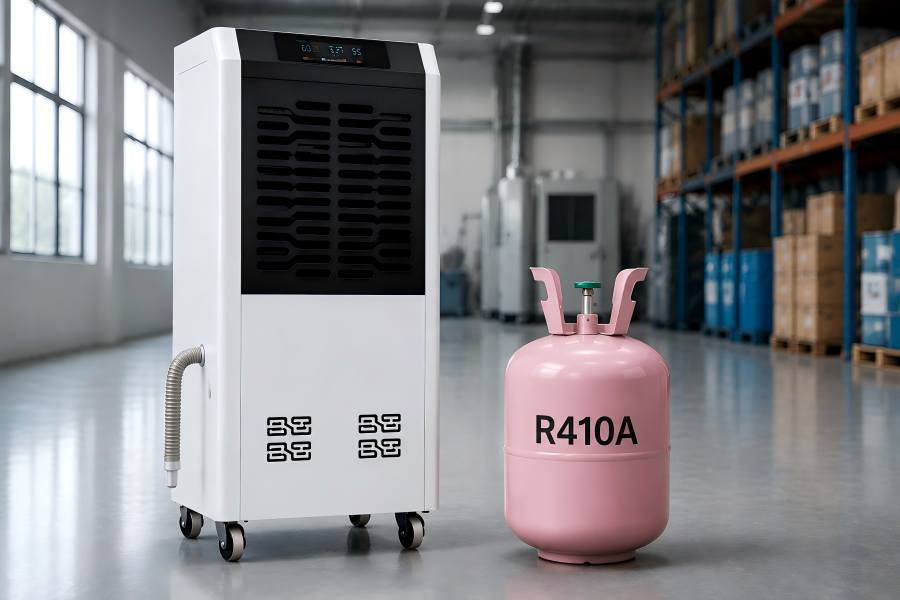
R410A is commonly used in air-conditioning and dehumidification systems because of its reliable performance and mature technology. It is a refrigerant blend of R32 and R125.
Advantages of R410A
Mature and Reliable Technology
One of the key advantages of R410A is its long-standing use in commercial applications.
Manufacturers and service technicians have extensive experience with:
- System design
- Component selection
- Maintenance procedures
- Refrigerant handling
This makes R410A equipment reliable and widely available.
Good Cooling Performance
R410A provides strong cooling capacity and stable operation.
For dehumidifiers, this helps achieve:
- Effective moisture removal
- Stable temperature control
- Reliable long-term operation
Wide Application Experience
R410A is commonly used in a range of commercial and industrial systems.
Typical applications include:
- Commercial buildings
- Warehouses
- Production facilities
- General humidity control systems
Limitations of R410A
Higher GWP
The main drawback of R410A is its relatively high global warming potential.
With increasing environmental requirements, many markets are gradually moving toward lower-GWP alternatives.
Higher Refrigerant Charge
Compared with some newer refrigerants, R410A systems may require a larger refrigerant charge for equivalent performance.
This can increase:
- Environmental impact
- Long-term regulatory pressure
R410A Applications in Dehumidifiers
R410A remains suitable for:
- Existing dehumidifier systems
- Replacement applications
- General commercial humidity control
However, new equipment designs increasingly consider lower-GWP alternatives.
R134a Refrigerant for Dehumidifiers
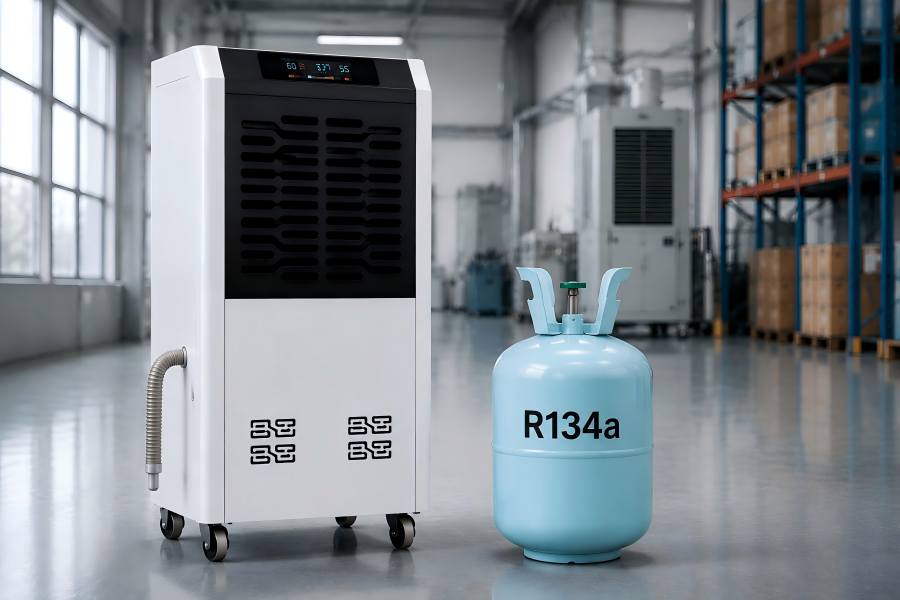
R134a is another widely used HFC refrigerant known for stable operation and reliability.
It has been commonly applied in refrigeration, air-conditioning, and dehumidification systems.
Advantages of R134a
Stable Performance
R134a provides reliable refrigeration performance under medium-temperature conditions.
It has been widely adopted because of:
- Good chemical stability
- Reliable compressor compatibility
- Mature service technology
Suitable for Medium-Temperature Applications
R134a performs well in environments where moderate cooling temperatures are required.
Common applications include:
- Commercial dehumidifiers
- Storage rooms
- Industrial humidity control systems
Easy Maintenance
Due to its long market history, technicians are familiar with R134a systems.
Maintenance advantages include:
- Available service experience
- Mature components
- Established operating procedures
Limitations of R134a
Higher GWP Than Newer Alternatives
Although R134a has stable performance, its environmental impact is higher compared with R290 and R32.
This has led many manufacturers to evaluate alternative refrigerants.
Lower Efficiency Compared With Some New Options
Compared with newer refrigerants, R134a may provide lower efficiency in some system designs.
R134a Applications in Dehumidifiers
R134a remains suitable for:
- Medium-capacity dehumidifiers
- Existing industrial systems
- Applications requiring stable operation
However, future equipment development is increasingly focused on lower-GWP refrigerants.
R290 Refrigerant for Dehumidifiers
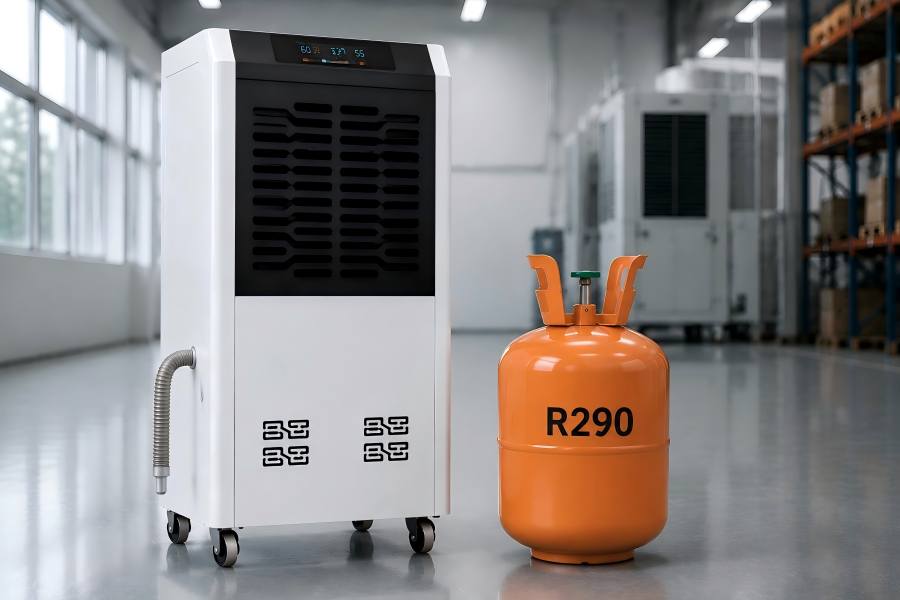
R290, or propane, is a natural refrigerant known for its low environmental impact and growing use as an environmentally friendly alternative.
Advantages of R290
Extremely Low GWP
The biggest advantage of R290 is its very low GWP value.
Compared with HFC refrigerants:
- R410A: GWP approximately 2088
- R134a: GWP approximately 1430
- R32: GWP approximately 675
- R290: GWP approximately 3
This makes R290 one of the most environmentally friendly refrigerant options currently available.
High Energy Efficiency
R290 has excellent thermodynamic properties.
Benefits include:
- Efficient heat transfer
- Lower energy consumption
- Strong refrigeration performance
For energy-conscious applications, R290 can provide significant advantages.
Smaller Refrigerant Charge
R290 systems often require a smaller refrigerant charge because of their high efficiency.
This helps reduce:
- Operating cost
- Environmental impact
- Refrigerant usage
Limitations of R290
Flammability
The main challenge of R290 is its flammability.
Because propane is combustible, equipment design must consider:
- Safety standards
- Refrigerant charge limits
- Electrical component selection
- Leakage prevention
Installation Requirements
R290 systems may require stricter installation and service procedures compared with non-flammable refrigerants.
R290 Applications in Dehumidifiers
R290 is suitable for:
- Energy-efficient dehumidifiers
- Environmentally focused products
- Commercial humidity control systems
- Residential and light industrial applications
It is especially attractive for markets with strict environmental regulations.
R32 vs R410A vs R134a vs R290: Performance Comparison
| Comparison Factor | R32 | R410A | R134a | R290 |
| GWP | 675 | 2088 | 1430 | 3 |
| Energy Efficiency | High | Medium–High | Medium | High |
| Environmental Impact | Lower | Higher | Medium | Very Low |
| Flammability | Mild | No | No | Higher |
| Technology Maturity | Growing | Very Mature | Mature | Growing |
| Future Potential | High | Medium | Medium | Very High |
How to Choose the Right Refrigerant for a Dehumidifier?
Selecting the best refrigerant depends on application requirements rather than one single performance factor.
Choose R32 When:
- Energy efficiency is important
- Lower environmental impact is required
- Compact system design is preferred
- Modern commercial equipment is needed
R32 provides a good balance between performance and environmental requirements.
Choose R410A When:
- Existing systems already use R410A
- Mature technology is preferred
- Stable operation is the priority
R410A remains reliable for many current applications, although environmental regulations may influence future replacement decisions.
Choose R134a When:
- Medium-temperature operation is required
- Stable and proven technology is preferred
- Existing systems need maintenance support
R134a continues to be used in many established systems.
Choose R290 When:
- Environmental performance is a priority
- Low GWP refrigerant is required
- High efficiency is desired
R290 offers excellent sustainability but requires careful safety design.
Refrigerant Selection for Industrial Dehumidifier Manufacturers
For industrial dehumidifier manufacturers, refrigerant selection affects system efficiency, equipment design, safety, and long-term reliability.
The suitable refrigerant depends on operating temperature, humidity requirements, dehumidification capacity, and application conditions.
Key Selection Factors
Application Environment
Different environments require different refrigerant characteristics. Normal-temperature warehouses, low-temperature storage areas, and precision manufacturing facilities may require different solutions.
Efficiency and Capacity
Refrigerant performance directly affects cooling efficiency, moisture removal capacity, compressor operation, and energy consumption. High-efficiency refrigerants can help develop more energy-saving dehumidification systems.
Environmental and Safety Requirements
- R410A and R134a provide mature performance but have higher GWP values.
- R32 offers improved efficiency with lower environmental impact.
- R290 provides excellent environmental performance but requires additional safety considerations.
Customized Design
For industrial applications, refrigerant selection should match operating conditions, humidity targets, capacity requirements, and installation requirements.