
Humidity can be described using relative humidity, dew point, and moisture content. These values are connected, but they describe different aspects of air moisture.
Understanding the difference is important for dehumidification, HVAC, storage, and industrial drying. A lower RH reading does not always mean that water has actually been removed from the air.
What Is Relative Humidity (RH)?
Relative humidity is the most commonly used humidity measurement in homes, offices, warehouses, basements, swimming pools, and many commercial spaces.
It describes how much water vapor is currently present compared with the saturation water vapor pressure at the same temperature.
Basic Formula
RH = Actual Water Vapor Pressure ÷ Saturation Water Vapor Pressure × 100%
For example, 60% RH means the water vapor pressure is approximately 60% of the saturation vapor pressure at the current air temperature.
Key Characteristics of RH
- Expressed as a percentage
- Strongly affected by temperature
- Commonly measured by RH sensors
- Easy to use for room humidity control
- Useful for comfort and storage applications
- Does not directly show total water vapor in the air
- Common control parameter for dehumidifiers
RH is convenient because users can easily set a target, such as 50% or 60%. A humidistat can then automatically control the dehumidifier around that set point.
However, RH is a relative measurement. Its value can change significantly when temperature changes, even if almost no moisture is added or removed.
For example, heating a closed room can lower RH because warmer air has a higher saturation vapor pressure. The air appears drier by RH, but its actual water vapor content may remain almost unchanged.
What Is Dew Point?
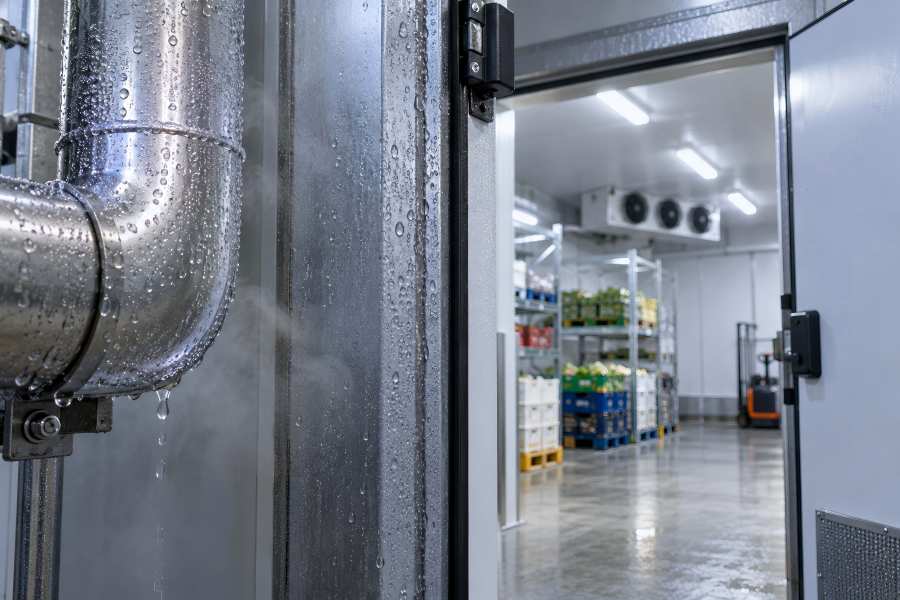
Dew point is the temperature where air reaches saturation during cooling without significantly losing or gaining moisture.
Once the air reaches its dew point, further cooling can cause water vapor to condense into liquid water.
For example, if room air has a dew point of 15°C, a pipe, wall, or metal surface below approximately 15°C may develop condensation.
Key Characteristics of Dew Point
- Expressed as a temperature
- Closely related to the actual water vapor level
- Less sensitive than RH to sensible temperature changes
- Useful for predicting condensation
- Important in low-humidity environments
- Frequently used in industrial drying
- Common in desiccant dehumidification applications
Unlike RH, dew point usually remains nearly unchanged when air is simply heated without adding or removing moisture.
This makes dew point useful when air temperatures change significantly but the actual moisture condition still needs to be compared.
Why Dew Point Matters
Dew point becomes especially important when condensation prevention or very low humidity is required.
Typical applications include:
- Cold storage
- Pharmaceutical production
- Electronics manufacturing
- Lithium battery manufacturing
- Compressed-air systems
- Low-temperature warehouses
- Industrial drying
- Low-humidity process rooms
For example, a cold-storage door may have a surface temperature of 5°C. If surrounding air has a dew point of 10°C, that surface is below the dew point and condensation can occur.
What Is Moisture Content?
“Moisture content” can refer to either the amount of water vapor in air or the amount of moisture stored inside a material.
These are separate measurements and cannot be used interchangeably.
Moisture Content in Air
For HVAC and dehumidification calculations, air moisture content is commonly expressed as humidity ratio. It indicates the mass of water vapor relative to dry air.
It may be expressed as:
- g/kg of dry air
- kg/kg of dry air
- grains per pound of dry air
- lb water/lb dry air
For example, air may contain 10 g of water vapor per kg of dry air. If the air is heated without adding or removing moisture, this value remains approximately the same.
RH may change considerably during that heating process, which is why humidity ratio is often more useful for engineering calculations.
Moisture Content in Materials
Moisture content can also describe how much water is stored inside solid materials.
Examples include:
- Wood moisture content
- Concrete moisture
- Grain moisture
- Drywall moisture
- Agricultural product moisture
- Building material moisture
In structural drying, both measurements may be important. Air humidity describes the drying environment, while material moisture readings show whether the actual structure is becoming dry.
Relative Humidity vs. Dew Point vs. Moisture Content: Key Differences
Although these three measurements describe related moisture conditions, each answers a different question.
| Factor | Relative Humidity | Dew Point | Air Moisture Content |
| What It Indicates | Moisture relative to saturation | Temperature where saturation occurs | Actual mass of water vapor |
| Typical Unit | % RH | °C / °F | g/kg, kg/kg, grains/lb |
| Strongly Affected by Air Temperature | Yes | Much less | No, if no moisture is added or removed |
| Useful for Condensation Risk | Indirectly | Very useful | Indirectly |
| Common for Room Control | Excellent | Moderate | Moderate |
| Useful for Low-Humidity Processes | Limited alone | Excellent | Excellent |
| Easy to Understand | Excellent | Good | More technical |
| Useful for Moisture-Removal Calculations | Limited alone | Useful | Excellent |
For normal indoor humidity control, RH is usually sufficient. Industrial processes often use dew point or humidity ratio because these measurements describe actual moisture conditions more clearly.
Why Relative Humidity Changes with Temperature
Temperature has a strong influence on relative humidity because saturation vapor pressure increases as air temperature rises.
If actual water vapor remains nearly constant while temperature increases, RH falls. If the same air cools, RH rises.
When Air Is Heated
If air is heated without adding or removing moisture:
- Saturation vapor pressure increases
- Relative humidity decreases
- Dew point stays approximately unchanged
- Humidity ratio stays approximately unchanged
For example, air at 20°C and 60% RH can show a much lower RH after being heated.
However, heating has not actually removed water vapor. The air is simply farther from saturation at the higher temperature.
When Air Is Cooled
If air is cooled but remains above its dew point:
- Saturation vapor pressure decreases
- Relative humidity increases
- Dew point stays approximately unchanged
- Humidity ratio stays approximately unchanged
As cooling continues, RH eventually reaches 100%, meaning the air is saturated.
If the air cools below its dew point, water vapor begins to condense, causing the actual moisture content to decrease
Why This Matters for Dehumidification
This explains why heating and dehumidification are not the same process.
Heating may reduce a room from 70% RH to 50% RH, but if no water leaves the room, its dew point and humidity ratio remain almost unchanged.
When the room cools again, the RH may rise. A dehumidifier instead physically removes water, creating a more lasting reduction in moisture content.
How Dew Point Helps Predict Condensation
Condensation occurs when humid air contacts a surface colder than the surrounding air’s dew point.
Dew point therefore provides a direct way to evaluate whether pipes, windows, walls, refrigeration equipment, or other cold surfaces are at risk.
Simple Example
Assume a room has:
- Air temperature = 24°C
- Relative humidity = 60%
- Dew point ≈ 16°C
Now suppose a metal pipe has a surface temperature of 14°C.
Because:
14°C < 16°C dew point
water vapor can condense on the pipe surface.
If the surface temperature remains above the dew point, condensation is much less likely.
Common Condensation Risk Areas
- Cold pipes
- Windows
- Metal equipment
- Cold-storage doors
- Refrigeration surfaces
- Exterior walls
- Basement surfaces
- Industrial process equipment
This is particularly important in cold rooms, basements, production areas, and refrigerated warehouses where surfaces may remain much colder than the surrounding air.
Why RH Alone Is Not Enough
A room at 50% RH may appear acceptable, but condensation risk still depends on temperature.
For example, 50% RH at 30°C represents more water vapor and a higher dew point than 50% RH at 10°C.
When the primary goal is avoiding condensation, dew point is therefore often more useful than RH alone.
Why Moisture Content Is Useful for Dehumidification Calculations
Humidity ratio is especially useful when determining how much water must actually be removed from an air stream.
Because RH changes whenever temperature changes, an RH percentage alone cannot accurately describe a dehumidification load.
Typical Applications
Moisture content is useful for:
- Dehumidifier sizing
- HVAC calculations
- Industrial drying
- Agricultural storage
- Water damage restoration
- Process air treatment
- Desiccant system design
Suppose process air enters at 12 g/kg of dry air, while the required supply condition is 7 g/kg.
The system needs to remove approximately:
12 − 7 = 5 g of water per kg of dry air
Once airflow and air mass are known, this difference can be used to estimate the required moisture-removal rate.
Why This Is Better Than RH Alone
Imagine that process air enters at 70% RH and leaves at 30% RH. That appears to represent a large reduction in humidity.
However, if the leaving air is much warmer, part of the RH reduction may result from temperature rather than actual moisture removal.
Comparing inlet and outlet humidity ratio gives a clearer indication of how much water vapor has physically been removed.
Material Moisture Also Matters
In drying applications, the air is only part of the moisture system.
Water may still be stored inside products, floors, walls, wood, concrete, grain, or other materials even when room RH has already fallen.
Material moisture readings should therefore be considered together with air humidity when evaluating actual drying progress.
How Dehumidification Changes RH, Dew Point, and Moisture Content
A real dehumidification process physically removes water vapor instead of merely changing its relative condition through temperature.
As water is removed:
- Air moisture content decreases
- Dew point decreases
- Relative humidity generally decreases
- Condensation risk decreases
The exact RH change also depends on the air temperature before and after dehumidification.
Refrigerant Dehumidifier
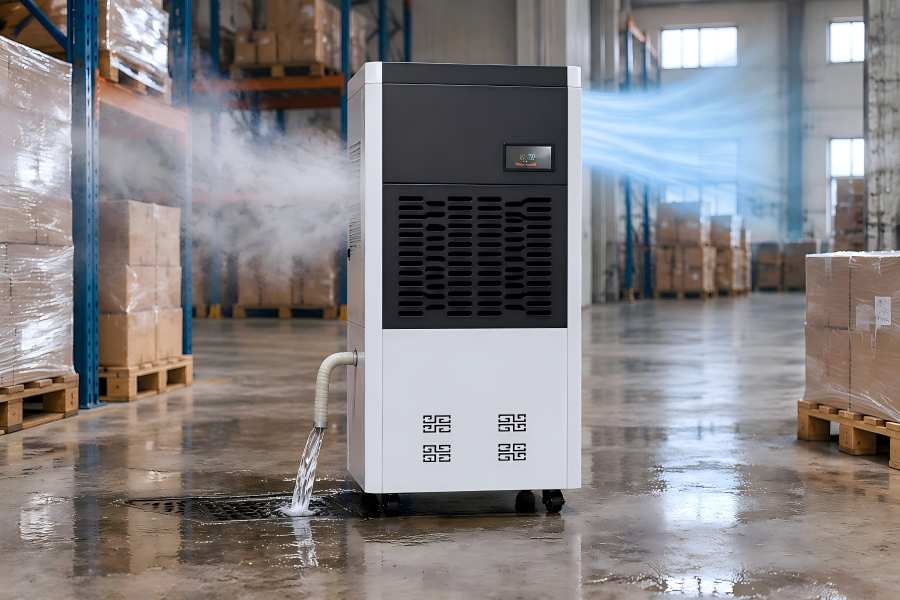
A refrigerant dehumidifier typically follows this process:
- Humid air enters the machine
- Air passes across a cold evaporator coil
- The air cools below its dew point.
- Water vapor condenses on the coil
- Condensate drains away
- The air passes across a warmer condenser
- Drier air returns to the room
Because liquid water is physically drained from the system, the air’s humidity ratio decreases.
The discharge air is also usually warmer than the entering air. Its RH may therefore decrease due to both actual moisture removal and temperature increase.
This is why comparing inlet and outlet RH alone does not always show a dehumidifier’s true moisture-removal performance.
Desiccant Dehumidifier
A desiccant dehumidifier removes moisture with an adsorbent rotor rather than primarily through refrigeration and condensation.
The process generally includes:
- Humid process air enters the rotor
- Water vapor is adsorbed by the desiccant
- Dry process air leaves the rotor
- Heated regeneration air passes through another rotor section
- Moisture is released into the regeneration air
- The wet regeneration air is discharged
Desiccant systems can achieve very low dew points and maintain drying performance at lower temperatures.
They are therefore commonly considered for cold environments, dry rooms, low-dew-point processes, and other demanding industrial applications.
Which Measurement Should You Use for Humidity Control?
The most useful humidity measurement depends on what the system needs to control.
Use Relative Humidity When
RH is generally suitable for:
- Homes
- Offices
- Hotels
- Warehouses
- General storage
- Swimming pools
- Basements
- Conventional commercial dehumidifiers
These applications usually need the space to remain within an acceptable percentage humidity range.
A standard commercial dehumidifier can therefore use an RH sensor and humidistat to automatically operate around the required set point.
Use Dew Point When
Dew point becomes more useful when:
- Condensation prevention is critical
- Operating temperatures are low
- Very dry air is required
- Process conditions change in temperature
- Low dew points must be maintained
- Desiccant dehumidification is used
Typical applications include:
- Lithium battery production
- Pharmaceutical processing
- Cold rooms
- Electronics manufacturing
- Compressed-air systems
- Low-humidity dry rooms
In these environments, a target such as a specified dew point can provide more meaningful process control than RH alone.
Use Moisture Content When
Humidity ratio is especially useful when:
- Calculating dehumidifier capacity
- Evaluating moisture loads
- Designing HVAC systems
- Comparing inlet and outlet air
- Calculating process drying
- Measuring actual water removal
- Performing psychrometric analysis
For engineering calculations, humidity ratio directly connects airflow with the mass of water that must be removed.
Use More Than One Measurement When Necessary
Professional humidity-control systems often combine several measurements instead of depending on one value.
For example:
- Temperature + RH can be used to calculate dew point.
- Temperature + Dew Point can provide a clearer picture of the actual moisture condition.
- Humidity Ratio + Airflow can help estimate the required moisture-removal capacity.
Using multiple parameters is especially useful when temperature changes significantly throughout the process.
RH, Dew Point, or Moisture Content: Which Matters Most for Dehumidification?
For general indoor humidity control, relative humidity is usually the most practical value. It is easy to monitor and works well for homes, offices, hotels, basements, warehouses, and many commercial spaces.
For condensation prevention and low-humidity industrial processes, dew point is often more useful. It directly relates air moisture conditions to the temperature at which condensation can occur.
For engineering calculations and moisture-load analysis, humidity ratio or air moisture content provides the clearest indication of actual water vapor quantity.
A simple way to distinguish them is:
- Relative Humidity—How close is the air to saturation?
- Dew Point—At what temperature can condensation begin?
- Moisture Content—How much water vapor is present in the air?
These measurements should not be compared as competing values. Each provides a different view of the same air condition and can be useful at different stages of dehumidification system design.
A conventional room dehumidifier may primarily use RH control, while a cold-storage or industrial dry-room system may rely on dew point. Humidity ratio can then be used to calculate actual moisture loads and required removal capacity.