
Choosing a dehumidifier is not only about capacity. The drainage method also affects installation, maintenance, convenience, and continuous operation.
The main options are a water tank, gravity drain, and built-in pump. The best choice depends on the installation location, drain access, and maintenance needs.
How Does Dehumidifier Drainage Work?
Most residential refrigerant dehumidifiers pull humid air across a cold evaporator coil. Water vapor condenses into liquid water, which then flows into the machine’s collection or drainage system.
The condensate can collect in a removable tank, flow continuously through a drain hose, or be pumped to another location. The drainage method does not change the rated dehumidification capacity; it only determines how the collected water leaves the unit.
This is why dehumidifier capacity and tank capacity should not be confused. A 50-pint dehumidifier may remove several gallons of moisture per day while having a much smaller internal water tank.
Dehumidifier Drainage Options: Quick Comparison
The three methods handle the same condensate but differ in installation and maintenance.
| Feature | Water Tank | Gravity Drain | Built-In Pump |
| Drainage Method | Manual emptying | Continuous hose drainage | Automatic pumped drainage |
| Drain Required | No | Yes | Yes |
| Can Drain Upward | No | No | Yes |
| Maintenance | Higher | Low | Low–Moderate |
| Installation | Very Easy | Moderate | Moderate |
| Continuous Operation | Limited | Excellent | Excellent |
| Installation Flexibility | High | Limited by gravity | High |
| Best For | Occasional use | Long-term operation | Difficult drain locations |
A water tank offers the simplest setup. Gravity drainage is usually the simplest continuous option, while a built-in pump is better when the drain is higher or farther from the machine.
What Is a Dehumidifier Water Tank?
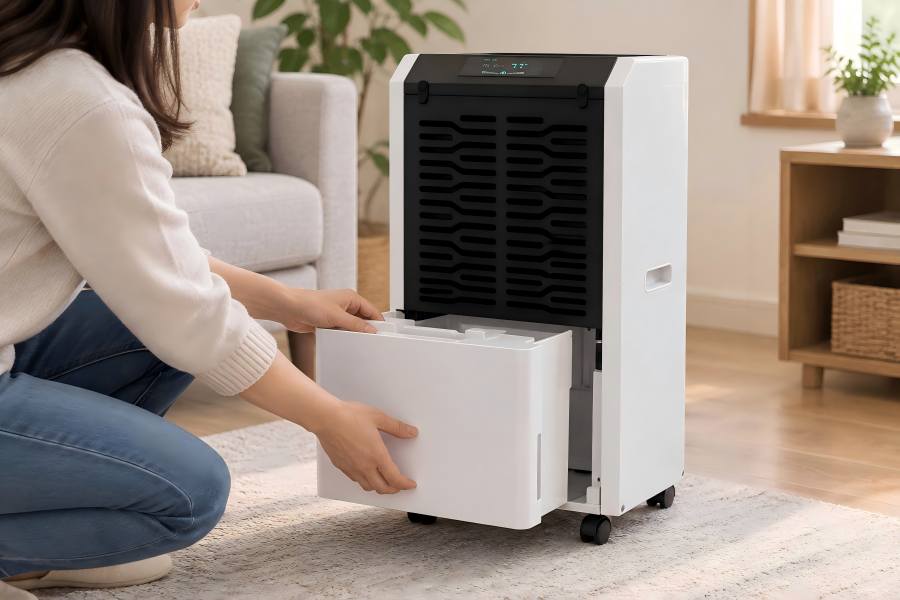
A water tank, also called a collection bucket or reservoir, stores condensate inside the dehumidifier. As moisture is removed from the air, water flows into the tank until it reaches its maximum level.
When the tank becomes full, most machines automatically stop to prevent overflow. The user must then remove the tank, empty it, and reinstall it before dehumidification continues.
This method requires almost no installation and keeps the unit portable, making it convenient for rooms without permanent drainage.
Advantages of a Water Tank
Water tank drainage is popular because it is simple and flexible.
Main advantages include:
- No permanent drainage connection required
- Easy installation
- Portable and flexible
- Suitable for temporary use
- Convenient for rooms without drains
- No drain hose routing required
For bedrooms, living rooms, or offices with moderate humidity, manual tank drainage may be completely adequate.
It also allows the dehumidifier to be moved between rooms without changing hoses or drainage connections.
Disadvantages of a Water Tank
The main disadvantage is the need for regular emptying. In humid conditions, a small tank may fill several times during the day.
Once full, most dehumidifiers stop removing moisture until the tank is emptied, which can interrupt humidity control when nobody is available.
Disadvantages include:
- Requires regular emptying
- Machine may stop when the tank is full
- Less convenient for continuous operation
- Higher daily maintenance
- Not ideal for difficult-to-access areas
- Can interrupt humidity control when unattended
This issue becomes more noticeable with higher-capacity machines because they can potentially generate more condensate each day.
Best Applications for Water Tank Drainage
Water tanks are best where portability and simple installation are more important than continuous unattended operation.
Typical applications include:
- Bedrooms
- Living rooms
- Home offices
- Small apartments
- Guest rooms
- Temporary humidity control
They are especially useful when no floor drain, sink, or other practical drainage point is available.
What Is Gravity Drainage on a Dehumidifier?
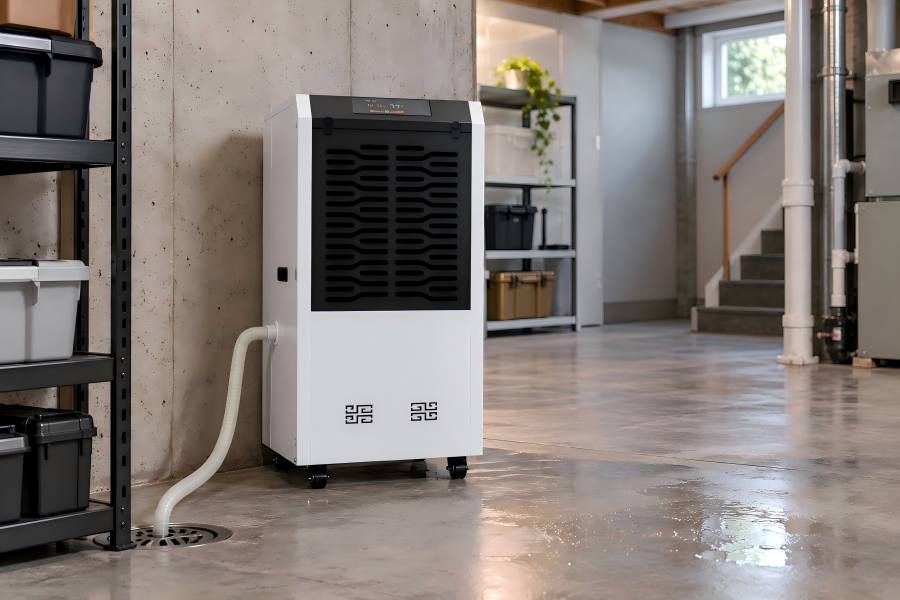
Gravity drainage sends condensate continuously from the dehumidifier through a hose to a lower drain. Water does not need to stay in the collection tank.
Since there is no pump, the system relies entirely on gravity for drainage. The drain destination must therefore be lower than the dehumidifier’s drain outlet.
When the hose is routed correctly, gravity drainage provides a simple and low-maintenance way to operate a dehumidifier for long periods.
How Gravity Drainage Works
- Moisture condenses inside the dehumidifier
- Water flows toward the drain outlet
- Condensate enters the connected hose
- Gravity moves the water downward
- Water reaches a floor drain or other suitable outlet
The hose should maintain a continuous downward slope from the machine to the drain.
Loops, raised sections, kinks, or low points can trap water and reduce drainage reliability.
Advantages of Gravity Drainage
The biggest advantage is continuous drainage without regular bucket emptying.
Other benefits include:
- Continuous drainage
- No regular tank emptying
- Simple system with few moving components
- Low maintenance
- Suitable for long-term operation
- No condensate pump required
Because gravity drainage has few mechanical components, it is usually reliable when installed correctly.
If a suitable floor drain is already located near the dehumidifier, this is often the most straightforward drainage option.
Disadvantages of Gravity Drainage
The main limitation is that gravity cannot move water uphill. The drain must be positioned below the dehumidifier outlet.
Hose routing also matters because poor slope or restricted flow can prevent condensate from draining properly.
Potential disadvantages include:
- Requires a nearby drain
- Cannot move water upward
- Hose must maintain proper slope
- Installation location may be limited
- Kinks can restrict water flow
- Poor routing can cause water backup
For example, a nearby basement floor drain can work well with gravity drainage, while an elevated utility sink cannot be reached without a pump.
Best Applications for Gravity Drainage
Gravity drainage works best in areas where continuous moisture control is required and a suitable lower drain is available.
Common applications include:
- Basements
- Garages
- Laundry rooms
- Mechanical rooms
- Storage areas
- Utility rooms
It is particularly practical for dehumidifiers that operate for many hours each day during humid seasons.
What Is a Built-In Pump Dehumidifier?
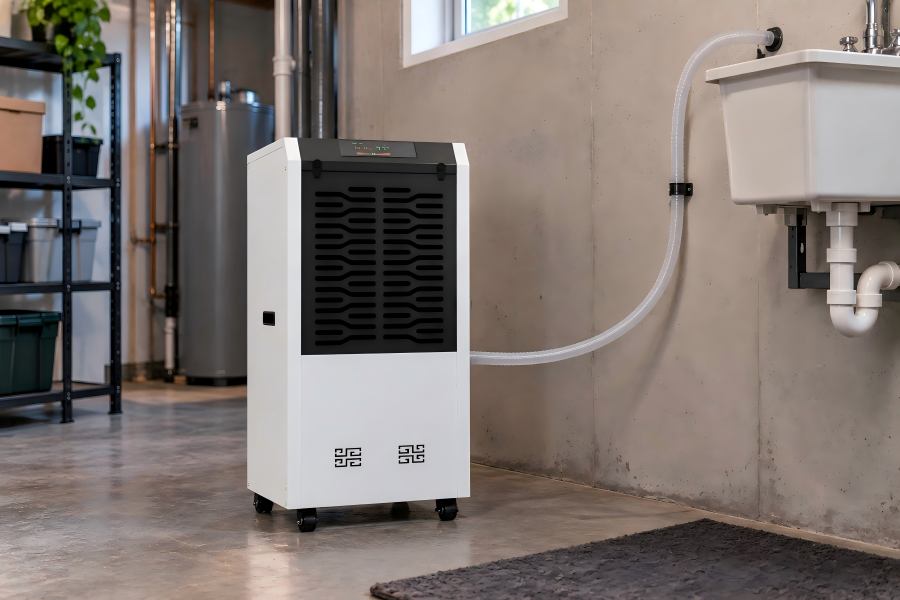
A built-in pump actively pushes condensate away from the dehumidifier instead of relying only on gravity. Water usually collects in a small internal reservoir before being pumped through a discharge hose.
When the reservoir reaches a certain level, a float or sensor activates the pump automatically. This allows condensate to move upward or across a longer distance.
The main benefit is installation flexibility because the drain no longer has to be positioned below the dehumidifier.
How the Built-In Pump Works
A typical pump cycle includes:
- Moisture condenses inside the dehumidifier
- Water enters the internal pump reservoir
- A float or sensor detects the water level
- The condensate pump starts automatically
- Water is pushed through the discharge hose
- The pump stops after the reservoir level drops
The process is automatic and generally requires little daily attention.
However, the maximum pumping height and distance vary by model and should be checked before installation.
Advantages of a Built-In Pump
A built-in pump offers greater freedom when deciding where to place the dehumidifier.
Advantages include:
- Can move condensate upward
- Supports longer drain routes
- Works when no floor drain is nearby
- Reduces manual water handling
- Supports unattended operation
- Provides flexible installation
For example, a dehumidifier on a basement floor may need to drain into a utility sink several feet higher. A built-in pump can often handle this situation, while gravity drainage cannot.
Disadvantages of a Built-In Pump
The additional flexibility comes with more mechanical and electrical components.
Pumps, sensors, reservoirs, and tubing may eventually require cleaning, inspection, or replacement.
Potential disadvantages include:
- Higher purchase price
- More components to maintain
- Pump may eventually require service
- Pump hose can become blocked
- Slight additional operating noise
- Pump capacity has height and distance limits
A built-in pump should therefore be selected when the installation actually requires it rather than simply because it appears more advanced.
Water Tank vs. Gravity Drain: Which Is Better?
The main difference is manual maintenance versus continuous drainage.
| Factor | Water Tank | Gravity Drain |
| Installation | Very Easy | Requires Drain Hose |
| Manual Maintenance | Higher | Low |
| Continuous Operation | Limited | Excellent |
| Portability | Better | More Limited |
| Drain Required | No | Yes |
| Risk of Full-Tank Shutdown | Yes | Low |
| Best For | Temporary or Local Use | Long-Term Humidity Control |
A water tank is more convenient when the dehumidifier needs to move frequently or when no suitable drain is available.
Gravity drainage makes more sense when the machine runs for many hours each day and a lower drainage point is nearby.
Emptying a bedroom dehumidifier once a day may not be inconvenient. Emptying a basement unit several times daily throughout summer can become unnecessary work.
Gravity Drain vs. Built-In Pump: Which Should You Choose?
Both options support continuous drainage. The main difference is whether gravity alone can move the water to the required destination.
Choose Gravity Drain When:
- A floor drain is nearby
- The drain is below the dehumidifier
- The hose can maintain a downward slope
- Simple installation is possible
- Lower maintenance is preferred
- Long-term operation is required
If gravity can reliably move the condensate, it usually provides the simpler solution with fewer components to maintain.
A correctly installed drain hose is inexpensive, easy to inspect, and suitable for long-term operation.
Choose a Built-In Pump When:
- The drain is higher than the dehumidifier
- Water must travel a longer distance
- No suitable floor drain is nearby
- The unit cannot be positioned near the drain
- Unattended operation is important
- Installation flexibility is required
A built-in pump is therefore mainly a solution for difficult drainage locations.
If a suitable lower drain is already available, there is usually little reason to add pump complexity.
Water Tank vs. Built-In Pump: Convenience and Cost
A water tank offers the lowest installation complexity because no drain connection is required. The trade-off is regular manual emptying.
A built-in pump costs more but can remove condensate automatically and allows greater freedom in positioning the machine.
Important comparison factors include:
- Initial purchase price
- Daily maintenance
- Installation flexibility
- Long-term convenience
- Pump maintenance
- Drainage reliability
- Need for unattended operation
For occasional bedroom or office use, paying extra for a pump may not be necessary.
For a basement dehumidifier operating continuously for months, automatic drainage may provide much greater convenience.
Which Drainage Option Is Best for Different Rooms?
Drainage requirements vary according to room type, moisture load, accessibility, and available plumbing.
Bedroom
A water tank is usually sufficient because bedroom moisture loads are often moderate and the machine remains easy to access.
It also avoids running a visible drain hose across the room and keeps the unit easy to move.
Basement
Basements often benefit from continuous drainage because humidity problems can persist for long periods.
If a floor drain is nearby, gravity drainage is usually the simplest solution. If the nearest suitable drain is higher than the machine, a built-in pump is more appropriate.
Laundry Room
Laundry activities can add significant moisture through washing, wet clothes, and drying.
Because plumbing and drainage are often already nearby, continuous gravity drainage can be convenient and easy to install.
Garage
Garages may experience outdoor humidity, frequent door opening, and changing seasonal conditions.
Gravity drainage works well when a lower drain is available, while a built-in pump is useful when drainage access is more difficult.
Crawl Space
Manual water tanks are often impractical because crawl spaces can be difficult to access regularly.
Continuous drainage is generally preferable, using gravity when possible or a pump when elevation and routing make gravity drainage unsuitable.
Does Dehumidifier Capacity Affect Drainage Choice?
Yes. Higher-capacity dehumidifiers can potentially remove several gallons of moisture each day, making manual tank emptying less convenient.
For example, a dehumidifier removing 50 pints/day can theoretically collect:
50 pints ÷ 8 = 6.25 gallons/day
A 70-pint/day unit can theoretically remove:
70 pints ÷ 8 = 8.75 gallons/day
Actual daily collection is usually different because it depends on temperature, humidity, runtime, and room conditions.
However, these numbers show why drainage becomes increasingly important as dehumidifier capacity and moisture load increase.
If the machine has a one-gallon tank, several gallons of daily condensate could require multiple emptying cycles.
For high-capacity or long-running applications, continuous drainage can therefore reduce maintenance significantly.
How Often Should You Empty a Dehumidifier Water Tank?
There is no fixed answer because tank filling depends on both tank volume and actual daily moisture removal.
Important factors include:
- Tank capacity
- Dehumidifier capacity
- Room humidity
- Room temperature
- Moisture sources
- Runtime
- Air leakage
- Weather conditions
Suppose a dehumidifier has a 1-gallon tank, equal to approximately 8 pints.
If the machine actually removes 24 pints of water during one day:
24 pints ÷ 8 = 3 gallons/day
The tank could theoretically require emptying about three times.
If the same machine removes only 6 pints in a drier room, the tank may not fill completely during the entire day.
This is why tank-emptying frequency should be judged by actual operating conditions rather than rated capacity alone.
Common Gravity Drainage Problems
Gravity drainage is simple, but poor installation can still cause water backup or leakage.
Drain Hose Is Not Sloped Properly
The hose should run continuously downward toward the drain.
Raised sections or low loops can trap water and interrupt normal condensate flow.
Hose Is Kinked or Blocked
A kink reduces the internal opening of the hose and restricts drainage.
Dust, debris, or biological buildup can also cause blockage during long-term operation.
Drain Point Is Too High
Gravity cannot push water upward.
If the drain is higher than the dehumidifier outlet, a condensate pump or other drainage method is required.
Hose Connection Is Loose
Loose fittings can allow condensate to leak around the machine instead of entering the drain hose.
Connections should be checked during installation and periodically during operation.
Common Built-In Pump Problems
Built-in pumps reduce daily maintenance but still require occasional inspection.
Potential problems include:
- Blocked pump hose
- Dirty pump reservoir
- Float switch problems
- Improper hose routing
- Pump failure
- Drain outlet restrictions
A blocked pump system may cause the machine to stop or display an error, depending on its design.
Keeping the reservoir, hose, and outlet clean can help maintain reliable drainage and reduce unnecessary pump problems.
Key Factors When Choosing a Dehumidifier Drainage System
Before selecting a drainage option, first inspect the installation location and available drains.
Consider:
- Available drain location
- Distance to the drain
- Height difference
- Dehumidifier capacity
- Expected daily runtime
- Frequency of maintenance
- Accessibility of the unit
- Need for unattended operation
Drain location is usually the most important factor.
If a suitable lower drain is close to the machine, gravity drainage is often the easiest solution. If water needs to move upward or farther away, a built-in pump offers more flexibility.
If no suitable drain exists and the machine is used only occasionally, a removable water tank may be the most practical option.
Water Tank, Gravity Drain or Built-In Pump: Final Comparison
Each drainage option suits a different operating situation.
| Choose | Best When |
| Water Tank | You need simple, portable, occasional dehumidification |
| Gravity Drain | A lower drain is nearby and continuous operation is needed |
| Built-In Pump | Water must move upward or to a difficult drain location |
A water tank provides simple installation and maximum portability, making it suitable for bedrooms, offices, apartments, and temporary humidity control.
A gravity drain provides reliable continuous operation when a lower drain is available, making it a practical choice for basements, garages, laundry rooms, and utility spaces.
A built-in pump provides greater installation flexibility when gravity cannot move condensate to the required destination, especially when the water must travel upward to a sink or elevated drain.
The best drainage option is therefore not necessarily the most advanced one. It is the method that can remove condensate reliably with the least unnecessary installation and maintenance.