
Proper drainage is essential for commercial dehumidifiers to operate efficiently. Without effective water removal, collected moisture can interrupt operation, increase maintenance requirements, and reduce overall dehumidification performance.
Water tanks and continuous drainage are two common solutions. Understanding their differences in convenience, installation, costs, and maintenance helps businesses select the most suitable drainage method for their facilities.
What Is Water Tank Drainage in a Commercial Dehumidifier?
Water tank drainage is a traditional moisture collection method used in many portable and smaller commercial dehumidifiers. The system collects condensed water in a removable container that must be emptied manually.
This drainage method is particularly suitable for facilities where permanent drainage connections are unavailable or equipment needs to be moved frequently.
How Does Water Tank Drainage Work?
Most refrigerant commercial dehumidifiers remove moisture by passing humid air over cold evaporator coils. Droplets formed on the cold coil drain into the unit’s removable reservoir.
The process generally involves:
- Moisture Collection: Condensed water flows from the evaporator coils into the collection tank.
- Water Storage: The tank temporarily stores the collected moisture.
- Water Level Detection: A float switch or electronic sensor monitors the water level.
- Automatic Shutdown: When the tank reaches capacity, the dehumidifier stops moisture removal to prevent overflow.
- Manual Emptying: The operator removes the tank, empties the water, and reinstalls it.
Water tank capacities vary depending on equipment design. Check the usable tank capacity in the selected model’s specification; a dehumidifier’s daily extraction rating is not its tank volume.
Advantages of Water Tank Drainage
Simple Installation
Water tank drainage requires no external hoses, pumps, or permanent plumbing connections. Operators can typically begin using the dehumidifier immediately after proper setup.
Flexible Equipment Placement
Because the unit does not need a nearby drainage outlet, it can be installed in different areas of a commercial facility.
Lower Initial Investment
Water tank systems generally require fewer additional components, helping reduce initial installation expenses.
Suitable for Temporary Applications
Water tanks are convenient for short-term moisture control, temporary drying projects, and smaller commercial spaces.
Limitations of Water Tank Drainage
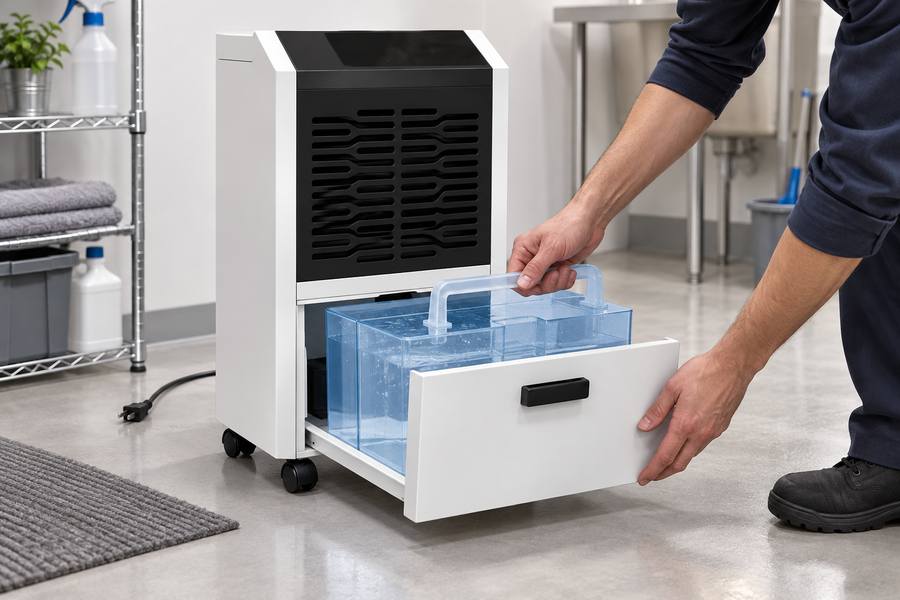
Despite its simplicity, water tank drainage has several limitations:
- Frequent Emptying: High moisture removal rates can fill the tank quickly.
- Operating Interruptions: Dehumidification stops when the tank reaches capacity.
- Manual Labor: Employees must regularly check and empty collected water.
- Limited Unattended Operation: Overnight or weekend operation may be interrupted.
- Maintenance Requirements: Clean the reservoir on a regular schedule so residue and stale water do not accumulate.
For high-capacity commercial dehumidifiers operating continuously, these limitations can significantly reduce convenience.
Understanding Automatic Condensate Discharge
Continuous drainage allows a commercial dehumidifier to discharge collected condensate automatically through a drainage hose or piping system.
Instead of storing water in a removable tank, moisture is directed toward a suitable drain, allowing the dehumidifier to operate for extended periods without routine manual emptying.
Continuous drainage is commonly used in warehouses, commercial basements, manufacturing facilities, and other locations requiring long-term humidity control.
How Does Continuous Drainage Work?
A continuous drainage system connects the dehumidifier’s condensate outlet to a suitable drainage location.
During operation:
- Moisture condenses on the dehumidifier’s evaporator coils.
- Collected water flows into a condensate tray or drainage outlet.
- Water enters a connected drainage hose or pipe.
- Condensate is discharged through gravity or a pump.
- The dehumidifier continues operating according to its humidity settings.
Unlike water tank drainage, properly configured continuous drainage does not require operators to empty a collection container.
However, hoses, pumps, and drainage outlets must remain functional to prevent water accumulation.
Main Types of Continuous Drainage
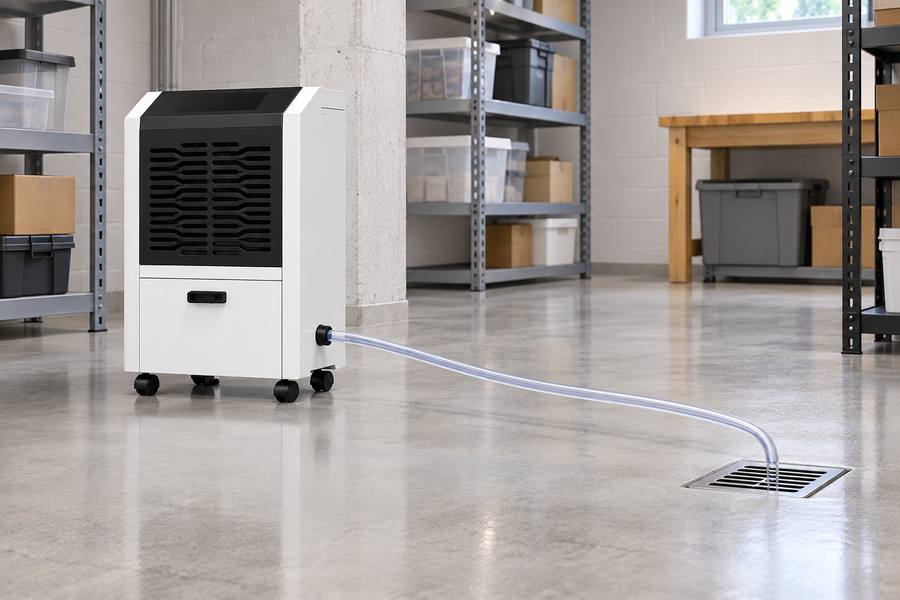
Commercial dehumidifiers generally use two main continuous drainage methods.
Gravity Drainage
Gravity drainage relies on natural water flow to discharge condensate through a downward-sloping hose.
Its main characteristics include:
- No additional pumping equipment is required.
- Electricity is not needed specifically for water discharge.
- Installation is relatively simple when a suitable drain is available.
- The receiving drain must be lower than the drainage outlet.
- Hose routing must prevent kinks, blockages, and water accumulation.
Gravity drainage is particularly suitable for commercial basements, warehouses, and facilities with accessible floor drains.
Pump-Assisted Drainage
Pump-assisted drainage uses a built-in or external condensate pump to move collected water toward a drainage location.
Its main characteristics include:
- Water can be discharged to a higher drainage point.
- Drainage hoses can be routed more flexibly.
- Suitable for locations without convenient gravity drainage.
- Requires additional equipment and electricity.
- Pump capacity and maximum lift height must match installation requirements.
Pump-assisted drainage is often useful in commercial facilities where condensate must be lifted to an elevated drain or routed around structural obstacles.
Advantages of Continuous Drainage
Extended Operating Time
Continuous drainage allows commercial dehumidifiers to operate without routine tank-emptying interruptions, provided the drainage system functions correctly.
Reduced Manual Labor
Employees do not need to repeatedly empty collected water, making daily equipment management more convenient.
Handling Larger Condensate Volumes
A high-output unit may collect more water than staff can conveniently carry away in a tank. Continuous drainage supports reliable water removal during extended operation.
Convenient for Permanent Installations
Commercial buildings requiring regular humidity control can connect dehumidifiers to suitable drainage infrastructure.
Limitations of Continuous Drainage
Continuous drainage also has several limitations:
- A suitable drainage location must be available.
- Gravity drainage requires proper hose positioning.
- Drain hoses can become blocked, disconnected, or damaged.
- Pump-assisted systems introduce additional maintenance requirements.
- Permanent drainage connections can reduce equipment mobility.
Proper installation and periodic inspection are essential for reliable operation.
Water Tank vs. Continuous Drainage: Key Differences
Water tank drainage and continuous drainage serve the same purpose but differ in daily operation, installation flexibility, maintenance, and suitability for commercial environments.
| Comparison Factor | Water Tank Drainage | Continuous Drainage |
| Water Collection | Removable water tank | Drain hose or piping system |
| Installation | Simple setup | Requires drainage connection |
| Manual Emptying | Required | Normally unnecessary |
| Operating Time | Limited by tank capacity | Supports extended operation |
| Equipment Mobility | High | Depends on drainage connections |
| Maintenance | Tank emptying and cleaning | Hose, drain, and pump inspection |
| Initial Cost | Generally lower | May require additional components |
| Labor Requirements | Higher | Lower |
| Best Applications | Portable and temporary use | Permanent and high-humidity applications |
Convenience and Daily Operation
The most noticeable difference is the level of manual intervention required.
Water tank drainage requires employees to monitor water levels and empty the tank whenever it becomes full. This may be manageable in small offices or facilities where dehumidifiers operate occasionally.
Continuous drainage eliminates routine tank emptying, making it particularly beneficial for warehouses, storage facilities, and commercial buildings operating for long periods.
For businesses with limited maintenance staff, automatic drainage can reduce daily workload.
Drainage Capacity and Operating Time
The relationship between daily moisture removal and tank capacity significantly affects operating time.
For example, consider a commercial dehumidifier collecting 20 liters of water per day under its actual operating conditions.
If the unit has a 5-liter tank:
20 L ÷ 5 L = 4 tankfuls per day
At a constant moisture collection rate, the tank would reach capacity approximately every six hours.
If the moisture collection rate increases to 40 liters per day, the same tank could fill approximately every three hours.
These examples assume consistent moisture collection. Actual filling frequency varies with indoor humidity, temperature, and equipment cycling.
With continuous drainage, the same dehumidifier can discharge water automatically, avoiding interruptions caused by a full collection tank.
Installation Requirements
Water tank drainage requires minimal installation because the collected moisture remains inside the equipment.
Continuous gravity drainage requires a secure hose connection and sufficient downward slope toward the receiving drain.
Pump-assisted drainage offers greater routing flexibility but requires a suitable power supply, pump installation, and appropriate discharge tubing.
Commercial buyers should also consider hose length, outlet diameter, drainage height, and available installation space.
Maintenance and Reliability
Both drainage methods require maintenance, although their maintenance tasks differ.
Water tank systems need regular emptying, cleaning, and inspection of tank-full sensors.
Continuous drainage systems require periodic hose inspection, drainage cleaning, and leak prevention. Pump-assisted installations also need pump inspection and functional testing.
For unattended commercial operation, drainage overflow protection and appropriate fault detection are particularly important.
Water Tank vs. Continuous Drainage: Cost Comparison
Cost is an important factor when selecting a commercial dehumidifier drainage system.
Although water tank drainage generally has lower initial setup costs, continuous drainage may provide long-term savings by reducing manual labor and operating interruptions.
Initial Equipment and Installation Costs
Water tank drainage usually requires no additional drainage equipment because the collection tank is included with the dehumidifier.
Continuous gravity drainage may require a compatible hose, fittings, and installation materials.
Pump-assisted drainage generally involves higher costs because a condensate pump, electrical connection, and additional tubing may be necessary.
Estimated Drainage System Cost Comparison
The following comparison separates included components, costs requiring a quotation, and one verified U.S. accessory listing in USD. The commercial dehumidifier itself is excluded.
| Cost Category | Water Tank Drainage | Gravity Drainage | Pump-Assisted Drainage |
| Additional Equipment | $0 extra if the original tank is included | Obtain a quote for a compatible hose and fittings | $67.03 example: Little Giant 554405 VCMA-15ULS pump only |
| Basic Installation Labor | $0 | Quote according to hose route and local labor | Quote pump connection, tubing, wiring, and commissioning |
| Drainage Electricity | None | None | Low, depends on pump |
| Manual Emptying Labor | Higher | Minimal | Minimal |
| Routine Maintenance | Tank cleaning | Hose inspection | Pump and hose inspection |
| Overall Initial Cost | Lowest | Low | Moderate to High |
Source and scope: Plumbing Planet listed the Little Giant 554405 VCMA-15ULS condensate pump at US$67.03 per unit when checked on October 15, 2026. This is one retail example, not a market range or a WetWells quotation. Installation, separate tubing, applicable tax, and shipping are excluded from the comparison and must be confirmed with the seller. Verify pump compatibility, voltage, flow at the required lift, and overflow protection before selecting accessories.
Commercial facilities requiring extensive piping, elevated drainage, or specialized pumps may experience higher installation costs.
Labor and Maintenance Costs
Manual tank emptying can create recurring labor expenses, especially when several commercial dehumidifiers operate simultaneously.
For a hypothetical U.S. facility budget in USD, consider employees emptying a dehumidifier tank four times daily. The following calculation uses assumed labor time and rate, not a quoted wage or service charge.
If each emptying takes three minutes:
4 × 3 minutes = 12 minutes per day
At an illustrative labor rate of $20 per hour:
12 ÷ 60 × $20 = $4 per day
Over 365 operating days:
$4 × 365 = $1,460 annually
This example demonstrates how manual drainage can create additional labor costs over time. Actual costs depend on operating frequency, staff availability, and the number of dehumidifiers installed.
Continuous drainage can reduce this recurring workload, although hoses and pumps still require periodic inspection.
Long-Term Operating Costs
When comparing long-term expenses, businesses should consider:
- Initial drainage equipment investment
- Installation and plumbing expenses
- Manual labor requirements
- Maintenance and replacement parts
- Potential operating interruptions
- Risks associated with drainage failures
Gravity drainage generally offers low ongoing drainage-related operating costs because it requires no pump electricity.
Pump-assisted drainage consumes additional electricity and introduces mechanical components that may eventually need replacement.
However, both continuous drainage methods can reduce labor requirements compared with manual tank emptying.
For commercial facilities operating dehumidifiers continuously, the long-term convenience of automatic drainage often outweighs its higher initial installation cost.
Which Drainage Method Is Better for Different Commercial Applications?
Different commercial environments have different moisture loads, operating schedules, and drainage conditions.
The appropriate drainage method should match the facility’s daily requirements rather than relying solely on equipment capacity.
Commercial Basements
Commercial basements frequently experience elevated humidity due to groundwater moisture, inadequate ventilation, and surrounding soil conditions.
Continuous drainage is often suitable because dehumidifiers may need to operate for extended periods.
Gravity drainage works well when a suitable floor drain is available below the dehumidifier outlet.
If condensate must be lifted to an elevated drainage point, a pump-assisted system may be required.
Warehouses and Storage Facilities
Warehouses require stable humidity to protect packaging materials, stored goods, metal components, and moisture-sensitive products.
In large storage facilities, manually emptying multiple water tanks can become labor-intensive.
Routing condensate directly to a drain offers several warehouse benefits:
- Keeps tank capacity from limiting the operating schedule.
- Reduces routine staff intervention.
- Helps avoid tank-full shutdowns.
- Accommodates substantial moisture collection.
For permanently installed warehouse dehumidifiers, gravity drainage is often preferred when suitable floor drains are available.
Construction Sites and Temporary Drying
Construction sites often require dehumidification during building renovation, water damage restoration, and material drying.
Water tank drainage can be convenient for short-term applications where equipment mobility is important and plumbing connections are unavailable.
However, large drying projects can generate substantial amounts of condensate.
In these situations, continuous drainage or pump-assisted drainage may be more practical, especially when dehumidifiers operate overnight.
Manufacturing and Industrial Facilities
Manufacturing facilities may require continuous moisture control to protect machinery, maintain product quality, and support production processes.
High-capacity dehumidifiers can generate large condensate volumes during operation.
Continuous drainage is generally recommended for these environments because it reduces manual intervention and supports extended operating schedules.
Facilities with existing drainage infrastructure can often integrate dehumidifiers into designated condensate discharge systems, subject to applicable installation requirements.
Offices and Small Commercial Spaces
Small offices and commercial rooms may only require occasional dehumidification.
When moisture production is relatively low and employees are available to empty the collection tank, water tank drainage can be a convenient and economical choice.
For equipment installed in unattended storage rooms or operating during weekends, continuous drainage may offer greater convenience.
Recommended Drainage Methods by Application
| Commercial Application | Recommended Drainage Method | Main Reason |
| Small Commercial Office | Water Tank | Simple installation and occasional use |
| Commercial Basement | Continuous Drainage | Long-term humidity control |
| Warehouse | Continuous Drainage | Extended operating hours |
| Construction Site | Water Tank or Continuous Drainage | Depends on site conditions |
| Manufacturing Workshop | Continuous Drainage | High moisture removal demand |
| Storage Facility | Continuous Drainage | Reduced manual maintenance |
| Temporary Moisture Control | Water Tank | Equipment mobility |
| Unattended Equipment Room | Continuous Drainage | Fewer operating interruptions |
These recommendations provide general guidance. Drainage access, expected condensate volume, installation conditions, and operating schedules should determine the final selection.
Can Commercial Dehumidifiers Support Both Drainage Methods?
Some commercial dehumidifiers feature dual drainage systems, allowing users to choose between manual water collection and continuous drainage.
This design provides greater flexibility for businesses that use dehumidification equipment in different environments.
How Does Dual Drainage Work?
A dual-drainage commercial dehumidifier typically includes a removable water tank and a separate drainage outlet.
When manual drainage is selected, condensed water flows into the collection tank.
When continuous drainage is selected, a compatible hose directs water toward a designated drainage location.
Depending on the equipment design, users may need to remove a drain plug, connect the hose, or adjust the drainage configuration.
Some models also support optional or built-in condensate pumps.
However, not all commercial dehumidifiers include water tanks. Many high-capacity units are designed primarily for continuous drainage.
Benefits of Dual Drainage Options
Greater Installation Flexibility
Businesses can use water tank drainage where permanent drainage connections are unavailable and switch to continuous drainage when suitable infrastructure exists.
Adaptability to Different Applications
The same equipment may serve temporary drying projects, storage areas, and permanent commercial installations.
Convenient Equipment Relocation
Portable units with dual drainage options can be moved between locations without depending entirely on fixed plumbing connections.
Support for Changing Operating Requirements
Businesses can select the most practical drainage method according to operating hours, moisture loads, and staff availability.
Important Compatibility Considerations
Before purchasing a commercial dehumidifier with multiple drainage options, buyers should verify the following specifications:
- Drain Outlet Design: Check whether the equipment supports an external drainage connection.
- Hose Diameter: Confirm compatibility with the manufacturer’s recommended drainage hose.
- Gravity Drainage Requirements: Verify the outlet position and required downward slope.
- Pump Compatibility: Determine whether a built-in or external condensate pump is supported.
- Overflow Protection: Check for water level sensors, pump fault protection, or automatic shutdown functions.
- Drainage Capacity: Size the discharge arrangement for the unit’s anticipated water collection rate.
Following the manufacturer’s installation instructions helps prevent leaks, drainage blockages, and equipment malfunction.
How to Choose the Right Drainage Method for a Commercial Dehumidifier
Selecting the right drainage method requires evaluating moisture removal capacity, drainage accessibility, operating schedules, and long-term maintenance requirements.
Consider Daily Moisture Removal Capacity
One of the most important factors is the amount of condensate produced during operation.
Commercial dehumidifiers with higher moisture removal capacities may fill relatively small water tanks several times daily.
For example, a dehumidifier collecting 30 liters per day with a 5-liter tank could require up to six tank-emptying events daily under constant operating conditions.
Businesses should compare expected condensate volume with tank capacity before choosing manual drainage.
For equipment generating large amounts of water, continuous drainage is generally more practical.
Evaluate Drainage Availability
The availability and location of drainage infrastructure strongly influence the selection.
Before installing continuous drainage, consider:
- Is a suitable floor drain available nearby?
- Is the receiving drain lower than the dehumidifier outlet?
- Can the drainage hose maintain the required slope?
- Does the installation require upward water discharge?
- Is an electrical connection available for a condensate pump?
When gravity drainage is possible, it often provides the simplest automatic drainage solution.
When the discharge point is elevated, pump-assisted drainage may be necessary.
Determine Operating Hours
Operating schedules are another important consideration.
For occasional dehumidification during staffed working hours, manual tank drainage may be sufficient.
However, commercial facilities operating dehumidifiers overnight, during weekends, or continuously can benefit from automatic drainage.
Continuous drainage reduces interruptions caused by full collection tanks, helping equipment maintain its intended humidity-control schedule.
Compare Installation and Maintenance Requirements
Water tank drainage offers simple installation but requires regular attention.
Continuous drainage generally requires more preparation during installation but reduces daily manual water removal.
For pump-assisted systems, businesses should consider pump capacity, maintenance accessibility, electrical requirements, and expected replacement costs.
Facilities with limited maintenance resources may prefer gravity drainage when suitable infrastructure is available.
Consider Equipment Mobility and Future Requirements
Portable commercial dehumidifiers are frequently moved between different rooms, buildings, or temporary work areas.
For these applications, water tank drainage provides convenient installation flexibility.
Permanent commercial installations, particularly those involving high-capacity equipment, generally benefit more from continuous drainage.
Businesses expecting changing operating requirements may consider dehumidifiers with both drainage options.
Prioritize Drainage Reliability and Safety
Regardless of the selected method, drainage reliability is essential for protecting equipment and surrounding property.
For water tank drainage, buyers should look for automatic tank-full shutoff and reliable water level sensors.
For continuous drainage, proper hose installation, leak prevention, and periodic inspections are important.
Pump-assisted systems should have suitable overflow protection, especially in unattended locations.
For most high-capacity commercial dehumidifiers operating for extended periods, continuous drainage is the more practical choice. Water tank drainage remains suitable for portable equipment, temporary applications, and facilities with relatively low moisture loads.
The final decision should balance drainage capacity, installation conditions, operating convenience, maintenance requirements, and total long-term costs.