
The total cost of ownership (TCO) of an industrial dehumidifier includes its purchase price, installation, electricity consumption, maintenance, repairs, and end-of-life expenses. In the illustrative 10-year budget below, electricity is the largest expense; the actual cost balance depends on operating hours, energy prices, equipment selection, and service requirements.
Which Expenses Belong in an Industrial Dehumidifier Ownership Budget?
Buying an industrial dehumidifier starts a series of expenses that continue throughout its use. Industrial facilities must consider several direct and indirect expenses throughout the equipment’s operating life.
Understanding these costs helps facility managers, procurement teams, and industrial buyers evaluate equipment investments more accurately.
Initial Purchase Cost
The purchase price is the first major expense when investing in an industrial dehumidifier. Prices vary depending on moisture-removal capacity, dehumidification technology, equipment construction, and additional features.
Typical factors affecting purchase prices include:
- Dehumidification capacity: Higher-capacity equipment generally requires larger compressors, fans, heat exchangers, or desiccant systems.
- Technology: Refrigerant dehumidifiers and desiccant dehumidifiers use different moisture-removal technologies, affecting equipment costs.
- Construction materials: Corrosion-resistant components and industrial-grade housings may increase the initial investment.
- Control systems: Digital humidity controllers, remote monitoring, and automation integration can add to equipment prices.
- Customization: Special voltage configurations, duct connections, and installation requirements may increase costs.
Although lower-priced equipment reduces initial capital expenditure, it does not necessarily provide the lowest lifetime cost.
Installation and Setup Cost
Industrial dehumidifiers often require professional installation, especially when integrated into existing ventilation or industrial humidity-control systems.
Installation expenses may include:
- Electrical wiring and circuit protection
- Drainage connections and condensate pumps
- Air ducts and ventilation modifications
- Equipment mounting and positioning
- Initial testing and commissioning
Portable industrial dehumidifiers generally have lower installation costs than large ducted or centralized systems.
For facilities requiring three-phase electrical connections, installation expenses may increase if the existing electrical infrastructure needs modification.
Electricity and Operating Cost
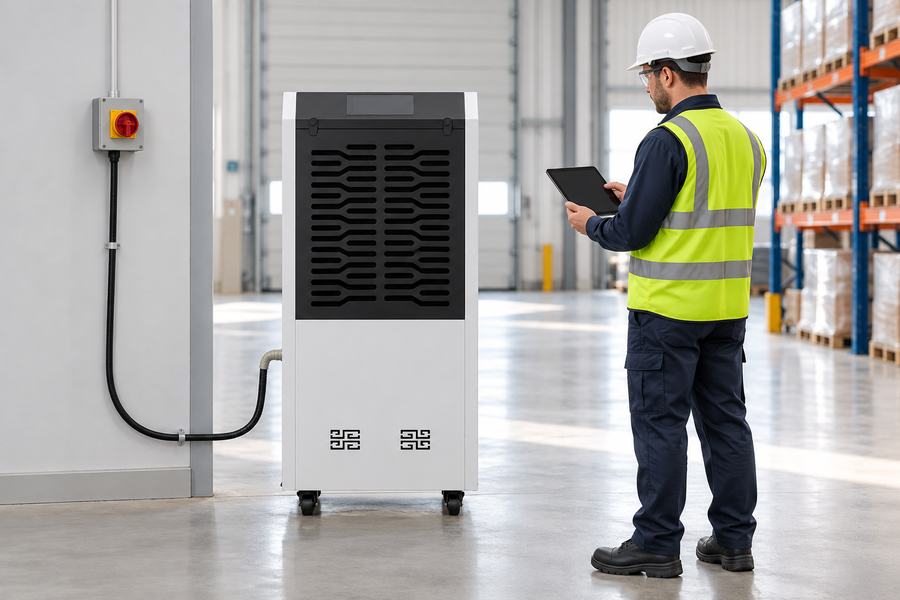
Electricity consumption is often one of the most significant long-term ownership expenses.
Industrial dehumidifiers may operate for several hours daily or continuously, depending on the facility’s humidity-control requirements.
The main factors influencing electricity costs include:
- Rated power consumption in kilowatts
- Daily operating hours
- Number of operating days annually
- Local electricity prices
- Indoor temperature and relative humidity
- Moisture load and humidity-control settings
A dehumidifier operating continuously can consume substantially more electricity annually than an identical model operating only during production hours.
Actual electricity consumption also depends on compressor cycling, fan operation, defrost cycles, and system efficiency.
Maintenance and Repair Cost
Regular maintenance helps industrial dehumidifiers maintain consistent performance and reduces the risk of unexpected failures.
Common maintenance activities include:
- Cleaning or replacing air filters
- Inspecting evaporator and condenser coils
- Checking drainage systems
- Inspecting electrical connections
- Testing humidity sensors and controllers
- Checking compressors, fans, and other mechanical components
Repair costs depend on equipment quality, operating conditions, maintenance frequency, and spare-parts availability.
Dust accumulation, corrosive exposure, and persistent moisture can shorten the appropriate interval between service visits.
Replacement and End-of-Life Cost
Industrial dehumidifiers eventually require major component replacement or complete equipment replacement.
Potential end-of-life expenses include equipment removal, refrigerant recovery where applicable, transportation, recycling, and disposal.
A ten-year evaluation period is a budgeting assumption, not a guaranteed service life. Confirm the expected life and replacement needs for the selected equipment and operating environment.
Residual or resale value can partially offset the total ownership cost.
Industrial Dehumidifier Cost Breakdown
| Cost Category | Main Expenses | Cost Frequency |
| Equipment Purchase | Dehumidifier, controls, accessories | One-time |
| Installation | Electrical work, drainage, commissioning | One-time |
| Electricity | Compressor, fans, heaters, controls | Daily |
| Maintenance | Cleaning, filters, inspections | Periodic |
| Repairs | Replacement components and labor | As needed |
| End-of-Life | Removal, recycling, disposal | Long-term |
How Much Does an Industrial Dehumidifier Cost Over Its Lifetime?
The lifetime cost of an industrial dehumidifier depends on its purchase price, energy consumption, maintenance requirements, and expected operating life.
For many facilities, the combined operating expenses over several years can exceed the original equipment investment.
Typical Initial Purchase Cost
Industrial dehumidifier prices vary widely according to capacity and application.
Two U.S. equipment listings checked on October 15, 2026 illustrate how purchase prices differ by product. These are individual USD prices, not capacity-based market ranges or WetWells quotations.
- Uline H-12683 heavy-duty dehumidifier: US$850 for one unit on Uline’s listing, with a listed extraction rating of 140 pints/day.
- Quest Hi-E Dry 195, SKU 4046400: US$4,099.95 for one unit on HVACDirect’s listing, with a listed extraction rating of 195 pints/day.
- Custom industrial systems: Obtain a project-specific quotation for the required capacity, dew point, controls, and installation scope.
Source and scope: Uline’s Heavy-Duty Dehumidifier listing and HVACDirect’s Quest Hi-E Dry 195 product listing. Installation is excluded from this comparison; confirm tax, accessories, and delivery conditions with the seller. HVACDirect advertised free shipping, while Uline specified motor freight. The extraction ratings are seller specifications and should not be treated as directly comparable without checking test conditions.
Purchase prices also vary by manufacturer, geographic market, construction materials, and control features.
Estimated Annual Operating Cost
Annual operating costs are primarily determined by electricity consumption and maintenance requirements.
For a hypothetical U.S. facility budget in USD, assume the following values. The energy rate, equipment allowances, and service costs in the worked examples are planning inputs, not quotations or current market averages. Calculations were prepared on October 15, 2026; energy charges exclude demand charges, fixed utility fees, and taxes.
- Rated electrical power: 3 kW
- Daily operating time: 10 hours
- Annual operating days: 365
- Electricity rate: $0.20/kWh
The estimated annual electricity consumption is:
3 kW × 10 hours × 365 days = 10,950 kWh
Annual electricity cost:
10,950 kWh × $0.20 = $2,190
If annual maintenance expenses are approximately $300, the estimated annual operating and maintenance cost becomes $2,490, excluding repairs.
This calculation assumes constant 3 kW consumption during all scheduled operating hours. Actual energy use may be lower when compressors cycle off or variable-speed controls reduce power demand.
Example of a 10-Year Total Cost of Ownership
A 10-year ownership calculation provides a clearer picture of the long-term financial commitment.
The following example assumes an industrial dehumidifier operating for 10 hours daily throughout the year.
| Cost Item | Estimated Cost |
| Equipment Purchase | $5,000 |
| Installation | $1,000 |
| Electricity (10 Years) | $21,900 |
| Maintenance (10 Years) | $3,000 |
| Repairs (10 Years) | $1,500 |
| 10-Year Cost Subtotal (Before Exclusions) | $32,400 |
These hypothetical USD allowances assume constant 3 kW consumption at US$0.20/kWh for 10 hours per day and 365 days per year. The US$5,000 purchase, US$1,000 installation, US$300 annual maintenance, and US$1,500 ten-year repair amounts are assumed budgeting inputs. The subtotal excludes tax, freight, demand and fixed utility charges, inflation, financing, downtime, and end-of-life costs; no residual value is credited. Add the applicable amounts to obtain a complete project TCO.
In this example, electricity represents approximately 67.6% of the total 10-year ownership cost.
The equipment purchase price represents only about 15.4% of the total.
This demonstrates why industrial buyers should evaluate energy consumption carefully rather than focusing exclusively on the initial equipment quotation.
How Do You Calculate the Total Cost of Ownership of an Industrial Dehumidifier?
Calculating total cost of ownership requires estimating all major expenses over a defined period.
A consistent calculation method allows buyers to compare different industrial dehumidifier models under equivalent operating conditions.
Industrial Dehumidifier TCO Formula
The basic formula is:
TCO = Purchase Cost + Installation Cost + Electricity Cost + Maintenance Cost + Repair Cost + End-of-Life Cost − Residual Value
Each component should be estimated over the same ownership period, typically five or ten years.
For more detailed financial evaluations, buyers can also include financing, downtime, labor, energy-price escalation, and the time value of money.
How to Calculate Electricity Costs
Electricity costs can be estimated using the following formula:
Annual Electricity Cost = Power Consumption (kW) × Daily Operating Hours × Annual Operating Days × Electricity Rate ($/kWh)
For example, consider a 5 kW industrial dehumidifier operating 12 hours per day for 300 days annually at $0.15/kWh.
Annual electricity consumption:
5 × 12 × 300 = 18,000 kWh
Annual electricity cost:
18,000 × $0.15 = $2,700
Over 10 years, the estimated electricity expense would be $27,000, assuming constant operating conditions and electricity prices.
For equipment with variable power consumption, average measured power is generally more useful than maximum rated power.
Desiccant systems may also require separate calculations for electricity, steam, gas, or other regeneration energy sources.
How to Estimate Maintenance and Repair Expenses
Maintenance costs should include routine servicing, replacement consumables, and expected component repairs.
For budgeting purposes, buyers can estimate maintenance using:
- Manufacturer-recommended service intervals
- Historical maintenance records
- Replacement filter and component prices
- Local technician labor rates
- Operating environment and equipment workload
For example, a facility budgeting $300 annually for preventive maintenance would allocate $3,000 over 10 years.
Additional repair allowances should be included separately to avoid underestimating lifetime expenses.
How to Compare TCO Across Different Models
When comparing industrial dehumidifiers, all calculations should use consistent assumptions.
These include identical operating hours, electricity prices, ownership periods, and moisture-removal requirements.
Equipment should also be compared at equivalent temperature and relative humidity conditions.
A dehumidifier with lower electrical power consumption is not automatically more efficient if it removes significantly less moisture.
For accurate comparisons, buyers should evaluate energy consumption relative to actual moisture-removal performance.
Why Do Industrial Dehumidifier Ownership Budgets Differ?
Several technical and environmental factors influence industrial dehumidifier ownership costs.
Evaluating these conditions before buying helps prevent wasted electricity and replacement purchases that better planning could avoid.
Dehumidification Capacity and Equipment Sizing
Selecting the correct dehumidification capacity is essential for controlling long-term expenses.
An oversized industrial dehumidifier may involve unnecessary equipment investment and inefficient operation, depending on its controls and operating characteristics.
An undersized dehumidifier may operate continuously without achieving the required humidity level.
Proper sizing should consider:
- Facility floor area and ceiling height
- Outdoor air infiltration
- Indoor temperature and relative humidity
- Moisture generated by industrial processes
- Required humidity setpoint
- Ventilation and air exchange rates
Moisture-load calculations are generally more reliable than selecting equipment based only on floor area.
Moisture Removal per Unit of Energy
For an equivalent drying duty, needing fewer kilowatt-hours reduces the electricity bill.
For refrigerant dehumidifiers, efficiency is commonly evaluated using moisture removal per unit of electricity consumed, such as liters per kilowatt-hour (L/kWh).
Higher moisture removal per kWh generally indicates better energy performance under comparable conditions.
For example, if two dehumidifiers remove the same amount of moisture but one consumes 20% less electricity, the more efficient model can generate substantial savings over several years.
However, efficiency ratings must be compared at the same temperature, humidity, and test conditions.
Operating Temperature and Humidity
Ambient conditions significantly influence dehumidifier performance.
Refrigerant dehumidifiers generally perform well in moderate-to-warm environments where condensation-based moisture removal is effective.
At lower temperatures, evaporator frosting and defrost cycles can reduce effective moisture-removal performance.
Desiccant dehumidifiers can be more suitable for low-temperature or very low-humidity applications, although regeneration energy must be considered.
Maintaining unnecessarily low humidity levels can also increase energy consumption.
Daily Operating Hours
Operating schedules strongly influence lifetime electricity expenses.
A dehumidifier running 24 hours daily accumulates more operating hours than one used only during production shifts.
For example:
- 8 hours daily: 2,920 operating hours annually
- 12 hours daily: 4,380 operating hours annually
- 24 hours daily: 8,760 operating hours annually
These calculations assume 365 operating days per year.
Continuous operation may be necessary for warehouses, pharmaceutical facilities, food processing plants, and other moisture-sensitive environments.
However, facilities with variable humidity loads may reduce electricity consumption through automatic humidity control and optimized scheduling.
Equipment Quality and Service Life
Equipment durability affects both repair expenses and replacement frequency.
Industrial dehumidifiers designed with reliable compressors, corrosion-resistant components, and accessible service panels may offer lower maintenance requirements in suitable applications.
Important quality considerations include:
- Compressor and fan reliability
- Heat exchanger construction
- Electrical component protection
- Sensor accuracy
- Spare-parts availability
- Manufacturer warranty and technical support
A longer equipment lifespan can spread the initial investment across more years, provided maintenance and energy expenses remain reasonable.
Refrigerant vs. Desiccant Industrial Dehumidifiers: Which Has a Lower TCO?
Refrigerant and desiccant industrial dehumidifiers have different operating principles, which influence their purchase prices, energy requirements, and maintenance expenses.
Compare refrigerant and desiccant proposals against the same inlet temperature, moisture load, and target dew point; those requirements determine which system offers a workable lifetime budget.
Refrigerant Industrial Dehumidifiers
Refrigerant dehumidifiers remove moisture by cooling humid air below its dew point, allowing water vapor to condense.
Their main energy consumers are compressors, fans, and associated electrical components.
These systems are often economical for general industrial humidity control in moderate-to-warm environments.
Typical applications include:
- Warehouses and storage facilities
- Manufacturing workshops
- Commercial buildings
- General industrial moisture control
Refrigerant systems often have lower initial costs than specialized desiccant systems with comparable application requirements.
A cold inlet air stream or a very demanding humidity target can limit the useful drying output of a refrigerant unit.
Desiccant Industrial Dehumidifiers
Desiccant dehumidifiers use moisture-sorbing materials to remove water vapor from the air.
Many industrial desiccant systems use rotating desiccant wheels that require thermal regeneration.
Regeneration energy can come from electricity, steam, gas, or available waste heat.
These systems are particularly useful in applications requiring low dew points or reliable moisture removal at low temperatures.
Typical applications include:
- Pharmaceutical manufacturing
- Battery production
- Cold storage facilities
- Electronics manufacturing
- Low-humidity production environments
Although desiccant systems may involve higher initial and operating costs, they can provide better application performance where refrigerant systems cannot efficiently achieve the required conditions.
Refrigerant vs. Desiccant TCO Comparison
| Comparison Factor | Refrigerant Dehumidifier | Desiccant Dehumidifier |
| Initial Investment | Generally lower | Generally higher |
| Main Energy Consumption | Compressor and fans | Regeneration heat and fans |
| Suitable Temperature | Moderate to warm | Broad range, including low temperatures |
| Low-Humidity Performance | More limited | Strong |
| Maintenance Focus | Coils, filters, refrigeration components | Rotor, heaters, filters, seals |
| Typical Cost Advantage | General humidity control | Specialized low-dew-point applications |
| Main TCO Consideration | Electricity efficiency | Regeneration energy and heat recovery |
For industrial buyers, the correct technology should be selected according to actual environmental requirements rather than purchase price alone.
Which Operating Changes Can Lower Lifetime Dehumidification Spending?
Reducing ownership costs requires a combination of appropriate equipment selection, efficient operation, and preventive maintenance.
Several practical strategies can lower electricity consumption and extend equipment service life.
Choose the Right Dehumidification Capacity
Accurate equipment sizing prevents unnecessary investment and operating inefficiencies.
Before purchasing, facilities should calculate their moisture loads and determine the required dehumidification capacity under actual operating conditions.
Avoid selecting equipment solely based on the maximum advertised moisture-removal capacity.
Manufacturers may rate dehumidifiers under different temperature and humidity conditions, making direct comparisons misleading.
Select an Energy-Efficient Model
Energy-efficient equipment can reduce lifetime electricity expenses.
Industrial buyers should compare:
- Moisture removal per kWh
- Rated and average power consumption
- Compressor efficiency
- Fan motor efficiency
- Variable-speed capabilities
- Automatic humidity controls
Even relatively small improvements in energy efficiency can produce meaningful savings in facilities with long operating hours.
For continuous industrial applications, energy performance should be a major purchasing criterion.
Optimize Humidity Settings and Operating Schedules
Humidity setpoints directly influence dehumidifier operating time.
Setting humidity lower than necessary may increase electricity consumption without providing additional operational benefits.
Facilities should establish humidity targets according to actual product, process, and storage requirements.
A humidity controller can stop the drying cycle once its setpoint is satisfied, avoiding operation when no further moisture removal is needed.
Programmable schedules and building management system integration may provide further savings where operating conditions permit.
Perform Regular Preventive Maintenance
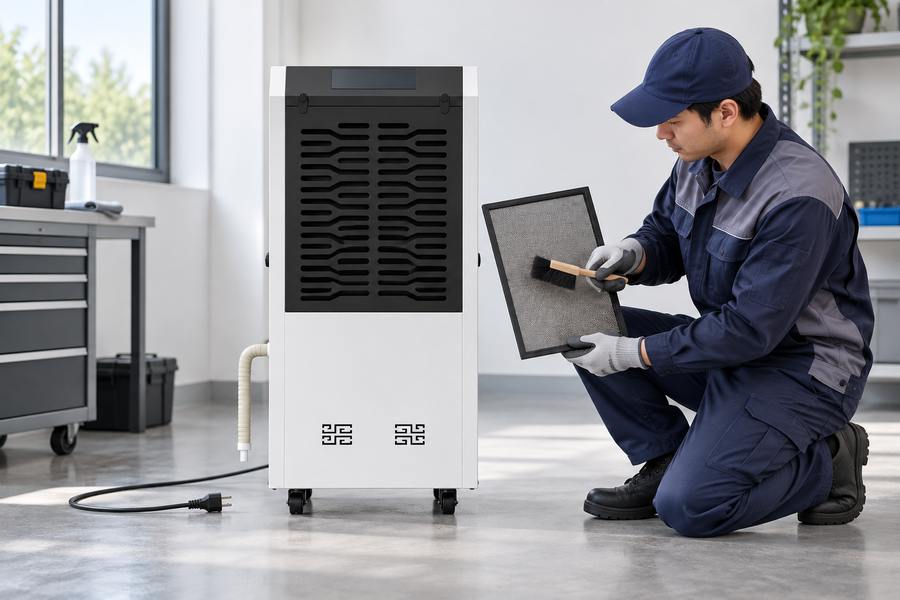
Preventive maintenance helps maintain airflow, heat transfer, and equipment reliability.
Dust on filter media or coil surfaces can obstruct the air path and leave the unit removing less moisture.
Blocked drainage systems may cause water leakage or automatic shutdowns.
Use the equipment manual to set inspection intervals and define the cleaning and functional checks required at each visit.
Early identification of mechanical or electrical problems can prevent more expensive failures and production interruptions.
Improve Facility Moisture Control
Reducing the moisture entering a facility can lower the workload placed on industrial dehumidifiers.
Practical measures include:
- Sealing unnecessary air leaks
- Repairing water leaks
- Improving door and window sealing
- Controlling humid outdoor air infiltration
- Managing moisture generated by production processes
- Improving insulation where condensation is a problem
Facilities with frequently opened loading doors may benefit from air curtains, vestibules, or operational changes that reduce humid air entry.
Lower moisture loads can reduce operating hours and improve overall system efficiency.
How Do You Choose an Industrial Dehumidifier with the Lowest Long-Term Cost?
Selecting an industrial dehumidifier requires evaluating both technical performance and financial considerations.
The lowest-priced equipment is not necessarily the most economical option over five or ten years.
Verify Actual Moisture-Removal Capacity
Industrial buyers should confirm dehumidification capacity under the facility’s expected operating conditions.
Performance ratings measured at high temperature and humidity may not represent actual moisture removal in cooler or drier environments.
Requesting performance data at relevant operating conditions helps prevent oversizing, undersizing, and unexpected operating expenses.
For accurate equipment selection, buyers should provide manufacturers with the following information:
- Required indoor temperature and relative humidity
- Facility dimensions and air volume
- Existing ventilation conditions
- Estimated daily moisture load
- Daily operating hours
- Available electrical power supply
These details help manufacturers recommend equipment that meets the required humidity conditions without excessive energy consumption.
Compare Purchase and Installation Costs
Equipment quotations should include all necessary components and installation requirements.
A cheaper unit can lose its upfront advantage once the budget includes new wiring, condensate handling, or air-distribution work.
Buyers should request detailed quotations covering:
- Industrial dehumidifier purchase price
- Optional accessories and control systems
- Electrical and drainage requirements
- Installation and commissioning expenses
- Shipping and delivery costs
Comparing complete installed costs provides a more accurate financial assessment than comparing equipment prices alone.
Evaluate Energy Consumption and Operating Efficiency
Electricity expenses should be calculated using realistic operating conditions rather than relying exclusively on rated power.
Buyers should request information about:
- Rated electrical power consumption
- Expected average power consumption
- Moisture removal per kilowatt-hour
- Energy consumption at different humidity levels
- Automatic control and energy-saving functions
For industrial facilities operating continuously, even modest energy efficiency improvements can produce substantial long-term savings.
Check Maintenance Requirements and Spare Parts
Maintenance costs depend on equipment design, accessibility, and replacement component availability.
Before purchasing, buyers should evaluate the recommended maintenance schedule and identify components that may require periodic replacement.
Equipment with accessible filters, reliable components, and readily available spare parts can help reduce service labor and unexpected downtime.
Manufacturers offering technical documentation and responsive after-sales support may also help facilities control maintenance expenses.
Review Warranty Coverage and Expected Lifespan
Warranty terms can affect the financial risks associated with equipment ownership.
Industrial buyers should review:
- Warranty duration
- Covered components
- Compressor warranty conditions
- Exclusions related to operating conditions
- Technical support availability
- Replacement parts policies
A longer warranty does not automatically guarantee a longer equipment lifespan, but comprehensive coverage can reduce certain repair expenses during the warranty period.
Compare Five-Year and Ten-Year Ownership Costs
A five-year comparison is useful for facilities with shorter investment cycles, while a ten-year calculation provides a broader view of long-term expenses.
Both evaluations should consider purchase price, installation, electricity consumption, maintenance, and anticipated repairs.
When comparing multiple models, buyers should use consistent assumptions regarding operating hours, electricity prices, and moisture-removal requirements.
This approach helps identify equipment that offers the best balance between performance, reliability, and financial efficiency.
Is an Energy-Efficient Industrial Dehumidifier Worth the Higher Initial Cost?
An energy-efficient industrial dehumidifier can justify a higher purchase price when lifetime electricity savings exceed the additional investment.
However, the financial advantage depends on equipment efficiency, daily operating hours, electricity prices, and the required moisture-removal capacity.
Initial Price vs. Lifetime Savings
For a hypothetical USD comparison, assume two industrial dehumidifiers provide the same moisture removal under identical conditions. The prices and power draws below are assumed inputs, not product quotations.
- Model A: Purchase price of $5,000 and average power consumption of 4 kW.
- Model B: Purchase price of $6,500 and average power consumption of 3 kW.
Assume both models operate 12 hours daily for 300 days annually, with electricity priced at $0.15/kWh.
Model A annual electricity cost:
4 × 12 × 300 × $0.15 = $2,160
Model B annual electricity cost:
3 × 12 × 300 × $0.15 = $1,620
The annual electricity savings from Model B would be:
$2,160 − $1,620 = $540
Over ten years, Model B could save approximately $5,400 in electricity expenses.
After subtracting its $1,500 higher initial purchase price, the net savings would be approximately $3,900.
This example assumes identical moisture-removal performance, installation costs, maintenance requirements, and equipment lifespan, with constant energy prices.
How to Calculate the Payback Period
The payback period indicates how long it takes for operating cost savings to recover the additional initial investment.
The formula is:
Payback Period = Additional Initial Investment ÷ Annual Operating Cost Savings
Using the previous example:
$1,500 ÷ $540 = 2.78 years
Model B would recover its higher purchase price in approximately 2.8 years through electricity savings alone.
Once the price premium has been recovered, further reductions in the electricity bill improve the lifetime cost comparison.
Simple payback calculations do not account for financing costs, inflation, equipment degradation, or the time value of money. For major industrial investments, a discounted cash flow or net present value analysis can provide a more complete financial comparison.
When a Higher-Priced Model Makes Financial Sense
Higher-efficiency industrial dehumidifiers are particularly attractive in facilities with intensive humidity-control requirements.
Continuous Industrial Operations
Facilities operating dehumidifiers 24 hours daily accumulate more operating hours, increasing the value of energy efficiency improvements.
High Electricity Prices
When electricity rates are high, reducing power consumption delivers greater annual cost savings.
Long Equipment Service Life
A longer ownership period gives facilities more time to recover higher initial investments through reduced operating expenses.
Strict Humidity-Control Requirements
Facilities requiring stable humidity levels may benefit from advanced controls, reliable components, and efficient operation under changing environmental conditions.
Large-Scale Dehumidification Applications
In facilities using multiple industrial dehumidifiers, relatively small efficiency improvements per unit can generate significant cumulative savings.
Ultimately, the most cost-effective industrial dehumidifier is not necessarily the model with the lowest purchase price, but the one that reliably meets humidity-control requirements at the lowest total lifetime cost. Proper sizing, efficient operation, preventive maintenance, and realistic TCO calculations help industrial buyers make better long-term equipment investments.