
High indoor humidity can cause discomfort, condensation, musty odors, mold, and moisture damage. Homeowners typically choose between portable and whole-house dehumidifiers. Portable units suit individual rooms, while whole-house systems provide more consistent humidity control across multiple areas of the home.
What Is a Whole-House Dehumidifier?
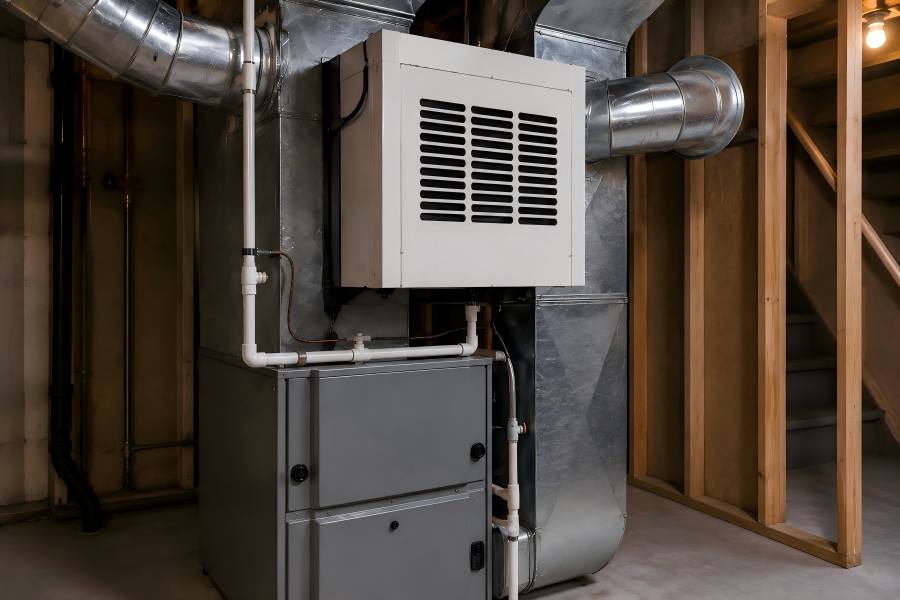
A whole-house dehumidifier regulates humidity throughout multiple rooms or the entire home. It typically connects to the existing HVAC ductwork or a dedicated air distribution system.
Humid air enters the dehumidifier, where moisture is condensed and drained away. The drier air is then distributed to different areas of the home through the ductwork.
Common installation locations include:
- Basements
- Mechanical rooms
- Utility rooms
- Attics
- Crawl spaces
- Dedicated HVAC areas
Whole-house systems are especially useful for larger homes, multi-story properties, and houses in consistently humid climates.
Because the system serves several areas at once, homeowners can maintain a more stable indoor humidity level without operating separate appliances in every room.
What Is a Portable Dehumidifier?
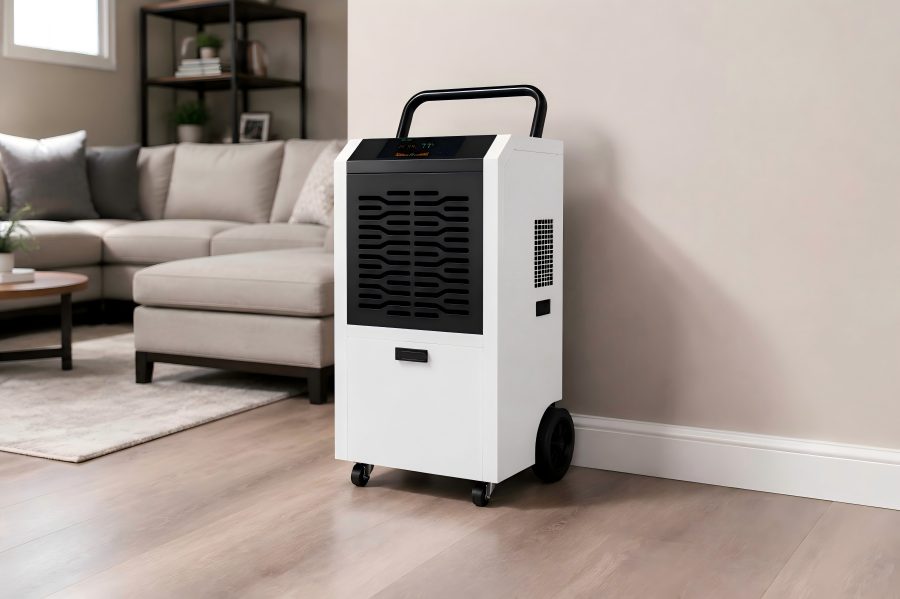
A portable dehumidifier is a standalone unit designed to control humidity in a single room or small residential area.
It draws humid air into the unit, cools the air to condense moisture, collects or drains the water, and releases drier air back into the room.
Portable dehumidifiers are commonly used in:
- Bedrooms
- Bathrooms
- Laundry rooms
- Basements
- Home offices
- Small apartments
Most units include a water tank, washable filter, built-in humidistat, and continuous drainage connection. Some models also include a condensate pump.
Their main advantage is flexibility. They can normally be installed without changing ductwork and moved between rooms when moisture conditions change.
Whole-House vs. Portable Dehumidifiers: Key Differences
Both systems remove excess moisture, but they are designed for different residential conditions and coverage requirements.
| Feature | Whole-House Dehumidifier | Portable Dehumidifier |
| Coverage | Multiple rooms or entire home | Individual room or zone |
| Installation | Usually requires ductwork | Plug-and-play |
| Humidity Control | Centralized | Localized |
| Drainage | Usually continuous | Tank or drain hose |
| Noise | Unit can be away from living spaces | Operates inside the room |
| Initial Cost | Higher | Lower |
| Maintenance | One central system | Each unit maintained separately |
| Portability | Fixed | Easy to move |
The biggest difference is coverage. A portable unit may work very well in one basement room but have little effect on bedrooms located farther away.
A whole-house system distributes conditioned air through several areas, making it more suitable when high humidity is a problem throughout the home.
Which Option Works Best for Different Home Sizes?
The size of the home is an important consideration, but moisture levels also matter. A small, very damp basement can require more dehumidification than a larger but relatively dry living space.
Small Apartments and Single Rooms
Portable dehumidifiers are usually the most practical choice for small apartments, bedrooms, bathrooms, and individual moisture problem areas.
Their main advantages include:
- Lower purchase cost
- Simple installation
- Easy relocation
- No duct modification
- Convenient seasonal use
If condensation mainly appears in one bedroom or laundry area, a portable unit may provide enough moisture control without installing a central system.
Medium-Sized Homes
For medium-sized homes, the best option depends on how many areas are affected. One or two portable units may still be practical when moisture is limited to specific rooms.
If humidity appears in several rooms, managing multiple portable units can become inconvenient. Each unit requires separate drainage, cleaning, filter maintenance, and humidity adjustment.
At this point, a whole-house system may provide simpler and more consistent humidity control.
Large or Multi-Story Homes
Whole-house dehumidifiers are generally better suited to large or multi-story homes where excess humidity is widespread.
A central system can serve multiple rooms and floors while reducing the need to place separate appliances throughout the house.
Homes with existing central HVAC ductwork are especially suitable because the dehumidifier can often be integrated into the existing air distribution system.
Compare Dehumidification Capacity
Dehumidification capacity describes how much moisture a unit can remove from the air over a certain period. It is commonly measured in liters per day or pints per day.
Actual moisture removal varies with temperature and humidity. A dehumidifier generally removes more water from warm, humid air than from cool, relatively dry air.
Typical residential capacity ranges include:
- 20–30 L/day: small rooms and apartments
- 31–50 L/day: medium residential areas
- 50+ L/day: large basements and larger homes
These values are useful references, but capacity should not be selected only according to floor area.
A basement with high moisture infiltration, poor ventilation, or frequent condensation may need significantly more capacity than a similarly sized living room.
Avoid Undersizing
An undersized dehumidifier may operate for long periods without reaching the required humidity level.
This can result in:
- Longer operating time
- Higher energy consumption
- Faster component wear
- Poor humidity control
- Persistent condensation
If a unit runs almost continuously but the room still feels damp, insufficient capacity may be one of the reasons.
Avoid Excessive Oversizing
A much larger dehumidifier is not always necessary. Excessive capacity can increase the initial purchase cost without providing meaningful benefits in a small or moderately humid space.
The better approach is to match capacity with the actual moisture load, room volume, temperature, airflow, and target RH.
Installation Requirements
Installation is one of the clearest differences between whole-house and portable systems.
A portable dehumidifier can normally be used almost immediately, while a whole-house system often requires more planning and professional installation.
Whole-House Dehumidifier Installation
Whole-house systems may require:
- Supply and return ducts
- Electrical connections
- Condensate drainage
- HVAC integration
- Control wiring
- Service access
Correct airflow is especially important. Poor duct design can reduce dehumidification efficiency and create uneven humidity levels between rooms.
A permanent drainage connection is also recommended because larger units can remove significant amounts of water during humid weather.
Portable Dehumidifier Installation
Portable units require much less preparation. In most cases, the homeowner simply places the unit in the target area and connects it to an electrical outlet.
Basic installation involves:
- Place the unit on a stable surface.
- Keep the air inlet and outlet clear.
- Connect the power supply.
- Set the required humidity level.
- Use the tank or connect a drain hose.
For long-term operation, continuous drainage is usually more convenient than manually emptying the water tank.
A drain hose can often send water directly to a floor drain. Models with condensate pumps are useful when gravity drainage is not possible.
Humidity Control and Comfort
For many homes, maintaining indoor humidity at approximately 30–50% RH provides a comfortable balance between excessive moisture and overly dry air.
When indoor humidity stays too high, homeowners may notice condensation, damp fabrics, musty smells, swelling wood, or mold developing in poorly ventilated areas.
The purpose is not to eliminate as much moisture as possible. Good dehumidification should keep humidity within a stable and appropriate range.
Whole-House Humidity Control
Whole-house systems provide centralized humidity management. A humidistat can automatically start or stop the dehumidifier according to the selected RH setting.
Because conditioned air moves through several rooms, humidity levels can remain more consistent throughout the property.
This is particularly useful when humidity is high in bedrooms, living areas, hallways, and basements at the same time.
Portable Humidity Control
Portable units also use built-in humidistats, but their effect is mainly limited to the room where they are installed.
Closed doors, walls, stairs, and limited air circulation can prevent one portable unit from controlling humidity evenly throughout an entire house.
For example, a unit operating in a downstairs hallway may have little effect on an upstairs bedroom when the bedroom door remains closed.
Noise: Which One Is Better for Living Spaces?
Noise matters in bedrooms, home offices, reading rooms, and other quiet residential environments.
Portable compressor dehumidifiers produce sound from both the fan and compressor. Some vibration and airflow noise are therefore unavoidable.
For quiet residential spaces, homeowners may prefer models operating around 40–50 dB(A) or lower, depending on unit size and operating mode.
Noise can become more noticeable when the dehumidifier is positioned directly beside a bed, desk, or sofa.
Whole-house systems have an advantage because the main equipment can often be installed in a basement, utility room, attic, or mechanical area.
This keeps most compressor and fan noise away from occupied spaces, leaving mainly airflow noise through the supply and return vents.
Energy Efficiency and Operating Cost
Energy use depends on dehumidification capacity, indoor humidity, temperature, daily operating hours, equipment efficiency, and the selected humidity setting.
A portable dehumidifier can be economical when only one room requires moisture control because there is no need to dehumidify the entire house.
However, the total operating cost can increase when several portable units are needed at the same time.
For example, suppose three portable dehumidifiers each consume 500 W and operate for eight hours per day.
500 W × 3 × 8 hours = 12 kWh/day
Over 30 days:
12 kWh × 30 = 360 kWh/month
At an electricity price of $0.15/kWh, the approximate monthly electricity cost would be:
360 × $0.15 = $54/month
This does not mean that every whole-house dehumidifier will automatically cost less. Actual consumption depends on system capacity, efficiency, operating time, and the home’s moisture load.
However, the example shows why comparing one portable unit with one whole-house unit does not always provide a complete picture.
Modern residential dehumidifiers may improve efficiency through:
- Automatic humidistats
- Smart compressor cycling
- Variable fan operation
- Programmable controls
- Remote monitoring
These functions help reduce unnecessary operation after the required humidity level has been reached.
Drainage and Maintenance
Both types of dehumidifiers need regular maintenance. The main difference is whether maintenance is spread across several small units or concentrated in one central system.
Portable Dehumidifier Maintenance
Common tasks include:
- Emptying and cleaning the water tank
- Cleaning washable filters
- Inspecting drainage hoses
- Checking the condensate pump
- Cleaning air inlets and outlets
If continuous drainage is not installed, the tank may need frequent emptying during very humid weather.
A dirty air filter can also restrict airflow, reducing moisture removal and forcing the dehumidifier to run longer.
Whole-House Dehumidifier Maintenance
Typical maintenance includes:
- Cleaning or replacing filters
- Checking drainage lines
- Inspecting coils
- Checking duct connections
- Confirming correct airflow
- Inspecting electrical components
Maintenance is more centralized because there is usually only one main dehumidification system.
However, ductwork, controls, electrical parts, or refrigerant-system problems may require inspection by an HVAC technician.
When Should You Choose a Portable Dehumidifier?
A portable dehumidifier is generally better when the moisture problem is limited to a specific room or smaller area.
Choose a portable unit when:
- Only one or two rooms are humid
- You live in a rented property
- Permanent installation is not possible
- Your initial budget is limited
- Humidity problems are seasonal
- Flexible placement is important
For example, a damp laundry room or small basement usually does not justify installing a whole-house system if the rest of the home remains within a normal RH range.
Portable units are also useful when homeowners need a quick solution without making changes to the HVAC or duct system.
They can be moved as conditions change, making them practical for seasonal moisture problems.
When Should You Choose a Whole-House Dehumidifier?
Whole-house dehumidification is more suitable when high humidity is widespread, persistent, or difficult to manage with individual appliances.
Consider a whole-house system when:
- Several rooms remain humid
- Multiple portable units are required
- Suitable ductwork is available
- Centralized RH control is preferred
- Condensation is a recurring problem
- Long-term humidity control is needed
For homes in consistently humid climates, centralized dehumidification can be easier to manage than moving or maintaining several portable appliances.
It also provides a cleaner installation because equipment does not need to occupy floor space in bedrooms, hallways, living rooms, or other occupied areas.
Can You Use Both Systems Together?
Yes. A whole-house dehumidifier and a portable unit can work together when one part of the home has a much higher moisture load than the rest.
For example, a whole-house unit may maintain general indoor humidity around 45–50% RH, while a basement laundry room still experiences additional moisture.
A portable dehumidifier can provide extra capacity in that specific area without forcing the central system to handle the entire localized moisture load.
This approach can also work well in finished basements, storage rooms, workshops, or other spaces that receive less conditioned airflow from the central HVAC system.
The two systems serve different purposes: one provides general humidity control, while the other handles a specific moisture problem.
Selecting the Right Dehumidifier for Your Home
Before choosing a system, evaluate the actual conditions inside your home instead of relying only on room size.
Several factors can help determine whether a portable or whole-house dehumidifier is the better choice.
1. Measure Indoor Humidity
Use a hygrometer to measure RH in several parts of the home over a few days.
Check areas such as the basement, bedrooms, bathrooms, and living spaces because humidity can vary significantly from one room to another.
If only one room consistently records high humidity, localized dehumidification may be enough.
2. Identify the Moisture Source
A dehumidifier removes moisture from the air, but it cannot repair a leaking pipe, roof, foundation, or other source of water intrusion.
Check for common moisture sources such as:
- Plumbing or roof leaks
- Foundation seepage
- Poor bathroom ventilation
- Indoor clothes drying
- Crawl-space moisture
- Persistent condensation
Serious water intrusion should be repaired before relying on a dehumidifier as the main solution.
3. Determine How Many Rooms Are Affected
If only one area has a humidity problem, a portable unit is usually more practical.
If several rooms consistently remain above the desired RH level, centralized dehumidification may provide better control.
Home layout also matters because closed doors and separate floors can limit the effectiveness of a portable unit.
4. Select the Right Capacity
Consider room volume, starting RH, target RH, temperature, air leakage, and moisture generation.
Do not select capacity based only on square footage, particularly for basements and other high-moisture environments.
A properly sized unit should be able to reach the required humidity without operating continuously under normal conditions.
5. Check Drainage Availability
Continuous drainage makes long-term operation much easier and reduces the need to manually empty water tanks.
Whole-house systems normally use permanent drainage, while portable units may use a tank, gravity drain hose, or condensate pump.
If there is no suitable floor drain nearby, a portable unit with a pump can offer more installation flexibility.
6. Consider Existing HVAC and Ductwork
Homes with central ductwork are generally easier to equip with a whole-house dehumidifier.
For homes without ductwork, installing a centralized system may require additional construction and increase the initial cost.
In these cases, portable units may provide a simpler solution.
7. Compare Noise, Cost, and Maintenance
Purchase price is only one part of the total cost of owning a dehumidifier.
Also consider energy consumption, maintenance frequency, drainage, filter replacement, noise level, and the number of units required.
One inexpensive portable unit may be economical, while several continuously operating units can make a centralized solution more attractive.