
Choosing the right power supply is essential when purchasing an industrial dehumidifier. The voltage must match your facility’s electrical system while supporting the equipment’s operating requirements.
Among 110V, 220V, and 380V industrial dehumidifiers, each configuration offers different advantages. Understanding these differences helps businesses avoid installation problems, unnecessary costs, and equipment compatibility issues.
Understanding Industrial Dehumidifier Power Supply Requirements
Industrial dehumidifiers are available in different voltage configurations to accommodate various electrical systems and operational requirements. Before selecting equipment, buyers should understand how voltage, electrical phases, and power consumption affect installation and operation.
Interpreting the Voltage Rating
Voltage refers to the electrical potential supplied to operate the dehumidifier’s compressor, fan motors, control system, and other electrical components.
Common voltage configurations include:
- 110V: Generally associated with smaller portable and light-duty dehumidifiers. In North America, the standard nominal supply is typically 120V.
- 220V: Widely used for commercial and medium-capacity industrial dehumidifiers. Depending on the market, nominal supplies may be 220V, 230V, or 240V.
- 380V: Commonly used for larger industrial dehumidifiers operating on three-phase electrical systems, particularly in China and certain international markets.
The supply voltage is one of the quantities used to calculate current for a specified electrical load.
For example, at the same input power and power factor, a higher supply voltage generally allows equipment to draw less current. However, voltage alone does not determine moisture removal capacity or energy efficiency.
Single-Phase vs. Three-Phase Power Supply
Industrial dehumidifiers commonly operate using either single-phase or three-phase electricity.
Single-Phase Power Supply
Single-phase electricity is commonly available in residential buildings, small workshops, offices, and many commercial facilities.
Its characteristics include:
- Relatively straightforward installation where suitable circuits already exist.
- Common availability at 110–120V and 220–240V.
- Compatibility with many portable and medium-capacity dehumidifiers.
- Potential limitations when supplying high-power equipment.
Three-Phase Power Supply
Three-phase electricity is frequently used in factories, large warehouses, and industrial production facilities.
Its advantages include:
- Supporting higher electrical loads.
- Providing a practical power supply for large compressors and industrial motors.
- Distributing electrical loads across three phases.
- Accommodating continuous industrial operations.
Three-phase supplies are available at multiple voltages, including 220V, 380V, 400V, 415V, and 480V, depending on the electrical system.
For facilities requiring large-capacity dehumidification, three-phase equipment is often a practical choice.
110V Industrial Dehumidifiers
110V industrial dehumidifiers are generally suitable for small-scale moisture control applications where portable equipment and relatively low electrical power requirements are important.
In markets such as the United States and Canada, equipment advertised as 110V may actually be designed for nominal 115V or 120V operation. Buyers should always check the manufacturer’s rated voltage range.
Key Features of 110V Industrial Dehumidifiers
110V dehumidifiers are commonly associated with compact equipment designed for localized humidity control.
Typical characteristics include:
- Single-phase electrical operation.
- Compact or portable equipment designs.
- Relatively low input power compared with large industrial systems.
- Convenient positioning in smaller facilities.
- Compatibility with appropriately rated electrical circuits.
These units may include automatic humidity control, continuous drainage connections, defrost functions, and portable wheels.
Advantages of 110V Industrial Dehumidifiers
Convenient Installation
Where a compatible electrical circuit is available, installation can be relatively straightforward. Many smaller models do not require extensive electrical infrastructure upgrades.
Good Portability
110V dehumidifiers are often designed for applications requiring frequent movement between rooms or work areas.
Suitable for Localized Moisture Control
They can provide effective humidity management in relatively small enclosed spaces without requiring a centralized system.
Lower Initial Installation Complexity
Compared with large three-phase equipment, smaller 110V units may involve fewer electrical installation requirements.
Limitations of 110V Industrial Dehumidifiers
The main limitation is the amount of electrical power that can be supplied through typical branch circuits.
For a given input power, a 110–120V appliance generally requires more current than a comparable 220–240V single-phase appliance.
Other limitations include:
- Smaller practical equipment capacities in common portable product ranges.
- Limited suitability for large, continuously operating industrial systems.
- Potential circuit overloading if electrical capacity is insufficient.
- Reduced suitability for centralized moisture control across extensive facilities.
Typical Applications
110V industrial dehumidifiers are commonly suitable for:
- Small warehouses and storage rooms.
- Workshops and maintenance areas.
- Equipment storage facilities.
- Small commercial premises.
- Localized moisture control during restoration work.
For larger facilities, multiple small dehumidifiers may be needed. However, operating several units can increase maintenance requirements and complicate humidity management.
220V Industrial Dehumidifiers
220V industrial dehumidifiers provide a practical option for businesses requiring more moisture removal capacity than typical light-duty portable equipment.
Warehouse operators and workshop buyers will encounter many models in this supply range.
Key Features of 220V Industrial Dehumidifiers
220V dehumidifiers are available in various equipment configurations, including portable, floor-standing, and ducted systems.
Common characteristics include:
- Single-phase configurations, with some equipment designed for three-phase operation.
- A broad range of available moisture removal capacities.
- Compatibility with many commercial electrical installations.
- Support for larger compressors and motors than are practical on typical low-current 110V circuits.
- Suitability for fixed or portable installation, depending on equipment design.
A 220V dehumidifier can be appropriate for facilities that require continuous humidity management without investing in a larger three-phase system.
Advantages of 220V Industrial Dehumidifiers
Wide Range of Equipment Choices
Manufacturers offer many commercial and industrial dehumidifiers in the 220–240V category.
Suitable for Medium-Capacity Applications
These systems can handle substantial moisture loads in warehouses, production areas, and commercial facilities.
Lower Current at Equivalent Single-Phase Power
Compared with 110V equipment, a 220V single-phase system generally draws less current when supplying the same real power at the same power factor.
Flexible Installation Options
Depending on the model, 220V dehumidifiers can be installed as standalone units, ducted systems, or components of a larger humidity control solution.
Limitations of 220V Industrial Dehumidifiers
Despite their versatility, 220V systems have several considerations:
- Dedicated electrical circuits may be necessary.
- High-capacity models can still draw substantial electrical current.
- Three-phase and single-phase versions are not interchangeable.
- A nominal 220V rating does not automatically guarantee compatibility with every 230V or 240V supply.
Buyers should verify the equipment nameplate and installation specifications before purchasing.
Typical Applications
220V industrial dehumidifiers are widely used in:
- Medium-sized warehouses.
- Manufacturing workshops.
- Food processing and packaging areas.
- Commercial storage facilities.
- Printing and packaging facilities.
- Industrial equipment storage rooms.
For businesses operating in existing commercial buildings, 220V equipment can offer a practical balance between equipment capacity and installation requirements.
380V Industrial Dehumidifiers
380V industrial dehumidifiers are commonly designed for high-capacity applications where large moisture loads and continuous operation require substantial electrical power.
Most conventional 380V industrial dehumidifiers operate on three-phase electricity.
Key Features of 380V Industrial Dehumidifiers
380V industrial dehumidifiers commonly incorporate larger compressors, industrial fan motors, and controls designed for demanding operating environments.
Their key characteristics include:
- Three-phase electrical operation.
- High-capacity moisture removal configurations.
- Suitability for continuous industrial operation.
- Compatibility with centralized or ducted dehumidification systems.
- Installation in facilities with suitable industrial electrical infrastructure.
Some large industrial dehumidifiers also support customized electrical configurations to meet different market requirements.
Advantages of 380V Industrial Dehumidifiers
Suitable for High Electrical Loads
Three-phase 380V systems can support large-capacity dehumidification equipment without the high current that an equivalent single-phase configuration would require.
Practical for Large Industrial Facilities
Factories, warehouses, and processing plants often have electrical distribution systems designed for industrial machinery.
Appropriate for Centralized Installations
High-capacity dehumidifiers may supply conditioned air to multiple areas through ductwork, reducing the need for numerous standalone units.
Supports Continuous Operation
Industrial three-phase equipment can be configured for long operating schedules, provided its components and controls are rated for the required duty.
Limitations of 380V Industrial Dehumidifiers
The main limitation is electrical infrastructure compatibility.
Important considerations include:
- A compatible three-phase power supply is generally required.
- Installation may require specialized electrical protection and wiring.
- Electrical infrastructure upgrades can increase project costs.
- Equipment may be larger and less portable.
- A 380V unit may not be suitable for a 400V or 415V supply unless its rated voltage range explicitly permits it.
A higher operating voltage should not be interpreted as proof of higher energy efficiency. Actual performance depends on the equipment design.
Typical Applications
380V industrial dehumidifiers are commonly selected for:
- Large manufacturing facilities.
- Industrial warehouses.
- Pharmaceutical production and storage facilities.
- Food processing plants.
- Industrial drying rooms.
- Large-scale packaging and production areas.
- Facilities requiring centralized humidity control.
For operations that already have compatible three-phase electricity, 380V equipment may offer a practical solution for large moisture removal requirements.
110V vs. 220V vs. 380V Industrial Dehumidifiers: Key Differences
The main differences involve available equipment configurations, electrical requirements, and typical applications.
| Comparison Factor | 110V | 220V | 380V |
| Typical Power Configuration | Single-phase | Single-phase or three-phase | Three-phase |
| Common Equipment Category | Portable and light-duty | Commercial and medium-duty industrial | High-capacity industrial |
| Typical Moisture Removal Requirement | Small or localized loads | Moderate to substantial loads | Large industrial loads |
| Electrical Current at Equivalent Power | Higher for single-phase comparisons | Lower than 110V single-phase | Often lower line current with three-phase power |
| Installation Complexity | Usually relatively low | Moderate | May require specialized infrastructure |
| Portability | Often high | Varies by model | Often lower |
| Typical Facilities | Small workshops and storage rooms | Warehouses and production areas | Large factories and industrial facilities |
| Electrical Infrastructure Requirements | Compatible low-voltage circuit | Suitable single- or three-phase circuit | Compatible three-phase system |
These differences represent common equipment configurations rather than strict technical limits. Actual dehumidification capacity depends on the specific model, not voltage alone.
Dehumidification Capacity and Performance
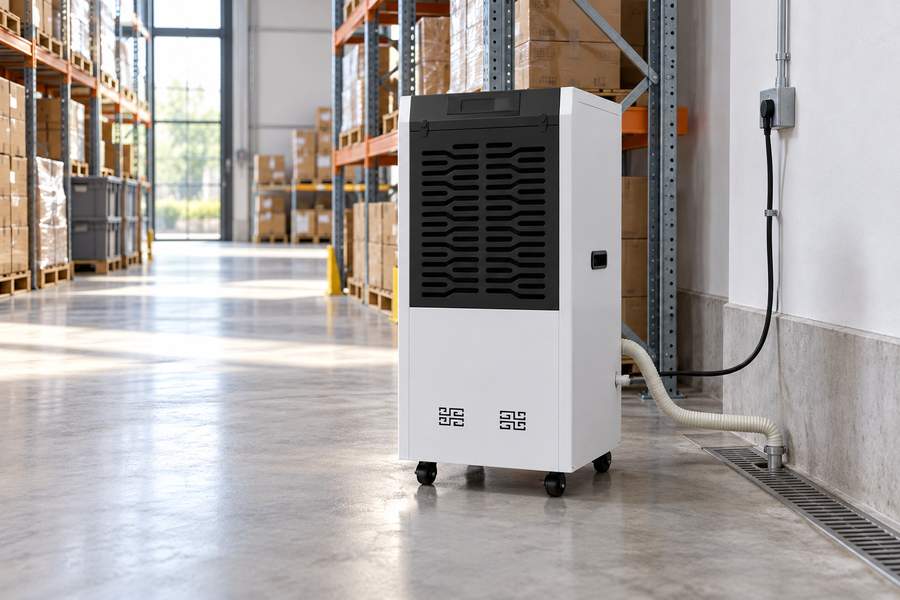
Dehumidification capacity describes how much moisture a system removes from the air under specified operating conditions.
Capacity specifications commonly express the collected water as:
- Daily water volume in liters (L/day).
- Pints per day (PPD).
- Kilograms of moisture per hour (kg/h).
A dehumidifier’s rated capacity depends on compressor performance, heat exchanger design, airflow, and environmental conditions.
For example, a unit rated at 100 L/day under warm, humid test conditions may remove substantially less moisture in a cooler environment with lower relative humidity.
Therefore, comparing a 220V dehumidifier with a 380V model based only on electrical voltage provides little useful information about actual drying performance.
Buyers should compare equipment using the same capacity test conditions whenever possible.
Does Higher Voltage Mean Better Energy Efficiency?
Not necessarily.
Higher voltage can reduce electrical current for the same power level, which may help electrical distribution design. However, it does not directly establish that the dehumidifier consumes less energy.
Energy efficiency depends on factors such as:
- Compressor efficiency.
- Fan motor efficiency.
- Refrigeration system design.
- Heat exchanger performance.
- The temperature and moisture level of the incoming air.
- How the controls cycle the machine and how long it runs.
An energy performance measurement such as liters of water removed per kilowatt-hour (L/kWh) is more useful than voltage when comparing dehumidifiers under equivalent test conditions.
A well-designed 220V dehumidifier may be more energy-efficient than a poorly optimized 380V model, particularly when comparing systems with similar moisture removal capacities.
Energy Consumption and Operating Costs
Electrical operating costs are an important consideration for industrial dehumidifiers because many facilities require humidity control for extended periods.
The main factors affecting electricity expenses are input power, operating hours, and local electricity rates.
How to Calculate Dehumidifier Electricity Costs
A basic calculation is:
Electricity Cost = Input Power (kW) × Operating Hours × Electricity Rate ($/kWh)
For example, a dehumidifier with an average operating power of 2 kW running for 10 hours per day consumes:
2 kW × 10 hours = 20 kWh per day.
Using an assumed U.S. electricity price of US$0.15/kWh for illustration, the daily energy charge is:
20 kWh × $0.15 = $3.00 per day.
Actual energy consumption may vary depending on compressor cycling, humidity levels, operating conditions, and control settings.
Estimated Electricity Costs for Different Voltage Configurations
The following U.S. budgeting example uses USD and an assumed energy-only rate of US$0.15/kWh, not a current utility quotation. Each hypothetical unit runs at its stated average input power for 10 hours per day and 30 days per month. Annual figures assume 12 such months, or 360 operating days. Calculations prepared October 15, 2026 exclude demand charges, fixed utility fees, taxes, equipment, freight, and installation costs.
| Comparison Factor | 110V Dehumidifier | 220V Dehumidifier | 380V Dehumidifier |
| Example Input Power | 0.75 kW | 2.0 kW | 5.5 kW |
| Daily Operating Hours | 10 hours | 10 hours | 10 hours |
| Daily Energy Consumption | 7.5 kWh | 20 kWh | 55 kWh |
| Monthly Energy Consumption | 225 kWh | 600 kWh | 1,650 kWh |
| Electricity Rate | $0.15/kWh | $0.15/kWh | $0.15/kWh |
| Estimated Monthly Electricity Cost | $33.75 | $90.00 | $247.50 |
| Estimated Annual Electricity Cost | $405 | $1,080 | $2,970 |
These are illustrative calculations for equipment with different input powers, not directly comparable dehumidification capacities. Actual expenses depend on equipment specifications, operating conditions, and local electricity rates.
In this example, multiplying consumed kWh by the assumed tariff gives the energy charge; the voltage label is not part of that calculation.
A larger 380V dehumidifier may have higher total electricity consumption because it is designed to handle substantially greater moisture loads.
However, one appropriately sized industrial unit may be more economical than several smaller units, depending on efficiency, operating hours, and installation conditions.
Installation and Maintenance Requirements
Selecting the right voltage also affects equipment installation and long-term maintenance.
Electrical Installation Requirements
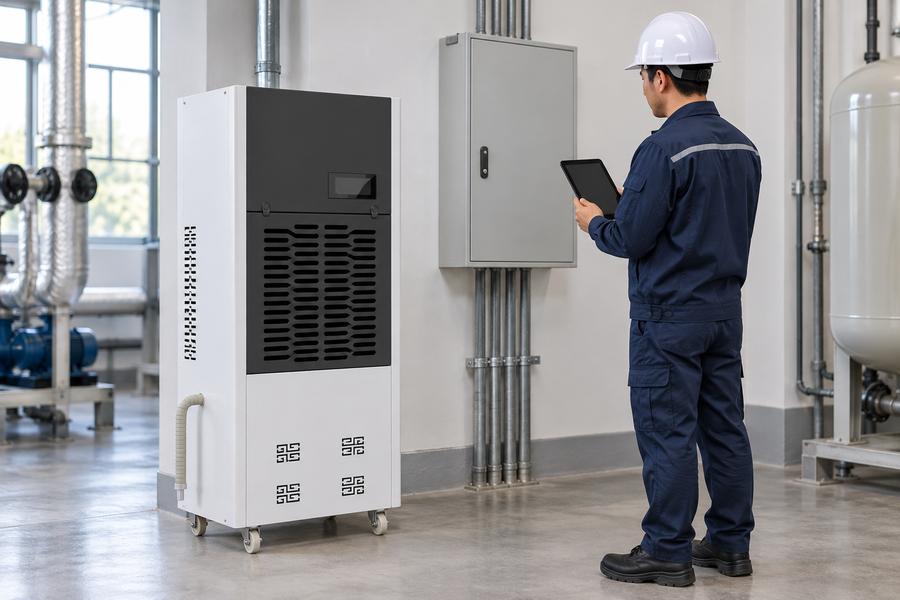
Before installing an industrial dehumidifier, the facility’s electrical system should be evaluated.
Important considerations include:
- Circuit Capacity: The electrical supply must accommodate the equipment’s rated current and applicable installation requirements.
- Circuit Protection: Breakers, fuses, and protective devices must be suitable for the equipment and local electrical codes.
- Wiring: Cable sizes must comply with electrical standards and installation conditions.
- Starting Current: Compressor and motor startup requirements may affect circuit protection and power distribution design.
- Grounding: Proper protective earthing is essential for electrical safety.
For example, large three-phase dehumidifiers may require dedicated industrial circuits rather than standard electrical outlets.
Have a suitably qualified electrician design or review the supply circuit and complete the electrical installation.
Maintenance Considerations
Maintenance requirements are not determined solely by voltage.
Most industrial dehumidifiers require periodic inspection of:
- Air filters and airflow passages.
- Condensate drainage systems.
- Compressor and refrigeration components.
- Fan motors and electrical connections.
- Humidity sensors and control systems.
- Electrical protection devices.
High-capacity industrial equipment may involve more components and specialized servicing.
For three-phase installations, planned servicing remains necessary to keep moisture-control equipment dependable over its working life.
How to Choose the Right Power Supply for Your Industrial Dehumidifier
Choosing between 110V, 220V, and 380V should begin with an evaluation of the facility’s available electricity and required moisture removal capacity.
Check Your Facility’s Electrical Supply
The first step is to confirm the existing electrical configuration.
Buyers should identify:
- Nominal supply voltage.
- Single-phase or three-phase availability.
- Electrical frequency.
- Available circuit capacity.
- Electrical panel configuration.
- Grounding and protection requirements.
For example, a facility with a suitable 220V single-phase supply may be able to install a compatible medium-capacity dehumidifier without major electrical modifications.
However, installing a 380V three-phase model in a building without compatible three-phase electricity could require substantial upgrades.
Evaluate the Required Dehumidification Capacity
Equipment capacity should match the actual moisture load rather than being selected based only on room size.
Important factors include:
Facility Size
Larger buildings may require higher airflow and greater moisture removal capacity.
Temperature and Humidity
Warm, humid air generally contains more moisture than cool air at the same relative humidity. Operating conditions also affect refrigerant dehumidifier performance.
Moisture Sources
Production processes, wet materials, washdown operations, and ventilation can create substantial moisture loads.
Target Relative Humidity
Different applications require different humidity conditions. General storage facilities may tolerate humidity levels that are unsuitable for pharmaceutical products or moisture-sensitive materials.
Operating Schedule
Facilities running continuously may need equipment designed for extended or 24-hour operation.
A proper moisture load assessment helps prevent both undersizing and oversizing.
Budget for the Complete Installation
The purchase invoice does not cover every expense needed to put the unit into service.
Buyers should also evaluate:
- Electrical installation expenses.
- Required circuit upgrades.
- Transformer or distribution equipment costs, where necessary.
- Drainage and ductwork installation.
- Ongoing maintenance expenses.
- Future equipment expansion.
A smaller dehumidifier may have a lower purchase price but may not provide sufficient performance for a large facility.
Oversizing can tie up additional capital even when the extra drying capacity provides little benefit at the site.
Calculate Long-Term Operating Costs
Long-term expenses should be assessed using the expected operating schedule.
For example, a warehouse requiring moisture control around the clock has different requirements from a workshop operating only during daytime shifts.
Obtain the following information for each shortlisted model:
- Nameplate input power and expected average power during use.
- Water extraction results at the intended room temperature and humidity.
- Test results showing water removed per unit of energy.
- Recommended operating temperature range.
- Maintenance intervals.
- Expected component replacement requirements.
Evaluating these factors provides a better estimate of total ownership costs than comparing purchase prices alone.
Common Mistakes When Selecting Industrial Dehumidifier Voltage
Incorrect electrical specifications can result in installation delays, equipment damage, and unexpected expenses.
Several common mistakes should be avoided.
Choosing Voltage Instead of Dehumidification Capacity
A 380V dehumidifier is not automatically the best choice for every industrial facility.
The correct equipment must first provide sufficient moisture removal capacity for the intended environment.
Confusing Single-Phase and Three-Phase Electricity
A 220V single-phase supply cannot automatically operate a 220V three-phase dehumidifier.
The voltage may be similar, but the electrical configurations are fundamentally different.
Ignoring Electrical Frequency
A dehumidifier designed for 50Hz operation may not be suitable for a 60Hz electrical system unless the manufacturer approves that configuration.
Frequency differences can affect compressor motors, fan speeds, and other electrical components.
Assuming Higher Voltage Always Reduces Electricity Costs
Higher voltage may reduce current for a given electrical load, but it does not necessarily reduce total energy consumption.
Electricity costs are primarily determined by actual kilowatt-hour usage and the applicable tariff.
Allowing for Motor Startup
A motor-driven compressor can impose a brief current surge as it starts, exceeding its normal running draw.
The supply design and protective devices must account for that starting behavior.
Assuming Similar Nominal Voltages Are Interchangeable
A dehumidifier rated strictly for 380V should not automatically be connected to a 400V or 415V supply.
Likewise, 110V, 115V, and 120V equipment are not universally interchangeable.
Use only a supply that falls within the voltage limits specified for the particular model.
Industrial Dehumidifier Voltage Requirements in Different Countries
Electrical standards vary across international markets. Therefore, industrial dehumidifier suppliers must consider destination-specific voltage and frequency requirements.
The following table summarizes common electrical systems.
| Country or Region | Common Single-Phase Voltage | Common Three-Phase Voltage | Frequency |
| United States | 120V, 240V | 208V, 240V, 480V | 60Hz |
| Canada | 120V, 240V | 208V, 600V; other systems also used | 60Hz |
| China | 220V | 380V | 50Hz |
| Germany | 230V | 400V | 50Hz |
| United Kingdom | 230V | 400V | 50Hz |
| Singapore | 230V | 400V | 50Hz |
| Australia | 230V | 400V | 50Hz |
| Malaysia | 230V | 400V | 50Hz |
These are common nominal electrical systems, not a complete list of available supply configurations. Actual service voltage, phase availability, and frequency must be verified at the installation site.
Voltage Requirements in North America
Industrial facilities in the United States commonly use 208V, 240V, or 480V three-phase power, depending on the electrical installation.
Canada also has widespread use of 600V three-phase industrial systems.
Consequently, equipment manufactured for nominal 380V three-phase operation may require a different electrical configuration for North American facilities.
Manufacturers may offer compatible voltage variants or engineered electrical solutions for these markets.
Voltage Requirements in Europe
Many European countries use nominal 230V single-phase and 400V three-phase electrical systems at 50Hz.
Industrial buyers importing equipment should verify compatibility with these nominal voltages and the applicable electrical safety requirements.
Voltage Requirements in China and Southeast Asia
China commonly uses nominal 220V single-phase and 380V three-phase systems at 50Hz.
For Singapore and Malaysia, the usual low-voltage service ratings are 230V for single phase and 400V between phases, with a 50Hz frequency.
However, electrical requirements differ across Southeast Asia. Some markets and installations use other voltage configurations or 60Hz electricity.
For international procurement, the destination country’s general electrical standard is a useful starting point, but the actual facility supply and equipment specifications must be confirmed before ordering.
Why Voltage Customization Matters for Industrial Buyers
Industrial dehumidifier manufacturers serving international markets may offer multiple electrical configurations.
Depending on product design and manufacturing capabilities, customization may include:
- Alternative rated supply voltages.
- 50Hz or 60Hz electrical configurations.
- Single-phase or three-phase versions.
- Compatible motors and compressors.
- Region-specific electrical protection components.
- Control panels suited to local electrical requirements.
Not every dehumidifier can be converted to every voltage or frequency. Buyers should confirm available options with the manufacturer rather than assuming equipment can be adapted after delivery.
For distributors and industrial equipment importers, ordering the correct configuration helps reduce installation complications and improve compatibility with local facilities.
What to Confirm Before Ordering an Industrial Dehumidifier
Before placing an order, industrial buyers should prepare a complete set of electrical and operating requirements.
Electrical Specifications
Confirm the following information:
- Operating Voltage: 110V, 220V, 380V, or another required nominal voltage.
- Phase Configuration: Single-phase or three-phase.
- Electrical Frequency: 50Hz or 60Hz.
- Rated Input Power: The equipment’s specified electrical power consumption.
- Rated Current: The expected operating current stated by the manufacturer.
- Starting Requirements: Compressor startup characteristics and required electrical protection.
- Voltage Tolerance: The manufacturer’s permitted operating voltage range.
Dehumidification Requirements
Provide the manufacturer with:
- Facility dimensions and application type.
- Required moisture removal capacity in L/day.
- Normal temperature and humidity conditions.
- Target relative humidity.
- Estimated moisture sources.
- Expected daily operating hours.
- Available drainage and installation space.
Equipment Configuration and Supplier Support
For B2B procurement, buyers should also verify:
- Available voltage and frequency versions.
- Product electrical certifications relevant to the destination market.
- Equipment dimensions and installation drawings.
- Maintenance requirements and spare parts availability.
- Technical documentation and wiring diagrams.
- Warranty and after-sales support.
- Compatibility with existing facility control systems.
The most suitable industrial dehumidifier is one that meets both the facility’s moisture removal requirements and its electrical supply conditions.
For small facilities with compatible circuits, 110–120V dehumidifiers can offer convenient portable moisture control. For warehouses and medium-sized industrial applications, 220–240V equipment may provide a practical combination of capacity and installation flexibility. For large manufacturing facilities with compatible three-phase power, 380V industrial dehumidifiers can support high-capacity moisture control.
Selecting equipment based on electrical compatibility, dehumidification performance, and total operating costs helps ensure reliable operation while avoiding unnecessary installation expenses.