
A rotary compressor is often a practical starting point for a compact dehumidifier. A scroll is worth evaluating for larger duties where smooth operation and capacity control matter. A reciprocating compressor remains a valid choice when its performance, operating range, and service availability fit the application.
None is best for every dehumidifier. Select the specific compressor that works within its approved envelope and delivers the required moisture removal in a properly matched refrigeration system. A technology name alone cannot establish efficiency, noise, or reliability.
Understand What the Three Compressor Types Change
All three compress refrigerant vapor, creating the pressure difference that allows the evaporator to absorb heat and the condenser to reject it. They do not directly separate water from air; condensation occurs on the evaporator surface.
| Type | Compression Mechanism | Useful Selection Focus |
| Rotary | In a common rolling-piston design, an eccentric roller and vane create changing chamber volumes | Packaging, model availability, and performance at the required duty |
| Reciprocating | A piston moves within a cylinder, drawing in and compressing vapor through valves | Application range, capacity match, vibration, and local support |
| Scroll | Fixed and orbiting spirals form gas pockets that shrink toward the center | Smooth compression, capacity options, and operating-envelope suitability |
Here, “rotary” refers to compact refrigeration designs such as rolling-piston compressors, not industrial screw compressors.
- The mechanisms have overlapping application ranges.
- Compressor dimensions do not establish the finished machine’s capacity.
- Fixed-speed and variable-capacity options must be checked by model.
- Refrigerant, motor supply, oil, and protection requirements remain model-specific.
Match the Compressor Inquiry to the Dehumidifier Duty
WetWells lists rotary, reciprocating, and scroll options on its custom refrigerant dehumidifier page. Use the equipment application to define the inquiry before requesting a preferred compressor type.
| Product Inquiry Page | Published Equipment Reference | Compressor Question to Resolve |
| MCH-790B Commercial Dehumidifier | 90 L/day; 1,200 m³/h airflow | Which approved compressor meets the room duty and acoustic target? |
| MCH-7G Ceiling-Mounted Dehumidifier | 180 L/day; 2,400 m³/h airflow | How will compressor dimensions, mounts, and piping fit the installation? |
| MCH-7480B Industrial Dehumidifier | 480 L/day; 5,600 m³/h airflow | Which compressor arrangement covers peak and reduced loads? |
The moisture-removal ratings above use 30°C and 80% RH. They describe complete machines, not standalone compressor performance.
The linked model pages do not establish the specific compressor mechanism supplied. Request the manufacturer, exact compressor code, refrigerant, and approved configuration in the quotation.
- A named compressor brand does not identify its mechanism.
- An industrial cabinet does not prove that a scroll is fitted.
- A larger machine may use multiple circuits; confirm the actual arrangement.
Check the Operating Envelope Before Comparing Efficiency
A compressor’s operating envelope defines permitted conditions, commonly expressed using evaporating and condensing temperatures with specified suction conditions. It is different from the dehumidifier’s room-temperature range.
| Dehumidifier Condition | Compressor Selection Check |
| Warm, humid startup | Capacity, current, and motor limits at the resulting load |
| Cooler room or lower target RH | Low-side conditions, frost behavior, and approved operating limits |
| Hot room or restricted condenser airflow | Condensing pressure and discharge-temperature limits |
| Remote condenser | Piping, refrigerant charge, and oil-return requirements |
| Defrost and restart | Transient conditions as well as steady operation |
- Define the actual inlet-air range and humidity target.
- Determine the corresponding refrigeration operating points.
- Check each candidate compressor against its manufacturer’s selection data.
- Validate the complete dehumidifier through the intended operating range.
Reciprocating and scroll product families both include models for different refrigeration duties. Neither mechanism is automatically the best low-temperature choice. Approval for one refrigerant or application does not guarantee a compressor’s suitability for others.
Compare Moisture Removal per Unit of Electricity
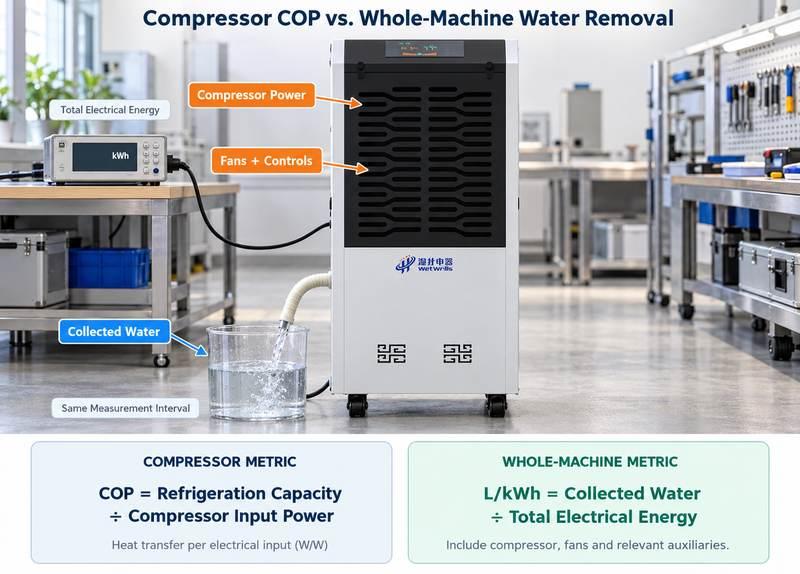
Compressor efficiency matters, but the buyer needs the efficiency of the complete drying process. Compressor cooling capacity and COP are not the same as liters of water removed per kilowatt-hour.
| Measurement | What It Describes | What It Does Not Establish |
| Refrigeration capacity | Heat absorbed at the evaporator under stated conditions | Water removal without air-side data |
| Compressor COP | Refrigeration capacity divided by compressor input | Total machine drying efficiency |
| L/kWh or kWh/L | Water removal relative to measured electricity | Performance at other inlet conditions |
- Compare the same inlet condition, airflow, and operating mode.
- Include compressor, fans, controls, and relevant auxiliary power.
- State whether the measurement includes defrost and cycling.
- Request both design-point and reduced-load results.
The evaporator removes sensible heat as well as the latent heat associated with condensation. Coil design, airflow, and refrigerant control influence that split. A higher-COP compressor does not automatically produce a higher-efficiency dehumidifier.
Separate Compressor Mechanism from Capacity Control
“Scroll” does not mean “inverter,” and “reciprocating” does not necessarily mean fixed speed. Rotary, reciprocating, and scroll families can include different control arrangements, depending on the available models.
| Control Arrangement | Potential Benefit | What Requires Verification |
| Fixed-speed cycling | Straightforward operation at a suitable load | Cycling behavior and humidity fluctuation |
| Multiple compressor stages | Capacity steps and circuit flexibility | Stage sequencing and minimum stable duty |
| Approved variable-speed package | Capacity adjustment as load changes | Drive compatibility, speed limits, lubrication, and coil performance |
At reduced speed, the evaporator must remain cold enough to condense water. Reducing compressor speed without coordinating airflow and metering can change the leaving-air moisture condition.
- Check the lowest useful drying capacity, not only maximum output.
- Confirm oil return across the approved speed range.
- Review starts, minimum runtime, and restart requirements for the selected model.
- Test approaching-setpoint behavior instead of assuming modulation guarantees tight RH control.
Judge Noise and Vibration at the Finished Machine
Scroll compression generally produces a smoother pressure delivery than piston compression. That can help acoustic design, but it does not guarantee the quietest installed dehumidifier.
| Noise or Vibration Source | Design Detail to Evaluate |
| Compressor mechanism and motor | Sound data at comparable operating points |
| Start and stop events | Mounts, piping movement, and control sequence |
| Cabinet panels | Resonance, stiffness, and fasteners |
| Fans and air paths | Fan speed, grille velocity, and duct resistance |
| Building connections | Isolation from rigid supports and ductwork |
A well-mounted rotary or reciprocating unit may suit an occupied room better than a poorly integrated scroll system. Compare complete-machine results using stated measurement distance and mode.
For concealed installations, also check sound transmitted through ducts and vibration entering the supporting structure. Moving the cabinet out of sight does not remove those paths.
Verify Protection During Startup, Defrost, and Faults
Continuous-duty reliability depends on system design and protection, not simply the compressor’s moving-part count.
- Liquid return:Control superheat and evaluate floodback during relevant operating transitions.
- Off-cycle migration:Assess whether refrigerant movement during shutdown requires additional measures.
- Lubrication:Verify oil return with the actual piping and capacity-control arrangement.
- Electrical conditions:Match voltage, frequency, phase, starting equipment, and protection.
- Airflow problems:Confirm the response to restricted filters or fan faults.
- Defrost recovery:Check restart and refrigerant behavior after frost removal.
Some compressor designs tolerate limited liquid exposure better than others, but that is not permission to operate with uncontrolled floodback. Accumulators, crankcase heaters, and other protections should follow application requirements rather than a universal checklist.
No mechanism can compensate for a refrigerant circuit that runs outside its approved conditions.
Compare Serviceability and Ownership Cost by Model
Do not assume that a reciprocating compressor can be rebuilt on site. A welded hermetic piston compressor is normally replaced as an assembly, while serviceable semi-hermetic designs are a different construction.
| Ownership Item | Evidence to Request |
| Purchase cost | Comparable complete-machine quotations |
| Electricity | Measured drying performance over the expected duty |
| Replacement availability | Exact compressor code and acceptable replacement route |
| Electronics | Availability of any dedicated drive or controller |
| Service access | Removal space and piping access |
| Downtime | Parts lead time and support arrangements |
- Compare total equipment cost rather than compressor price alone.
- Confirm that a proposed substitute preserves the approved system configuration.
- Include refrigerant service and commissioning in replacement planning.
- Ask which parts the local service organization can obtain.
A familiar compressor with documented performance and available support may be a better ownership choice than an unfamiliar alternative selected only for its mechanism.
Use a Performance-Based Selection Brief
Shortlist technologies, then make the final choice using evidence for the actual application.
| Project Priority | Sensible Starting Point | Final Decision Test |
| Compact packaged machine | Evaluate suitable rotary models | Complete-machine size, noise, and drying performance |
| Application with an established piston-compressor solution | Retain reciprocating candidates | Envelope, efficiency, and support remain suitable |
| Larger duty requiring smooth compression | Evaluate scroll alongside alternatives | Actual operating-point performance and integration |
| Widely varying moisture load | Assess suitable modulation or staging | Stable drying at peak and reduced loads |
| Cold or demanding operation | Compare application-approved candidates | Full-system operation, including defrost |
Provide inlet conditions, target RH, required removal rate, airflow, power supply, installation limits, and working schedule. Ask for the exact compressor selection and whole-machine verification results.
Choose the compressor that supports the required dehumidifier performance across the duty cycle. Rotary, reciprocating, and scroll are useful engineering options; the winning configuration must be demonstrated at the conditions your building or process will actually experience.