
Choose a fresh-air dehumidifier when your building needs controlled outdoor-air supply and that incoming air requires moisture treatment. Choose a recirculating dehumidifier when ventilation is already handled separately and the remaining task is to remove moisture from indoor air.
Buildings with substantial ventilation and indoor moisture loads may need both functions. The decision depends on where the moisture enters, how much outdoor air is required, and which equipment will maintain the room condition—not simply the building’s floor area.
Identify the Air Path Before Comparing Equipment
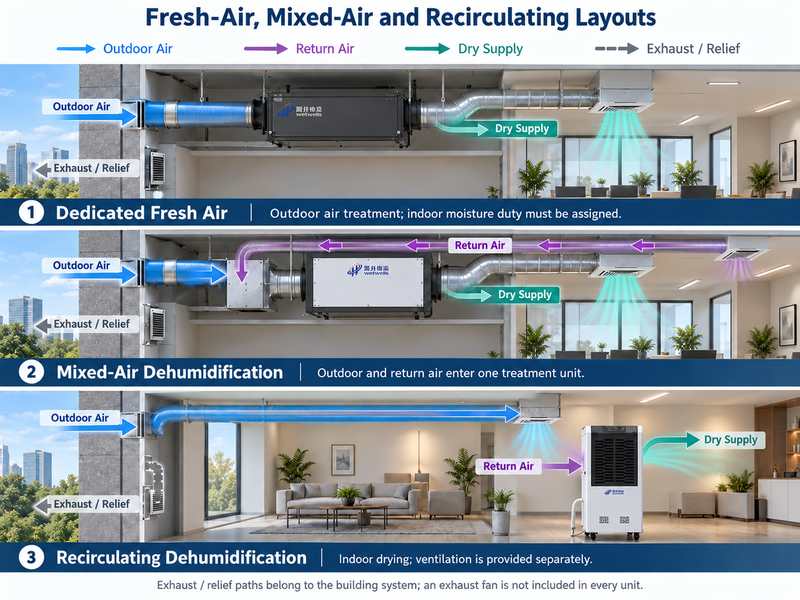
“Fresh-air” describes an outdoor-air function, but it does not automatically mean the machine processes only outdoor air. Some systems mix outdoor air with return air; others switch between ventilation and recirculation modes.
| Arrangement | Air Path | Main Task |
| Dedicated outdoor-air treatment | Outdoors → treatment unit → occupied space | Condition ventilation air before delivery |
| Mixed-air dehumidification | Outdoor air + indoor return air → unit → space | Combine ventilation and indoor moisture treatment |
| Recirculating dehumidification | Room → unit → same room or served zones | Remove moisture from existing indoor air |
WetWells’ custom refrigerant dehumidifier solutions provide a starting point for discussing airflow, duct connections, controls, drainage, and structure.
- Request an air-path drawing identifying outdoor, return, supply, and exhaust air.
- Confirm the outdoor-air fraction in each operating mode.
- Establish whether listed airflow means total supply, recirculation, or outdoor air.
- Ask whether exhaust or relief equipment is included or supplied separately.
Select a Product Configuration That Matches the Air Duty
The product category helps narrow the discussion, but the proposed connections and performance data determine whether a configuration suits the building.
| Product Inquiry Page | Published Reference Data | What to Confirm for Your Project |
| MCH-138C Fresh Air Dehumidifier | 138 L/day; fresh air 500–600 m³/h; circulating airflow 900–1,000 m³/h | Simultaneous flow arrangement, outdoor-air fraction, leaving-air condition |
| MCH-156C Fresh Air Dehumidifier | 156 L/day; fresh air 600–800 m³/h; circulating airflow 1,000–1,200 m³/h | Fan performance, controls, and capacity at the proposed air mixture |
| MCH-790B Commercial Dehumidifier | 90 L/day; airflow 1,200 m³/h | Room circulation, moisture load, installation location |
| MCH-7G Ceiling-Mounted Dehumidifier | 180 L/day; airflow 2,400 m³/h | Duct resistance, return path, service access |
The listed moisture-removal ratings use 30°C and 80% RH. They are reference values, not predictions for every outdoor or mixed-air condition.
Do not add fresh-air and circulating-air figures together unless the manufacturer confirms their definitions. Ceiling mounting describes installation; it does not establish ventilation capability.
Determine Ventilation Needs Separately from Humidity Control
A recirculating dehumidifier removes water vapor but does not, by itself, exchange indoor air with outdoor air. It cannot replace the building’s ventilation function.
| Building Situation | Selection Implication |
| Office or classroom with regular occupancy | Establish outdoor-air demand and how it will be conditioned |
| Hotel with bathroom exhaust | Coordinate replacement air with exhaust operation |
| Storage room with an existing ventilation system | Assess whether additional recirculating moisture removal is sufficient |
| Workshop with source extraction | Determine makeup-air demand and prevent unsuitable air recirculation |
- Establish the project’s ventilation requirement through the building-services design.
- Record occupied schedules and zones with different demands.
- Identify exhaust fans and their operating schedules.
- Measure existing outdoor-air delivery before adding equipment.
Particle filtration and moisture removal address different problems. A particle filter does not generally remove carbon dioxide, and lower RH does not demonstrate adequate ventilation.
Separate Outdoor Moisture from Indoor Moisture Generation
Fresh-air treatment and recirculating treatment handle different parts of the moisture balance. Account for both before selecting capacity.
| Moisture Source | Information Needed |
| Intentional outdoor-air supply | Airflow and outdoor design humidity ratio |
| Uncontrolled infiltration | Door activity, leakage paths, pressure differences |
| People and wet activities | Occupancy, showers, cleaning, activity schedules |
| Processes or materials | Evaporation rate, wet deliveries, exposed water surfaces |
For an air stream, moisture removal can be estimated as dry-air mass flow multiplied by the decrease in humidity ratio.
- Illustrative case:500 kg/h of dry air loses 6 g of water per kg of dry air during treatment.
- Required removal:500 × 0.006 = 3 kg/h.
- Continuous equivalent:72 kg/day if those conditions persist for 24 hours.
These chosen values illustrate the calculation, not a WetWells model’s performance. Converting volumetric airflow to dry-air mass flow requires the air properties at the relevant conditions.
Avoid counting the same load twice. Outdoor-air treatment to the room’s humidity ratio offsets that ventilation moisture load but provides no surplus drying for moisture generated inside the room.
Set the Supply-Air Moisture Target Before the RH Display
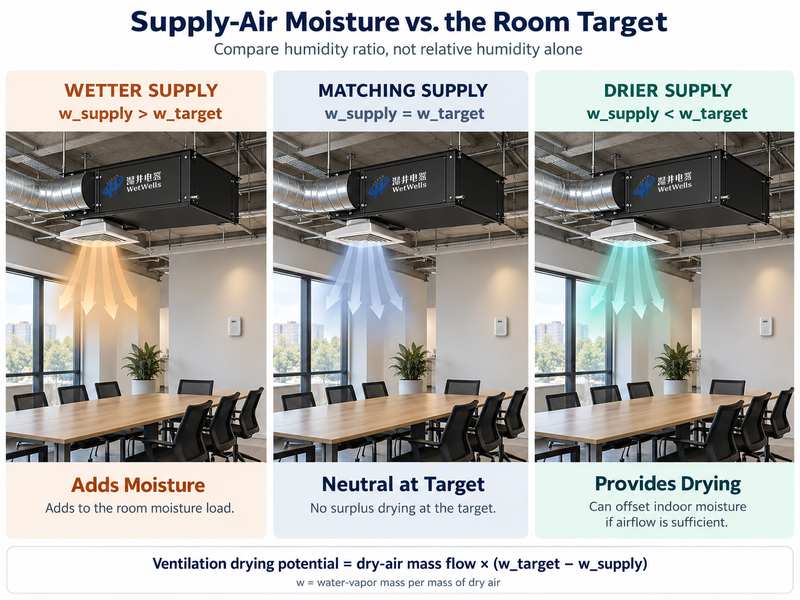
Relative humidity changes with temperature. Comparing outdoor RH with indoor RH alone can therefore give the wrong impression of which air is drier.
Use humidity ratio or dew point to assess the moisture content, then specify supply temperature separately.
| Supply-Air Condition | Effect on the Room Moisture Balance |
| Wetter than the target room air | Adds a moisture load |
| Same humidity ratio as the target room air | Offsets its own ventilation load, without removing indoor-generated moisture |
| Drier than the target room air | Can help absorb indoor moisture, depending on airflow and load |
- Calculate how dry the supply must be if it is expected to handle room moisture generation.
- Check performance when cooling demand is low but ventilation continues.
- Verify that the chosen refrigeration system can deliver air at the specified outlet conditions.
- Avoid specifying a universal supply dew point for every building.
Coordinate Supply, Exhaust, and Building Pressure
A fresh-air inlet adds air to the building. That air needs a planned exit route, and its flow must be coordinated with exhaust and transfer paths.
| Airflow Issue | Design Response |
| Exhaust exceeds planned replacement air | Review unintended infiltration and pressure effects |
| Supply exceeds the available exit path | Provide the intended relief or exhaust arrangement |
| Closed doors isolate rooms | Establish transfer or return paths |
| Supply discharges near return intake | Prevent short-circuiting that leaves remote areas untreated |
For recirculating systems, distribution matters even though the unit does not intentionally add net air to the building. A dry reading near the machine can coexist with damp corners or shelving bays.
- Measure airflow with the installed filters and ductwork.
- Check the available external static pressure rather than assuming the total pressure represents the same value.
- Assess pressure relationships with all relevant exhaust systems ope
- Keep outdoor intakes away from unsuitable discharge locations.
Pressure control is a system function, not something established by the “fresh-air” label alone.
Account for Supply Temperature and Room Heat Gain
Refrigerant dehumidification first cools air to remove moisture. What happens afterward depends on condenser placement and any reheat or temperature-control arrangement.
| Configuration | Temperature Issue to Check |
| Self-contained recirculating unit | Warm discharge and added room cooling demand |
| Fresh-air treatment unit | Supply temperature across changing outdoor conditions |
| Remote-condenser or configurable system | Heat-rejection location and operating sequence |
| Treatment combined with existing air conditioning | Interaction between humidity and temperature controls |
- Confirm the allowable supply temperature where people receive the air.
- Evaluate room heat gain rather than assuming dehumidification provides cooling.
- Include mild, humid weather in the design review.
- Check cold-weather intake conditions against the equipment’s operating envelope.
A room thermostat can be satisfied while humidity remains high. Independent humidity control may still be needed, particularly when outdoor air continues entering during low cooling demand.
Define Occupied and Unoccupied Operating Modes
Ventilation schedules and moisture-control schedules may differ. A building can need drying after occupants leave because of infiltration, wet cleaning, or stored materials.
| Mode | Control Questions |
| Occupied ventilation | How is required outdoor airflow maintained and verified? |
| Occupied humidity control | Which sensor triggers drying, and where is it located? |
| Unoccupied drying | Can the system recirculate without unnecessary outdoor intake? |
| Fault or power restoration | What happens to fans, dampers, compressors, and alarms? |
If a fresh-air machine is expected to recirculate after hours, confirm that the return connection, dampers, and control logic support that mode. It cannot be assumed from the product name.
Agree sensor locations and operating priorities. Outdoor-air dew point, supply moisture condition, room RH, and room temperature describe different parts of the system; one reading cannot verify all of them.
Compare Running Costs at Equivalent Building Duties
Fresh-air and recirculating systems are not interchangeable energy comparisons unless both proposals satisfy the same ventilation and humidity requirements.
- Compare identical outdoor-air quantities and room targets.
- Include compressor, supply-fan, exhaust-fan, and pump energy.
- Account for reheat and any extra cooling needed to remove room heat gain.
- Evaluate filter pressure drop and realistic duct resistance.
- Consider energy recovery where suitable, while retaining enough active drying capacity.
- Include maintenance access, filter changes, drains, and controls in the ownership assessment.
A recirculating unit may use less power than a fresh-air proposal simply because it is performing less work. Conversely, unnecessary outdoor intake can increase treatment demand without improving the planned ventilation service.
Verify the System During Real Building Operation
Approve the selection against an equipment schedule and a test plan, with clear responsibility for each load.
| Acceptance Item | Evidence to Record |
| Ventilation delivery | Outdoor airflow by served zone and operating mode |
| Moisture treatment | Entering and leaving air conditions at the measured airflow |
| Room performance | RH and temperature at representative locations |
| Air balance | Supply, exhaust, transfer paths, and pressure behavior |
| Reliability | Drainage, alarms, damper operation, and restart sequence |
Test representative occupied conditions, mild humid weather where practicable, and the agreed unoccupied mode. Record recovery after a defined moisture disturbance rather than judging performance from one favorable reading.
Use fresh-air treatment to condition required ventilation, recirculation to address indoor drying where appropriate, and a coordinated combination when one arrangement cannot cover both duties.